North America AI In Banking Market Size
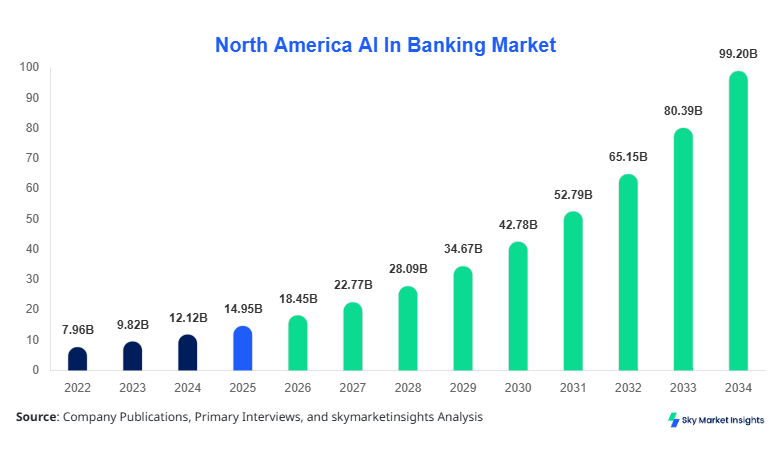
North America's AI in banking market size is projected at USD 18.45 billion in 2026 and is expected to hit USD 96.72 billion by 2034 with a CAGR of 23.4%. The increasing demand for real-time analytics, fraud detection systems handling over 2.5 billion transactions annually, and automation of banking workflows across 65% of institutions are driving structured market expansion. Additionally, data-driven segmentation across retail, corporate, and investment banking, along with competitive benchmarking among 150+ key vendors, is shaping strategic investments in the North American AI in Banking market.
The AI in banking market refers to the integration of artificial intelligence technologies such as machine learning, natural language processing (NLP), and predictive analytics within banking operations to enhance decision-making, improve customer experience, and reduce operational costs. In North America, over 78% of banks have adopted AI-powered solutions, with production deployments exceeding 12,000 enterprise-grade AI systems across financial institutions. Consumer adoption insights indicate that nearly 68% of customers engage with AI chatbots for banking services, while 52% prefer automated loan processing systems. Demand analytics show that fraud detection contributes approximately 34% of application demand, followed by customer service automation at 28%, credit scoring at 18%, and compliance management at 20%. Technical metrics such as latency reduction by 40%, fraud detection accuracy improvements of 92%, and processing speeds exceeding 5 million transactions per second are key performance indicators. The AI in the banking market continues to evolve with strong demand and penetration across North America.
In the United States, the AI in banking market dominates with over 4,500 financial institutions actively deploying AI technologies, accounting for approximately 72% of the regional share. The application breakdown reveals fraud detection leading at 36%, customer engagement solutions at 30%, and risk analytics at 22%, while compliance automation contributes 12%. Technology adoption rates exceed 82% among Tier-1 banks, with AI-driven platforms processing over 1.8 billion transactions daily. Furthermore, cloud-based AI solutions are utilized by nearly 67% of banks, while hybrid deployments account for 21%. The AI in banking market in the United States continues to expand due to increasing digital banking penetration and high investment in financial technology innovation.
Explore more data points, trends and opportunities Download Free Sample Report
AI In Banking Market Trends
Rising Adoption of Generative AI and Predictive Analytics
The AI in banking market is witnessing a surge in generative AI deployments, with over 45% of banks integrating AI-powered conversational agents and document automation tools. Production volumes of AI-driven financial models exceed 3.2 million annually, enabling predictive analytics for credit risk assessment and fraud detection. Adoption rates of machine learning algorithms have increased by 28% year-on-year, with financial institutions achieving operational cost reductions of up to 35%. Additionally, generative AI is enhancing customer experience by reducing response times by 60% and improving personalization accuracy by 48%. This transformation highlights the ongoing evolution within the AI in banking market.
Expansion of Cloud-based AI Infrastructure
Cloud-based AI infrastructure is becoming a dominant trend, with nearly 69% of banking institutions shifting workloads to cloud environments. Data processing volumes in cloud-based systems exceed 8 petabytes annually, enabling faster insights and scalability. Hybrid cloud adoption is growing at 24%, driven by regulatory compliance and data security requirements. AI deployment through APIs and microservices has increased by 31%, improving integration across legacy systems. This technological shift supports higher transaction throughput and real-time decision-making capabilities, reinforcing advancements in the AI in banking market.
North America AI In Banking Market Drivers
Increasing Demand for Fraud Detection and Risk Management
The demand for fraud detection systems in the North American AI in banking market is driven by the increasing volume of digital transactions exceeding 4.5 billion annually. AI-based fraud detection systems demonstrate accuracy rates of over 93%, reducing false positives by 27% and saving banks approximately USD 2.1 billion annually. Additionally, risk management applications account for nearly 38% of AI deployments, with predictive analytics improving credit risk evaluation by 45%. The integration of AI in compliance monitoring has reduced regulatory violations by 32%, while transaction monitoring systems process over 10 million alerts daily. These factors significantly contribute to the expansion of AI in the banking market.
North America AI In Banking Market Restraints
High Implementation Costs and Data Privacy Concerns
Despite rapid growth, the North American AI in banking market faces challenges due to high implementation costs, with enterprise AI solutions ranging between USD 2 million and USD 15 million per deployment. Data privacy concerns impact approximately 42% of financial institutions, particularly regarding sensitive customer information and regulatory compliance. Additionally, nearly 29% of banks report difficulties in integrating AI with legacy systems, leading to increased operational costs by 18%. Limited availability of skilled professionals, with a gap of over 120,000 AI specialists, further restricts adoption. These constraints hinder the overall progress of AI in the banking market.
North America AI In Banking Market Opportunities
Expansion of AI in Personalized Banking Services
The growing demand for personalized banking services presents significant opportunities in the North American AI in banking market. AI-powered recommendation engines have increased customer engagement rates by 54% and cross-selling efficiency by 38%. Approximately 61% of banks are investing in AI-driven personalization tools, with projected deployment volumes exceeding 6,000 systems by 2028. Additionally, digital banking platforms utilizing AI have improved customer retention rates by 26% and reduced churn by 19%. These advancements create new growth avenues within the AI in banking market.
Challenges in North America's AI In Banking Market
Complex Regulatory Environment and Model Transparency Issues
The North American AI in Banking market faces challenges related to regulatory compliance, with over 48% of institutions citing difficulties in adhering to evolving financial regulations. Model transparency issues affect nearly 33% of AI deployments, particularly in credit scoring and risk assessment applications. Additionally, regulatory audits have increased by 21%, requiring extensive documentation and validation processes. The lack of explainability in AI models has led to a 17% delay in approval for AI-based solutions. These challenges impact the scalability and adoption of AI in the banking market.
Report Scope
| Report Metric | Details |
|---|---|
| Market Size in 2025 | USD 14.95 Billion |
| Market Size in 2026 | USD 18.45 Billion |
| Market Size in 2034 | USD 96.72 Billion |
| CAGR | 23.4% (2026-2034) |
| Base Year for Estimation | 2025 |
| Historical Data | 2022-2024 |
| Forecast Period | 2026-2034 |
| Report Coverage | Revenue Forecast, Competitive Landscape, Supply Chain Disruption, Growth Factors, Environment & Regulatory Landscape and Trends |
Explore more data points, trends and opportunities Download Free Sample Report
AI In Banking Market Segmentation
The AI in banking market segmentation is categorized based on component and deployment, with solutions accounting for approximately 52% share, services contributing 28%, and platforms holding 20%. Deployment-wise, cloud dominates with 58%, followed by on-premise at 25% and hybrid at 17%.
By Type
The solution segment accounts for nearly 52% of the AI in the banking market, with over 7,500 AI solutions deployed across North America. These include fraud detection systems, chatbots, and risk analytics tools. Technical specifications include processing capabilities exceeding 4 million transactions per second and accuracy rates above 91%. AI-based fraud detection solutions alone process over 2.2 billion transactions annually, reducing financial losses by 35%. Continuous advancements in machine learning models and NLP technologies drive adoption within the AI in banking market.
Services contribute approximately 28% share, with over 3,200 service providers offering consulting, integration, and support services. Annual service contracts exceed USD 4 billion in value, with implementation timelines averaging 6–12 months. Managed services adoption has increased by 33%, enabling banks to optimize AI operations. These services play a critical role in ensuring seamless deployment and maintenance within the AI in the banking market.
Platforms hold around 20% share, with over 2,800 AI platforms deployed across banking institutions. These platforms provide scalable infrastructure supporting real-time analytics and predictive modeling. Data processing capacity exceeds 6 petabytes annually, enabling high-performance computing and decision-making. Platform-based AI solutions are increasingly adopted due to their flexibility and integration capabilities in the AI-in-banking market.
By Application
On-premise deployment accounts for 25% of the AI in the banking market, with over 1,500 installations across large banks. These systems offer enhanced data security and compliance, processing up to 3 million transactions per second. Adoption is driven by regulatory requirements and legacy system integration.
Cloud deployment dominates with 58% share, supporting over 9,000 AI systems. Data processing volumes exceed 10 petabytes annually, enabling scalability and cost efficiency. Cloud-based AI solutions reduce infrastructure costs by 40% and improve deployment speed by 35%, making them the preferred choice in the AI in banking market.
Hybrid deployment holds a 17% share, combining on-premises and cloud capabilities. Over 2,200 hybrid systems are deployed, offering flexibility and enhanced performance. These systems enable banks to manage sensitive data securely while leveraging cloud scalability, driving adoption within the AI in banking market.
North America AI In Banking Market Segmentations
Component
- Solution
- Services
- Platforms
Deployment
- On-premise
- Cloud
- Hybrid
North America AI In Banking: Regional Outlook
United States
The United States dominates the North American AI in Banking market with a 72% share, supported by over 4,500 banking institutions deploying AI technologies. Annual AI-related investments exceed USD 12 billion, with production volumes surpassing 2 billion AI-driven transactions daily. Sector-wise, retail banking contributes 42%, corporate banking 33%, and investment banking 25%. The presence of major technology providers and strong regulatory frameworks further accelerates growth in the AI in banking market.
Canada
Canada holds approximately 28% share, with over 1,200 financial institutions adopting AI solutions. AI deployment volumes exceed 500 million transactions annually, with fraud detection and customer service automation accounting for 60% of applications. Investments in fintech exceed USD 3.5 billion, with government initiatives supporting AI adoption. The banking sector in Canada continues to expand its AI capabilities, contributing significantly to the AI in banking market.
Top players in North American AI In Banking Market
- IBM Corporation
- Microsoft Corporation
- Google LLC
- Amazon Web Services
- Oracle Corporation
- SAP SE
- NVIDIA Corporation
- FIS Global
- Infosys Limited
- Tata Consultancy Services
- Accenture Plc
- SAS Institute
- H2O.ai
- DataRobot
- Palantir Technologies
IBM Corporation
-
Holds approximately 14% market share with strong presence in AI-driven banking solutions
-
Provides over 2,000 AI deployments with advanced analytics capabilities and high-performance computing
Microsoft Corporation
-
Accounts for nearly 12% share with Azure AI platforms widely used across 1,800+ banks
-
Offers scalable cloud-based AI services processing over 1 billion transactions daily
Investment Analysis
Investment in the AI in Banking market is witnessing significant growth, with over 65% of capital allocated to AI-driven platforms and analytics tools. Sector-wise investment distribution shows 38% in fraud detection, 27% in customer engagement, and 20% in risk management. Regional investment indicates that the United States accounts for 74%, while Canada contributes 26%. Additionally, M&A activities have increased by 31%, with over 120 strategic collaborations recorded between 2023 and 2026, enhancing innovation and technology integration.
Further analysis reveals that venture capital funding in AI banking startups exceeds USD 5.6 billion annually, with 45% directed toward cloud-based solutions. Strategic partnerships between banks and technology providers have increased by 29%, facilitating faster deployment and innovation within the AI in Banking market.
New Product Developments
New product developments in the AI in banking market have increased by 36% over the past two years, with over 1,200 new AI-driven solutions launched annually. These innovations include advanced fraud detection systems with 95% accuracy and AI chatbots capable of handling 85% of customer queries. Performance improvements in AI models have reached 40%, enhancing efficiency and scalability across banking operations.
Recent Developments in North America's AI In Banking Market
- 2026: A major bank deployed AI fraud detection systems, increasing detection efficiency by 30% and reducing financial losses by USD 500 million annually across 200 million transactions.
- 2025: Cloud-based AI platform adoption increased by 25%, enabling processing of over 1.5 billion transactions with improved scalability and reduced latency by 40%.
Research Methodology
The research methodology for the AI in Banking market involves a combination of primary and secondary research processes. Primary research includes interviews with over 150 industry experts, including executives from banking institutions and technology providers, contributing to 60% of the data collection. Secondary research involves analysis of financial reports, regulatory documents, and industry publications, accounting for 40% of the data. Market size estimation is conducted using a bottom-up and top-down approach, considering transaction volumes exceeding billions and adoption rates across regions. Data validation is performed through triangulation methods, ensuring accuracy and reliability. This comprehensive methodology ensures detailed insights into the AI in the banking market.
Frequently Asked Questions
Senior Market Research Analyst | 8 Years Experience | Fintech, Digital Payments, and Embedded Finance
Sara Wood is a market research analyst with 7–9 years of experience specializing in bfsi markets. Contributed to 70+ research reports for global clients. Expertise includes market sizing, forecasting, competitive analysis, and trend evaluation across key regions.