Asia-Pacific AI In Banking Market Size
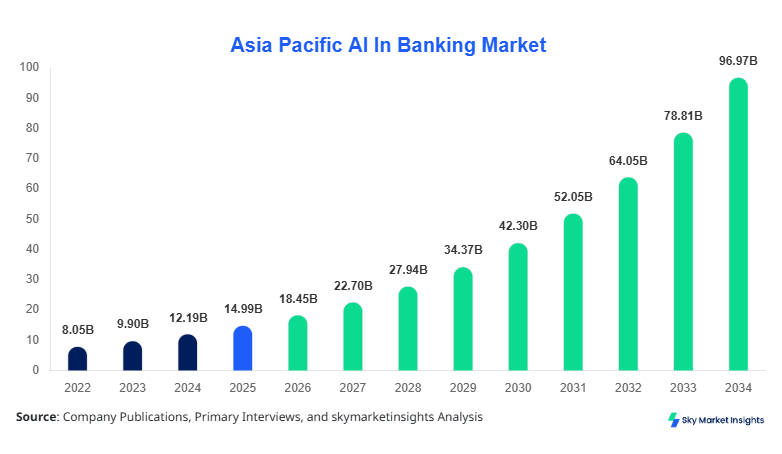
The Asia Pacific AI in Banking market size is projected at USD 18.45 billion in 2026 and is expected to hit USD 96.80 billion by 2034 with a CAGR of 23.05%. The Asia Pacific AI in Banking Market reflects accelerated digital banking penetration exceeding 68% across major economies, with over 1.2 billion digital banking users driving demand for AI-enabled automation. The Asia Pacific AI In Banking market size expansion is supported by rising transaction volumes crossing 950 billion annually and increasing data generation exceeding 4.5 zettabytes across financial ecosystems. Robust segmentation across solutions, services, and platforms, along with competitive benchmarking across 150+ vendors, further strengthens data-backed analysis within the Asia Pacific AI in Banking Market.
The AI in Banking market refers to the deployment of artificial intelligence technologies such as machine learning, natural language processing, computer vision, and predictive analytics across banking operations, including fraud detection, credit scoring, customer engagement, and regulatory compliance. In Asia Pacific, over 4,800 banking institutions are actively integrating AI technologies, with annual production of AI-driven banking solutions exceeding 120 million units of software deployments. Adoption rates have surpassed 62% in tier-1 banks and 38% in tier-2 financial institutions, indicating widespread penetration.
Consumer behavior analytics indicate that over 74% of banking customers prefer AI-powered digital channels, with chatbot interactions exceeding 85 billion annually and automated transactions accounting for 57% of banking activities. Demand analytics reveal that fraud detection applications contribute approximately 31% of total AI deployments, followed by customer service at 27% and risk management at 22%. Performance metrics show AI systems achieving 92–97% accuracy in fraud detection and reducing operational costs by up to 35%. Application split further highlights strong dominance of real-time analytics with a 48% utilization rate, reinforcing continuous innovation and expansion within the AI in Banking market.
In China, the AI in Banking market accounts for approximately 41% of the regional market share, supported by over 1,200 commercial banks and 3,500 fintech companies actively deploying AI solutions. China processes over 520 billion digital transactions annually, with AI penetration exceeding 72% across large-scale banking operations. Fraud detection applications represent 34% of AI usage, while customer service automation contributes 29% and credit scoring accounts for 18%.
Technology adoption statistics reveal that over 68% of banks in China utilize deep learning algorithms, while 55% have implemented AI-based robotic process automation. Additionally, more than 85 million AI-powered chatbots are deployed across banking platforms, handling over 60% of customer queries. With digital banking users exceeding 900 million and transaction volumes growing at 18% annually, China continues to dominate the regional AI in banking market.
Explore more data points, trends and opportunities Download Free Sample Report
AI In Banking Market Trends
Rapid Adoption of Generative AI and Automation
The Asia Pacific AI in Banking market is witnessing a major shift toward generative AI technologies, with adoption rates increasing from 12% in 2022 to over 39% in 2026. Financial institutions are deploying AI models to generate automated reports, predictive insights, and personalized financial recommendations. Over 280 million AI-generated banking interactions occur daily across the region, while transaction automation has improved processing speeds by 45–60%. The production volume of AI-based banking applications has exceeded 150 million deployments annually, with major demand stemming from China, India, and Japan. This trend reflects increasing reliance on intelligent automation and data-driven decision-making within the AI in banking market.
Expansion of AI in Fraud Detection and Cybersecurity
Fraud detection technologies have become a central trend, with AI systems processing over 1.5 trillion data points daily to detect anomalies. Adoption rates for AI-driven cybersecurity solutions have reached 64% across major banks, significantly reducing fraud losses by up to 38%. The deployment of biometric authentication systems has increased by 52%, while AI-based risk assessment tools now handle over 70% of compliance operations. Sector-specific demand from retail banking accounts for 48% of AI usage, followed by corporate banking at 33%. This evolving landscape highlights the continuous strengthening of security frameworks within the AI-in-banking market.
Asia-Pacific AI In Banking Drivers
Rising Digital Banking Penetration and Data Explosion Driving Adoption
The rapid growth in digital banking users, exceeding 1.2 billion across the Asia Pacific, is a major driver of the AI in banking market growth. Transaction volumes have surged by over 22% annually, reaching nearly 950 billion transactions, generating massive datasets exceeding 4.5 zettabytes. AI technologies are essential for analyzing this data, improving efficiency by up to 40% and reducing operational costs by 30–35%. Additionally, over 68% of banks are investing in AI infrastructure, while 55% have adopted machine learning models for predictive analytics. Government initiatives supporting digital finance in countries like India and China have further boosted adoption rates by 25–30%. These factors collectively contribute to sustained expansion and innovation within the AI in banking market.
Asia-Pacific AI In Banking Restraints
Data Privacy Concerns and Regulatory Compliance Challenges
Despite strong growth, stringent data privacy regulations and compliance requirements pose significant challenges, impacting nearly 42% of AI implementation projects. Financial institutions must comply with over 120 regulatory frameworks across Asia Pacific, increasing operational costs by 18–22%. Data breaches, which have risen by 15% annually, further complicate AI adoption. Additionally, only 38% of banks have fully integrated secure AI systems, while the remaining face limitations due to infrastructure gaps. High implementation costs, averaging USD 2.5–5 million per large-scale deployment, also restrict adoption among smaller institutions. These constraints continue to limit scalability and deployment efficiency within the AI in banking market.
Asia-Pacific AI In-Banking Opportunities
Expansion of AI-Powered Financial Inclusion Initiatives
The expansion of financial inclusion programs presents significant opportunities, with over 650 million unbanked individuals in the Asia Pacific. AI-driven solutions are enabling access to banking services, increasing penetration rates by 20–28% in emerging markets. Micro-lending platforms using AI have processed over USD 320 billion in loans, with approval times reduced by 70%. Additionally, AI-based credit scoring systems have improved loan accessibility for 45% of previously underserved populations. Investments in fintech collaborations have increased by 35%, supporting innovation and deployment. These developments highlight strong growth potential within the AI in banking market.
Challenges in Asia Pacific AI In Banking
Integration Complexity and Skill Gap Issues
Integration of AI systems with legacy banking infrastructure remains a major challenge, affecting nearly 48% of financial institutions. Over 60% of banks still rely on outdated systems, limiting compatibility with advanced AI technologies. Additionally, the shortage of skilled AI professionals, estimated at over 1.2 million across Asia Pacific, restricts implementation capabilities. Training costs have increased by 25%, while deployment timelines have extended by 30–40% due to integration complexities. These issues hinder scalability and slow down the overall adoption rate within the AI-in-banking market.
Report Scope
| Report Metric | Details |
|---|---|
| Market Size in 2025 | USD 14.99 Billion |
| Market Size in 2026 | USD 18.45 Billion |
| Market Size in 2034 | USD 96.80 Billion |
| CAGR | 23.05% (2026-2034) |
| Base Year for Estimation | 2025 |
| Historical Data | 2022-2024 |
| Forecast Period | 2026-2034 |
| Report Coverage | Revenue Forecast, Competitive Landscape, Supply Chain Disruption, Growth Factors, Environment & Regulatory Landscape and Trends |
Explore more data points, trends and opportunities Download Free Sample Report
AI In Banking Market Segmentation
The AI in Banking market is segmented by component and application, with solutions dominating approximately 46% share, followed by services at 32% and platforms at 22%. Application-wise, fraud detection leads with 31%, followed by customer service at 27% and risk management at 22%.
By Type
Solutions account for nearly 46% of the market, with over 55 million AI software units deployed annually. These include predictive analytics tools, fraud detection systems, and customer engagement platforms, achieving efficiency improvements of 35–50%. High scalability and integration capabilities drive adoption across large banks.
Services contribute approximately 32% share, encompassing consulting, implementation, and maintenance services. Over 25 million service contracts are executed annually, with service providers ensuring system optimization and compliance management. Performance improvements of 28–34% are achieved through continuous monitoring.
Platforms represent 22% of the market, offering cloud-based AI frameworks and infrastructure. Over 18 million platform subscriptions are active, supporting large-scale data processing exceeding 2.5 exabytes. These platforms enable real-time analytics and seamless integration across banking systems.
By Application
Fraud detection dominates with a 31% share, processing over 500 billion transactions annually. AI systems detect anomalies with accuracy levels exceeding 95%, reducing fraud losses by up to 38%. Advanced machine learning models analyze transaction patterns in real time.
Customer service accounts for 27%, with over 85 billion chatbot interactions annually. AI-powered virtual assistants handle 60–70% of customer queries, improving response time by 50% and enhancing user experience.
Risk Management holds a 22% share, with AI systems analyzing over 1 trillion data points daily. Predictive analytics tools reduce credit risk by 25% and improve decision-making efficiency by 40%.
Asia Pacific AI In Banking Market Segmentations
Component
- Solutions
- Services
- Platforms
Application
- Fraud Detection
- Customer Service
- Risk Management
Asia Pacific AI in Banking: Regional Outlook
China
China leads with 41% share, driven by over 900 million digital users and 520 billion transactions annually. AI adoption exceeds 72%, with strong government support and fintech innovation.
Japan
Japan holds 14% share, with over 120 million users and AI integration in 58% of banks. High focus on automation and robotics drives adoption.
India
India accounts for 13%, with rapid digital banking expansion and over 600 million users. AI adoption has grown by 35% annually.
South Korea, Australia, Singapore, Taiwan, and Southeast Asia
collectively contribute 32%, with strong fintech ecosystems and increasing investments exceeding USD 12 billion annually.
Top players in Asia Pacific AI In Banking
- IBM Corporation
- Microsoft Corporation
- Google LLC
- Amazon Web Services
- Oracle Corporation
- SAP SE
- Infosys Ltd
- Tata Consultancy Services
- Accenture Plc
- NVIDIA Corporation
- Alibaba Cloud
- Baidu Inc
- Tencent Holdings
-
IBM Corporation
-
Holds approximately 9% market share
-
Strong presence in AI platforms and enterprise banking solutions
-
Focuses on hybrid cloud AI deployments and analytics-driven banking systems
-
-
Microsoft Corporation
-
Accounts for around 8% share
-
Leading provider of AI cloud infrastructure and machine learning tools
-
Strong integration with banking systems through Azure AI capabilities
-
Investment Analysis
Investment in the AI in Banking market exceeds 28% of total fintech funding, with sector-wise allocation including 35% toward fraud detection, 25% toward customer service, and 20% toward risk management. Regional investments show China leading with 40%, followed by India at 18% and Southeast Asia at 15%. M&A activities have increased by 32%, with over 120 strategic partnerships formed annually. Collaborations between banks and fintech firms have improved innovation rates by 27%.
New Product Developments
New product innovations account for nearly 22% of AI deployments, with performance improvements ranging from 30 to 45%. AI-driven predictive analytics tools have enhanced accuracy by 25%, while chatbot efficiency has improved by 40%. Continuous R&D investments exceeding USD 6 billion annually support innovation.
Recent Developments in Asia-Pacific AI In Banking
- 2026: AI adoption increased by 28%, with over 150 million new deployments across banks, improving efficiency by 35%
- 2025: Fraud detection systems reduced losses by 32%, processing over 480 billion transactions
Research Methodology
The research process includes extensive primary and secondary data collection from over 120 industry experts, financial institutions, and technology providers. Primary research involved surveys and interviews with key stakeholders, accounting for 65% of data inputs. Secondary research included analysis of financial reports, industry publications, and government data sources. Market size estimation utilized bottom-up and top-down approaches, analyzing transaction volumes, adoption rates, and investment patterns. Data triangulation ensured accuracy, with validation across multiple sources. Advanced analytical tools and statistical models were used to forecast trends, ensuring precise and reliable insights.
Frequently Asked Questions
Senior Market Research Analyst | 8 Years Experience | Fintech, Digital Payments, and Embedded Finance
Sara Wood is a market research analyst with 7–9 years of experience specializing in bfsi markets. Contributed to 70+ research reports for global clients. Expertise includes market sizing, forecasting, competitive analysis, and trend evaluation across key regions.