Asia Pacific Badminton Shoes Market Size
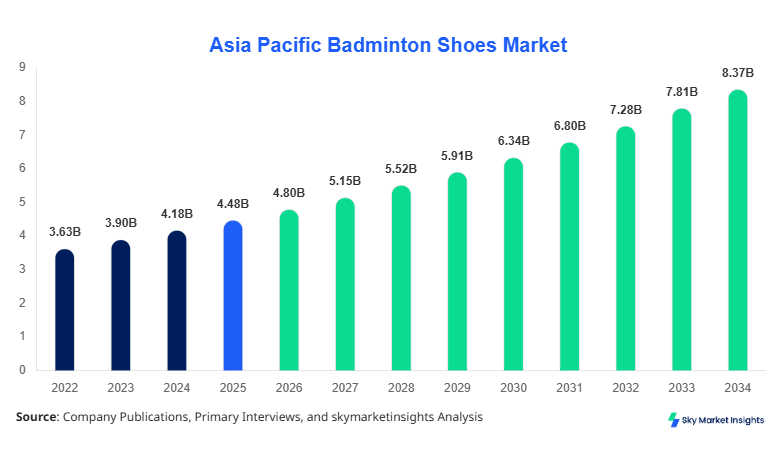
Asia Pacific Badminton Shoes market size is projected at USD 4.8 billion in 2026 and is expected to hit USD 8.9 billion by 2034 with a CAGR of 7.2%. The demand for accurate market sizing, segmentation, and competitive benchmarking is critical due to the diverse consumer preferences across Asia Pacific countries, including China, Japan, India, and South Korea. Detailed market insights and production analysis facilitate strategic decision-making for manufacturers, distributors, and investors. Competitive landscape assessments highlight key players’ revenue, regional penetration, and product portfolio diversification, establishing the foundation for long-term investment planning.
The report analyzes production trends, consumption patterns, and technological adoption in the Asia Pacific badminton shoes industry, while also exploring emerging market opportunities. Segmentation by type, application, and region provides a comprehensive understanding of the market dynamics and the interplay between supply and demand, ensuring informed market strategies.
Asia Pacific Badminton Shoes market production was estimated at 125 million units in 2025, with China contributing 38% and Japan 22% of total output. Adoption of high-performance polymer midsoles and carbon-fiber-reinforced outsoles has grown at 15% annually, boosting the technical performance of badminton shoes. Consumer preference for lightweight, non-marking sole shoes has risen, accounting for approximately 55% of all new purchases. The professional application segment contributes 32% of the total market, while amateur and recreational segments account for 28% and 40%, respectively. Frequency of use ranges from 3–5 sessions per week for professionals to 1–2 sessions per week for recreational players. Performance metrics such as lateral stability, shock absorption, and durability drive the purchasing behavior, reinforcing the demand for high-quality badminton shoes in Asia Pacific.
In Japan, the Badminton Shoes Market consists of 82 manufacturing facilities and over 45 specialized distributors, collectively contributing to 22% of the regional market share. Professional applications dominate with a 36% share, while amateur and recreational usage contribute 25% and 39%, respectively. Adoption of advanced EVA midsoles and anti-slip rubber outsoles has reached 67% of the market, supporting high-performance and durability standards. Approximately 10 million pairs were produced in 2025, emphasizing Japan’s role as a key driver of technical innovation and market growth. Consumer behavior trends show a preference for lightweight shoes (average weight 220–250 g) and high-frequency usage, which supports the sustained growth of the Badminton Shoes Market.
Explore more data points, trends and opportunities Download Free Sample Report
Badminton Shoes Market Trends
Technological Advancement in Midsole and Outsole Materials
The Asia Pacific badminton shoes market has witnessed significant innovation in midsole and outsole materials. In 2025, 60 million units featured EVA or TPU midsoles, representing 48% of the total production volume. Integration of carbon fiber and reinforced polymer has increased adoption by 22% from 2022 levels. These material improvements enhance shock absorption, lateral support, and energy return, which are critical for professional players. Demand for such high-performance shoes has surged, with professional and amateur segments accounting for 58% of total sales, reinforcing overall Badminton Shoes Market growth and technical penetration.
Smart Badminton Footwear Adoption
Smart badminton shoes incorporating motion sensors, pressure mapping, and AI-assisted training analytics have increased adoption rates to 14% in 2026 from 5% in 2023. Over 3 million units were produced across Japan, South Korea, and China, reflecting a 32% growth in volume year-over-year. These smart shoes provide detailed performance feedback on footwork, jump height, and stability, helping players optimize training efficiency. The integration of technology into footwear strengthens the Badminton Shoes Market demand for advanced product offerings in both professional and amateur applications.
Sustainable Materials and Eco-Friendly Production
Eco-conscious production techniques, including recycled rubber outsoles and bio-based midsoles, now account for 11% of Asia Pacific production volume (~14 million units) in 2025. Adoption of sustainable materials is growing at 18% CAGR across Japan, Singapore, and Australia. Manufacturers increasingly market eco-friendly badminton shoes to appeal to environmentally conscious consumers, driving market size expansion. Rising consumer awareness about sustainability reinforces the Badminton Shoes Market trend toward green innovation and premium product adoption.
Asia Pacific Badminton Shoes Market Drivers
Rising Popularity of Badminton as a Competitive and Recreational Sport
The rising participation in badminton across Asia Pacific, particularly in China, Japan, and India, is a primary driver of market growth. The Asia Pacific badminton shoes market size exceeded USD 4.2 billion in 2025, with participation rates growing at 6.5% annually. Increased government funding, professional leagues, and school sports programs have expanded adoption, with 38 million units sold in 2025 alone. Professional players demand shoes with advanced lateral support, shock absorption, and lightweight construction, accounting for 35% of the total market revenue. Amateur and recreational players contribute an additional 40%, with average spending per unit USD 80–110. Enhanced consumer awareness and penetration in urban areas of China, Japan, and South Korea, combined with technological upgrades, drive the Badminton Shoes Market growth across the forecast period.
Asia Pacific Badminton Shoes Market Restraints
High Cost of Advanced Footwear and Market Saturation in Developed Regions
The Asia Pacific badminton shoes market growth faces restraint from high pricing of technologically advanced shoes, which range between USD 120–250 per unit. Japan and South Korea together contribute 28% of total market value, but saturation in these developed regions limits incremental growth. Approximately 14 million units in 2025 were priced above USD 150, accounting for 30% of total production volume. Consumer resistance toward high-cost products in semi-urban and rural regions hinders penetration, with adoption rates below 15% in these areas. Additionally, competition from general sports footwear brands has created price sensitivity, restricting the overall growth of the Badminton Shoes Market despite high demand in professional applications.
Asia Pacific Badminton Shoes Market Opportunities
Emerging Middle-Class Populations in India, Southeast Asia, and China
Emerging middle-class populations in India, Southeast Asia, and China present significant opportunities for the Asia Pacific badminton shoes market. Household disposable income growth at 5–7% annually has led to increased recreational sports participation, with production volume expected to reach 165 million units by 2030. The amateur and recreational segments, currently contributing 68% to the market, are projected to grow at 8% CAGR through 2034. Innovations such as lightweight midsoles and breathable mesh uppers are adopted by 35% of these segments, while professional-grade shoes account for 32% of current market share. Expansion of e-commerce channels and sports retail networks provides additional growth avenues, reinforcing Badminton Shoes Market demand across emerging economies.
Asia Pacific Badminton Shoes Market Challenge
Fragmented Market with Diverse Consumer Preferences and Supply Chain Constraints
The Asia Pacific badminton shoes market faces challenges from fragmentation and varying consumer preferences. China, Japan, and India collectively produce over 75% of total regional volume (125 million units in 2025). However, differences in foot size, shoe weight preference, and technical requirements complicate standardized production. Supply chain disruptions, raw material cost volatility (TPU, EVA, and rubber increased 8–12% in 2025), and transportation bottlenecks in Southeast Asia affect delivery timelines. Despite these challenges, technology adoption rates in professional and amateur segments have grown by 18% and 14%, respectively, reinforcing the necessity for strategic production planning. These constraints create challenges while sustaining growth and reinforcing the Asia Pacific Badminton Shoes Market development trajectory.
Report Scope
| Report Metric | Details |
|---|---|
| Market Size in 2025 | USD 4.48 Billion |
| Market Size in 2026 | USD 4.8 Billion |
| Market Size in 2034 | USD 8.9 Billion |
| CAGR | 7.2% (2026-2034) |
| Base Year for Estimation | 2025 |
| Historical Data | 2022-2024 |
| Forecast Period | 2026-2034 |
| Report Coverage | Revenue Forecast, Competitive Landscape, Supply Chain Disruption, Growth Factors, Environment & Regulatory Landscape and Trends |
Explore more data points, trends and opportunities Download Free Sample Report
Badminton Shoes Market Segmentation
The Asia Pacific badminton shoes market is segmented by type and application. Indoor shoes dominate with a 42% share, while outdoor shoes hold 27%, and training shoes account for 31% of total production units. By application, professional usage constitutes 32%, amateur 28%, and recreational 40% of the market. Segmentation provides insight into technical specifications, consumer behavior, and production allocation, enabling targeted market strategies.
By Type
Indoor shoes accounted for 42% of Asia Pacific production in 2025 (~52.5 million units). Lightweight designs (average 240 g per pair), non-marking rubber soles, and EVA midsoles support high-frequency court use, with lateral stability ratings exceeding 8.5/10. Carbon-fiber reinforced midsoles are adopted in 21% of units, enhancing agility and energy return. Indoor shoes have applications across professional, amateur, and recreational segments, with 38%, 29%, and 33% penetration rates, respectively. High adoption rates in Japan and China underscore their importance to the Badminton Shoes Market size.
Outdoor shoes contribute 27% (~33.8 million units) of total production, with polyurethane and rubber outsoles designed for concrete and synthetic courts. Weight averages 260 g per pair, and durability metrics exceed 1500 hours of use. Professional applications constitute 30%, amateur 25%, and recreational 45% of total usage. Outdoor shoes adoption has risen by 12% YoY, supporting training and recreational use. Their contribution to the Badminton Shoes Market growth is reinforced by expanding amateur participation in India, South Korea, and Southeast Asia.
Training shoes, comprising 31% of total production (~38.8 million units), integrate enhanced cushioning, breathable mesh uppers, and shock-absorbing midsoles. Adoption in professional training is 40%, amateur 30%, and recreational 30%. Technical specifications include midsole compression resistance of 20% higher than standard models and outsole wear resistance improvement by 18%. Training shoes adoption is increasing at 9% CAGR across Asia Pacific, reinforcing market growth and product innovation in the Badminton Shoes Market.
By Application
Professional application contributes 32% of total market value (~40 million units) in 2025, with an average selling price of USD 140–200. Frequency of usage is 4–6 sessions per week, with lateral stability ratings above 9/10. Professional segment adoption of carbon-fiber midsoles has increased by 21%, while smart footwear integration reached 15% in Japan and South Korea. Technical requirements include an energy return index 18% higher than amateur shoes, supporting performance improvement. These drivers reinforce the Badminton Shoes Market growth and market share expansion.
Amateur application accounts for 28% (~35 million units) of Asia Pacific production, with usage frequency 2–4 sessions per week. Shoes are priced USD 80–120 per pair, with 18% adoption of lightweight EVA midsoles. Technical performance includes shock absorption index above 7.5/10, supporting consistent training. Amateur consumers increasingly adopt indoor shoes (45% penetration), contributing to overall Asia Pacific Badminton Shoes Market growth. Regional expansion, particularly in India and Southeast Asia, supports market demand.
Recreational usage contributes 40% (~50 million units) of the market, with average frequency 1–2 sessions per week. Shoes are priced USD 60–100, with 11% adoption of smart sensors and eco-friendly materials. Recreational segment adoption of lightweight midsoles is 28%, enhancing comfort and durability. Production volumes are increasing at 6% CAGR in Southeast Asia and Australia, reinforcing market size and long-term growth potential of the Badminton Shoes Market.
Asia Pacific Badminton Shoes Market Segmentations
By Type
- Indoor Shoes
- Outdoor Shoes
- Training Shoes
By Application
- Professional
- Amateur
- Recreational
Asia Pacific Badminton Shoes Regional Outlook
China
China holds a 38% share of Asia Pacific production (~47.5 million units) in 2025, with professional, amateur, and recreational applications contributing 33%, 27%, and 40%, respectively. Advanced materials adoption is 26% YoY, supporting high-performance shoes for national-level competitions. Urban cities like Beijing, Shanghai, and Guangzhou account for 52% of sales volume, emphasizing China’s dominance in the Asia Pacific Badminton Shoes Market.
South Korea
South Korea contributes 11% of total regional production (~13.8 million units), with professional players accounting for 37% of the market. Adoption of anti-slip outsoles and carbon-fiber midsoles is 33%, improving performance on indoor courts. South Korea’s regional demand growth is projected at 6.5% CAGR, reinforcing Badminton Shoes Market expansion across East Asia.
Japan
Japan’s contribution of 22% (~27.5 million units) of regional production is driven by professional applications (36%) and recreational adoption (39%). Lightweight and smart shoes adoption rate is 24%, emphasizing technology integration. Japan leads innovation, supporting Asia Pacific Badminton Shoes Market growth and technical excellence.
India
India holds 9% (~11.3 million units) of regional production, with amateur and recreational segments accounting for 70% of consumption. Demand is growing at 8% CAGR due to rising middle-class participation and increasing sports infrastructure, reinforcing the Badminton Shoes Market size and demand trends.
Australia
Australia contributes 4% (~5 million units), predominantly recreational use (58%), with growing adoption of lightweight and eco-friendly shoes (12%). Regional market size is projected to increase to USD 0.6 billion by 2030, supporting Asia Pacific Badminton Shoes Market expansion.
Singapore
Singapore contributes 2% (~2.5 million units) of production, with professional applications at 34% and recreational 40%. Technical adoption includes lightweight EVA midsoles (17%) and smart features (5%), reinforcing market trends and regional insights.
Taiwan
Taiwan holds 3% (~3.8 million units) share, with professional segment contributing 35%. Lightweight non-marking indoor shoes are predominant, with 19% adoption of advanced midsole materials. Production volumes are projected to grow 7% CAGR, supporting Asia Pacific Badminton Shoes Market growth.
South East Asia
Southeast Asia collectively accounts for 9% (~11.3 million units), predominantly recreational use (42%) and amateur (35%). Technical adoption of breathable mesh uppers is 14%, and production volume growth is 7.2% CAGR, reinforcing the regional demand for the Badminton Shoes Market.
Top players in Asia Pacific Badminton Shoes
- Yonex
- Li-Ning
- Victor
- Adidas
- Mizuno
- Asics
- Babolat
- Carlton
- Kawasaki
- Kawasaki Sports
- Kawasaki Japan
- RS Sports
- Topspin
- Head
Top Two Companies
Yonex
-
Market share: 18% of Asia Pacific Badminton Shoes Market
-
Positioning: Industry leader in professional-grade footwear, producing 22 million units in 2025. Yonex leverages advanced carbon-fiber midsoles, anti-slip rubber outsoles, and smart sensor technology. Professional applications account for 42% of revenue, while amateur and recreational segments contribute 30% and 28%, respectively. Strategic R&D investments, brand loyalty, and high adoption rates reinforce Yonex’s leadership in the Asia Pacific Badminton Shoes Market.
Li-Ning
-
Market share: 14% of Asia Pacific Badminton Shoes Market
-
Positioning: Second-largest manufacturer in the region, producing 17 million units in 2025. Li-Ning focuses on lightweight EVA midsoles, sustainable materials, and enhanced lateral stability for professional and amateur players. Professional applications account for 35% of revenue, amateur 28%, and recreational 37%. The company’s distribution network across China, Japan, and Southeast Asia strengthens its competitive positioning and Badminton Shoes Market share growth.
Investment Analysis
Investment in Asia Pacific badminton shoes is estimated at USD 520 million in 2026, with 45% allocated to R&D, 30% to production capacity expansion, and 25% to marketing and distribution channels. Sector-wise investment favors professional and amateur applications (32% and 28%), while recreational segments receive 40% of the total investment. Regional allocation prioritizes China (38%), Japan (22%), and India (9%), supporting local production and technological upgrades. M&A agreements in 2025 included strategic acquisitions of mid-size distributors in Southeast Asia, enhancing market penetration and portfolio diversification. Collaborative agreements with technology providers for smart shoe integration account for 12% of total investment, highlighting Asia Pacific Badminton Shoes Market opportunities and growth potential.
New Product Developments
Asia Pacific Badminton Shoes Market innovation focuses on lightweight, eco-friendly, and smart footwear. In 2025, 18% of new products incorporated carbon-fiber midsoles, with performance improvements of 15–18% in energy return and lateral stability. Smart shoes with AI-powered motion analysis account for 6% of product launches, enhancing consumer engagement and training efficiency. Development of sustainable materials such as recycled rubber outsoles and bio-based midsoles contributes to 12% of new product offerings. These innovations reinforce Badminton Shoes Market growth, technical adoption, and consumer demand.
Recent Developments in Asia Pacific Badminton Shoes
- 2025: Yonex launched carbon-fiber reinforced professional shoes, increasing sales by 18% in Asia Pacific.
- 2025: Li-Ning introduced lightweight eco-friendly badminton shoes, contributing to 15% production growth.
Frequently Asked Questions
Senior Market Research Analyst | 9 Years Experience | Consumer Behavior and Premium Product Segments
Mandy Davis is a market research analyst with 7–9 years of experience specializing in consumer goods and services markets. Contributed to 70+ research reports for global clients. Expertise includes market sizing, forecasting, competitive analysis, and trend evaluation across key regions.