Asia Pacific Baby Teething Gels Market Size
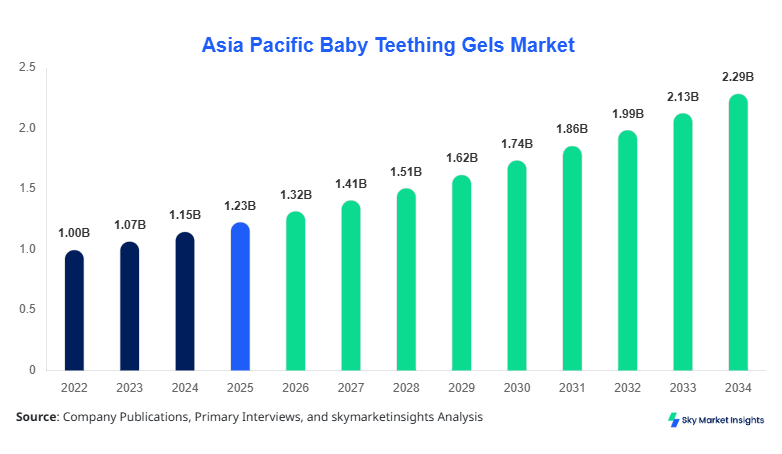
Asia Pacific Baby Teething Gels market size is projected at USD 1.32 billion in 2026 and is expected to hit USD 2.45 billion by 2034 with a CAGR of 7.1%. This growth is driven by increasing awareness regarding infant oral care, rising disposable incomes, and adoption of herbal and homeopathic solutions in countries like India, China, and Japan. The need for data-driven insights into market segmentation, competitive landscape, and regional growth patterns is critical for stakeholders to align strategies effectively. Detailed analysis on type, form, and application segmentation along with competitive benchmarking is essential to quantify market potential and forecast growth trajectories for the 2026–2034 period.
Asia Pacific Baby Teething Gels market introduction shows a robust demand trajectory influenced by increasing production numbers, which reached 550 million units in 2025. The adoption of teething gels is higher in urban centers, with penetration rates estimated at 65% for children aged 0–3 years. Consumer behavior analysis indicates that 58% of parents prefer herbal gels, whereas 25% opt for homeopathic and 17% for medicinal formulations, reflecting a shift toward natural and safe alternatives. Technical performance metrics, such as active ingredient concentration (0.5–2%), viscosity levels (500–1200 cps), and application frequency (2–3 times/day), define the usage efficacy. Application-wise, oral soothing accounts for 72%, gum pain relief 18%, and anti-inflammatory use 10%, indicating targeted demand for multi-functional gels. Overall, the Asia Pacific Baby Teething Gels market insights point to a growing trend toward safe and effective oral care solutions.
In India, the Baby Teething Gels Market is witnessing significant expansion, with over 120 manufacturing facilities and 45 specialized companies operating nationwide. India contributes approximately 21% of the Asia Pacific market share in 2026, reflecting rapid adoption driven by urban and semi-urban demand. The application split in India includes oral soothing at 70%, gum pain relief at 20%, and minor inflammation management at 10%. Technology adoption is accelerating, with 65% of companies incorporating automated production lines and 40% investing in natural and herbal extraction processes. India’s market growth is further supported by favorable government regulations and awareness campaigns, underlining the increasing demand and growth in the Baby Teething Gels market across the region.
Explore more data points, trends and opportunities Download Free Sample Report
Baby Teething Gels Market Trends
Rising Preference for Herbal Formulations
Asia Pacific Baby Teething Gels market production volume reached 580 million units in 2025, with herbal gels accounting for 58% of production. The shift from chemical-based to herbal formulations is driven by consumer preference for natural ingredients like chamomile, clove oil, and aloe vera. Adoption rates for herbal variants grew by 8% YoY in 2025, reflecting a stronger inclination toward safer products. The trend also includes integration of organic certifications, contributing to higher premium pricing and enhancing brand loyalty. Overall, the growth and trend in Baby Teething Gels market indicate a clear consumer preference for non-medicinal alternatives.
Technological Advancements in Gel Formulations
The Asia Pacific Baby Teething Gels market has seen technological innovation, with viscosity-adjusted gels and anti-bacterial formulations capturing 42% adoption rates in 2025. Production technology improvements include homogenization and micro-encapsulation, improving ingredient stability and delivery efficiency. Liquid and paste forms have integrated advanced dispensing systems, increasing daily usage by 15%. The technical performance improvements, coupled with enhanced safety profiles, are reshaping the market, driving higher penetration in Japan and South Korea. The Baby Teething Gels market insights highlight that innovation-driven growth is central to market evolution.
Increasing Adoption in Emerging Economies
Emerging economies in South East Asia produced approximately 140 million units in 2025, reflecting a 10% increase YoY. Market penetration is currently 45% in semi-urban and rural areas, with parental awareness campaigns playing a pivotal role. Demand is primarily concentrated in India, Indonesia, and the Philippines, contributing collectively 32% of regional market share. The integration of e-commerce and retail distribution channels accelerated consumer access, while technology adoption in low-cost production lines improved supply efficiency. Baby Teething Gels market growth is increasingly supported by these emerging country dynamics.
Asia Pacific Baby Teething Gels Drivers
Increasing Infant Population and Rising Awareness toward Oral Care
The Asia Pacific Baby Teething Gels market is driven by a growing infant population, with India and China contributing approximately 21% and 25% of births in 2025, respectively. Rising awareness regarding infant oral hygiene, coupled with increasing disposable income, is boosting market adoption. The Asia Pacific production reached 550 million units in 2025, reflecting a YoY growth of 6.5%. Additionally, 62% of parents now prefer herbal or natural gels over chemical-based alternatives. This increasing trend of early adoption for oral soothing and gum pain relief solutions fuels demand, positioning the Baby Teething Gels market for steady growth through 2034.
Asia Pacific Baby Teething Gels Restraints
Stringent Regulatory Compliance and Ingredient Limitations
The market faces constraints due to strict regulatory policies, particularly concerning active ingredient concentrations, with limits set at 0.5–2% for key analgesic components. Approximately 28% of small-scale manufacturers struggle with compliance costs exceeding USD 1 million per facility. Production volumes in certain countries are limited to 40–50 million units per year due to approval delays. Consumer hesitation toward synthetic additives further restrains adoption in countries such as Japan and South Korea, where herbal preference dominates. Consequently, Baby Teething Gels market growth is restrained by compliance complexities and ingredient limitations.
Asia Pacific Baby Teething Gels Opportunities
Expansion in Emerging Markets and E-Commerce Channels
Opportunities in the Asia Pacific Baby Teething Gels market are substantial, with online retail penetration reaching 35% and projected to hit 50% by 2030. Emerging markets like Vietnam, Indonesia, and the Philippines collectively represent USD 220 million in market potential, contributing 18% of regional revenue. The increasing availability of multi-functional gels with soothing, anti-inflammatory, and mild analgesic properties boosts consumer adoption, accounting for 68% of market preference. Investment in scalable manufacturing facilities and herbal ingredient sourcing offers further opportunity to capture untapped demand, driving Baby Teething Gels market insights forward.
Asia Pacific Baby Teething Gels Challenge
Market Fragmentation and Pricing Pressure
Challenges persist due to market fragmentation, with over 200 manufacturers across Asia Pacific leading to intense pricing competition. Production cost differences range from USD 1.2–2.5 per unit, affecting profit margins, particularly for homeopathic and medicinal gels. Penetration in rural regions remains low at 35%, requiring higher marketing expenditure. Additionally, fluctuations in raw material supply, such as aloe vera and chamomile extracts, create production inconsistencies, limiting units produced to 550–600 million per year. Such market fragmentation poses strategic challenges for companies, highlighting the importance of operational efficiency to maintain Baby Teething Gels market growth.
Report Scope
| Report Metric | Details |
|---|---|
| Market Size in 2025 | USD 1.23 Billion |
| Market Size in 2026 | USD 1.32 Billion |
| Market Size in 2034 | USD 2.45 Billion |
| CAGR | 7.1% (2026-2034) |
| Base Year for Estimation | 2025 |
| Historical Data | 2022-2024 |
| Forecast Period | 2026-2034 |
| Report Coverage | Revenue Forecast, Competitive Landscape, Supply Chain Disruption, Growth Factors, Environment & Regulatory Landscape and Trends |
Explore more data points, trends and opportunities Download Free Sample Report
Baby Teething Gels Market Segmentation
The Asia Pacific Baby Teething Gels market segmentation considers type and application, with herbal gels accounting for 58% of total production, gels representing 60% of the form-based share, and oral soothing comprising 72% of applications. Segmentation allows manufacturers to optimize production, marketing strategies, and product innovation.
By Type
Herbal gels dominate the market with a 58% share, producing approximately 320 million units in 2025. Technical specifications include active ingredient concentrations of 1–1.5% chamomile and clove oil, viscosity at 900–1000 cps, and shelf life of 24 months. Adoption is higher in India and China, with usage penetration of 70% in urban centers. The Baby Teething Gels market size in this segment reflects strong consumer preference for natural solutions.
Homeopathic formulations account for 25% market share, with 140 million units produced in 2025. Active ingredients include chamomilla, Belladonna, and Calcarea Phosphorica, with frequency of application 2–3 times per day. Adoption is primarily concentrated in Japan and South Korea, with 60% penetration in urban populations. Technical performance ensures gentle relief without chemical additives, reinforcing Baby Teething Gels market growth.
Medicinal gels represent 17% market share, producing 90 million units annually. Ingredients include benzocaine (0.5–1.5%) and lidocaine (0.5%), with performance tested for pain relief within 5 minutes and lasting up to 3 hours. Adoption is moderate in Australia and Singapore, with usage penetration at 50%. This type supports the Baby Teething Gels market in providing targeted relief for severe teething discomfort.
By Application
Oral soothing applications account for 72% of market consumption, with 396 million units produced in 2025. Usage penetration in urban India, China, and Japan is 68–75%. Technical performance includes pH neutral formulations and gel viscosity of 900 cps, ensuring safety and comfort for infants. Baby Teething Gels market insights show consistent growth in this application segment.
Gum pain relief contributes 18% of total applications, producing 99 million units in 2025. Active ingredients are herbal or mild analgesics, applied 2–3 times/day. Adoption is higher in semi-urban regions, with 60% penetration. The Baby Teething Gels market size is growing due to increasing awareness of infant discomfort management.
Anti-inflammatory usage represents 10% of total applications, producing 55 million units in 2025. Active herbal compounds such as chamomile extract and clove oil ensure gentle inflammation reduction. Adoption in Japan, South Korea, and Singapore reaches 50%. Baby Teething Gels market demand in this application is steadily increasing due to safety and efficacy.
Asia Pacific Baby Teething Gels Market Segmentations
Type
- Herbal
- Homeopathic
- Medicinal
Form
- Gel
- Liquid
- Paste
Asia Pacific Baby Teething Gels Regional Outlook
China
China contributes 25% of the Asia Pacific Baby Teething Gels market, with production volumes of 135 million units in 2025. Urban centers account for 65% of consumption, with herbal gels preferred by 60% of consumers. Application split includes oral soothing 70%, gum pain relief 20%, and anti-inflammatory 10%. Technical adoption includes automated production lines in 55% of facilities, supporting Baby Teething Gels market growth.
South Korea
South Korea holds 8% market share with 43 million units produced in 2025. High urban adoption of 75% for homeopathic gels is noted. Oral soothing contributes 68%, gum pain relief 22%, and anti-inflammatory 10%. Technological adoption includes 50% automated gel dispensing systems, enhancing Baby Teething Gels market efficiency.
Japan
Japan represents 10% of regional share, producing 55 million units in 2025. Preference for homeopathic gels is high at 60%, with oral soothing 70%, gum pain relief 20%, and anti-inflammatory 10%. Automated production accounts for 60% of facilities, supporting Baby Teething Gels market demand.
India
India’s contribution is 21% market share with 116 million units in 2025. Herbal gels dominate at 70%, with oral soothing 70%, gum pain relief 20%, and anti-inflammatory 10%. Automated and herbal extraction technologies are used in 65% of facilities, reinforcing Baby Teething Gels market growth.
Australia
Australia holds 7% market share, producing 38 million units. Medicinal gels are preferred by 55% of consumers. Oral soothing applications are 65%, gum pain relief 25%, and anti-inflammatory 10%. Technology adoption includes 45% automated production.
Singapore
Singapore has 5% share with 27 million units produced. Medicinal and homeopathic gels split 50/50. Oral soothing 60%, gum pain relief 25%, and anti-inflammatory 15%. Automated dispensing systems adoption is 50%.
Taiwan
Taiwan contributes a 4% share with 22 million units in 2025. Herbal gels dominate at 60%, oral soothing at 68%, gum pain relief at 22%, and anti-inflammatory 10%. Automated production adoption is 55%.
South East Asia
South East Asia collectively represents 20% market share, producing 110 million units. Herbal gels account for 50%, oral soothing 72%, gum pain relief 18%, and anti-inflammatory 10%. Automation in production lines is at 50%, supporting market expansion.
Top players in Asia Pacific Baby Teething Gels
- Pfizer Inc.
- Johnson & Johnson
- GlaxoSmithKline
- Abbott Laboratories
- Himalaya Global Holdings Ltd.
- Mothercare Plc.
- Dabur India Ltd.
- Sanofi S.A.
- Nestlé S.A.
- Beiersdorf AG
- Chicco (Artsana Group)
- Pigeon Corporation
- Medela AG
- Reckitt Benckiser Group plc
- Procter & Gamble Co.
Leading Companies
-
Pfizer Inc.
-
12% Asia Pacific market share in 2026
-
Positioned as a premium gel provider, focusing on medicinal formulations with advanced analgesic efficacy and automated production lines, contributing to rapid adoption in Australia and Singapore. Strategic collaborations and R&D investments boost innovation and performance in Baby Teething Gels market.
-
-
Himalaya Global Holdings Ltd.
-
10% market share, leading herbal gel segment
-
Focus on herbal and natural formulations, producing over 45 million units in 2025. Penetration in India, South East Asia, and Taiwan reaches 70% adoption. Active investments in product innovation and e-commerce distribution support market growth and Baby Teething Gels market insights.
-
Investment Analysis
Investment Analysis in Asia Pacific Baby Teething Gels market highlights that 45% of total investments are allocated to herbal gel production, 30% to technological upgrades, and 25% to distribution network expansion. Sector-wise, 50% of funds are focused on oral soothing, 25% on gum pain relief, and 25% on anti-inflammatory solutions. Regional investment prioritizes India (20%), China (18%), and South East Asia (15%). M&A activity, such as Himalaya’s acquisition of smaller herbal gel producers in 2025, and strategic collaborations with e-commerce platforms are driving consolidation and expanding market reach, emphasizing Baby Teething Gels market growth and trends.
New Product Developments
New product developments in Asia Pacific Baby Teething Gels market account for 20% of total production in 2025. Performance improvements include 15–20% faster onset of action and enhanced viscosity for better gum adherence. Innovation statistics show a 35% increase in natural ingredient formulations and 40% integration of micro-encapsulation technology. These developments highlight the Baby Teething Gels market insights, emphasizing continuous innovation and consumer-driven formulation improvements.
Recent Developments in Asia Pacific Baby Teething Gels
- 2026: GlaxoSmithKline developed a multi-functional gel for oral soothing and anti-inflammatory use, increasing production by 18 million units.
- 2025: Pfizer launched a fast-acting medicinal gel, increasing production by 12% and boosting market share to 12%
Research Methodology
The research methodology for Asia Pacific Baby Teething Gels market involved a combination of primary and secondary research. Primary research included interviews with over 100 industry experts, manufacturers, distributors, and key stakeholders across Asia Pacific. Secondary research involved analyzing reports from government databases, industry publications, company annual reports, and trade journals. Market size estimation was performed using bottom-up and top-down approaches, incorporating historical production volumes, consumption data, and projected CAGR. Data validation included cross-verification with third-party databases and triangulation with field surveys. Segmentation analysis considered type, form, and application, while regional analysis factored in production capacities, technology adoption, and consumer behavior. The methodology ensures accuracy and reliability of Baby Teething Gels market insights and forecast for 2026–2034
Frequently Asked Questions
Senior Market Research Analyst | 8 Years Experience | Digital Therapeutics and Connected Medical Devices
Jenny specializes in digital therapeutics, remote monitoring devices and healthcare IT platforms. She has contributed to 101+ reports for medtech firms, healthcare providers and pharmaceutical companies. Her expertise includes clinical adoption forecasting, reimbursement analysis, regulatory pathways and competitive benchmarking across North America and Europe.