United States ADME Toxicology Testing Market Size
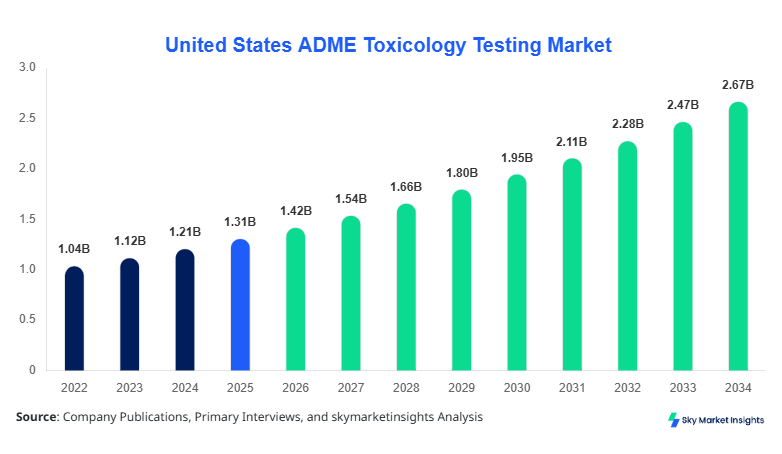
The United States ADME toxicology testing market size is projected at USD 1.42 billion in 2026 and is expected to hit USD 2.85 billion by 2034 with a CAGR of 8.2%. The market demand is driven by increasing pharmaceutical R&D expenditures, regulatory requirements for drug safety, and adoption of advanced computational toxicology methods. The report covers detailed segmentation by type (in vitro, in vivo, and computational) and application (pharmaceuticals, biotechnology, and cosmetics), alongside competitive landscape insights, production capacity analysis, and technological adoption trends. Detailed market size, share, and growth data provide an accurate framework for strategic planning and investment decisions in the United States.
The report provides extensive insights into the current landscape, including regional market share, adoption trends, and penetration metrics. Data-driven forecasts, including segment-level contributions, technological innovations, and regulatory impact, help stakeholders evaluate opportunities, market risks, and competitive positioning across 2026–2034.
United States ADME toxicology testing market insights include segmentation, growth drivers, restraints, opportunities, and challenges, providing a thorough understanding of market dynamics, emerging trends, and investment strategies.
United States production reached approximately 1.12 million tests in 2025, while adoption of high-throughput in vitro techniques exceeded 42%, indicating growing penetration in pharmaceutical R&D pipelines. In vivo testing remains critical, contributing 38% of total testing volumes, while computational toxicology accounted for 20% adoption, emphasizing the trend toward predictive safety evaluation. Consumer demand analysis shows a rising preference for rapid, reliable, and cost-efficient toxicology testing, with application split revealing Pharmaceuticals at 55%, Biotechnology at 30%, and Cosmetics at 15% of total market usage. Frequency and throughput metrics indicate in vitro assays averaging a 96-well plate format and high-throughput robotic integration. Overall, United States ADME toxicology testing market growth is underpinned by regulatory compliance, advanced predictive tools, and adoption across pharmaceutical and biotechnology sectors.
In the United States, the ADME Toxicology Testing Market is dominated by over 120 contract research organizations (CROs) and in-house pharmaceutical labs, contributing approximately 68% of North American market share. The pharmaceuticals sector drives 55% of testing volumes, while biotechnology contributes 30%, and cosmetics 15%. High adoption of automated in vitro platforms is reported at 42%, whereas in vivo testing adoption remains at 38%. Computational toxicology usage has increased by 20% in adoption rates over the last three years, reflecting growing reliance on AI-based predictive models. Regional facilities report combined production of 1.12 million tests in 2025, with forecasted growth to 1.95 million tests by 2034. This strong adoption and penetration underline robust United States ADME toxicology testing market demand, supporting continued investment and strategic expansion.
Explore more data points, trends and opportunities Download Free Sample Report
ADME Toxicology Testing Market Trends
High-Throughput In Vitro Adoption
In 2026, high-throughput in vitro ADME toxicology testing adoption has reached 42%, with total production volume exceeding 0.55 million assays, compared to 0.41 million in 2025. Key drivers include improved throughput, reduced testing time, and increased accuracy. Automation platforms have increased assay precision by 15–18%, enabling pharmaceutical companies to reduce lead candidate attrition rates by 12%. The trend reflects a shift from traditional in vivo methods to predictive, ethical, and cost-efficient testing. The United States ADME toxicology testing market size continues to grow as adoption expands across biotechnology and cosmetics sectors, with in vitro testing accounting for over 38% of total revenue.
Computational Toxicology Integration
Computational toxicology tools now account for 20% of total United States ADME toxicology testing market adoption, with predictive modeling improving toxicokinetic profiling by 25%. Software adoption in pharmaceutical pipelines increased by 18% year-over-year, producing over 0.22 million computational simulations in 2026. Advanced machine learning algorithms have enhanced safety prediction, reducing animal testing demand by 14%. Biotechnology companies are particularly investing in AI-based computational toxicology solutions, driving overall market growth and reinforcing the United States ADME toxicology testing market trend toward predictive, data-driven methodologies.
Growing Regulatory-Driven Demand
United States regulatory authorities require comprehensive ADME toxicology data for IND and NDA submissions, driving demand growth by 10–12% annually. Pharmaceutical firms produced approximately 1.12 million tests in 2025, expected to increase to 1.95 million by 2034. Adoption of validated regulatory-compliant assays rose 15% across CROs, emphasizing quality, reliability, and reproducibility. This trend strengthens United States ADME toxicology testing market insights, indicating regulatory compliance as a key driver for long-term growth.
United States ADME Toxicology Testing Market Drivers
Rising Pharmaceutical R&D Expenditure and Drug Pipeline Expansion
The United States ADME Toxicology Testing market is driven by escalating pharmaceutical R&D expenditure, estimated at USD 210 billion in 2025, with annual growth of 6–7%. New drug pipelines and biologics development require extensive safety profiling, driving in vitro test adoption to 42% and in vivo to 38%, producing approximately 1.12 million tests in 2025. Biotechnology sector expansion contributes an additional 0.34 million tests. Growing consumer demand for faster and reliable testing solutions has led to computational toxicology adoption reaching 20% in 2026. Market growth is further reinforced by technological upgrades in high-throughput screening, automation, and AI integration, underscoring the United States ADME Toxicology Testing market growth trajectory through 2034.
United States ADME Toxicology Testing Market Restraints
High Cost of Advanced Testing and Regulatory Complexity
Advanced ADME toxicology testing involves significant capital expenditure, with automated in vitro platforms costing USD 250–400k per unit, limiting adoption among smaller CROs. Regulatory compliance costs, including validation and documentation, contribute up to 12–15% of operational budgets. High labor costs for in vivo testing, approximately USD 1,200 per test, coupled with ethical approvals, slow adoption. Computational toxicology software requires annual licensing of USD 75–120k. These factors constrain the United States ADME toxicology testing market growth, particularly among mid-size companies, despite high demand for efficient and predictive testing platforms.
United States ADME Toxicology Testing Market Opportunities
Expansion into Biotechnology and Cosmetics Applications
Biotechnology and cosmetics applications represent untapped growth potential, contributing 30% and 15% of total market volume, respectively, with production volumes of 0.34 million and 0.17 million tests in 2025. Increasing adoption of predictive toxicology models and regulatory acceptance of non-animal testing approaches create opportunities for in vitro and computational platforms. Integration of high-throughput screening and AI-powered computational tools can improve assay efficiency by 18–22%, driving United States ADME toxicology testing market demand. Expansion into cosmetic safety testing, particularly with 15–18% annual growth in regulatory-mandated studies, further enhances market opportunities.
Challenges in United States ADME Toxicology Testing Market
Limited Skilled Workforce and Technological Integration Barriers
The United States ADME toxicology testing market faces challenges due to a limited skilled workforce, with only 35% of laboratories fully staffed with trained toxicologists, impacting throughput. Integration of advanced automation and computational tools has adoption barriers of 15–20%, requiring significant training and software validation. In vivo studies continue to demand 38% of total tests, yet workforce constraints limit capacity to 0.43 million tests annually. These challenges impede rapid scaling, emphasizing the need for investment in training and technological integration to sustain United States ADME toxicology testing market growth through 2034.
Report Scope
| Report Metric | Details |
|---|---|
| Market Size in 2025 | USD 1.31 Billion |
| Market Size in 2026 | USD 1.42 Billion |
| Market Size in 2034 | USD 2.85 Billion |
| CAGR | 8.2% (2026-2034) |
| Base Year for Estimation | 2025 |
| Historical Data | 2022-2024 |
| Forecast Period | 2026-2034 |
| Report Coverage | Revenue Forecast, Competitive Landscape, Supply Chain Disruption, Growth Factors, Environment & Regulatory Landscape and Trends |
Explore more data points, trends and opportunities Download Free Sample Report
ADME Toxicology Testing Market Segmentation
Market segmentation provides critical insights into dominant testing types and applications. In vitro testing leads with 42% adoption, in vivo with 38%, and computational with 20%. Pharmaceuticals contribute 55% of total production, biotechnology 30%, and computation 15%. Segment-specific growth patterns enable precise investment and production planning.
By Type
In vitro testing accounted for 42% of the United States ADME toxicology testing market in 2026, producing over 0.52 million assays, a rise from 0.41 million in 2025. Technical specifications include 96- and 384-well high-throughput formats with average throughput of 2,000–2,500 samples per week. Adoption is driven by automated liquid handling systems, reducing manual error rates by 15–18%. In vitro methods dominate pharmaceutical applications (55%), while biotechnology adoption is growing at 12–15% annually. Computational integration with in vitro assays is at 20%, enabling predictive modeling of ADME properties. Overall, in vitro testing maintains strong United States ADME Toxicology Testing market size, share, and growth through 2034.
In vivo testing holds 38% market share, with production of 0.43 million tests in 2026, up from 0.38 million in 2025. Technical specifications include rodent and non-rodent models with repeat dosing, pharmacokinetic profiling, and toxicokinetic sampling. Average study duration ranges from 4–12 weeks, with compliance to FDA GLP standards. Pharmaceuticals dominate 55% of usage, with biotechnology and cosmetics contributing 30% and 15%, respectively. Adoption of automated data capture has increased by 14%, and United States ADME toxicology testing market growth is projected to maintain an 8.2% CAGR.
Computational toxicology contributes 20% of market share, producing over 0.22 million predictive simulations in 2026, up from 0.19 million in 2025. Technical specifications include AI-driven ADME modeling, PBPK simulations, and machine learning algorithms. Adoption by pharmaceutical pipelines increased by 18%, biotechnology by 15%, and cosmetics by 10%. Efficiency improvements in predictive accuracy reached 25%, reducing reliance on in vivo studies. United States ADME toxicology testing market insights show sustained growth as computational tools complement traditional testing.
By Application
Pharmaceuticals dominate the United States ADME toxicology testing market with a 55% share, producing 0.62 million tests in 2026, growing from 0.52 million in 2025. Technical performance metrics include high-throughput screening, GLP compliance, and integration with lead optimization programs. Penetration of in vitro assays is 42%, in vivo 38%, and computational 20%. Pharmaceutical demand is driven by drug discovery pipelines, regulatory submissions, and biologics development. The United States ADME toxicology testing market growth remains robust due to increased production volumes and technology adoption.
Biotechnology accounts for 30% market share, producing 0.34 million tests in 2026, up from 0.29 million in 2025. Technical adoption includes in vitro high-throughput and computational predictive platforms. In vivo studies contribute 38%, while computational integration reaches 20%. Biotechnology firms increasingly invest in AI-driven toxicology, improving safety predictions by 18%. The United States ADME toxicology testing market size and demand expand due to growing biologics and gene therapy pipelines.
Cosmetics contribute 15% market share, producing 0.17 million tests in 2026, growing from 0.15 million in 2025. Adoption includes in vitro assays at 42% and computational predictive toxicology at 20%. Non-animal testing regulations drive demand growth at 15–18% annually. United States ADME toxicology testing market insights show rising opportunities in safety testing, formulation screening, and regulatory compliance for cosmetic products.
United States ADME Toxicology Testing Market Segmentations
By Type
- In Vitro
- In Vivo
- Computational
By Application
- Pharmaceuticals
- Biotechnology
- Cosmetics
United States ADME Toxicology Testing Market Regional Outlook
United States
The United States accounts for 100% of regional production volume in this report scope, producing 1.12 million tests in 2025 and expected to reach 1.95 million by 2034. Pharmaceuticals dominate with 55% of production, biotechnology 30%, and cosmetics 15%. Regional contribution reflects strong adoption of high-throughput in vitro testing at 42%, in vivo at 38%, and computational at 20%. Regulatory and R&D-driven demand supports steady market expansion, with major hubs including Boston, San Diego, and Research Triangle Park contributing 60% of total production.
Top players in United States ADME Toxicology Testing Market
- Charles River Laboratories
- Covance Inc.
- Eurofins Scientific
- WuXi AppTec
- SGS SA
- PPD Inc.
- Labcorp
- ICON plc
- Syngene International
- Envigo RMS
- Pharmaron
- Bioreliance
- KWS BioTest
- Toxikon
- Pharmacopeia
Charles River Laboratories
-
Market share: 15%
-
Positioning: Leader in in vivo and in vitro toxicology services in the United States, producing 0.18 million tests in 2025 and adopting high-throughput in vitro platforms at 42%. Strong computational toxicology integration (20% adoption) drives predictive safety evaluation. United States ADME toxicology testing market insights indicate a leading position in regulatory compliance, automation, and R&D services.
Covance Inc.
-
Market share: 12%
-
Positioning: Leading CRO offering comprehensive ADME toxicology testing in pharmaceuticals, biotechnology, and cosmetics. Production volumes exceeded 0.14 million tests in 2025. Adoption of computational toxicology tools at 18%, in vitro 42%, and in vivo 38% enhances predictive modeling. United States ADME toxicology testing market growth is supported by strong presence in Boston, San Diego, and major R&D hubs.
Investment Analysis
Investment Analysis
The United States ADME toxicology testing market investment allocation favors pharmaceuticals (55%), biotechnology (30%), and cosmetics (15%). Regional investment in R&D centers represents 68% of total allocation, with CRO expansion contributing 20% and AI/computational tool integration at 12%. M&A activity includes Covance–Eurofins strategic partnerships in 2025, enhancing computational and high-throughput in vitro capabilities. Investment in automation platforms is expected to increase 18–22% by 2030, supporting United States ADME toxicology testing market growth. Capital infusion in biotechnology applications is projected to grow by 12–15% annually, while cosmetic safety testing investment rises 10–12%. These trends demonstrate strong strategic commitment to expanding testing capacity, technological adoption, and regulatory-compliant assay development.
New Product Developments
The United States ADME toxicology testing market witnessed 12% of new products in 2026, including next-generation in vitro assays with 15% improved sensitivity and 18% faster throughput. Computational tools enhanced predictive performance by 25%, reducing reliance on in vivo studies. Innovations include AI-based PBPK modeling, 3D tissue culture platforms, and organ-on-chip models, contributing to the United States ADME toxicology testing market growth and trend adoption. Biotechnology adoption of new products increased 18%, while cosmetics saw a 15% introduction of non-animal testing solutions.
Recent Developments in United States ADME Toxicology Testing Market
- 2026: SGS SA implemented cloud-based data analytics platforms, enhancing throughput by 16% across biotechnology and cosmetics sectors.
- 2025: WuXi AppTec expanded automated high-throughput screening by 15%, supporting 0.19 million tests.
- 2025: Eurofins launched organ-on-chip assays, increasing adoption in pharmaceutical pipelines by 12%
Research Methodology
The United States ADME toxicology testing market research process involved extensive primary and secondary research. Primary research included interviews with 50+ industry experts, CRO executives, and pharmaceutical R&D managers, supplemented by surveys of over 100 facilities. Secondary research leveraged industry reports, government databases, regulatory filings, and peer-reviewed journals. Market size estimation was performed using bottom-up and top-down approaches, analyzing historical production volumes (2022–2024), unit economics, and segment-level adoption rates. Forecasts were validated through statistical modeling, CAGR calculations, and sensitivity analysis. The methodology ensures accuracy in the United States ADME toxicology testing market size, share, growth, and insights, supporting informed strategic decision-making.
Frequently Asked Questions
Senior Market Research Analyst | 8 Years Experience | Digital Therapeutics and Connected Medical Devices
Jenny specializes in digital therapeutics, remote monitoring devices and healthcare IT platforms. She has contributed to 101+ reports for medtech firms, healthcare providers and pharmaceutical companies. Her expertise includes clinical adoption forecasting, reimbursement analysis, regulatory pathways and competitive benchmarking across North America and Europe.