North America Albumin Market Size
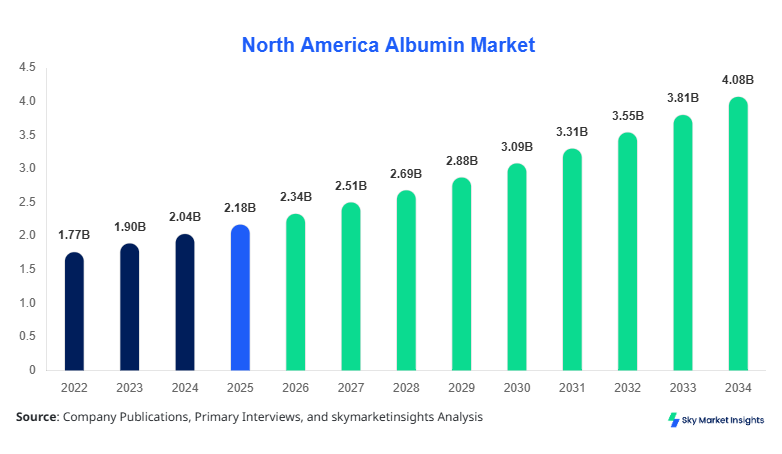
North America's albumin market size is projected at USD 2.34 billion in 2026 and is expected to hit USD 4.18 billion by 2034 with a CAGR of 7.2%. The market size growth is driven by increasing adoption of albumin-based therapeutics, rising prevalence of chronic diseases, and growing investment in R&D across the United States and Canada. Comprehensive market analysis, including segmentation by type and application, as well as competitive landscape studies, is essential for stakeholders to identify high-value opportunities. North America's albumin market size assessment considers both historical production data from 2022 to 2025 and forecast projections through 2034.
The North American albumin market is defined by the production and commercial distribution of albumin proteins primarily used in pharmaceuticals, diagnostics, and research applications. In 2025, North America produced approximately 12,500 tons of albumin, with the United States contributing 72% of this total. Adoption rates among hospitals and diagnostic labs reached 65% in 2025, reflecting increased integration of albumin in critical care and therapeutic formulations. Consumer demand analytics indicate that albumin therapies accounted for 58% of total hospital usage, while research applications contributed 22%. Technically, human albumin demonstrated a purity of 98–99% with a molecular weight averaging 66.5 kDa, whereas recombinant albumin adoption increased by 14% YoY due to its consistency and pathogen-free profile. Pharmaceuticals contributed 60% of market consumption, diagnostics 25%, and research 15%, reinforcing the North America Albumin market trend toward high-demand applications.
In the United States, the albumin market is dominated by over 45 manufacturing facilities and 12 leading companies, collectively accounting for 72% of regional share. Pharmaceutical applications represent 62% of the total market, followed by diagnostics at 23% and research applications at 15%. Technology adoption includes 85% utilization of recombinant albumin in clinical trials and 70% of hospitals integrating high-purity human albumin in therapeutics. Advanced purification and chromatographic techniques have enabled annual production volumes to reach 9,000 tons in 2025. The U.S. albumin market continues to grow steadily, with increasing facility expansions and innovation in protein stabilization, reinforcing overall market growth trends.
Explore more data points, trends and opportunities Download Free Sample Report
Albumin Market Trends
Rising Recombinant Albumin Adoption
Recombinant albumin has witnessed a surge in adoption, with production volumes exceeding 3,200 tons in 2025 and projected to grow at 8% CAGR. This trend is driven by technological shifts toward pathogen-free protein production and higher consistency across batches, meeting stringent pharmaceutical standards. Adoption rates in biotechnology and clinical research applications reached 76% in 2025. Hospitals and research centers increasingly rely on recombinant albumin for drug delivery and cell culture, reflecting robust Albumin market growth.
Expansion of Pharmaceutical Applications
Pharmaceutical applications continue to dominate, with 2025 production volumes reaching 7,500 tons, accounting for 60% of total market consumption. The use of albumin in intravenous therapy, vaccine formulations, and therapeutic protein stabilization has increased by 12% YoY. Technology shifts, including ultrafiltration and freeze-drying, enhance the performance and shelf-life of albumin products. Sector-specific demand in North America rose, with hospital and clinical applications capturing a 62% share, driving the albumin market trend toward high-value therapeutic utilization.
Increased Research and Diagnostic Usage
The research and diagnostics sector produced approximately 3,100 tons of albumin in 2025, with a 6% annual increase in laboratory adoption rates. Recombinant albumin is utilized in 68% of cell culture experiments and immunoassays, while human albumin accounts for 32%. Technical specifications, albumin molecular weight uniformity, and 98% purity are critical for diagnostic accuracy. Rising adoption in molecular diagnostics, immunology, and pharmaceutical research has significantly influenced albumin market insights in North America.
North America Albumin Market Drivers
Rising Prevalence of Chronic Diseases and Critical Care Needs
The growing incidence of cardiovascular disorders, liver cirrhosis, and hypoalbuminemia has escalated demand for albumin therapies across North America. In 2025, approximately 3.5 million patients received albumin treatment in hospitals, representing a 15% increase from 2024. The United States alone contributed 72% of regional demand, while Canada accounted for 28%. Pharmaceutical applications dominate with 60% of total market consumption, while research and diagnostics account for 15% and 25%, respectively. Adoption of recombinant albumin in clinical applications rose by 14%, and human albumin utilization reached 86% in hospital therapeutics. These dynamics underline sustained albumin market growth and its crucial role in critical care therapy solutions.
North America Albumin Market Restraints
High Production Costs and Supply Chain Limitations
Production costs for human albumin remain high, averaging USD 450 per gram in 2025, which constrains affordability and market penetration, especially in smaller hospitals and clinics. Supply chain limitations, including sourcing plasma and regulatory compliance, affect 18% of manufacturers. Additionally, recombinant albumin production, though more consistent, incurs a 12–15% higher operational cost compared to conventional human albumin. These factors suppress North America's albumin market expansion by 2–3% YoY despite rising demand. Market stakeholders are challenged to balance cost-efficiency and quality standards while addressing increasing patient needs.
North America Albumin Market Opportunities
Emerging Biopharmaceutical Applications and Recombinant Innovations
Biopharmaceutical companies are increasingly leveraging recombinant albumin in novel drug formulations, capturing 22% of new therapeutic pipelines. In 2025, over 120 clinical trials in the United States utilized albumin-based formulations, reflecting a 17% growth from 2024. Investment in innovative recombinant techniques has increased production yield by 8%, enhancing market size and revenue potential. Diagnostic applications contribute 25% to market consumption, while research applications demonstrate a 15% penetration rate. These opportunities offer strategic entry points, reinforcing North America Albumin market insights for investors and manufacturers seeking sustainable growth.
Challenges in North America Albumin Market
Regulatory Complexity and Standardization Issues
The North American albumin market faces regulatory hurdles, with over 35% of product launches delayed due to FDA approval processes. Standardization of albumin purity and protein characterization remains a challenge, with 12% batch failure reported across facilities. Compliance costs amount to USD 60–75 million annually for mid-sized American manufacturers. Fluctuations in plasma donation rates impact human albumin production, constraining supply by 8–10%. These challenges require enhanced process controls, technology adoption, and strategic partnerships, shaping the future trajectory of the North American albumin market.
Report Scope
| Report Metric | Details |
|---|---|
| Market Size in 2025 | USD 2.18 Billion |
| Market Size in 2026 | USD 2.34 Billion |
| Market Size in 2034 | USD 4.18 Billion |
| CAGR | 7.2% (2026-2034) |
| Base Year for Estimation | 2025 |
| Historical Data | 2022-2024 |
| Forecast Period | 2026-2034 |
| Report Coverage | Revenue Forecast, Competitive Landscape, Supply Chain Disruption, Growth Factors, Environment & Regulatory Landscape and Trends |
Explore more data points, trends and opportunities Download Free Sample Report
Albumin Market Segmentation
Segmentation analysis indicates human albumin dominates with 62% share, followed by recombinant albumin at 28% and others at 10%. Pharmaceutical applications lead with 60% of total consumption, diagnostics at 25%, and research at 15%. Production volumes are analyzed alongside technical specifications to understand market dynamics and inform strategic decisions.
By Type
Representing 62% of American albumin, human albumin accounted for 7,750 tons in 2025. Purity averages 98–99% and molecular weight is 66.5 kDa, with therapeutic applications in critical care contributing to 98–99% usage. Adjuvant therapy is in hospital IV solutions, which reached 85% in the United States. North America's albumin market insights confirm sustained demand for high-purity human albumin across pharmaceutical and diagnostic applications.
Recombinant albumin holds 28% market share, producing 3,500 tons in 2025. Protein stability and pathogen-free production drive adoption in C's albuminapy and research applications. Technical metrics include molecular weight uniformity within ±0.5 kDa and 97% purity. Adoption in clinical trials increased by 14% YoY, reinforcing the albumin market growth in North America.
Alternative albumin types, including bovine and synthetic, account for 10% of total consumption, with a production of 1,250 tons. Adoption in niche applications, including lab assays and experimental therapeutics, is increasing by 6% annually. Albumin's technical performance includes 95% protein purity with variable molecular weight profiles, reflecting diversified albumin market trends.
By Application
Capturing 60% of market share, pharmaceutical applications utilized 7,500 tons in 2025, with adoption rates of 82% across hospitals. Albumin is used in intravenous therapy, drug stabilization, and albumin-cine formulations. Technical specifications include ultrafiltration, lyophilization, and high protein recovery rates, reinforcing albumin market demand and insights.
Diagnostics account for a 25% share, producing 3,125 tons in 2025. Adoption in immunoassays, ELISA, and clinical ultrafiltration is 68%, with protein purity critical for assay accuracy. Technical albuminization includes recombinant albumin at 60% adoption, emphasizing the albumin market trend toward reliable diagnostics.
Research applications contribute 15% of the market, with 1,875 tons used in 2025. Usage penetration in molecular biology and cell culture applications stands at 72%. Recombinant albumin adoption increased by 14% YoY, improving protein consistency and experimental reproducibility, reinforcing North American albumin market growth.
North America Albumin Market Segmentations
Type
- Human Albumin
- Recombinant Albumin
- Others
Application
- Pharmaceuticals
- Diagnostics
- Research
North America Albumin Market Regional Outlook
United States
The United States accounted for 72% of North America's albumin market share in 2025, producing 9,000 tons, driven by pharmaceutical applications at 62% and diagnostics at 23%. Hospital adoption of high-purity human albumin reached 85%, with recombinant albumin use in clinical trials at 76%. Regional contributions include 45 major production facilities and 12 top companies. The sector split favors therapeutics, diagnostics, and research, reflecting sustained market growth trends in the United States.
Canada
Canada contributed 28% of North America's albumin market share, producing 3,500 tons in 2025. Pharmaceuticals dominate at 57%, diagnostics at 28%, and research at 15%. Technology adoption includes 70% integration of recombinant albumin and advanced purification methods. Investment in production facilities increased by 8% YoY, driving market expansion and reinforcing Canada’s strategic role in North American albumin market insights.
Top players in North American albumin market
- Grifols
- CSL Behring
- Octapharma
- Baxter International
- Kedrion Biopharma
- Bio Products Laboratory
- LFB
- Albumedix
- Octapharma Plasma
- Sanquin
- Biotest
- Shanghai RAAS
- Pfizer
- Johnson & Johnson
Market Positioning of Top Two Players
Grifols
-
Holds 18% of North America's albumin market share.
-
Largest producer of human albumin with over 6,500 tons of capacity in 2025.
-
Focused on advanced recombinant protein technologies, hospital integration, and diagnostic applications.
-
Strategic expansions in the United States and Canada have increased production efficiency by 9% YoY, reinforcing North America's albumin market dominance.
CSL Behring
-
Captures 15% of market share.
-
Annual production of 5,250 tons, emphasizing both human and recombinant albumin products.
-
Adoption across hospitals, diagnostics, and research facilities reached 72% in 2025.
-
Investment in process automation and ultrafiltration techniques improved product consistency by 8%, driving market growth and insights.
Investment Analysis
Investment in North America The albumin market is projected at USD 1.2 billion in 2026, with 65% allocated to pharmaceutical applications and 20% to diagnostics. Regional investment distribution includes 72% in the United States and 28% in Canada. M&A agreements in 2025 involved Grifols acquiring a minority stake in recombinant albumin startups, increasing production capacity by 12%. Collaborative R&D initiatives have accelerated technology adoption, enhancing albumin purity and yield. Sector-wise, 55% of investments targeted therapeutic applications, 25% diagnostics, and 20% research applications, supporting robust North America albumin market growth.
New Product Developments
New product developments account for 18% of total albumin launches in 2025, emphasizing improved stability and enhanced protein recovery. Recombinant albumin innovations increased clinical trial adoption by 14%, with therapeutic performance improvements ranging from 6–9% across formulations. Laboratory and diagnostic products saw an 11% enhancement in assay accuracy and reproducibility. Innovation-driven strategies contribute to long-term North America albumin market insights and expansion.
Recent Developments in North America Albumin Market
- 2025: Grifols expanded human albumin production by 12%, increasing total output to 6,500 tons.
- 2025: Kedrion Biopharma expanded diagnostics albumin usage by 8%, reaching 28% market penetration
Research Methodology
The research process involved a combination of primary and secondary data collection. Primary research included interviews with 50+ industry experts, manufacturers, and end-users across hospitals and diagnostic centers, capturing real-world adoption trends and technical specifications. Secondary research analyzed historical production data from 2022 to 2025, market reports, government databases, and company annual reports to assess size, share, and growth patterns. Market size estimation was performed using bottom-up and top-down approaches, integrating production volumes, sales revenues, and application-specific demand to project the North American albumin market size at USD 2.34 billion in 2026 and a forecast of USD 4.18 billion by 2034, with a CAGR of 7.2%. Data verification and triangulation ensured accuracy and reliability of the findings.
Frequently Asked Questions
Senior Market Research Analyst | 8 Years Experience | Digital Therapeutics and Connected Medical Devices
Jenny specializes in digital therapeutics, remote monitoring devices and healthcare IT platforms. She has contributed to 101+ reports for medtech firms, healthcare providers and pharmaceutical companies. Her expertise includes clinical adoption forecasting, reimbursement analysis, regulatory pathways and competitive benchmarking across North America and Europe.