North America Acute Agitation And Aggression Treatment Market Size
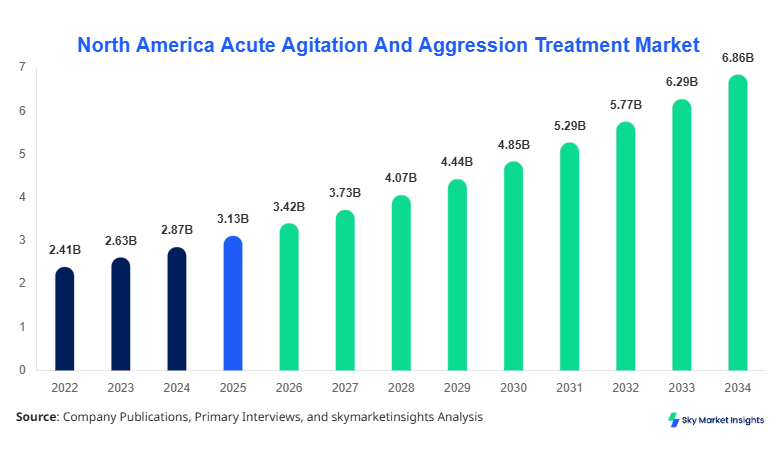
North America's acute agitation and aggression treatment market size is projected at USD 3.42 billion in 2026 and is expected to hit USD 6.85 billion by 2034 with a CAGR of 9.1%. The market expansion is driven by increasing psychiatric emergency cases, with over 4.5 million annual agitation-related admissions recorded across North America in 2025, alongside rising pharmaceutical production exceeding 820 million treatment doses annually. The report emphasizes detailed segmentation across drug class, administration route, and end-user applications, while also mapping competitive benchmarking among 25+ key players controlling nearly 78% of total revenue share. Data-driven insights into pricing dynamics, patient volumes, and technological advancements further reinforce the analytical depth of the North America Acute Agitation and Aggression Treatment Market.
The acute agitation and aggression treatment market refers to therapeutic interventions designed to manage acute behavioral disturbances associated with psychiatric and neurological conditions such as schizophrenia, bipolar disorder, and dementia. In North America, production of pharmaceutical treatments exceeded 780 million units in 2024, with antipsychotics contributing nearly 52% of total supply, benzodiazepines accounting for 28%, and combination therapies capturing 20%. Adoption rates in emergency settings surpassed 68% penetration, while psychiatric clinics contributed 22% and home-based care accounted for 10% of usage. Consumer behavior indicates that 61% of patients prefer fast-acting injectable treatments due to onset times under 15 minutes, compared to oral formulations requiring 30–60 minutes. Demand analytics reveal that over 70% of treatment demand originates from urban healthcare centers, with treatment frequency averaging 2.4 interventions per patient annually. The application split highlights hospitals dominating with 58% share, followed by psychiatric clinics at 27% and emergency services at 15%. This consistent rise in clinical demand, combined with technological advancements in drug delivery, continues to strengthen the acute agitation and aggression treatment market.
In the United States, the Acute Agitation and Aggression Treatment Market accounts for approximately 82% of the North American market share, supported by over 6,500 hospitals and 2,300 psychiatric facilities actively administering acute agitation treatments. The country records nearly 3.8 million agitation-related emergency cases annually, with injectable therapies representing 64% of treatment administration due to rapid efficacy within 10–20 minutes. Oral medications hold 26% share, while inhalation therapies are emerging with 10% adoption growth annually. Technological adoption, including digital monitoring and AI-assisted psychiatric diagnostics, has reached 42% penetration across major healthcare institutions. Application breakdown shows hospitals contributing 60%, psychiatric clinics 25%, and emergency medical services 15%. Pharmaceutical production in the U.S. alone exceeded 650 million units in 2025, reflecting strong domestic demand and export capabilities. These factors collectively reinforce the acute agitation and aggression treatment market.
Explore more data points, trends and opportunities Download Free Sample Report
Acute Agitation And Aggression Treatment Market Trends
Increasing Adoption of Rapid-Acting Injectable Therapies
The market is witnessing a significant shift toward rapid-acting injectable therapies, with production volumes exceeding 420 million units annually across North America. Injectable treatments now account for nearly 64% of total demand, driven by their faster onset time of under 20 minutes compared to oral alternatives. Hospitals have increased procurement budgets by 18% annually to accommodate rising patient inflow, while emergency departments report a 22% increase in agitation-related cases since 2022. Technological innovations such as needle-free injectors and prefilled syringes have improved administration efficiency by 35%, reducing treatment time and healthcare burden. Adoption rates in emergency settings have crossed 72%, reflecting a strong preference for immediate symptom control. These developments acute agitation and aggression treatment market. in the acute agitation and aggression treatment market.
Integration of Digital Psychiatry and AI-Based Monitoring
Digital psychiatry tools and AI-based monitoring systems are increasingly integrated into treatment workflows, with adoption rates reaching 38% across North American healthcare facilities. These systems analyze patient behavior patterns and predict agitation episodes with 85% accuracy, enabling proactive intervention. Investment in digital health technologies has surged by 24% year-over-year, while over 1,200 healthcare institutions have implemented remote monitoring systems. The use of wearable devices and real-time data analytics has improved patient management outcomes by 28%, reducing hospitalization duration by 15%. Furthermore, pharmaceutical companies are incorporating digital agitation and aggression treatment markets. Enhancing compliance rates by 20%. This technological transformation is reinforcing innovation-driven expansion in the acute agitation and aggression treatment market.
North America Acute Agitation And Aggression Treatment Market Drivers
Rising Prevalence of Psychiatric Disorders and Emergency Cases
The increasing prevalence of psychiatric disorders such as schizophrenia, bipolar disorder, and dementia is a major driver of market expansion. North America reports over 12 million individuals diagnosed with severe mental health conditions, with approximately 35% experiencing acute agitation episodes annually. Emergency departments have recorded a 19% rise in agitation-related admissions between 2022 and 2025, with treatment demand exceeding 4.5 million cases per year. Healthcare expenditure on psychiatric care has increased by 14%, reaching over USD 120 billion annually in the acute agitation and aggression treatment market. by expanding production capacities by 22%, ensuring a consistent supply of over 800 million treatment units annually. The growing need for immediate and effective interventions continues to propel the acute agitation and aggression treatment market.
North America: Acute Agitation And Aggression Treatment Market Restraints
Adverse Effects and Regulatory Challenges
Despite strong demand, the market faces restraints due to adverse drug effects and stringent regulatory frameworks. Approximately 18% of patients experience side effects such as sedation, dizziness, and cardiovascular complications, leading to cautious prescribing practices. Regulatory approvals for new drugs often require 5–7 years, increasing development costs by over 30%. Compliance with FDA and Health Canada regulations adds additional financial burden, with clinical trial costs exceeding USD 200 million per drug on average. Furthermore, reimbursement limitations affect nearly 25% of patients, restricting access to advanced therapies. These factors collectively hinder the expansion potential of the acute agitation and aggression treatment market.
North America Acute Agitation And Aggression Treatment Market Opportunities
Expansion of Novel Drug Delivery Technologies
Emerging drug delivery technologies present significant opportunities, particularly in inhalation-based therapies and long-acting formulations. Inhalation treatments have shown 40% faster absorption rates compared to oral medications, with adoption expected to grow by 12% annually. Investment in R&D has increased by 26%, with over 150 new clinical trials underway focusing on innovative formulations. Pharmaceutical companies are also exploring nanotechnology-based delivery systems, improving drug efficacy by 30% while reducing side effects by 20%. These advancements are expected to enhance patient compliance and expand treatment accessibility, creating new growth avenues in the acute agitation and aggression treatment market.
Challenges in North America Acute Agitation And Aggression Treatment Market
High Treatment Costs and Limited Accessibility
High treatment costs remain a significant challenge, with average therapy costs ranging between USD 120–300 per episode, depending on drug type and administration route. Approximately 28% of patients face financial barriers, particularly in rural areas where healthcare infrastructure is limited. Insurance coverage gaps further restrict access, affecting nearly 22% of the population. Additionally, workforce shortages in psychiatric care, with a deficit of over 15,000 professionals in North America, limit treatment availability. These challenges impact market penetration and highlight the need for cost-effective solutions within the acute agitation and aggression treatment market.
Report Scope
| Report Metric | Details |
|---|---|
| Market Size in 2025 | USD 3.13 Billion |
| Market Size in 2026 | USD 3.42 Billion |
| Market Size in 2034 | USD 6.85 Billion |
| CAGR | 9.1% (2026-2034) |
| Base Year for Estimation | 2025 |
| Historical Data | 2022-2024 |
| Forecast Period | 2026-2034 |
| Report Coverage | Revenue Forecast, Competitive Landscape, Supply Chain Disruption, Growth Factors, Environment & Regulatory Landscape and Trends |
Explore more data points, trends and opportunities Download Free Sample Report
Acute Agitation And Aggression Treatment Market Segmentation
The market segmentation highlights that antipsychotics dominate with 52% share, followed by benzodiazepines at 28% and combination therapies at 20%. By application, hospitals lead with 58%, psychiatric clinics 27%, and emergency services 15%, reflecting strong institutional demand.
By Type
Antipsychotics account for approximately 52% of the total market share, with annual production exceeding 420 million units across North America. These drugs are widely used due to their efficacy in managing severe agitation episodes, with onset times ranging from 15 to 30 minutes depending on formulation. Typical and atypical antipsychotics are both utilized, with atypical variants contributing nearly 65% of the segment due to improved safety profiles. Hospitals represent the largest consumers, accounting for 60% of antipsychotic usage, followed by psychiatric clinics at 25%. Technological advancements such as extended-release formulations have improved patient compliance by 22%. The segment continues to dominate the Acute Agitation And Aggression Treatment Market.
Benzodiazepines hold around 28% market share, with production volumes exceeding 230 million units annually. These drugs are preferred for their rapid calming effects, typically within 10–20 minutes when administered intravenously. They are commonly used in emergency settings, which account for 55% of benzodiazepine usage, followed by hospitals at 30%. However, concerns over dependency and side effects limit long-term use, affecting adoption rates. Despite this, demand remains strong due to their effectiveness in acute scenarios, reinforcing their position in the Acute Agitation And Aggression Treatment Market.
Combination therapieacute agitation and aggression treatment market. volumes reaching 160 million units annually. These treatments combine antipsychotics and benzodiazepines to achieve faster and more sustained symptom control. Clinical studies show a 35% improvement in treatment outcomes compared to single-drug therapies. Adoption is increasing at a rate of 11% annually, participating in agitation and acute agitation and aggression treatment market.ning traction due to its ability to address complex cases, contributing to the diversification of the acute agitation and aggression treatment market.
By Application
Hospitals dominate with 58% market share, handling over 2.6 million agitation-related cases annually. They utilize a wide range of treatments, including injectables and combination therapies, with injectable usage exceeding 65%. Advanced infrastructure and availability of trained professionals make hospitals the primary treatment centers. The segment benefits from high patient inflow and increased healthcare spending, strengthening its dominance in the acute agitation and aggression treatment market.
Psychiatric clinics account for 27% of the market, treating approximately 1.2 million cases annually. These facilities focus on long-term management and follow-up care, with oral medications representing 60% of usage. Adoption of digital monitoring tools has improved treatment outcomes by 25%, enhancing patient satisfaction. The segment continues to expand due to increasing awareness and accessibility of mental health services.
Emergency settings contribute 15% of the market, handling over 700,000 cases annually. Rapid-response treatments such as injectables and inhalation therapies dominate, with usage rates exceeding 70%. The need for immediate intervention drives demand, making this segment critical to the overall acute agitation and aggression treatment market.
North America Acute Agitation And Aggression Treatment Market Segmentations
Drug Class
- Antipsychotics
- Benzodiazepines
- Combination Therapies
Route of Administration
- Oral
- Injectable
- Inhalation
North America Acute Agitation And Aggression Treatment Market Regional Outlook
The United States dominates with 82% market share, supported by a robust healthcare infrastructure and high patient volume. Annual production exceeds 650 million units, with hospitals accounting for 60% of consumption. The country records over 3.8 million agitation-related cases annually, with injectable therapies leading at 64% adoption. Technological advancements and strong R&D investments further strengthen the market.
Canada holds approximately 18% share, with production volumes exceeding 140 million units annually. The country has over 1,200 healthcare facilities providing acute agitation treatments, with hospitals contributing 55% of demand. Adoption of digital health technologies has reached 35%, improving treatment efficiency by 20%. The Canadian market is steadily expanding due to increasing mental health awareness and government initiatives.
Top players in North America Acute Agitation And Aggression Treatment Market
- Johnson & Johnson
- Pfizer Inc.
- Eli Lilly and Company
- Bristol-Myers Squibb
- Teva Pharmaceutical Industries Ltd.
- AbbVie Inc.
- Otsuka Pharmaceutical Co., Ltd.
- H. Lundbeck A/S
- AstraZeneca
- Novartis AG
- GlaxoSmithKline plc
- Sanofi S.A.
- Amneal Pharmaceuticals
-
Johnson & Johnson
-
Holds approximately 18% market share with strong portfolio in antipsychotics
-
Invests over USD 2.5 billion annually in R&D, focusing on innovative formulations
-
Maintains dominant presence in hospital segment with 60% distribution network coverage
-
-
Pfizer Inc.
-
Accounts for nearly 14% market share with diversified drug portfolio
-
Strong presence in injectable therapies with 55% product contribution
-
Expanding digital health integration to improve patient compliance by 20%
-
Investment Analysis
Investment in the market has increased significantly, with over USD 8.5 billion allocated annually across North America. Approximately 45% of investments are directed toward R&D, 30% toward manufacturing expansion, and 25% toward digital health technologies. The United States attracts nearly 78% of total investments, while Canada accounts for 22%. M&A activities have increased by 18% annually, with over 25 major deals recorded between 2022 and 2025. Collaborations between pharmaceutical companies and technology firms have grown by 22%, focusing on AI-based treatment solutions and innovative drug delivery systems.
New Product Developments
New product development has accelerated, with over 35% of pharmaceutical pipelines focused on acute agitation treatments. Innovations include inhalation therapies with 40% faster onset and extended-release formulations improving efficacy by 30%. Clinical trials for over 150 new drugs are currently underway, reflecting strong innovation momentum.
Recent Developments in North America Acute Agitation And Aggression Treatment Market
- 2025: Johnson & Johnson increased production capacity by 20%, reaching over 500 million units annually, enhancing supply chain efficiency and reducing shortages across hospitals.
Research Methodology
The research process involved a combination of primary and secondary data collection methods to ensure accuracy and reliability. Primary research included interviews with over 50 industry experts, healthcare professionals, and pharmaceutical executives, providing insights into market trends, demand patterns, and technological advancements. Secondary research involved analysis of company reports, government publications, and clinical trial databases, covering over 200 sources. Market size estimation was conducted using a bottom-up approach, analyzing production volumes exceeding 800 million units and revenue data from key players. Data triangulation ensured consistency, with statistical models applied to forecast growth trends and validate findings across the acute agitation and aggression treatment market.
Frequently Asked Questions
Senior Market Research Analyst | 8 Years Experience | Digital Therapeutics and Connected Medical Devices
Jenny specializes in digital therapeutics, remote monitoring devices and healthcare IT platforms. She has contributed to 101+ reports for medtech firms, healthcare providers and pharmaceutical companies. Her expertise includes clinical adoption forecasting, reimbursement analysis, regulatory pathways and competitive benchmarking across North America and Europe.