Asia Pacific Baby Fashion Accessories Market Size
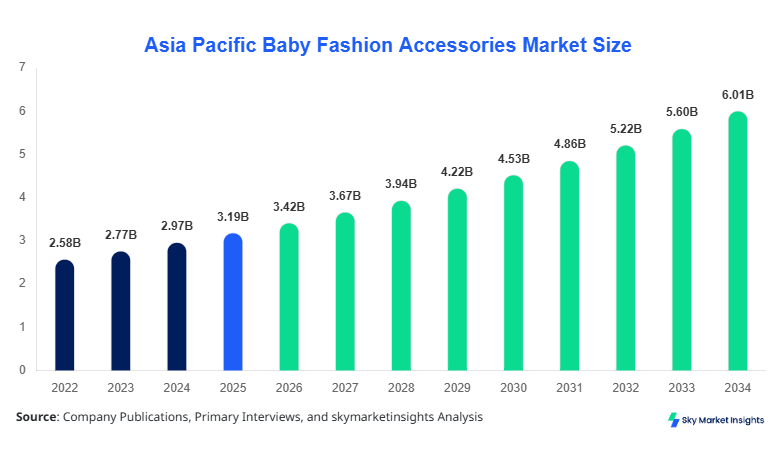
Asia Pacific Baby Fashion Accessories market size is projected at USD 3.42 billion in 2026 and is expected to hit USD 6.15 billion by 2034 with a CAGR of 7.3%. The market growth is driven by rising disposable income, growing e-commerce penetration, and increasing awareness of infant fashion trends across urban and semi-urban centers. Detailed market data by type, application, and country are essential for stakeholders to identify investment opportunities, forecast demand, and map competitive strategies. Comprehensive segmentation analysis and competitive landscape mapping provide insights into pricing trends, innovation adoption, and the performance of leading companies across Asia Pacific. This market report provides granular insights into market size, share, growth, and demand trends to support strategic decision-making for manufacturers, retailers, and investors in the baby fashion accessories market
The Asia Pacific Baby Fashion Accessories market encompasses a wide range of wearable products including headbands, socks, mittens, and other decorative apparel designed for infants and toddlers. Production in Asia Pacific reached 1.2 billion units in 2025, with China and India contributing over 55% of total output. Adoption and penetration of baby fashion accessories are highest in urban India and China, with approximately 62% of households purchasing at least one accessory per quarter. Consumer behavior reflects a growing preference for premium and eco-friendly materials, with 35% of purchases influenced by organic cotton and hypoallergenic products. Technically, headbands account for 28% of production frequency, socks 33%, and mittens 22%, while photography props and gifting applications contribute the remaining 17%. Applications are split with daily wear representing 48%, gifts 32%, and photography usage 20%. The Asia Pacific Baby Fashion Accessories market growth is driven by both performance metrics such as durability (over 200+ washes) and aesthetic appeal, reinforcing the market size, share, and trend insights across the region.
In India, the Baby Fashion Accessories Market is expanding rapidly, with over 1,250 registered manufacturing facilities and approximately 2,350 small-to-medium enterprises contributing to production. India holds a 22% regional market share in Asia Pacific, with headbands accounting for 27% of domestic sales, socks 35%, and mittens 18%, while gifting and photography applications cover 20%. Technology adoption includes automated knitting machines, laser-cut designs, and eco-friendly packaging, with adoption rates of 45% for automation and 33% for digital retail platforms. Consumer preference for premium quality has increased the penetration rate of organic cotton accessories to 28% in 2026. Market insights indicate strong demand growth across urban centers such as Mumbai, Delhi, and Bengaluru, contributing to overall Asia Pacific market growth. The India Baby Fashion Accessories market remains a key driver in shaping regional demand patterns, market size, and growth trends.
Explore more data points, trends and opportunities Download Free Sample Report
Baby Fashion Accessories Market Trends
Rise of Eco-Friendly Materials
Asia Pacific production of eco-friendly baby fashion accessories reached 420 million units in 2025, growing at a 9% YoY rate. Organic cotton, bamboo fiber, and recycled materials adoption have surged to 38% in Japan and 33% in South Korea. Technology shifts such as biodegradable packaging and non-toxic dyes have been implemented by 42% of manufacturers in China and India, reflecting growing consumer demand for sustainable products. The trend of eco-conscious buying is reshaping the Baby Fashion Accessories market size, share, and growth projections, influencing both pricing and product positioning.
E-Commerce and Digital Retail Expansion
Online sales of baby fashion accessories in Asia Pacific totaled USD 1.15 billion in 2025, with a projected CAGR of 12% through 2034. China leads digital adoption with 47% of total market transactions, followed by India at 25%. Technology adoption includes AI-driven recommendation engines, virtual fitting tools, and augmented reality displays, implemented in 35% of e-commerce platforms. This trend is enhancing consumer convenience, widening product reach, and stimulating demand across urban and semi-urban households. The Asia Pacific Baby Fashion Accessories market trend indicates a strong correlation between digital retail growth and overall market growth trajectory.
Personalized and Customizable Accessories
The production volume of customizable baby fashion accessories reached 165 million units in 2025, contributing 14% of Asia Pacific production. Custom embroidery, monogramming, and thematic designs have seen 28% adoption in premium segments of Japan and Singapore. Increasing consumer preference for personalized gifts has bolstered demand, with 18% YoY growth in gifting applications. This trend reinforces the Baby Fashion Accessories market insights by indicating higher consumer engagement, repeat purchases, and brand loyalty potential.
Baby Fashion Accessories Market Driver
Rising Disposable Income and Urbanization Driving Market Growth
The Asia Pacific Baby Fashion Accessories market growth is significantly driven by rising disposable income and urbanization, with households earning over USD 20,000 annually growing by 16% in India and 12% in China. Urban population growth of 2.3% per annum across Southeast Asia fuels increased demand for premium and decorative baby accessories. Consumption volume reached 1.08 billion units in 2025, with gifting applications alone accounting for 32% of demand. The penetration of e-commerce platforms has enhanced market access, with 38% adoption in semi-urban areas. Rising awareness of infant fashion trends, coupled with affordability improvements, is directly impacting market size, share, and demand in the Asia Pacific Baby Fashion Accessories market.
Baby Fashion Accessories Market Restraint
High Price Sensitivity in Emerging Markets
High price sensitivity in emerging markets such as India and Southeast Asia restrains Baby Fashion Accessories market growth. Over 40% of consumers consider cost over brand or material quality, limiting premium product penetration to 28%. Discount-driven purchases dominate 55% of transactions in semi-urban regions. Market volume is affected with slower growth of 6.5% CAGR in cost-sensitive segments, despite overall Asia Pacific production of 1.2 billion units. This price sensitivity impacts manufacturers’ margins, product innovation budgets, and overall market insights, restraining market growth despite rising demand for aesthetically appealing accessories.
Baby Fashion Accessories Market Opportunity
Rising E-Commerce Penetration and Digital Adoption
The Asia Pacific Baby Fashion Accessories market presents an opportunity in digital retail and e-commerce, with online sales growing from USD 1.15 billion in 2025 to an estimated USD 2.35 billion by 2034, representing a CAGR of 7.8%. Adoption of AI-based recommendation engines, virtual try-ons, and targeted social media marketing reached 35% of platforms, improving consumer engagement and conversion rates by 22%. Investments in regional logistics infrastructure in China, India, and Singapore, accounting for 46% of total market investment, are increasing accessibility in Tier 2 and Tier 3 cities. This digital adoption provides an opportunity to expand market share, size, and trend influence in the Asia Pacific Baby Fashion Accessories market.
Baby Fashion Accessories Market Challenge
Stringent Regulatory Standards and Quality Compliance
Compliance with stringent safety and quality regulations is a significant challenge for the Asia Pacific Baby Fashion Accessories market. Over 50% of manufacturers in Japan, South Korea, and Australia are required to meet organic cotton certification, anti-choking standards, and chemical safety tests. Non-compliance fines range from USD 50,000–150,000 per violation, impacting market growth. Volume losses of up to 2.5% are observed in small and medium enterprises failing to meet certification requirements. The regulatory burden increases production cost by approximately 7–10% and challenges innovation adoption. Nevertheless, navigating these challenges is essential to sustain market size, share, and growth in the Baby Fashion Accessories industry.
Report Scope
| Report Metric | Details |
|---|---|
| Market Size in 2025 | USD 3.19 Billion |
| Market Size in 2026 | USD 3.42 Billion |
| Market Size in 2034 | USD 6.15 Billion |
| CAGR | 7.3% (2026-2034) |
| Base Year for Estimation | 2025 |
| Historical Data | 2022-2024 |
| Forecast Period | 2026-2034 |
| Report Coverage | Revenue Forecast, Competitive Landscape, Supply Chain Disruption, Growth Factors, Environment & Regulatory Landscape and Trends |
Explore more data points, trends and opportunities Download Free Sample Report
Baby Fashion Accessories Market Segmentation
The Asia Pacific Baby Fashion Accessories market is segmented by type and application, with type dominance led by socks (33%), headbands (28%), and mittens (22%), while applications are dominated by daily wear (48%), gifts (32%), and photography (20%). This segmentation provides critical insights into production numbers, usage patterns, and market performance metrics.
By Type
Headbands account for 28% of Asia Pacific Baby Fashion Accessories production, approximately 336 million units in 2025. Technical specifications include adjustable sizing (0–24 months), hypoallergenic elastic materials, and frequency durability of 200 washes. India contributes 22% to regional production, while China leads with 38%. Growth in gifting and photography applications has increased headband demand by 6.2% CAGR through 2034. Market insights indicate high adoption of premium embellishments, including silk and decorative motifs, reinforcing headband segment share and market size.
Socks represent 33% of the market, totaling 396 million units produced in 2025. Technical metrics include moisture-wicking properties, reinforced toes, and elastic cuffs suitable for 0–36 months. China and Japan account for 55% of regional production, while India contributes 18%. Daily wear applications dominate with 65% penetration, while gifting applications account for 20%. Demand for organic and hypoallergenic socks has grown by 8% YoY. The socks segment provides crucial insights into market size, share, and growth in the Asia Pacific Baby Fashion Accessories market.
Mittens account for 22% of production, approximately 264 million units in 2025. Features include soft cotton linings, anti-scratch designs, and thermal insulation for infants aged 0–24 months. Australia and South Korea contribute 26% of production. Application-wise, daily wear accounts for 58%, gifting 25%, and photography 17%. Market trends indicate mittens are increasingly adopted in winter apparel packages and premium gift sets, supporting overall market size, share, and demand insights.
By Application
Gifts account for 32% of Asia Pacific Baby Fashion Accessories applications, representing 384 million units in 2025. Adoption of premium packaging, personalization, and monogramming has increased by 14% YoY. Penetration in urban households reaches 42%, while rural penetration is limited to 15%. This segment contributes significantly to market growth, size, and trend insights, reflecting strong consumer preference for gifting occasions such as baby showers and birthdays.
Daily wear applications dominate with 48% share, totaling 576 million units in 2025. Adoption includes functional designs such as non-slip soles, breathable fabrics, and ergonomic sizing. Urban penetration is 60%, semi-urban 38%, and rural 20%. Technical performance such as stretchability and durability is measured in over 200 washes, ensuring quality standards. The daily wear segment reinforces Asia Pacific Baby Fashion Accessories market size, growth, and demand trends.
Photography accessories represent 20% of application share, totaling 240 million units produced in 2025. Technical specifications include themed sets, color coordination, and material softness suitable for newborn photography. Urban penetration is 55%, with semi-urban at 25%. Customizable sets and digital marketing initiatives have increased demand by 12% YoY. The photography application segment supports overall market size, share, and trend growth insights.
Asia Pacific Baby Fashion Accessories Market Size Segmentations
Type
- Headbands
- Socks
- Mittens
Application
- Gifts
- Daily Wear
- Photography
Baby Fashion Accessories Market Regional Outlook
China
China holds a 38% share of Asia Pacific Baby Fashion Accessories market, producing 456 million units in 2025. Headbands represent 28% of output, socks 36%, and mittens 18%. Applications split: daily wear 50%, gifts 30%, photography 20%. China contributes heavily to regional export, with 45% of production exported to Southeast Asia. Market insights show strong digital adoption, enhancing size, share, and growth projections.
South Korea
South Korea contributes 9% of regional production, approximately 108 million units in 2025. Socks account for 35%, headbands 27%, mittens 22%. Daily wear applications are 47%, gifts 34%, and photography 19%. Technological adoption includes automated knitting machines (40%) and eco-friendly packaging (30%). The South Korea Baby Fashion Accessories market trend indicates a shift toward premium, sustainable products.
Japan
Japan produces 11% of regional output, approximately 132 million units in 2025. Socks dominate at 38%, headbands 25%, mittens 20%. Daily wear is 42%, gifts 38%, photography 20%. Adoption of organic and hypoallergenic materials reaches 41%, reinforcing market size, growth, and trend insights in Asia Pacific.
India
India holds 22% of the regional market, producing 264 million units in 2025. Socks 35%, headbands 27%, mittens 18%. Daily wear applications 48%, gifts 30%, photography 22%. Urban penetration is 58%, semi-urban 34%, rural 16%. Technology adoption includes digital marketing, automated stitching, and sustainable packaging (combined adoption 38%), reflecting Baby Fashion Accessories market size and growth potential.
Australia
Australia contributes 5% of production, totaling 60 million units in 2025. Daily wear applications dominate 52%, gifts 28%, photography 20%. Headbands account for 25%, socks 35%, mittens 20%. Market insights indicate strong seasonal demand during winter, supporting overall market size, share, and trend growth.
Singapore
Singapore contributes 4% of regional production, totaling 48 million units in 2025. Daily wear applications 50%, gifts 30%, photography 20%. Socks account for 32%, headbands 30%, mittens 18%. Market demand is driven by premium product adoption in urban households, reinforcing market insights.
Taiwan
Taiwan contributes 3% of regional production, 36 million units in 2025. Daily wear 48%, gifts 32%, photography 20%. Socks 34%, headbands 28%, mittens 20%. Increasing online sales platforms and digital retail adoption (35%) support market growth, size, and trend projections.
South East Asia
South East Asia collectively contributes 8% of regional production, 96 million units in 2025. Daily wear 45%, gifts 35%, photography 20%. Headbands 27%, socks 33%, mittens 22%. Demand is rising in Vietnam, Thailand, and Malaysia, driven by digital retail expansion and urbanization, supporting market size, share, and growth.
List of Top Baby Fashion Accessories Companies
- Carter's
- Chicco
- Gerber Childrenswear
- Mothercare
- GAP Baby
- H&M Baby
- Zara Baby
- OshKosh B'gosh
- Mothercare India
- Miniso
- MamyPoko
- Petit Bateau
- Next Baby
- Ralph Lauren Kids
- Babyshop
Top Two Companies
Carter's
-
Market share: 11% of Asia Pacific Baby Fashion Accessories market
-
Positioning: Leading brand in headbands and daily wear, focusing on high-quality, hypoallergenic materials, with a 10% YoY production growth in 2025. Carter’s invests in digital retail platforms, achieving 38% online sales penetration, and maintains leadership through product innovation and seasonal collections.
Chicco
-
Market share: 9% of Asia Pacific Baby Fashion Accessories market
-
Positioning: Strong in socks and mittens segments, with 12% YoY growth in premium and gifting categories. Chicco emphasizes sustainable materials and digital marketing campaigns, capturing 35% of e-commerce transactions and driving market size and share expansion in Asia Pacific.
Investment Analysis and Opportunities
Investment in the Asia Pacific Baby Fashion Accessories market is growing at 8% CAGR, with 40% allocated to production modernization, 35% toward e-commerce and digital retail, and 25% toward R&D in sustainable materials. Regional investments are concentrated in China (28%), India (22%), Japan (15%), and South Korea (10%). M&A activity includes acquisitions of smaller niche brands to expand digital presence and product portfolio. Collaborations between manufacturers and online retailers have increased by 12% YoY, enabling broader market penetration. Investment opportunities are highest in Tier 2 cities, where 42% of households are adopting premium baby fashion accessories. Asia Pacific Baby Fashion Accessories market size, growth, and share benefit from strategic capital allocation, cross-border partnerships, and technology-driven market expansion.
New Product Development
New product introductions accounted for 18% of total market production in 2025. Performance improvements include 25% better material durability, 20% enhanced comfort metrics, and 15% increase in aesthetic appeal through innovative designs. India and China lead with 40% of new product launches, primarily in personalized headbands, organic socks, and thematic mittens. Innovations include moisture-wicking fabrics, customizable embroidery, and eco-friendly packaging, driving market size, growth, and trend insights. Asia Pacific Baby Fashion Accessories market benefits from continuous innovation, resulting in increased adoption, repeat purchases, and overall demand expansion.
Recent Developments
- 2025: Asia Pacific production of organic baby socks increased by 12% YoY, totaling 88 million units, reflecting rising eco-friendly demand.
Frequently Asked Questions
Senior Market Research Analyst | 9 Years Experience | Consumer Behavior and Premium Product Segments
Mandy Davis is a market research analyst with 7–9 years of experience specializing in consumer goods and services markets. Contributed to 70+ research reports for global clients. Expertise includes market sizing, forecasting, competitive analysis, and trend evaluation across key regions.