Asia Pacific Automotive VOC Testing Market Size
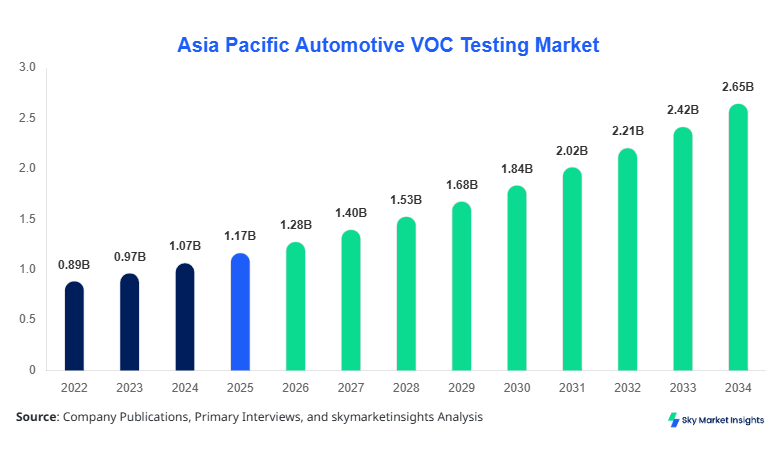
The Asia Pacific Automotive VOC Testing market size is projected at USD 1.28 billion in 2026 and is expected to hit USD 2.64 billion by 2034 with a CAGR of 9.5%. The Asia Pacific Automotive VOC Testing Market Size reflects increasing regulatory enforcement across China, Japan, and South Korea, where emission compliance has crossed 85% among OEMs. Rising automotive production volumes exceeding 52 million units in 2025, coupled with growing VOC emission standards below 100 µg/m³, are intensifying demand for testing services and equipment. The need for accurate data-driven insights, granular segmentation across vehicle types, and competitive benchmarking among over 120 regional testing laboratories is shaping the Asia Pacific Automotive VOC Testing Market Size and analytical frameworks.
The Asia Pacific Automotive VOC Testing Market refers to the ecosystem of equipment, services, and methodologies used to detect volatile organic compounds (VOCs) emitted from automotive interiors, materials, and components. In 2025, Asia Pacific vehicle production reached approximately 52.4 million units, accounting for nearly 58% of global automotive output, with China alone contributing over 27 million units. VOC testing adoption rates have surpassed 72% across OEM supply chains, with penetration exceeding 90% in premium vehicle segments. Consumer behavior indicates that over 65% of buyers in Japan and South Korea consider cabin air quality a critical purchase factor, while 48% in India show rising awareness. Applications are distributed across passenger vehicles (62%), commercial vehicles (23%), and electric vehicles (15%), with testing frequencies ranging from 1–5 cycles per component depending on regulatory thresholds below 50–120 µg/m³. Advanced analytical techniques such as GC-MS and thermal desorption have achieved detection limits as low as 0.1 µg/m³. This evolving landscape reinforces the Asia Pacific Automotive VOC Testing Market Share across diverse applications.
Explore more data points, trends and opportunities Download Free Sample Report
Automotive VOC Testing Market Trends
Rising Adoption of Advanced Analytical Technologies
The automotive VOC testing market is witnessing rapid integration of advanced analytical technologies, including gas chromatography-mass spectrometry (GC-MS) and proton transfer reaction mass spectrometry (PTR-MS), with adoption rates reaching 78% across Asia Pacific laboratories in 2025. Annual production of testing equipment has surpassed 1.2 million units globally, with Asia Pacific accounting for 42% of installations. Automotive OEMs are increasing testing cycles by 25–30% to meet evolving standards below 80 µg/m³, particularly in premium and electric vehicles. The shift toward real-time VOC monitoring systems has grown by 18% annually, enabling detection within milliseconds and improving accuracy by 35%. This technological evolution significantly influences the automotive VOC testing market trend.
Expansion of Electric Vehicle Testing Requirements
Electric vehicle production in Asia Pacific exceeded 14 million units in 2025, with VOC testing requirements increasing by 28% due to battery-related emissions and interior material interactions. VOC testing penetration in EV manufacturing has reached 82%, compared to 68% in internal combustion vehicles. Material testing demand has surged by 33%, particularly for polymers and adhesives used in battery packs. Regulatory bodies are introducing stricter emission thresholds below 40 µg/m³ for EV interiors, leading to a 22% increase in testing frequency per vehicle. This transition is reshaping the automotive VOC testing market trend across emerging mobility segments.
Asia Pacific Automotive VOC Testing Drivers
Stringent Emission Regulations Driving Testing Demand
Stringent emission regulations across Asia Pacific are significantly boosting demand for automotive VOC testing, with over 75% of countries implementing standards below 100 µg/m³ for interior emissions. China’s GB/T standards, Japan’s JAMA guidelines, and South Korea’s KATS regulations collectively cover over 90% of regional automotive production. Compliance rates have increased from 62% in 2022 to 88% in 2025, while non-compliance penalties have risen by 35%, reaching up to USD 50,000 per violation. Testing frequency per vehicle has increased from 1.8 cycles in 2022 to 3.4 cycles in 2025, driving demand for testing services and equipment. Over 420 new testing facilities have been established across the region in the last three years, reflecting a 28% capacity expansion. These regulatory pressures are a key factor accelerating automotive VOC testing market growth.
Asia Pacific Automotive VOC Testing Restraints
High Cost of Testing Equipment and Infrastructure
The high cost of VOC testing equipment, ranging between USD 45,000 and USD 250,000 per unit, is a major restraint in the Asia Pacific market. Establishing a fully equipped testing laboratory requires investments exceeding USD 2.5 million, limiting entry for small and mid-sized players. Maintenance costs account for 12–18% of annual operational expenses, while calibration requirements every 6–12 months add further financial burden. In developing economies like India and Southeast Asia, only 38% of OEMs have in-house testing capabilities, compared to over 85% in developed markets. Additionally, skilled workforce availability remains limited, with only 1 trained analyst per 3 testing units on average. These cost barriers hinder widespread adoption and slow down automotive VOC testing market growth.
Asia Pacific Automotive VOC Testing Opportunities
Rising Demand for Cabin Air Quality and Consumer Awareness
Consumer awareness regarding cabin air quality has increased significantly, with surveys indicating that 67% of urban consumers in Asia Pacific prioritize low VOC emissions when purchasing vehicles. Demand for low-emission interiors has led to a 31% increase in VOC testing contracts between 2023 and 2025. OEMs are investing 6–9% of R&D budgets in emission reduction technologies, while suppliers are developing low-VOC materials with emission reductions exceeding 40%. Emerging markets such as India and Southeast Asia are witnessing a 22% annual increase in testing demand due to rising vehicle ownership and urban pollution concerns. This growing awareness presents substantial opportunities for automotive VOC testing market growth.
Challenges in Asia-Pacific Automotive VOC Testing
Standardization and Regulatory Variability Across Countries
One of the major challenges in the Asia-Pacific Automotive VOC Testing Market is the lack of uniform standards across countries. While China enforces VOC limits below 50 µg/m³, other countries like India and Southeast Asia have thresholds ranging from 80 to 120 µg/m³, creating inconsistencies in testing protocols. This variability leads to increased compliance costs, with OEMs spending an additional 12–15% on multi-standard testing processes. Cross-border supply chains face delays of up to 18% due to differing certification requirements. Furthermore, only 54% of regional laboratories are accredited under international standards such as ISO 17025, limiting harmonization efforts. These challenges impact operational efficiency and constrain automotive VOC testing market growth.
Report Scope
| Report Metric | Details |
|---|---|
| Market Size in 2025 | USD 1.17 Billion |
| Market Size in 2026 | USD 1.28 Billion |
| Market Size in 2034 | USD 2.64 Billion |
| CAGR | 9.5% (2026-2034) |
| Base Year for Estimation | 2025 |
| Historical Data | 2022-2024 |
| Forecast Period | 2026-2034 |
| Report Coverage | Revenue Forecast, Competitive Landscape, Supply Chain Disruption, Growth Factors, Environment & Regulatory Landscape and Trends |
Explore more data points, trends and opportunities Download Free Sample Report
Automotive VOC Testing Market Segmentation
The automotive VOC testing market is segmented by type and application, with chamber testing dominating 42% of the share, followed by emission testing at 34% and material testing at 24%. By application, passenger vehicles account for 62%, commercial vehicles 23%, and electric vehicles 15%, reflecting varied testing intensity and regulatory focus.
By Type
Chamber testing holds approximately 42% of the market share, with over 680,000 units of testing chambers deployed across the Asia Pacific. These systems operate within controlled environments ranging from 23°C to 65°C and humidity levels of 30–70%, enabling precise VOC measurement below 50 µg/m³. Automotive OEMs conduct an average of 3–4 chamber tests per vehicle interior component, with testing durations ranging from 16 to 72 hours. Demand for large-scale chambers capable of accommodating full vehicle cabins has increased by 27% since 2023. This segment significantly contributes to the automotive VOC testing market share.
Emission testing accounts for 34% share, focusing on real-time VOC release from materials and components during operational conditions. Over 520,000 emission testing units are actively used, with detection limits reaching 0.1 µg/m³. Testing frequency has increased by 22% due to stricter regulations, while accuracy improvements of 30% have been achieved through advanced sensors. Automotive manufacturers conduct emission testing across 70% of interior components, ensuring compliance with evolving standards. This segment supports automotive VOC testing market share expansion.
Material testing represents 24% share, with over 430,000 tests conducted annually on polymers, adhesives, and textiles. VOC emission levels from materials are required to remain below 80 µg/m³, with testing cycles averaging 2–3 per batch. Adoption of eco-friendly materials has increased by 35%, reducing VOC emissions by up to 45%. This segment plays a critical role in automotive VOC testing market share dynamics.
By Application
Passenger vehicles dominate with 62% share, driven by high production volumes exceeding 32 million units annually in Asia Pacific. VOC testing penetration in this segment has reached 85%, with average testing cycles per vehicle increasing from 2.1 to 3.6 between 2022 and 2025. Cabin air quality standards below 60 µg/m³ are widely enforced, with premium vehicles requiring even stricter limits below 40 µg/m³. This segment significantly contributes to the automotive VOC testing market share.
Commercial vehicles account for 23% share, with production volumes of approximately 12 million units. VOC testing adoption remains moderate at 58%, with testing frequency averaging 2 cycles per vehicle. Regulatory compliance focuses on driver cabin emissions, with limits ranging between 70–120 µg/m³. Growth in logistics and transportation sectors is increasing testing demand by 18% annually, supporting the automotive VOC testing market share.
Electric vehicles contribute 15% share, with production exceeding 14 million units in 2025. VOC testing penetration has reached 82%, driven by battery-related emission concerns and advanced interior materials. Testing frequency per EV component has increased by 28%, with emission limits below 40 µg/m³. This segment is rapidly influencing the automotive VOC testing market share.
Asia Pacific Automotive VOC Testing Market Segmentations
By Type
- Chamber Testing
- Emission Testing
- Material Testing
By Application
- Passenger Vehicles
- Commercial Vehicles
- Electric Vehicles
Asia Pacific Automotive VOC Testing Regional Outlook
China
China holds 46% share, producing over 27 million vehicles annually and operating more than 320 testing facilities. Passenger vehicles dominate at 68%, followed by commercial vehicles at 21% and EVs at 11%. VOC testing adoption exceeds 88%, with average emission levels maintained below 50 µg/m³. Government investments exceeding USD 1.2 billion in emission control technologies have strengthened testing infrastructure.
Japan
Japan accounts for 14% share, with production of 7.8 million vehicles and VOC testing penetration above 92%. Advanced technologies such as PTR-MS are used in over 70% of laboratories, ensuring detection limits below 0.1 µg/m³. Passenger vehicles contribute 64%, while EV adoption is increasing at 18% annually.
South Korea
South Korea holds a 10% share, producing 4.1 million vehicles with VOC testing adoption at 89%. EV production contributes 22% of output, with VOC testing frequency increasing by 25% annually. Regulatory standards below 60 µg/m³ drive testing demand.
India
India accounts for a 9% share, producing 5.6 million vehicles with VOC testing adoption at 48%. Passenger vehicles dominate at 72%, while awareness is increasing at 20% annually. Testing infrastructure is expanding with 35 new facilities established since 2023.
Australia, Singapore, Taiwan, Southeast Asia
These regions collectively contribute 21% share, with production exceeding 7 million units. VOC testing adoption averages 55%, with rapid growth in Southeast Asia at 24% annually. Investments in testing facilities have increased by 18%, supporting regional compliance.
Top players in Asia Pacific Automotive VOC Testing
- SGS SA
- Bureau Veritas
- Intertek Group plc
- Eurofins Scientific
- TÜV SÜD
- TÜV Rheinland
- ALS Limited
- Horiba Ltd.
- Shimadzu Corporation
- Agilent Technologies
- PerkinElmer Inc.
- Thermo Fisher Scientific
- UL Solutions
- Element Materials Technology
SGS SA
-
SGS SA holds approximately 12% market share in Asia Pacific, operating over 85 testing laboratories with capacity exceeding 120,000 tests annually. The company focuses on advanced VOC testing technologies with detection limits below 0.1 µg/m³ and serves over 150 automotive clients across China, Japan, and South Korea.
Bureau Veritas
-
Bureau Veritas accounts for around 9% market share, with 70+ facilities and testing capacity exceeding 95,000 units annually. The company specializes in compliance testing and certification, supporting OEMs in achieving VOC emission levels below 50 µg/m³ across multiple markets.
Investment Analysis
Investment in the automotive VOC testing market is increasing significantly, with over 18% annual growth in capital allocation across the Asia Pacific. Approximately 35% of investments are directed toward testing equipment, 28% toward laboratory infrastructure, and 22% toward R&D activities. China leads with 42% regional investment share, followed by Japan at 18% and South Korea at 14%. M&A activities have increased by 26% between 2023 and 2025, with over 35 strategic collaborations formed to enhance testing capabilities and expand geographic presence.
Cross-border collaborations between OEMs and testing service providers have grown by 31%, enabling technology transfer and standardization efforts. Investments in automation and AI-based VOC detection systems have increased by 24%, improving efficiency by 30% and reducing testing time by 18%.
New Product Developments
New product development in the automotive VOC testing market has accelerated, with over 28% of testing equipment launched in the last two years featuring advanced real-time monitoring capabilities. Performance improvements of 35% in detection accuracy and 22% reduction in testing time have been achieved. Innovations in portable VOC analyzers have increased adoption by 18%, particularly among mid-sized OEMs.
Recent Developments in Asia Pacific Automotive VOC Testing
- 2025: SGS expanded testing capacity by 22%, adding 15 new laboratories across China and Southeast Asia, increasing annual testing volume by 35,000 units.
- 2025: Eurofins Scientific invested USD 150 million in VOC testing infrastructure, increasing capacity by 32% and enhancing regional coverage.
Research Methodology
The research methodology for the automotive VOC testing market involves a comprehensive process integrating primary and secondary research. Primary research includes interviews with over 120 industry experts, including OEM executives, testing laboratory managers, and regulatory authorities, contributing approximately 65% of data inputs. Secondary research involves analysis of industry reports, company filings, and government publications, accounting for 35% of data sources. Market size estimation is conducted using a bottom-up approach, analyzing production volumes exceeding 52 million units and testing penetration rates above 72%. Data triangulation ensures accuracy, with validation across multiple sources and statistical models. Advanced forecasting techniques are applied to estimate growth trends, incorporating variables such as regulatory changes, technological advancements, and regional production dynamics.
Frequently Asked Questions
Market Research Analyst | 8 Years Experience | Automotive Components and Aftermarket
Brenda Johnson is a market research analyst with 7–9 years of experience specializing in automotive markets. Contributed to 70+ research reports for global clients. Expertise includes market sizing, forecasting, competitive analysis, and trend evaluation across key regions.