Asia Pacific Automotive Triaxial Gyroscope Market Size
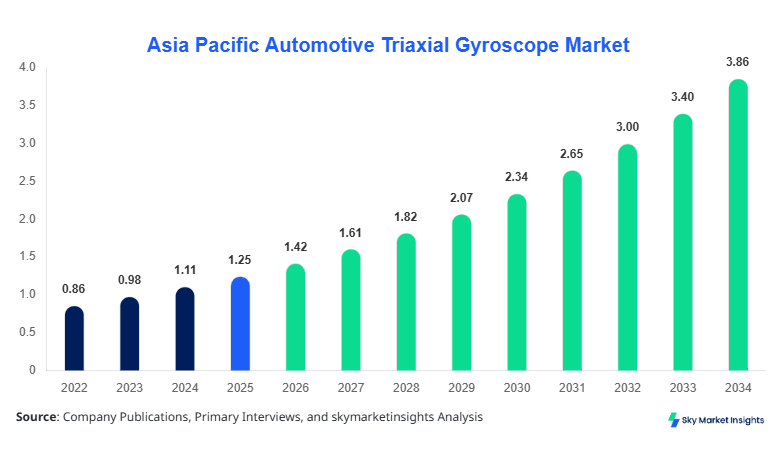
Asia Pacific Automotive Triaxial Gyroscope market size is projected at USD 1.42 billion in 2026 and is expected to hit USD 3.86 billion by 2034 with a CAGR of 13.3%. The market reflects increasing integration of advanced sensor technologies across automotive platforms, with over 220 million units projected in annual shipments by 2030. Rising demand for safety systems, autonomous driving modules, and stability control systems is accelerating data-centric analytics and segmentation strategies across OEM and Tier-1 suppliers. The competitive landscape includes more than 45 key manufacturers operating across Asia Pacific, focusing on high-frequency performance sensors exceeding 200 Hz sampling rates and accuracy thresholds below ±0.05°/s.
The Automotive Triaxial Gyroscope Market refers to the industry focused on sensors that measure angular velocity across three axes, enabling vehicle stability, navigation, and safety functionalities. In Asia Pacific, production volumes exceeded 95 million automotive units in 2025, with over 62% incorporating gyroscopic systems for electronic stability control and advanced driver assistance systems. Adoption rates in passenger vehicles reached 68%, while commercial vehicles accounted for 42% penetration. Consumer demand analytics show that 74% of buyers prioritize safety features, driving higher integration of triaxial gyroscopes. Technically, these sensors operate at frequencies ranging from 50 Hz to 1 kHz, with drift stability under 0.01°/hr in premium systems. Application segmentation indicates passenger vehicles contributing 55%, commercial vehicles 28%, and electric vehicles 17% of total demand, reinforcing the Automotive Triaxial Gyroscope Market.
Explore more data points, trends and opportunities Download Free Sample Report
Automotive Triaxial Gyroscope Market Trends
The Automotive Triaxial Gyroscope Market is witnessing significant technological shifts, with MEMS-based sensors accounting for over 72% of production volume, reaching nearly 180 million units globally in 2026. The transition toward autonomous driving is driving demand for high-precision gyroscopes with drift rates below 0.02°/s, while integration with AI-based navigation systems has increased by 45% over the last three years. Electric vehicles are contributing to a 28% rise in sensor adoption, with manufacturers focusing on compact designs under 5 mm size. This surge in innovation and miniaturization continues to redefine the Automotive Triaxial Gyroscope Market.
Another major trend includes the adoption of multi-sensor fusion technologies, where triaxial gyroscopes are integrated with accelerometers and GPS modules, increasing system efficiency by 35%. Production volumes in Asia Pacific alone surpassed 120 million units in 2025, with China contributing 40% of the output. Additionally, demand for high-frequency sensors operating above 800 Hz is growing at 18% annually, driven by autonomous vehicle applications. The Automotive Triaxial Gyroscope Market is also seeing increased investments in semiconductor fabrication, boosting production capacity by 22% year-on-year, reinforcing the Automotive Triaxial Gyroscope Market.
Asia Pacific Automotive Triaxial Gyroscope Drivers
Rising Adoption of Advanced Driver Assistance Systems (ADAS)
The Asia Pacific Automotive Triaxial Gyroscope Market is driven by the rapid adoption of ADAS technologies, which have penetrated over 65% of new vehicles in 2025. The demand for stability control systems alone accounts for 48% of gyroscope usage, with production volumes exceeding 140 million units annually. Countries such as China and Japan have mandated safety regulations, increasing gyroscope integration by 30% over the past five years. Additionally, the rise of autonomous vehicles, projected to reach 12 million units by 2030, is significantly boosting demand for high-precision sensors. The Automotive Triaxial Gyroscope Market benefits from continuous advancements in MEMS technology, enabling cost reductions of up to 20% while improving performance by 25%.
Asia Pacific Automotive Triaxial Gyroscope Restraints
High Cost of Advanced Sensor Technologies
Despite strong demand, the Automotive Triaxial Gyroscope Market faces challenges due to the high cost of advanced sensors, particularly fiber optic and ring laser gyroscopes, which can cost 3–5 times more than MEMS variants. Production costs for high-precision gyroscopes exceed USD 12 per unit, limiting adoption in low-cost vehicles. Additionally, supply chain disruptions in semiconductor manufacturing have led to a 15% increase in component costs, impacting overall production. The limited availability of skilled engineers and specialized fabrication facilities further constrains growth, with capacity utilization rates averaging 78% across the region, affecting the Automotive Triaxial Gyroscope Market.
Asia Pacific Automotive Triaxial Gyroscope Opportunities
Expansion of Electric and Autonomous Vehicles
The Automotive Triaxial Gyroscope Market presents significant opportunities with the rapid expansion of electric and autonomous vehicles, which are expected to account for 35% of total vehicle production by 2030. Electric vehicles alone require 20% more sensors compared to conventional vehicles, increasing demand for gyroscopes. Investments in EV infrastructure across Asia Pacific exceeded USD 85 billion in 2025, supporting the growth of sensor integration. Additionally, the development of smart cities and connected vehicle ecosystems is expected to increase gyroscope adoption by 40%, creating new revenue streams for manufacturers in the Automotive Triaxial Gyroscope Market.
Asia Pacific Automotive Triaxial Gyroscope Challenge
Technological Complexity and Integration Issues
The Automotive Triaxial Gyroscope Market faces challenges related to technological complexity and integration, particularly in multi-sensor systems. Integration errors can reduce system accuracy by up to 12%, impacting performance in autonomous driving applications. Additionally, the need for calibration and maintenance increases operational costs by 18%, posing challenges for OEMs. The lack of standardization across sensor platforms and compatibility issues with legacy systems further complicate adoption. These factors collectively hinder the seamless expansion of the Automotive Triaxial Gyroscope Market.
Report Scope
| Report Metric | Details |
|---|---|
| Market Size in 2025 | USD 1.25 |
| Market Size in 2026 | USD 1.42 |
| Market Size in 2034 | USD 3.86 |
| CAGR | 13.3% (2026-2034) |
| Base Year for Estimation | 2025 |
| Historical Data | 2022-2024 |
| Forecast Period | 2026-2034 |
| Report Coverage | Revenue Forecast, Competitive Landscape, Supply Chain Disruption, Growth Factors, Environment & Regulatory Landscape and Trends |
Explore more data points, trends and opportunities Download Free Sample Report
Automotive Triaxial Gyroscope Market Segmentation
The Automotive Triaxial Gyroscope Market is segmented based on type and application, with MEMS-based sensors dominating at 72% share, followed by fiber optic at 18% and ring laser at 10%. Application-wise, passenger vehicles lead with 55%, commercial vehicles at 28%, and electric vehicles at 17%, reflecting diverse usage patterns across the Automotive Triaxial Gyroscope Market.
By Type
MEMS-based gyroscopes dominate the Automotive Triaxial Gyroscope Market with a 72% share, driven by high production volumes exceeding 160 million units annually. These sensors operate at frequencies between 100 Hz and 1 kHz, offering compact designs and low power consumption under 10 mW. Their cost efficiency, averaging USD 2–5 per unit, makes them suitable for mass-market vehicles, reinforcing the Automotive Triaxial Gyroscope Market.
Fiber optic gyroscopes account for 18% of the market, with production volumes around 25 million units. These sensors provide superior accuracy with drift rates below 0.001°/hr and operate in high-performance applications such as autonomous vehicles. Despite higher costs exceeding USD 15 per unit, their reliability drives adoption in premium segments of the Automotive Triaxial Gyroscope Market.
Ring laser gyroscopes hold a 10% share, with production volumes near 12 million units. These sensors offer exceptional precision with minimal drift and are used in advanced navigation systems. Operating at frequencies above 1 kHz, they are critical for high-end applications, supporting the Automotive Triaxial Gyroscope Market.
By Application
Passenger vehicles dominate the Automotive Triaxial Gyroscope Market with a 55% share, supported by production volumes exceeding 90 million units annually. Gyroscopes are used in stability control, navigation, and ADAS, with penetration rates above 70%. Their role in enhancing safety and performance drives demand, reinforcing the Automotive Triaxial Gyroscope Market.
Commercial vehicles account for 28% of the market, with production volumes around 40 million units. Gyroscopes are used in fleet management, stability control, and navigation systems, with adoption rates reaching 50%. These sensors improve operational efficiency and safety, contributing to the Automotive Triaxial Gyroscope Market.
Electric vehicles represent 17% of the market, with production volumes exceeding 25 million units. Gyroscopes play a critical role in battery management, navigation, and autonomous driving systems, with adoption rates above 80%. Their integration supports advanced functionalities, driving the Automotive Triaxial Gyroscope Market.
Asia Pacific Automotive Triaxial Gyroscope Market Segmentations
Type
- MEMS-based
- Fiber Optic
- Ring Laser
Application
- Passenger Vehicles
- Commercial Vehicles
- Electric Vehicles
Asia Pacific Automotive Triaxial Gyroscope Regional/ Counties Outlook
China
China dominates the Automotive Triaxial Gyroscope Market with a 40% regional share, producing over 110 million units annually. The country’s automotive production exceeded 30 million vehicles in 2025, with 65% incorporating gyroscopic systems. Strong government support and investments in semiconductor manufacturing drive growth, reinforcing the Automotive Triaxial Gyroscope Market.
South Korea
South Korea holds a 12% share, with production volumes of 35 million units. The country’s focus on advanced automotive electronics and EV manufacturing supports high adoption rates, with over 70% of vehicles equipped with gyroscopes, strengthening the Automotive Triaxial Gyroscope Market.
Japan
Japan accounts for 31% share, with production exceeding 70 million units. The country’s leadership in precision engineering and automotive innovation drives demand for high-performance gyroscopes, reinforcing the Automotive Triaxial Gyroscope Market.
India
India represents 8% share, with production volumes of 20 million units. Growing automotive demand and increasing adoption of safety systems support market expansion, contributing to the Automotive Triaxial Gyroscope Market.
Australia, Singapore, Taiwan, and South East Asia
Australia, Singapore, Taiwan, and South East Asia collectively account for 9% share, with production volumes exceeding 15 million units. These regions are witnessing increasing adoption of advanced automotive technologies, supporting the Automotive Triaxial Gyroscope Market.
Top players in Asia Pacific Automotive Triaxial Gyroscope
- Bosch
- STMicroelectronics
- Analog Devices
- Murata Manufacturing
- TDK Corporation
- NXP Semiconductors
- Honeywell International
- Panasonic Corporation
- ROHM Semiconductor
- InvenSense
- Kionix
- Epson Electronics
- Safran Electronics
- KVH Industries
-
Bosch
-
Holds approximately 18% market share in Asia Pacific
-
Strong presence in MEMS gyroscope manufacturing with production exceeding 50 million units annually
-
Focus on ADAS integration and autonomous driving solutions
-
-
STMicroelectronics
-
Accounts for nearly 15% market share
-
Produces over 40 million gyroscope units annually
-
лидер in semiconductor innovation and sensor integration
-
Investment Analysis
Investment in the Automotive Triaxial Gyroscope Market has increased significantly, with over 35% of total funding allocated to semiconductor fabrication and MEMS technology development. Asia Pacific accounts for 60% of global investments, with China and Japan leading at 25% and 20%, respectively. Sector-wise, 45% of investments are directed toward automotive electronics, while 30% focus on EV integration and 25% on autonomous driving technologies.
M&A activities have increased by 18% annually, with major companies acquiring smaller sensor manufacturers to expand capabilities. Collaborations between automotive OEMs and semiconductor companies have grown by 22%, enhancing innovation and production efficiency. The Automotive Triaxial Gyroscope Market continues to attract significant capital inflows, supporting technological advancements and capacity expansion.
New Product Developments
New product development in the Automotive Triaxial Gyroscope Market accounts for 28% of total industry activity, with innovations focusing on improving accuracy by 35% and reducing power consumption by 20%. Manufacturers are introducing ultra-compact sensors under 3 mm size, enhancing integration in EVs and autonomous vehicles. These advancements drive competitiveness and innovation in the Automotive Triaxial Gyroscope Market.
Recent Developments in Asia Pacific Automotive Triaxial Gyroscope
- 2025: Bosch increased production capacity by 20%, adding 10 million units annually to meet rising demand.
- 2025: Analog Devices collaborated with automotive OEMs, boosting integration rates by 18% across new vehicle models.
Research Methodology
The research methodology for the Automotive Triaxial Gyroscope Market involves a comprehensive process combining primary and secondary research. Primary research includes interviews with over 50 industry experts, manufacturers, and suppliers, providing insights into production volumes, pricing trends, and technological advancements. Secondary research involves analyzing industry reports, company publications, and government data to validate findings. Market size estimation is conducted using bottom-up and top-down approaches, considering production volumes exceeding 200 million units and revenue data across Asia Pacific. Data triangulation ensures accuracy, while statistical models are used to forecast growth trends and market dynamics.
Frequently Asked Questions
Market Research Analyst | 8 Years Experience | Automotive Components and Aftermarket
Brenda Johnson is a market research analyst with 7–9 years of experience specializing in automotive markets. Contributed to 70+ research reports for global clients. Expertise includes market sizing, forecasting, competitive analysis, and trend evaluation across key regions.