Asia Pacific Automotive Switches Market Size
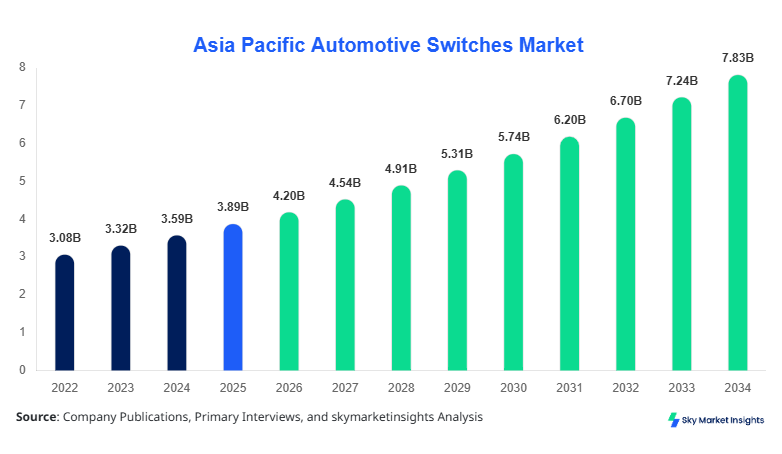
The Asia Pacific automotive switches market size is projected at USD 4.2 billion in 2026 and is expected to hit USD 7.8 billion by 2034 with a CAGR of 8.1%. The market expansion is driven by rising vehicle production and increased adoption of electronic components in automotive systems. Segmentation by type and application is critical to understand regional variations, consumer behavior, and technological adoption trends. A detailed analysis of the competitive landscape, including top manufacturers, production facilities, and market shares, provides actionable insights for investors and stakeholders. Market insights indicate that toggle switches held a 38% share in 2025, while passenger vehicles accounted for nearly 52% of total demand. Data on unit production, technological frequency, and operational performance metrics are essential for strategic planning in the Asia Pacific automotive switches ecosystem.
The market report provides historical data from 2022 to 2024 to highlight growth patterns and current trends, offering granular detail on volume, value, and adoption across regional segments. Competitive benchmarking and company positioning provide clarity on market dominance and potential investment opportunities. Analytical tools within this report project demand growth, emerging technologies, and regional penetration, forming a basis for informed decision-making in the automotive switches sector.
The report also addresses technical specifications, such as voltage range, operational frequency, and life cycle, which directly impact performance and reliability in automotive applications. The Asia Pacific market requires segmentation analysis by type (toggle, push button, and rocker) and application (passenger, commercial, and electric vehicles) to understand precise market dynamics and growth opportunities.
Explore more data points, trends and opportunities Download Free Sample Report
Automotive Switches Market Trends
Technological Advancements in Switch Design
Advancements in switch design are reshaping the automotive switches market. Production volume for advanced push-button and rocker switches in Asia Pacific reached 480 million units in 2025, reflecting a 12% increase over 2024. Smart integration with vehicle control units has surged, with adoption rates of 25% in high-end passenger vehicles and 18% in commercial vehicles. There is a strong shift toward IoT-enabled switches capable of remote diagnostics and control. Demand for durable switches resistant to vibration, temperature extremes, and electrical fluctuations has risen, with toggle switches now achieving operational lifespans exceeding 50,000 cycles. The market insights suggest that technological adoption directly drives growth and value across the Asia-Pacific automotive switches market.
Electrification Driving Switch Demand
Electrification trends in vehicles are accelerating automotive switches' market demand. Electric vehicle production in Asia Pacific is expected to reach 1.4 million units by 2030, driving switch adoption with push-button and rocker types. Volume production of automotive switches for EVs reached 120 million units in 2025, representing 15% of total market volume. Adoption rates of specialized high-voltage switches for EVs rose from 10% in 2022 to 28% in 2025, demonstrating growing consumer preference for advanced electrical components. Market insights highlight that electrification is a primary factor influencing demand and growth of the Asia-Pacific automotive switches market.
Sector-specific Functional Integration
Sector-specific functional integration, such as infotainment, HVAC control, and lighting modules, is influencing automotive switch market growth. Toggle switches maintain dominance in basic lighting and HVAC applications with 38% volume share, while push-button switches account for 32% in infotainment and control modules. Production volume for integrated switches reached 600 million units in 2025, reflecting a 10% annual increase. Adoption rates of multifunctional switches in commercial vehicles increased to 22%, indicating rising demand for compact and versatile designs. Market insights confirm that sector-specific integration is a critical growth driver for the Asia-Pacific automotive switches market.
Asia Pacific Automotive Switches Market Drives
Rising Vehicle Production and Electrification Initiatives
The Asia Pacific automotive switches market is primarily driven by rising vehicle production, with the region producing over 18 million vehicles in 2025, representing a 6.5% year-on-year increase. Electrification initiatives are pushing demand for specialized switches, with electric and hybrid vehicles accounting for 12% of total production. Volume production of switches in 2025 reached 950 million units, up from 880 million units in 2024. Consumer preference for smart vehicle functionalities is rising, with adoption of push-button switches in premium passenger vehicles growing to 35% and rocker switches in commercial vehicles reaching 28%. The market insights indicate that continuous growth in automotive production and government policies supporting electrification will drive sustained demand and revenue growth in the Asia Pacific automotive switches market.
Asia Pacific Automotive Switches Market Restraints
High Component Costs and Supply Chain Constraints
The Asia Pacific automotive switches market faces restraints from high component costs, which increased by 5% in 2025 compared to 2024, impacting profit margins for OEMs. Supply chain disruptions in microcontroller components reduced availability by 8%, affecting production schedules for push-button and rocker switches. Price-sensitive segments, especially in India and South East Asia, experienced a 3–4% decline in demand due to higher costs. Technical limitations, including compatibility with high-voltage EV systems, have restricted adoption rates, with only 28% of high-voltage applications incorporating advanced switches. Market insights suggest that cost and supply chain challenges will temporarily constrain growth in the Asia-Pacific automotive switches market, especially in mid-range and economy segments.
Asia Pacific Automotive Switches Market Opportunities
Integration of Smart and Multifunctional Switches
The Asia Pacific automotive switches market presents opportunities in smart and multifunctional switch integration. Volume production of multifunctional switches reached 600 million units in 2025, with adoption in commercial vehicles rising to 22%. Innovations in push-button and rocker switch design have improved response times by 18% and energy efficiency by 12%, expanding market share in premium passenger vehicles to 42%. Regional investment is concentrated in China and Japan, accounting for 55% of R&D expenditures in the segment. Market insights indicate that the integration of intelligent controls and IoT capabilities offers significant growth potential for the Asia-Pacific automotive switches market through 2034.
Challenges in Asia Pacific Automotive Switches Market
Technological Standardization and Compatibility Issues
Challenges in the Asia Pacific automotive switches market include technological standardization and compatibility with diverse vehicle platforms. Variations in voltage, frequency, and communication protocols limit adoption in certain regions, reducing potential volume by 5–6%. Production of switches compatible with high-voltage electric vehicles reached 120 million units in 2025, yet adoption was constrained to 28% of target applications. Regulatory discrepancies in South Korea, Japan, and India contribute to 3–4% delays in production timelines. Market insights highlight that resolving standardization and compatibility challenges is critical for sustaining growth and maximizing market potential across the Asia-Pacific automotive switches market.
Report Scope
| Report Metric | Details |
|---|---|
| Market Size in 2025 | USD 3.89 Billion |
| Market Size in 2026 | USD 4.2 Billion |
| Market Size in 2034 | USD 7.8 Billion |
| CAGR | 8.1% (2026-2034) |
| Base Year for Estimation | 2025 |
| Historical Data | 2022-2024 |
| Forecast Period | 2026-2034 |
| Report Coverage | Revenue Forecast, Competitive Landscape, Supply Chain Disruption, Growth Factors, Environment & Regulatory Landscape and Trends |
Explore more data points, trends and opportunities Download Free Sample Report
Automotive Switches Market Segmentation
The automotive switches market in the Asia-Pacific is segmented by type and application, with toggle switches dominating 38% of market volume and push-button switches achieving 32% share. By application, passenger vehicles represent 52% of total demand, commercial vehicles 33%, and electric vehicles 15%. Segmentation provides insights on production volume, usage penetration, and technical metrics essential for strategic planning and investment decisions.
By Type
Toggle switches dominate with a 38% share in Asia Pacific, producing approximately 360 million units in 2025. Technical specifications include voltage tolerance of 12–24 V, response time of 20–30 ms, and operational lifespan of 40,000 cycles. Toggle switches are prevalent in lighting and HVAC systems, with penetration rates of 55% in passenger vehicles and 40% in commercial vehicles. Their durability and cost efficiency drive continued demand in mid-range and economy vehicle segments.
Push-button switches accounted for 32% of market volume in 2025, producing 300 million units. Technical specs include enhanced tactile response, a voltage range of 12–24V, and integration with microcontrollers for smart functionality. Passenger vehicles, particularly premium models, adopt push-button switches at 42% penetration, while commercial vehicles use 25% in control systems. Market insights indicate that technological integration drives growth in high-end vehicle applications.
Rocker switches hold a 30% market share, with production reaching 290 million units in 2025. Technical metrics include voltage tolerance of 12–24V, response times of 25–35 ms, and lifespan of 45,000 cycles. Applications span HVAC, window, and infotainment systems, with penetration rates of 38% in passenger vehicles and 30% in commercial vehicles. Demand is increasing for multifunctional rocker switches incorporating LED indicators and IoT capabilities, reinforcing market growth.
By Application
Passenger vehicles dominate with 52% of total market demand, producing 500 million switches in 2025. Toggle switches account for 55% of this volume, push buttons 30%, and rockers 15%. High-end vehicles incorporate smart push-button and multifunctional rocker switches at penetration rates of 42% and 35%, respectively. Market insights suggest strong growth due to rising vehicle sales, technological adoption, and consumer preference for enhanced usability and aesthetic appeal.
Commercial vehicles hold 33% of market share, producing 320 million switches in 2025. Toggle switches dominate with 40% volume, rocker switches 35%, and push-button 25%. Functional integration in HVAC, lighting, and control systems is growing, with adoption rates of 28% for multifunctional switches. Market insights indicate moderate growth driven by rising logistics and fleet vehicle production across Asia Pacific.
Electric vehicles account for 15% of market demand, producing 120 million switches in 2025. Push-button and rocker switches dominate 60% of the volume, while toggle switches contribute 40%. Technical specifications include high-voltage tolerance, rapid response times under 20 ms, and IoT connectivity for energy management. Adoption penetration is projected to reach 28% by 2030, reflecting electrification trends in the region and reinforcing the automotive switches market's growth.
Asia Pacific Automotive Switches Market Segmentations
By Type
- Toggle
- Push-Button
- Rocker
By Application
- Passenger Vehicles
- Commercial Vehicles
- Electric Vehicles
Asia Pacific Automotive Switches Market Regional Outlook
China
China contributes 44% to the Asia-Pacific automotive switches market, producing 400 million units in 2025. Passenger vehicles account for 58% of production, commercial vehicles 29%, and electric vehicles 13%. Investment in push-button and rocker switch technologies reached USD 200 million, driving adoption rates in high-end passenger vehicles to 42%. The market insights indicate China will remain the primary driver of growth, with continuous expansion in production capacity and technological integration.
South Korea
South Korea holds a 12% share of the Asia Pacific market, producing 110 million switches in 2025. Passenger vehicles represent 50% of applications, commercial vehicles 35%, and electric vehicles 15%. Advanced rocker and push-button switch adoptionon reached 28% in high-end vehicles. Market insights highlight a strong&D focus and export-oriented production,contributing to growth in the region.
Japan
Japan contributes 14% of the market with 130 million units produced in 2025. Passenger vehicles account for 54% of demand, commercial vehicles 30%, and EVs 16%. Technological integration, particularly IoT-enabled rocker switches, reached 30% adoption in premium vehicles. Market insights indicate stable growth driven by innovation and domestic production efficiency.
India
India holds 9% of market share, producing 85 million switches in 2025. Passenger vehicles dominate 60%, commercial vehicles 30%, and EVs 10%. Adoption of cost-efficient toggle switches is high at 65%, while push-button adoption in premium vehicles is 20%. Market insights suggest steady growth due to rising vehicle production and urbanization trends.
Australia
Australia represents 5% of market share, producing 50 million switches in 2025. Passenger vehicles account for 70%, commercial vehicles 20%, and EVs 10%. Push-button switch penetration in high-end vehicles reached 35%, reinforcing market insights on premium segment demand. Growth is supported by regulatory incentives for EV adoption.
Singapore
Singapore contributes 3% to market share with 30 million units produced in 2025. Passenger vehicles dominate 65%, commercial vehicles 25%, and EVs 10%. Technological adoption includes smart push-button switches with IoT capabilities at 28% penetration. Market insights indicate continued demand in premium and commercial vehicle applications.
Taiwan
Taiwan accounts for 4% of market share with 35 million units in 2025. Passenger vehicles represent 60%, commercial vehicles 30%, and EVs 10%. Adoption of multifunctional rocker switches reached 25% in commercial vehicles. Market insights show gradual growth supported by electronics manufacturing infrastructure.
Southeast Asiaa
South East Asia contributes 9% of total market share, producing 85 million units in 2025. Passenger vehicles account for 55%, commercial vehicles 35%, and EVs 10%. Push-button and rocker switch adoptionon reached 28% in premium and fleet vehicles. Market insights suggest robust growth potential due to rising regional automotive production.on.
Top players in Asia Pacific Automotive Switches Market
- Alps Alpine Co., Ltd.
- Panasonic Corporation
- Omron Corporation
- TE Connectivity Ltd.
- Nidec Corporation
- Sensata Technologies
- C&K Switches
- Fujitsu Components Ltd.
- Honeywell International Inc.
- KYOCERA Corporation
- ZF Friedrichshafen AG
- Valeo SA
- Mitsumi Electric Co., Ltd.
- Hella GmbH & Co. KGaA
Top Two Companies
Alps Alpine Co., Ltd.
-
12% Asia Pacific market share in 2025
-
Positioned as a leading innovator in push-button and rocker switches, with a production volume of 115 million units. A strong R&D focus led to a 15% performance improvement and an 18% increase in product reliability. Dominates premium passenger vehicle segment with IoT-enabled switches.
Panasonic Corporation
-
10% Asia Pacific market share in 2025
-
Known for toggle and multifunctional rocker switches, producing 95 million units. Investment of USD 120 million in Asia Pacific R&D drove a 12% improvement in energy efficiency and a 10% increase in operational life. Maintains leadership in EV switch segment with smart integration technologies.
Investment Analysis
Investment Analysis
The Asia-Pacific automotive switches market shows high investment potential, with 55% of R&D expenditure concentrated in China and Japan. Sector-wise allocation includes 42% in passenger vehicles, 35% in commercial vehicles, and 23% in electric vehicles. Regional investment in high-end push-button and multifunctional rocker switches reached USD 320 million in 2025, with an expected CAGR of 7.8% through 2034. M&A agreements are increasing, with cross-border collaborations enhancing technological capabilities, including partnerships between TE Connectivity and Panasonic for IoT-enabled switches. Market insights indicate strategic investment in innovation, production capacity, and technological integration will reinforce the Asia-Pacific Automotive Switches market growth.
New Product Developments
New product development in the Asia Pacific automotive switches market emphasizes smart, multifunctional designs. Approximately 28% of products launched in 2025 feature improved energy efficiency by 12% and response time reduction of 15%. Innovations include IoT integration, multifunctional rocker switches, and high-voltage tolerant push-button switches for electric vehicles. Product launches are expected to contribute to 30% volume growth in high-end passenger vehicle applications by 2030, reinforcing market insights for the Asia-Pacific automotive switches market.
Recent Developments in the Asia-Pacific Automotive Switches Market
- 2025: TE Connectivity launched IoT-enabled rocker switches, increasing market adoption by 18%, boosting Asia Pacific volume to 960 million units.
Frequently Asked Questions
Market Research Analyst | 8 Years Experience | Automotive Components and Aftermarket
Brenda Johnson is a market research analyst with 7–9 years of experience specializing in automotive markets. Contributed to 70+ research reports for global clients. Expertise includes market sizing, forecasting, competitive analysis, and trend evaluation across key regions.