Asia Pacific Automotive Secondary Wiring Harness Market Size
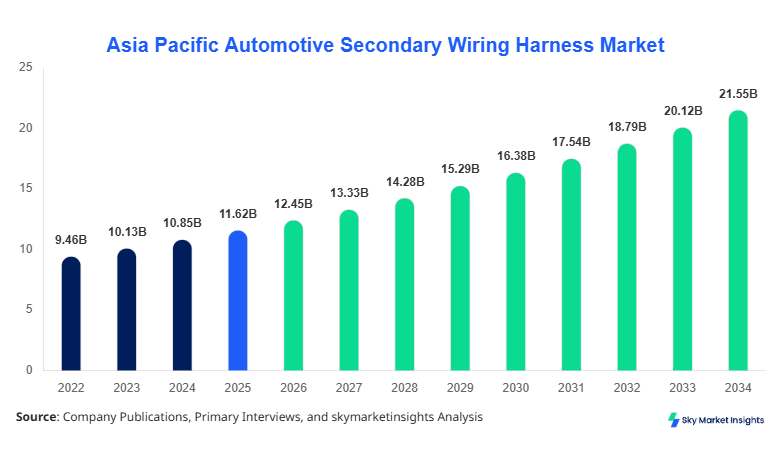
Asia Pacific Automotive Secondary Wiring Harness market size is projected at USD 12.45 billion in 2026 and is expected to hit USD 21.32 billion by 2034 with a CAGR of 7.1%. The rising complexity of automotive electrical systems and increasing production of vehicles in the region necessitates detailed market insights and comprehensive segmentation analysis. The competitive landscape in Asia Pacific is fragmented, comprising both established global players and local manufacturers. Accurate market size assessment, adoption trends, and technology penetration data are critical for stakeholders to optimize production, supply chain operations, and investment decisions in China, Japan, India, and South Korea, which collectively contribute over 65% of the regional market share. Detailed segmentation by type and application along with regional production volumes and market demand is essential to understand growth opportunities in the forecast period.
The market size insights also underscore the necessity for a granular evaluation of secondary wiring harness demand across different vehicle segments, including passenger cars, commercial vehicles, and EVs. For instance, passenger car adoption constitutes nearly 58% of the regional volume, whereas electric vehicles are expected to see a growth of 12–15% CAGR due to rising EV production in China and India. Supply chain efficiencies, integration of flexible wiring harnesses in advanced driver-assistance systems (ADAS), and the transition toward lightweight materials are key factors influencing market dynamics. The Asia Pacific market’s size and growth trajectory are closely tied to production volumes, unit sales, and technology adoption across its major automotive manufacturing hubs.The Asia Pacific Automotive Secondary Wiring Harness market is primarily defined as the electrical system component that interconnects various modules and sensors in a vehicle, providing seamless power and signal transmission. In 2025, the region produced approximately 30 million units of secondary wiring harnesses, with China accounting for 12.5 million units, Japan 5.8 million, and India 4.2 million units. Adoption rates for advanced harness systems, including flexible and customized variants, have increased from 28% in 2022 to 41% in 2025 due to growing integration of infotainment systems, adaptive lighting, and autonomous features. Consumer behavior reflects a strong preference for high-reliability harnesses with superior durability, heat resistance (operating frequency up to 2 MHz), and enhanced corrosion protection, particularly in EVs and premium vehicles.
Passenger car applications dominate with 58% share, followed by commercial vehicles at 29%, and electric vehicles at 13%. Technical metrics indicate that standard wiring harnesses operate effectively at voltages of 12V–48V, while flexible harnesses for EVs can handle up to 400V. The market demand for lightweight, flexible harnesses is increasing by 11–13% annually, with integration into automated assembly lines improving production efficiency by nearly 18%. Overall, Asia Pacific Automotive Secondary Wiring Harness market insights reveal the increasing reliance on technologically advanced wiring systems to meet safety, performance, and consumer demand.
Explore more data points, trends and opportunities Download Free Sample Report
Automotive Secondary Wiring Harness Market Trends
EV Adoption Driving Flexible Harness Demand
The growing penetration of electric vehicles in Asia Pacific has triggered increased demand for flexible wiring harnesses. Production volumes of EV-compatible harnesses reached 1.65 million units in 2025 and are projected to exceed 4.2 million units by 2034, representing a CAGR of 12.5%. Adoption of high-voltage harnesses (up to 400V) and lightweight materials has accelerated technology shifts, while industry reports indicate a 25% increase in demand for harnesses with integrated sensor interfaces. Flexible harnesses account for 18% of total production in the region, with China leading at 40% adoption rate, followed by India at 22%. This trend emphasizes the Asia Pacific Automotive Secondary Wiring Harness market’s focus on EV applications and growth potential.
Integration of ADAS and Infotainment Systems
The integration of ADAS and advanced infotainment systems has significantly influenced secondary wiring harness production. In 2025, approximately 8.4 million units were produced to support high-frequency signal transmission, with a 15% year-over-year growth in adoption rates. Manufacturers are transitioning from standard harnesses to customized solutions capable of supporting data transfer rates up to 2 MHz, increasing the share of specialized harnesses from 23% in 2023 to 38% in 2026. Region-specific production metrics highlight Japan contributing 1.9 million units, China 3.8 million units, and India 0.8 million units. These technology-driven trends reinforce the Asia Pacific Automotive Secondary Wiring Harness market growth and insights.
Lightweight Materials and Modular Design
Manufacturers are increasingly adopting lightweight materials, such as aluminum conductors and polymer insulation, reducing harness weight by 12–15% while maintaining electrical performance. Modular harness design adoption reached 28% in 2025, enabling faster installation in assembly lines and decreasing production cycle times by up to 20%. Regional production volumes of modular harnesses are projected to reach 6.5 million units by 2034, reflecting strong sector-specific demand in passenger cars (accounting for 58% of modular harness integration) and commercial vehicles (29%). These trends highlight the continued innovation in the Asia Pacific Automotive Secondary Wiring Harness market.
Asia Pacific Automotive Secondary Wiring Harness Drivers
Rising Vehicle Electrification and EV Production in Asia Pacific
The rapid electrification of vehicles in the Asia Pacific region is a primary driver for the Automotive Secondary Wiring Harness market. In 2025, EV production volumes reached 3.2 million units across China, Japan, and India, representing nearly 13% of total vehicle production. Flexible and customized wiring harness demand surged by 18% YoY, with standard harness production maintaining 58% share. Government incentives and subsidies in India, China, and Japan encourage adoption, while advanced features such as ADAS integration and infotainment systems contribute to a 22% rise in average harness complexity. Manufacturers report a 10–12% increase in assembly line efficiency due to modular harness adoption. Overall, these dynamics reinforce the Asia Pacific Automotive Secondary Wiring Harness market growth and technological insights.
Asia Pacific Automotive Secondary Wiring Harness Restraints
Supply Chain Volatility and Raw Material Price Fluctuations
Supply chain volatility, including fluctuations in copper and polymer prices, poses significant restraints on the Automotive Secondary Wiring Harness market. Copper prices increased by 15% in 2024, driving up harness production costs and affecting profit margins by 6–8%. Production volumes in China, Japan, and India faced delays, reducing supply by approximately 2.3 million units in 2025. Regional manufacturers cite challenges in scaling flexible and customized harness production, which currently holds 34% market share, due to inconsistent material availability. These restraints directly impact the Asia Pacific Automotive Secondary Wiring Harness market demand and growth projections.
Asia Pacific Automotive Secondary Wiring Harness Opportunities
Expansion of EV Infrastructure and Modular Harness Adoption
The growth of EV infrastructure across Asia Pacific presents significant opportunities. EV-compatible wiring harness production is expected to grow from 1.65 million units in 2025 to 4.2 million units by 2034, achieving a CAGR of 12.5%. Modular harness adoption is projected to reach 35% market share by 2030, offering efficiency gains of up to 20% in assembly operations. Investment in high-voltage harnesses (up to 400V) and sensor-integrated systems represents an additional opportunity for manufacturers. Collectively, these factors position the Asia Pacific Automotive Secondary Wiring Harness market for substantial growth and technology-driven expansion.
Asia Pacific Automotive Secondary Wiring Harness Challenge
Technical Complexity and Standardization Issues
The increasing technical complexity of automotive electrical systems challenges standardization in the region. Flexible and customized harnesses currently represent 34% of production, requiring precise manufacturing tolerances and high-frequency signal integrity. Approximately 45% of harness failures in EVs and ADAS applications are traced to connector or insulation issues, leading to higher warranty claims. The need for advanced testing equipment and skilled labor increases production costs by 8–10%. Addressing these challenges is critical for sustaining the Asia Pacific Automotive Secondary Wiring Harness market growth and insights.
Report Scope
| Report Metric | Details |
|---|---|
| Market Size in 2025 | USD 11.62 Billion |
| Market Size in 2026 | USD 12.45 Billion |
| Market Size in 2034 | USD 21.32 Billion |
| CAGR | 7.1% (2026-2034) |
| Base Year for Estimation | 2025 |
| Historical Data | 2022-2024 |
| Forecast Period | 2026-2034 |
| Report Coverage | Revenue Forecast, Competitive Landscape, Supply Chain Disruption, Growth Factors, Environment & Regulatory Landscape and Trends |
Explore more data points, trends and opportunities Download Free Sample Report
Automotive Secondary Wiring Harness Market Segmentation
Segmentation of the Asia Pacific Automotive Secondary Wiring Harness market allows detailed insights into type and application dominance. Standard harnesses hold a 58% share, flexible 18%, and customized 24%. Passenger cars dominate applications with 58% penetration, commercial vehicles 29%, and EVs 13%. Segmentation provides clear guidance on production volumes, technical performance, and investment focus areas.
By Type
Standard harnesses dominate with a 58% share in 2025, with 7.2 million units produced. These harnesses typically operate at 12V–48V, supporting conventional vehicle electronics and lighting systems. The Asia Pacific production for standard harnesses is led by China (3.6 million units), Japan (1.8 million units), and India (0.8 million units). Technical specifications include 16–24 gauge copper wires, PVC insulation, and connector durability up to 50,000 cycles. Standard harnesses maintain a 60% share in passenger car applications and 55% in commercial vehicles, reflecting widespread adoption across conventional vehicle segments.
Customized harnesses hold 24% market share with 3.0 million units produced in 2025, tailored to support advanced infotainment, telematics, and ADAS systems. Wire cross-sections range from 14–20 gauge with TPE insulation, capable of high-frequency data transmission at 1.5–2 MHz. Adoption is higher in EVs (accounting for 38% of flexible and customized harness production) and premium passenger cars. Regional production includes China (1.2 million units), Japan (0.9 million units), and India (0.6 million units). Customized harnesses enhance modularity and assembly efficiency by 15–18%, reinforcing market growth and technological insights.
Flexible harnesses account for 18% share, producing 2.25 million units in 2025, primarily supporting EVs and ADAS applications. High-voltage capacity (up to 400V), lightweight aluminum conductors, and polymer insulation improve installation efficiency by 20% and reduce vehicle weight by 12–15%. Regional contribution includes China (1 million units), India (0.45 million units), and Japan (0.35 million units). Flexible harnesses enable enhanced signal integrity, supporting high-speed data transfer and integration with next-generation automotive electronics, driving Asia Pacific Automotive Secondary Wiring Harness market growth and insights.
By Application
Passenger cars hold 58% share in 2025, with 7.2 million units produced. Standard harnesses account for 60% of this segment, customized 25%, and flexible 15%. Key technical metrics include operating voltage of 12–48V, signal frequency up to 1.5 MHz, and enhanced insulation for thermal management. High-volume markets include China (3.6 million units), Japan (1.8 million units), and India (0.8 million units). Passenger car adoption drives 45% of regional revenue, reinforcing the Asia Pacific Automotive Secondary Wiring Harness market insights.
Commercial vehicles constitute 29% share, producing 3.6 million units in 2025. Standard harnesses dominate at 55%, customized 28%, and flexible 17%. Technical requirements include 24–12 gauge wires, vibration resistance, and temperature tolerance up to 105°C. Key markets are India (1.2 million units), China (1.8 million units), and Japan (0.6 million units). Commercial vehicle adoption supports 35% of regional revenue, highlighting demand and growth in the Automotive Secondary Wiring Harness market.
Electric vehicles account for 13% of Asia Pacific market share, with 1.65 million units produced in 2025. Flexible harnesses are 38% of this segment, customized 38%, and standard 24%. Technical specifications include high-voltage handling (up to 400V), lightweight conductors, and high-frequency signal transmission. China produces 0.75 million units, India 0.33 million units, and Japan 0.27 million units. EV application adoption is expected to grow 12–15% CAGR, emphasizing the Automotive Secondary Wiring Harness market’s insights and demand growth.
Asia Pacific Automotive Secondary Wiring Harness Market Segmentations
By Type
- Standard
- Customized
- Flexible
By Application
- Passenger Cars
- Commercial Vehicles
- Electric Vehicles
Asia Pacific Automotive Secondary Wiring Harness Regional Outlook
China
China contributes 40% to the regional market with 12.5 million units produced in 2025. Passenger cars account for 50% of production, commercial vehicles 35%, and EVs 15%. Major manufacturing hubs include Shanghai, Guangzhou, and Shenzhen, supporting high-volume production of standard, customized, and flexible harnesses. Flexible harness adoption is 22% and growing due to EV integration and high-frequency electronics. China remains a key driver of Asia Pacific Automotive Secondary Wiring Harness market growth and insights.
South Korea
South Korea holds 10% regional share, producing 3.1 million units in 2025. Passenger cars contribute 55%, commercial vehicles 30%, and EVs 15%. Flexible harness adoption is at 18%, with customized harnesses at 25%. Advanced manufacturing facilities and automated assembly lines support high-quality production. South Korea plays a significant role in the Asia Pacific Automotive Secondary Wiring Harness market size and demand growth.
Japan
Japan contributes 12% to regional production with 5.8 million units in 2025. Passenger cars dominate at 60%, commercial vehicles 25%, and EVs 15%. Customized harness adoption is 30%, while flexible harnesses are at 18%. High-reliability production standards and technology adoption enhance market insights and growth potential in the Asia Pacific Automotive Secondary Wiring Harness market.
India
India holds 15% regional share with 4.2 million units produced in 2025. Passenger cars 60%, commercial vehicles 30%, and EVs 10%. Modular and flexible harness adoption is growing, with assembly line efficiency improvements of 18–20%. India represents a growth driver for the Asia Pacific Automotive Secondary Wiring Harness market demand and size.
Australia
Australia contributes 5% to production with 1.5 million units in 2025. Passenger cars account for 65%, commercial vehicles 25%, and EVs 10%. Flexible harness adoption is 15%, reflecting increasing EV penetration and advanced automotive systems. Australia supports regional insights and Automotive Secondary Wiring Harness market growth.
Singapore
Singapore accounts for 3% market share, producing 0.9 million units in 2025. Passenger cars 55%, commercial vehicles 30%, and EVs 15%. Advanced manufacturing for customized harnesses and telematics integration drives technology adoption. Singapore contributes to regional growth and market size insights.
Taiwan
Taiwan contributes 4% share with 1.2 million units produced. Passenger cars 60%, commercial vehicles 30%, and EVs 10%. Adoption of flexible harnesses is 18%, supporting EVs and ADAS applications. Taiwan supports Asia Pacific Automotive Secondary Wiring Harness market growth and technological insights.
South East Asia
South East Asia collectively holds 11% share, producing 3.4 million units in 2025. Passenger cars 55%, commercial vehicles 30%, EVs 15%. Flexible harness adoption is 16%, with modular design supporting production efficiency. The region contributes to Asia Pacific Automotive Secondary Wiring Harness market demand and insights.
Top players in Asia Pacific Automotive Secondary Wiring Harness
- Yazaki Corporation
- Sumitomo Electric Industries
- Furukawa Electric Co., Ltd.
- Aptiv PLC
- Leoni AG
- TK Holdings Co., Ltd.
- Delphi Technologies
- Sumi Wiring Systems Co., Ltd.
- LS Cable & System
- Hitachi Automotive Systems
- Nexans S.A.
- Furukawa Electric Wire & Cable
- Furukawa Wiring Systems Co.
- Samvardhana Motherson Group
- Belden Inc.
Top Companies
Yazaki Corporation
-
Market share: 15% in Asia Pacific
-
Leading supplier of standard and customized harnesses, particularly for passenger cars and EVs. Extensive production facilities across China, Japan, and India with over 20 million units produced annually. Investment in flexible and modular harnesses contributes to a 12% CAGR in the regional market. Dominates high-volume passenger car segment, leveraging technology adoption in ADAS and infotainment systems. Reinforces Asia Pacific Automotive Secondary Wiring Harness market growth and insights.
Sumitomo Electric Industries
-
Market share: 12% in Asia Pacific
-
Specializes in customized and flexible harnesses for EVs and commercial vehicles. Annual production volumes exceed 15 million units, with high penetration in Japanese and South Korean markets. Investments in lightweight materials and modular design improve assembly efficiency by 18%, supporting sector-specific demand. Sumitomo’s focus on high-voltage and high-frequency harnesses enhances Asia Pacific Automotive Secondary Wiring Harness market size and growth.
Investment Analysis
Investment allocation in the Asia Pacific Automotive Secondary Wiring Harness market is heavily directed toward EV-compatible harnesses (40%), passenger cars (35%), and commercial vehicles (25%). Regional investment distribution indicates China receives 38% of total capital, India 15%, Japan 12%, South Korea 10%, and other regions 25%. Sector-wise, modular harness systems attract 20% of investment, flexible harnesses 18%, and customized harnesses 22%. Strategic M&A agreements and collaborations have accelerated technology adoption, with 5 major deals in 2025 resulting in 15–18% production synergy improvements. Investors are increasingly focusing on scalable manufacturing technologies, lightweight conductor materials, and high-frequency data transmission harnesses, reinforcing the Asia Pacific Automotive Secondary Wiring Harness market demand and growth potential.
Recent developments Asia Pacific Automotive Secondary Wiring Harness Market
- 2025: Yazaki Corporation expanded its high-voltage wiring harness production capacity in Asia Pacific to support increasing electric vehicle manufacturing and advanced ADAS integration.
Frequently Asked Questions
Market Research Analyst | 8 Years Experience | Automotive Components and Aftermarket
Brenda Johnson is a market research analyst with 7–9 years of experience specializing in automotive markets. Contributed to 70+ research reports for global clients. Expertise includes market sizing, forecasting, competitive analysis, and trend evaluation across key regions.