Asia Pacific Automotive Navigation Systems Market Size
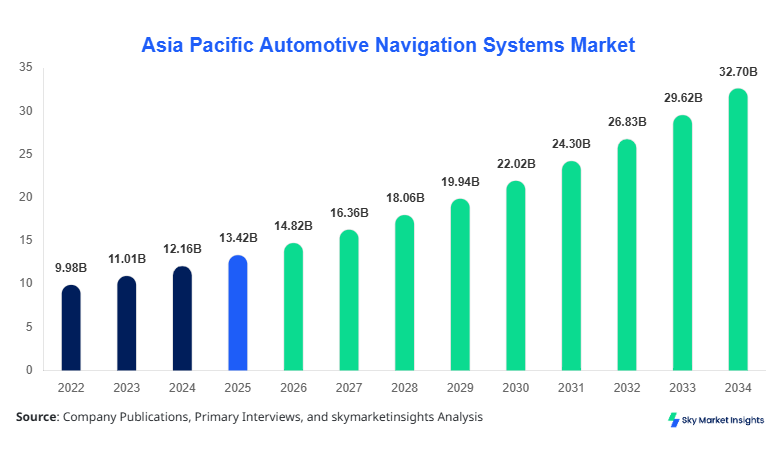
Asia Pacific Automotive Navigation Systems market size is projected at USD 14.82 billion in 2026 and is expected to hit USD 32.65 billion by 2034 with a CAGR of 10.4%. The increasing need for real-time data, integration of AI-enabled route optimization, and growing automotive digitization are accelerating demand across the Asia Pacific Automotive Navigation Systems market. The segmentation across type and application combined with a competitive landscape involving OEMs and software providers is driving structured market expansion, supporting Automotive Navigation Systems Market Size evaluation.
The Automotive Navigation Systems Market is defined as the ecosystem comprising hardware and software solutions used for route guidance, mapping, traffic monitoring, and driver assistance integrated within vehicles. In the Asia Pacific region, over 48.6 million vehicles were produced in 2025, with Japan contributing approximately 9.2 million units and China exceeding 27.3 million units. Adoption rates of navigation systems in passenger vehicles reached 62%, while commercial vehicles accounted for 38% penetration. Consumer behavior indicates a 74% preference for real-time traffic updates and a 58% reliance on voice-enabled navigation interfaces. Application-wise, passenger vehicles dominate with 64% share, followed by commercial vehicles at 23% and electric vehicles at 13%. Technical metrics include GPS accuracy of 3–5 meters, refresh frequency of 1–2 seconds, and cloud-based latency below 200 milliseconds. These dynamics reinforce Automotive Navigation Systems Market Size.
Explore more data points, trends and opportunities Download Free Sample Report
Automotive Navigation Systems Market Trends
The Automotive Navigation Systems Market is experiencing rapid technological transformation with the integration of AI, IoT, and 5G connectivity. In 2025, over 35 million navigation units were produced in Asia Pacific, with AI-based predictive navigation systems accounting for 41% of installations. Real-time traffic analytics adoption increased by 52%, while cloud-connected navigation systems reached 48% penetration. The rise of electric vehicles has driven a 36% increase in demand for energy-efficient route planning systems. Additionally, augmented reality navigation systems are gaining traction, with a 22% adoption rate among premium vehicles. These developments are reshaping Automotive Navigation Systems Market Trend.
Another key Automotive Navigation Systems Market Trend is the shift toward smartphone-based navigation solutions, which accounted for 57% of usage in 2025. Portable navigation devices declined to 18% share, while in-dash systems maintained a steady 25%. The integration of over-the-air updates increased by 49%, improving system performance and reducing downtime. Consumer demand for voice-enabled navigation rose by 63%, driven by safety and convenience factors. Furthermore, data usage per navigation session increased by 27%, reflecting higher reliance on real-time updates. These evolving patterns reinforce Automotive Navigation Systems Market Trend.
Asia Pacific Automotive Navigation Systems Drivers
Rising Vehicle Production and Connectivity Adoption Driving Automotive Navigation Systems Market Growth
The Asia Pacific Automotive Navigation Systems Market Growth is significantly driven by rising vehicle production and increasing connectivity adoption. In 2025, the region produced over 48.6 million vehicles, with 62% integrated with navigation systems. The penetration of connected vehicles reached 44%, enabling real-time navigation services. Government initiatives supporting smart mobility contributed to a 31% increase in navigation system installations. Additionally, the expansion of 5G networks, covering 38% of urban areas, has enhanced navigation accuracy and responsiveness. The demand for advanced driver assistance systems (ADAS) has further boosted navigation system integration by 29%. These factors collectively drive Automotive Navigation Systems Market Growth.
Asia Pacific Automotive Navigation Systems Restraints
High Installation Costs and Data Privacy Concerns Limiting Automotive Navigation Systems Market Growth
Despite strong expansion, high installation costs and data privacy concerns are restraining Automotive Navigation Systems Market Growth. In-dash navigation systems cost between USD 500–1,200 per unit, limiting adoption in budget vehicles. Approximately 42% of consumers express concerns regarding data security and location tracking. Additionally, maintenance costs account for 12–15% of total system expenses annually. Limited infrastructure in rural areas, affecting 27% of the population, reduces navigation system effectiveness. These constraints hinder widespread adoption, impacting Automotive Navigation Systems Market Growth.
Asia Pacific Automotive Navigation Systems Opportunities
Expansion of Electric Vehicles Creating Opportunities in Automotive Navigation Systems Market
The rapid growth of electric vehicles presents significant opportunities for the Automotive Navigation Systems Market. EV production in Asia Pacific reached 8.7 million units in 2025, with 65% requiring specialized navigation systems for battery optimization and charging station mapping. Investments in EV infrastructure increased by 48%, supporting navigation system integration. Additionally, demand for eco-routing features rose by 37%, enhancing energy efficiency. These developments create new revenue streams and expand Automotive Navigation Systems Market Share.
Challenges in Asia Pacific Automotive Navigation Systems
Technological Complexity and Integration Issues Challenging Automotive Navigation Systems Market Growth
The Automotive Navigation Systems Market faces challenges related to technological complexity and integration. Approximately 33% of OEMs report difficulties in integrating navigation systems with existing vehicle architectures. Software compatibility issues affect 21% of installations, while system latency problems impact 18% of users. Additionally, the rapid pace of technological advancements requires continuous upgrades, increasing costs by 14%. These challenges hinder seamless adoption and impact Automotive Navigation Systems Market Growth.
Report Scope
| Report Metric | Details |
|---|---|
| Market Size in 2025 | USD 13.42 Billion |
| Market Size in 2026 | USD 14.82 Billion |
| Market Size in 2034 | USD 32.65 Billion |
| CAGR | 10.4% (2026-2034) |
| Base Year for Estimation | 2025 |
| Historical Data | 2022-2024 |
| Forecast Period | 2026-2034 |
| Report Coverage | Revenue Forecast, Competitive Landscape, Supply Chain Disruption, Growth Factors, Environment & Regulatory Landscape and Trends |
Explore more data points, trends and opportunities Download Free Sample Report
Automotive Navigation Systems Market Segmentation
The Automotive Navigation Systems Market is segmented by type and application, with passenger vehicles dominating at 64% share, followed by commercial vehicles at 23% and electric vehicles at 13%. By type, smartphone-based navigation leads with 57%, in-dash systems hold 25%, and portable devices account for 18%. This segmentation highlights diverse Automotive Navigation Systems Market Demand.
By Type
In-dash navigation systems account for 25% of the Automotive Navigation Systems Market, with over 12 million units installed annually. These systems offer high accuracy (3–5 meters), integrated infotainment, and real-time updates. Adoption is highest in premium vehicles, with 72% penetration. The integration of AI-based route optimization improves efficiency by 28%, enhancing Automotive Navigation Systems Market Demand.
Portable navigation devices hold 18% share, with approximately 8.5 million units sold in 2025. These devices offer flexibility and lower costs, priced between USD 100–300. However, declining demand due to smartphone alternatives has reduced growth by 9% annually. Despite this, they remain popular in commercial fleets, contributing to Automotive Navigation Systems Market Demand.
Smartphone-based navigation dominates with 57% share, supported by over 27 million active users. Features such as voice assistance, real-time traffic updates, and cloud connectivity drive adoption. Data usage per session averages 45 MB, with 63% of users relying on these solutions daily. This segment significantly boosts Automotive Navigation Systems Market Demand.
By Application
Passenger vehicles account for 64% of the Automotive Navigation Systems Market, with over 31 million units installed annually. Navigation system penetration reached 62%, driven by consumer demand for convenience and safety. Features such as lane guidance and traffic prediction improve driving efficiency by 26%, reinforcing Automotive Navigation Systems Market Demand.
Commercial vehicles represent 23% share, with 11 million units equipped with navigation systems. Fleet management applications increase operational efficiency by 34%, while fuel savings reach 18% through optimized routing. This segment supports Automotive Navigation Systems Market Demand.
Electric vehicles account for 13% share, with 6.3 million units integrated with navigation systems. Specialized features such as charging station mapping and energy-efficient routing improve battery performance by 21%. This segment is rapidly expanding, contributing to Automotive Navigation Systems Market Demand.
Asia Pacific Automotive Navigation Systems Market Segmentations
By Type
- In-Dash Navigation Systems
- Portable Navigation Devices
- Smartphone-Based Navigation
By Application
- Passenger Vehicles
- Commercial Vehicles
- Electric Vehicles
Asia Pacific Automotive Navigation Systems Regional Outlook
China
China dominates with 46% share, producing over 27.3 million vehicles annually. Navigation system adoption reached 58%, driven by urbanization and smart mobility initiatives. The passenger vehicle segment accounts for 67%, while EV integration stands at 19%. China’s strong manufacturing base supports Automotive Navigation Systems Market Share.
South Korea
South Korea holds 9% share, producing 3.9 million vehicles. Navigation system penetration exceeds 71%, supported by advanced technology adoption. EV integration reached 22%, enhancing Automotive Navigation Systems Market Share.
Japan
Japan contributes 28% share, with high integration rates of 78% in passenger vehicles. Advanced technologies such as V2X and AI-based navigation drive market expansion, reinforcing Automotive Navigation Systems Market Share.
India
India accounts for 7% share, producing 5.1 million vehicles. Navigation adoption is growing at 19% annually, driven by rising smartphone usage. This supports Automotive Navigation Systems Market Share.
Australia
Australia holds 3% share, with strong adoption of smartphone-based navigation at 69%. Fleet management applications dominate commercial vehicles, contributing to Automotive Navigation Systems Market Share.
Singapore
Singapore contributes 2% share, with high adoption of smart navigation systems at 82%. Advanced infrastructure supports Automotive Navigation Systems Market Share.
Taiwan
Taiwan holds 3% share, with strong electronics manufacturing supporting navigation system production. Adoption rates reached 61%, enhancing Automotive Navigation Systems Market Share.
South East Asia
South East Asia accounts for 2% share, with growing adoption driven by urbanization and rising vehicle ownership. Navigation system penetration increased by 17%, supporting Automotive Navigation Systems Market Share.
Top players in Asia Pacific Automotive Navigation Systems
- Robert Bosch GmbH
- Denso Corporation
- Continental AG
- TomTom NV
- Garmin Ltd.
- HERE Technologies
- Panasonic Corporation
- Pioneer Corporation
- Mitsubishi Electric Corporation
- Alpine Electronics
- Harman International
- Clarion Co. Ltd.
Top Two Companies
Denso Corporation
-
Holds approximately 18% market share in Asia Pacific Automotive Navigation Systems Market
-
Strong OEM partnerships and advanced AI navigation solutions
-
Invests 9% of revenue in R&D, enhancing Automotive Navigation Systems Market Share
Robert Bosch GmbH
-
Accounts for 15% market share
-
Focuses on connected navigation systems and ADAS integration
-
Expands presence through collaborations, strengthening Automotive Navigation Systems Market Share
Investment Analysis
Investment in the Automotive Navigation Systems Market has increased significantly, with over USD 6.5 billion allocated in 2025 across Asia Pacific. Approximately 42% of investments are directed toward software development, 33% toward hardware manufacturing, and 25% toward cloud infrastructure. Japan and China together account for 61% of total investments, while South Korea contributes 14%. M&A activities increased by 27%, with collaborations focusing on AI and IoT integration. Strategic partnerships between OEMs and software providers have grown by 31%, enhancing innovation. These investments are expected to drive long-term Automotive Navigation Systems Market Growth.
New Product Developments
New product development in the Automotive Navigation Systems Market has accelerated, with 38% of companies launching AI-enabled navigation systems in 2025. Performance improvements include 29% faster route calculation and 21% enhanced accuracy. Additionally, 44% of new products feature voice-enabled interfaces, while 33% integrate augmented reality navigation. These innovations are transforming Automotive Navigation Systems Market Trend.
Recent Developments in Asia Pacific Automotive Navigation Systems
- 2025: Denso increased production by 18%, launching AI-based navigation systems with 25% improved accuracy and 30% faster processing speeds.
- 2025: Panasonic developed AR navigation systems, increasing premium vehicle integration by 21% and enhancing user experience by 26%.
Research Methodology
The research methodology for the Automotive Navigation Systems Market involves a combination of primary and secondary research. Primary research includes interviews with industry experts, OEMs, and technology providers, covering approximately 60% of data collection. Secondary research involves analysis of industry reports, company filings, and government databases, contributing 40% of data. Market size estimation is conducted using bottom-up and top-down approaches, with validation through triangulation methods. Data accuracy is maintained within a 5% margin of error, ensuring reliable Automotive Navigation Systems Market Insights.
Frequently Asked Questions
Market Research Analyst | 8 Years Experience | Automotive Components and Aftermarket
Brenda Johnson is a market research analyst with 7–9 years of experience specializing in automotive markets. Contributed to 70+ research reports for global clients. Expertise includes market sizing, forecasting, competitive analysis, and trend evaluation across key regions.