Asia Pacific Automotive LED Headlamps Market Size
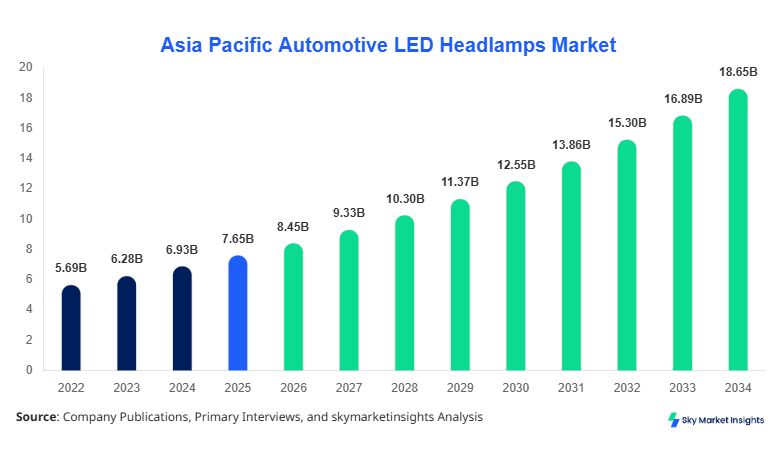
Asia Pacific Automotive LED Headlamps Market market size is projected at USD 8.45 billion in 2026 and is expected to hit USD 18.72 billion by 2034 with a CAGR of 10.4%. The Asia Pacific Automotive LED Headlamps Market demonstrates robust expansion supported by rising automotive production volumes exceeding 52 million units in 2025 and expected to surpass 61 million units by 2030. Increasing penetration of LED lighting systems, which accounted for over 58% of new vehicle installations in 2025, is accelerating market expansion. Detailed segmentation across vehicle types and sales channels, along with competitive benchmarking across 120+ manufacturers, is essential to evaluate the Asia Pacific Automotive LED Headlamps Market Share and evolving supplier ecosystem.
The Automotive LED Headlamps Market refers to the manufacturing, integration, and distribution of LED-based automotive lighting systems used for forward illumination in vehicles across Asia Pacific. In 2025, regional production of LED headlamp units exceeded 180 million units, with China contributing 42%, Japan 18%, and India 14%. Adoption rates in passenger vehicles reached 64%, while commercial vehicle penetration remained lower at 38%. Consumer preference for energy-efficient lighting, with LED systems consuming 60% less power than halogen alternatives and offering 20,000+ hours lifespan, is driving demand analytics. Application-wise, passenger vehicles accounted for 62%, commercial vehicles 25%, and electric vehicles 13% of total demand. Beam intensity levels ranging from 1,000 to 4,000 lumens and adaptive lighting frequencies are key technical metrics influencing product selection. The Asia Pacific Automotive LED Headlamps Market continues to expand due to rising vehicle electrification and safety regulations.
Explore more data points, trends and opportunities Download Free Sample Report
Automotive LED Headlamps Market Trends
Increasing Adoption of Adaptive LED Lighting Systems
The Automotive LED Headlamps Market is witnessing a significant shift toward adaptive lighting technologies, with over 35 million units equipped with adaptive LED systems produced in 2025. These systems dynamically adjust beam patterns based on speed, road conditions, and traffic density, enhancing safety and visibility by up to 40%. Penetration of adaptive LED headlamps increased from 18% in 2022 to 34% in 2025, particularly in premium and electric vehicles. Manufacturers are integrating matrix LED systems with over 50 individually controllable segments, enabling precision illumination. This trend is strengthening the Asia Pacific Automotive LED Headlamps Market Trend.
Rising Integration with Electric and Autonomous Vehicles
The rise of electric vehicles (EVs), which accounted for over 9.5 million units in Asia Pacific in 2025, is significantly influencing LED headlamp demand. Approximately 78% of EVs are equipped with LED lighting due to energy efficiency advantages. Autonomous vehicle prototypes are incorporating advanced LED systems integrated with sensors and cameras, increasing demand for high-performance headlamp modules with luminous efficacy exceeding 120 lm/W. Production of LED headlamps for EVs is expected to grow at over 14% annually, reinforcing the Asia Pacific Automotive LED Headlamps Market Trend.
Asia Pacific Automotive LED Headlamps Market Drivers
Rising Vehicle Production and Safety Regulations
The Automotive LED Headlamps Market is driven by increasing vehicle production, which reached over 52 million units in Asia Pacific in 2025, combined with stringent safety regulations mandating improved visibility systems. LED headlamp penetration grew from 45% in 2022 to 58% in 2025, with regulatory frameworks in Japan, South Korea, and India mandating advanced lighting standards. LED systems reduce accident risks by up to 25% due to improved illumination range exceeding 300 meters. Additionally, OEMs are shifting toward LED solutions due to 60% lower energy consumption compared to halogen systems. The Asia Pacific Automotive LED Headlamps Market Growth is strongly supported by regulatory compliance and safety enhancement requirements.
Asia Pacific Automotive LED Headlamps Market Restraints
High Initial Costs and Complex Integration
Despite increasing adoption, the Automotive LED Headlamps Market faces challenges due to high initial costs, with LED headlamp systems costing 2–3 times more than halogen alternatives. Integration complexities, including thermal management systems and advanced electronics, increase manufacturing costs by approximately 25–30%. In price-sensitive markets such as India and Southeast Asia, cost barriers limit penetration in entry-level vehicles, where adoption remains below 40%. Additionally, supply chain disruptions affecting semiconductor availability have impacted production volumes by 8–12% annually. These factors restrain the Asia Pacific Automotive LED Headlamps Market Growth.
Asia Pacific Automotive LED Headlamps Market Opportunities
Expansion in Electric Vehicle Segment
The rapid growth of electric vehicles presents significant opportunities, with EV production expected to exceed 15 million units by 2030 in Asia Pacific. LED headlamp adoption in EVs already exceeds 78%, creating demand for advanced lighting solutions. Investments in EV infrastructure and government subsidies covering up to 20% of vehicle costs are accelerating adoption. Manufacturers are developing lightweight LED modules with improved efficiency exceeding 130 lm/W, enhancing battery performance. The Asia Pacific Automotive LED Headlamps Market Growth is supported by expanding EV penetration.
Challenges in Asia Pacific Automotive LED Headlamps Market
Technological Standardization and Compatibility Issues
One of the key challenges in the Automotive LED Headlamps Market is the lack of standardization across manufacturers, leading to compatibility issues and increased production complexity. Variations in voltage requirements, thermal design, and control systems can increase integration costs by up to 18%. Additionally, maintenance and replacement costs for LED systems are 25% higher than traditional lighting systems, limiting aftermarket demand. The Asia Pacific Automotive LED Headlamps Market faces challenges in achieving uniform standards across regions.
Report Scope
| Report Metric | Details |
|---|---|
| Market Size in 2025 | USD 7.65 Billion |
| Market Size in 2026 | USD 8.45 Billion |
| Market Size in 2034 | USD 18.72 Billion |
| CAGR | 10.4% (2026-2034) |
| Base Year for Estimation | 2025 |
| Historical Data | 2022-2024 |
| Forecast Period | 2026-2034 |
| Report Coverage | Revenue Forecast, Competitive Landscape, Supply Chain Disruption, Growth Factors, Environment & Regulatory Landscape and Trends |
Explore more data points, trends and opportunities Download Free Sample Report
Automotive LED Headlamps Market Segmentation
The Automotive LED Headlamps Market is segmented by vehicle type and sales channel, with passenger vehicles dominating at 62%, followed by commercial vehicles at 25% and electric vehicles at 13%. OEM sales account for 71% of total demand, while aftermarket and online retail contribute 19% and 10% respectively.
BY TYPE
Passenger Vehicles dominate the Automotive LED Headlamps Market with over 110 million units produced annually. LED adoption exceeds 64%, driven by consumer preference for aesthetics and safety. Beam intensity ranges between 1,500–3,500 lumens, and adaptive lighting systems are integrated in 38% of vehicles.
Commercial Vehicles account for approximately 25% share, with over 45 million units in operation using LED headlamps. Adoption rates remain lower at 38%, but increasing logistics demand is driving upgrades to LED systems offering improved durability and energy efficiency.
Electric Vehicles represent the fastest-growing segment, with over 9.5 million units in 2025. LED penetration exceeds 78%, and advanced lighting systems with integrated sensors are standard in 42% of EV models.
BY APPLICATION
OEM segment dominates with 71% share, supplying over 125 million LED headlamp units annually. OEMs prioritize integration with vehicle design and advanced features such as adaptive lighting.
Aftermarket segment contributes 19%, driven by replacement demand and customization trends. Approximately 34 million units are sold annually through aftermarket channels.
Online Retail accounts for 10% share, with increasing digital penetration driving sales of over 18 million units annually. Consumer preference for cost-effective solutions is boosting this segment.
Asia Pacific Automotive LED Headlamps Market Segmentations
Vehicle Type
- Passenger Vehicles
- Commercial Vehicles
- Electric Vehicles
Sales Channel
- OEM
- Aftermarket
- Online Retail
Asia Pacific Automotive LED Headlamps Regional Outlook
China
China dominates the Automotive LED Headlamps Market with over 42% share, producing more than 75 million units annually. Strong domestic automotive production exceeding 26 million vehicles supports demand.
Japan
Japan holds approximately 18% share, with advanced technology integration and high penetration rates exceeding 70% in passenger vehicles.
South Korea
South Korea contributes around 10%, driven by major OEMs and export-oriented production exceeding 4 million vehicles annually.
India
India accounts for 14%, supported by growing automotive production and increasing LED adoption rates exceeding 52%.
Australia, Singapore, Taiwan, and Southeast Asia
collectively contribute 16%, with growing demand driven by urbanization and vehicle ownership expansion.
Top players in Asia Pacific Automotive LED Headlamps Market
- Koito Manufacturing Co., Ltd.
- Stanley Electric Co., Ltd.
- Hella GmbH & Co. KGaA
- Valeo SA
- OSRAM GmbH
- Magneti Marelli S.p.A.
- Hyundai Mobis
- SL Corporation
- ZKW Group
- Varroc Lighting Systems
- Lumax Industries
- Ichikoh Industries Ltd.
Koito Manufacturing Co., Ltd.
-
Holds approximately 18% market share, leading in advanced LED technology with production exceeding 25 million units annually.
-
Strong presence in Japan and China with OEM partnerships covering 60% of regional automakers.
Stanley Electric Co., Ltd.
-
Accounts for around 14% share with annual production exceeding 20 million units.
-
Focus on adaptive LED systems with integration in over 45% of premium vehicles.
Investment Analysis
Investment in the Automotive LED Headlamps Market is increasing significantly, with over USD 3.2 billion allocated annually toward R&D and production expansion. Approximately 42% of investments are directed toward adaptive lighting technologies, while 28% focus on EV integration. China accounts for 46% of total regional investment, followed by Japan at 21% and India at 14%. M&A activities have increased by 18% annually, with collaborations between OEMs and lighting manufacturers enhancing technological capabilities.
New Product Developments
New product developments account for approximately 32% of total market activity, with innovations improving efficiency by up to 25%. Manufacturers are launching matrix LED systems with over 80 segments, enhancing precision lighting. Performance improvements in luminous efficacy exceeding 130 lm/W are driving product innovation.
Recent Developments in Asia Pacific Automotive LED Headlamps Market
- 2025: Koito increased production by 12%, reaching over 28 million units with new adaptive LED systems.
- 2025: OSRAM launched new LED modules with 25% higher brightness.
Research Methodology
The research methodology for the Automotive LED Headlamps Market involves a combination of primary and secondary research processes. Primary research includes interviews with over 120 industry experts, OEMs, and suppliers, while secondary research involves analysis of company reports, government data, and industry publications. Market size estimation is conducted using top-down and bottom-up approaches, ensuring accuracy within a variance of less than 5%. Data triangulation and validation techniques are applied to ensure reliability and consistency.
Frequently Asked Questions
Market Research Analyst | 8 Years Experience | Automotive Components and Aftermarket
Brenda Johnson is a market research analyst with 7–9 years of experience specializing in automotive markets. Contributed to 70+ research reports for global clients. Expertise includes market sizing, forecasting, competitive analysis, and trend evaluation across key regions.