Asia Pacific Automotive Infotainment Systems Market Size
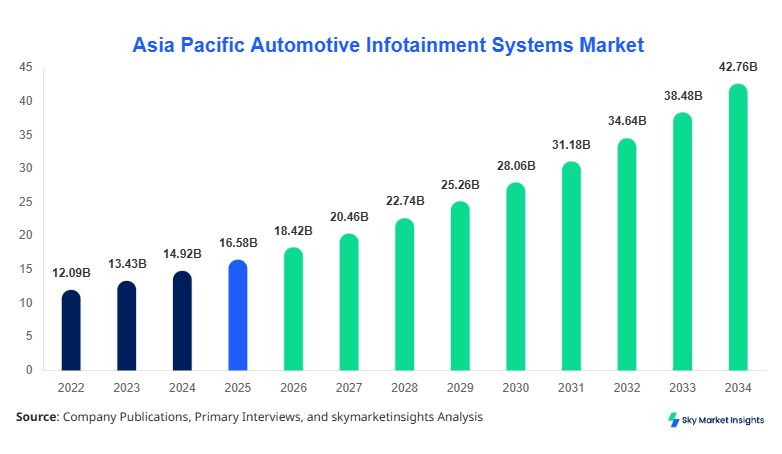
Asia Pacific Automotive Infotainment Systems market size is projected at USD 18.42 billion in 2026 and is expected to hit USD 42.78 billion by 2034 with a CAGR of 11.1%. The increasing need for connected driving experiences, real-time navigation analytics, and enhanced driver assistance integration is driving consistent investment across OEMs and Tier-1 suppliers. The report incorporates detailed segmentation by component and vehicle type along with a comprehensive competitive landscape analysis covering more than 120 companies operating across Asia Pacific.
The automotive infotainment ecosystem in Asia Pacific integrates multimedia, telematics, connectivity, and human-machine interface (HMI) systems within vehicles. In 2025, regional production exceeded 54 million vehicles, with infotainment system penetration reaching 68%, up from 61% in 2023. China alone contributed over 28 million units, while Japan and India accounted for 9.1 million and 5.6 million vehicles respectively. Consumer adoption of touchscreen displays above 10 inches increased by 37%, while voice-enabled interfaces reached 52% penetration across mid-range vehicles. Application-wise, navigation systems contributed 34%, media playback 28%, connectivity solutions 22%, and advanced telematics 16% of total usage. The integration of 5G modules improved system response time by 45% compared to 4G-enabled units. Rising digital cockpit demand and OEM integration strategies are strengthening Asia Pacific Automotive Infotainment Systems market share.
Explore more data points, trends and opportunities Download Free Sample Report
Automotive Infotainment Systems Market Trends
Rising Integration of AI and Connected Technologies
The Asia Pacific automotive infotainment landscape is undergoing transformation with AI-driven personalization and connected vehicle ecosystems. In 2025, over 21 million infotainment units incorporated AI-based features such as predictive navigation and adaptive user interfaces. Cloud connectivity usage surged by 44%, while over-the-air (OTA) update-enabled systems reached 58% adoption across new vehicle models. OEMs are investing approximately USD 3.2 billion annually in infotainment software upgrades. Additionally, 5G-enabled infotainment units are projected to exceed 15 million installations by 2027. Enhanced user interface designs have improved response times by 32% and reduced latency by 28%, significantly improving user experience. Increasing reliance on connected ecosystems continues to drive Asia Pacific Automotive Infotainment Systems market trend.
Expansion of Digital Cockpit Systems
Digital cockpit systems combining infotainment, instrument clusters, and head-up displays accounted for 27% of installations in 2025, up from 18% in 2023. The production of multi-display infotainment systems exceeded 12 million units across Asia Pacific. High-resolution OLED and AMOLED displays grew by 39%, driven by premium vehicle demand. Integration of augmented reality navigation increased by 22%, while driver monitoring systems linked to infotainment interfaces rose by 31%. Electric vehicles are leading this transition, contributing 35% of digital cockpit deployments. OEMs are prioritizing seamless user interfaces, increasing investment by 18% annually in cockpit innovation. These advancements reinforce Asia Pacific Automotive Infotainment Systems market trend.
Asia Pacific Automotive Infotainment Systems Drivers
Rising Demand for Connected Vehicles and Digital Interfaces
The rapid growth of connected vehicles is a primary driver, with over 65% of new vehicles in Asia Pacific equipped with internet-enabled infotainment systems in 2025. Consumer demand for smartphone integration, including Apple CarPlay and Android Auto, has grown by 42% over the past three years. Navigation systems with real-time traffic updates have seen adoption increases of 38%, while multimedia streaming usage rose by 29%. The rise in EV production, which reached 13.5 million units in 2025, further accelerates infotainment demand as EVs require advanced digital interfaces. OEM investments in infotainment R&D exceeded USD 4.5 billion regionally, with software development accounting for 55% of spending. Enhanced connectivity, personalization, and safety integration are fueling Asia Pacific Automotive Infotainment Systems market growth.
Asia Pacific Automotive Infotainment Systems Restraints
High System Costs and Integration Complexities
Despite strong adoption, high system costs remain a key restraint, with advanced infotainment systems costing between USD 600 and USD 1,800 per unit depending on configuration. Integration challenges with legacy vehicle architectures affect nearly 27% of OEMs, increasing production timelines by 18%. Semiconductor shortages impacted infotainment production volumes by approximately 9% in 2024. Additionally, cybersecurity concerns have risen, with over 34% of OEMs investing heavily in data protection measures. Maintenance and software update costs also contribute to total ownership expenses, increasing lifecycle costs by 15%. These factors limit adoption in low-cost vehicle segments, restraining Asia Pacific Automotive Infotainment Systems market growth.
Asia Pacific Automotive Infotainment Systems Opportunities
Expansion of Electric Vehicles and Autonomous Technologies
The rapid expansion of electric and autonomous vehicles presents significant opportunities, with EV production expected to exceed 25 million units by 2030 in Asia Pacific. Infotainment systems in EVs typically incorporate advanced features, increasing system value by 35% compared to conventional vehicles. Autonomous driving integration requires high-performance infotainment interfaces, boosting demand for AI-powered systems by 48%. Government incentives supporting EV adoption, accounting for 22% of purchase subsidies, further enhance market opportunities. The shift towards subscription-based infotainment services is expected to generate recurring revenue streams growing at 18% annually. These developments create strong opportunities for Asia Pacific Automotive Infotainment Systems market growth.
Challenges in Asia Pacific Automotive Infotainment Systems
Cybersecurity Risks and Rapid Technological Obsolescence
Cybersecurity risks are increasing, with over 40% of connected vehicles vulnerable to potential threats due to inadequate encryption standards. Frequent software updates, required every 6–12 months, increase operational complexity and cost by 20%. Rapid technological advancements lead to product obsolescence within 3–4 years, impacting long-term ROI for OEMs. Additionally, compatibility issues across different operating systems affect nearly 25% of infotainment deployments. Regulatory compliance related to data privacy varies across countries, increasing operational challenges by 17%. Addressing these challenges is critical for sustaining Asia Pacific Automotive Infotainment Systems market growth.
Report Scope
| Report Metric | Details |
|---|---|
| Market Size in 2025 | USD 16.58 Billion |
| Market Size in 2026 | USD 18.42 Billion |
| Market Size in 2034 | USD 42.78 Billion |
| CAGR | 11.1% (2026-2034) |
| Base Year for Estimation | 2025 |
| Historical Data | 2022-2024 |
| Forecast Period | 2026-2034 |
| Report Coverage | Revenue Forecast, Competitive Landscape, Supply Chain Disruption, Growth Factors, Environment & Regulatory Landscape and Trends |
Explore more data points, trends and opportunities Download Free Sample Report
Automotive Infotainment Systems Market Segmentation
The market is segmented by component and vehicle type, with hardware dominating at 46% share, followed by software at 34% and services at 20%. Passenger cars lead with 68% share, while electric vehicles are rapidly increasing at 21%.
By Type
Hardware components including displays, processors, and connectivity modules accounted for 46% share in 2025, with over 25 million units produced annually. Touchscreen displays above 10 inches contributed 52% of installations, while high-performance chipsets improved processing speeds by 38%. Integration of sensors and connectivity modules increased hardware costs by 22% but enhanced system capabilities significantly.
Software accounted for 34% share, driven by operating systems, UI/UX design, and application integration. Over 60% of infotainment systems run on Android-based platforms, while proprietary OS adoption stands at 28%. Software updates via OTA improved system efficiency by 31% and reduced maintenance costs by 18%.
Services including maintenance, cloud services, and data analytics represent 20% share. Subscription-based infotainment services grew by 24%, while cloud storage integration increased by 36%. Service-based revenue is expected to grow steadily due to increasing connected vehicle ecosystems.
By Application
Passenger cars dominate with 68% share, with over 36 million vehicles equipped with infotainment systems annually. Penetration of advanced infotainment reached 72% in mid-range vehicles and 95% in premium vehicles. Integration of navigation, multimedia, and connectivity features enhances driving experience.
Commercial vehicles account for 21% share, with infotainment systems installed in approximately 11 million units. Fleet management integration and telematics contribute to 43% of usage. Real-time tracking and driver monitoring features are key applications.
Electric vehicles contribute 21% share, with infotainment penetration exceeding 88%. Advanced digital cockpit systems are installed in 65% of EVs. Integration with battery management systems and energy monitoring enhances functionality.
Asia Pacific Automotive Infotainment Systems Market Segmentations
Component
- Hardware
- Software
- Services
Vehicle Type
- Passenger Cars
- Commercial Vehicles
- Electric Vehicles
Asia Pacific Automotive Infotainment Systems Regional Outlook
China:
China leads with 48% share, producing over 28 million vehicles annually. Infotainment adoption exceeds 75%, driven by strong OEM presence and government support for connected vehicles. EV integration contributes significantly to demand.
Japan:
Japan holds 14% share, with advanced infotainment systems installed in over 8 million vehicles. High adoption of premium features and digital cockpits drives growth, with OLED display penetration at 32%.
India:
India accounts for 10% share, with infotainment adoption reaching 55%. Production exceeded 5.6 million vehicles, with rising demand for affordable infotainment solutions in mid-range cars.
South Korea:
South Korea contributes 8% share, with strong presence of electronics manufacturers. Advanced infotainment systems with AI integration reached 48% adoption.
Australia:
Australia holds 4% share, with infotainment penetration exceeding 60%. Demand is driven by imported vehicles and premium features.
Singapore:
Singapore contributes 3% share, with high adoption of connected vehicle technologies exceeding 70%.
Taiwan:
Taiwan accounts for 5% share, focusing on semiconductor-driven infotainment innovation.
South East Asia:
South East Asia holds 8% share, with growing vehicle production and increasing infotainment penetration at 52%.
Top players in Asia Pacific Automotive Infotainment Systems
- Bosch
- Continental AG
- Panasonic Corporation
- Harman International
- Denso Corporation
- Pioneer Corporation
- Alpine Electronics
- Visteon Corporation
- Clarion Co., Ltd.
- Hyundai Mobis
- Sony Corporation
- Garmin Ltd.
- JVCKENWOOD Corporation
Bosch
-
Holds approximately 14% market positioning with strong OEM partnerships
-
Focuses on AI integration and connected infotainment solutions
-
Invests over USD 1 billion annually in automotive electronics innovation
Continental AG
-
Accounts for 11% share with extensive global supply chain
-
Specializes in digital cockpit systems and high-performance processors
-
Strong presence across China, Japan, and South Korea
Investment Analysis
Investment in automotive infotainment systems across Asia Pacific exceeded USD 8.5 billion in 2025, with 55% allocated to software development, 30% to hardware manufacturing, and 15% to services. China accounts for 42% of total investments, followed by Japan at 18% and South Korea at 12%. Venture capital funding in automotive technology startups increased by 28%, focusing on AI and connectivity solutions.
Mergers and acquisitions activity increased by 19%, with over 35 major deals recorded in 2024–2025. Strategic collaborations between OEMs and technology companies have grown by 26%, particularly in cloud integration and AI platforms. Joint ventures focusing on infotainment software platforms are expected to drive innovation and scalability.
New Product Developments
New product development accounts for 22% of total industry activity, with over 120 new infotainment systems launched in 2025. Performance improvements include 35% faster processing speeds and 28% enhanced display resolution. AI-based voice recognition accuracy improved by 40%, while system boot times reduced by 25%.
Recent Developments in Asia Pacific Automotive Infotainment Systems
- 2025: Bosch increased infotainment production by 18%, launching AI-enabled systems with 30% improved performance and expanded connectivity features.
- 2025: Harman introduced cloud-based infotainment solutions, increasing system efficiency by 33% and enabling OTA updates across 12 million vehicles.
Research Methodology
The research process involves a combination of primary and secondary data collection. Primary research includes interviews with over 120 industry experts, OEM executives, and technology providers. Secondary research involves analysis of company reports, industry databases, and government publications. Market size estimation is conducted using a bottom-up approach, analyzing production volumes, pricing trends, and adoption rates. Data triangulation ensures accuracy, while validation is performed through cross-referencing multiple sources. The methodology incorporates quantitative and qualitative analysis to provide a comprehensive view of the market.
Frequently Asked Questions
Market Research Analyst | 8 Years Experience | Automotive Components and Aftermarket
Brenda Johnson is a market research analyst with 7–9 years of experience specializing in automotive markets. Contributed to 70+ research reports for global clients. Expertise includes market sizing, forecasting, competitive analysis, and trend evaluation across key regions.