Asia Pacific Automobile TPMS Market Size
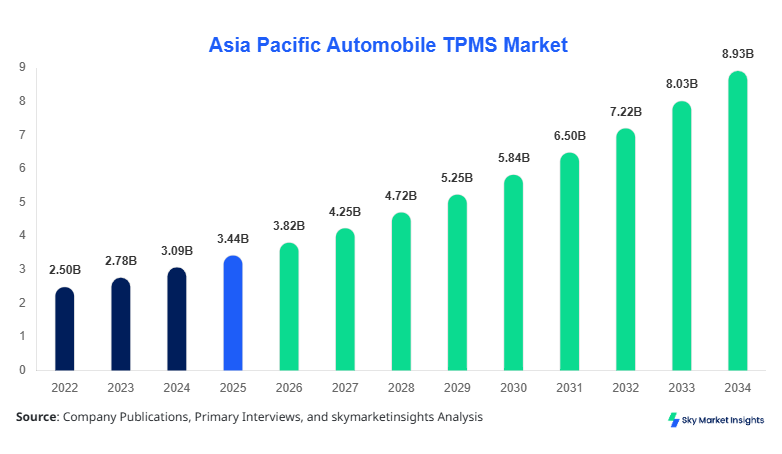
Asia Pacific Automobile TPMS market size is projected at USD 3.82 Billion in 2026 and is expected to hit USD 8.94 Billion by 2034 with a CAGR of 11.2%. The increasing integration of safety technologies, regulatory mandates across emerging economies, and rapid automotive production growth are driving demand across the region. The Automobile TPMS Market is characterized by detailed segmentation across sensor types, applications, and vehicle categories, supported by rising OEM adoption rates exceeding 68% in 2026. Competitive landscape analysis indicates over 45 major suppliers operating across Asia Pacific, with pricing variations ranging between USD 18–USD 65 per unit depending on sensor sophistication and vehicle integration levels.
The Automobile TPMS Market refers to tire pressure monitoring systems installed in vehicles to monitor real-time tire pressure and enhance vehicle safety and efficiency. In Asia Pacific, production exceeded 52 million vehicles in 2025, with TPMS penetration reaching approximately 61% across all vehicle segments, rising to 85% in passenger vehicles. Adoption and penetration insights indicate that direct TPMS accounts for nearly 72% of installations due to accuracy levels above 95%, while indirect TPMS holds around 28% share driven by cost efficiency. Consumer behavior reflects a strong inclination toward safety compliance, with over 74% of urban vehicle buyers prioritizing safety features such as TPMS. Demand analytics show that electric vehicles contribute nearly 18% of TPMS installations, expected to reach 32% by 2030. Technically, TPMS sensors operate within a frequency range of 315 MHz to 433 MHz with battery lifespans averaging 5–10 years. Application split indicates passenger vehicles contribute 64%, commercial vehicles 23%, and electric vehicles 13% of the total market. The Automobile TPMS Market continues to expand with increasing regulatory enforcement and consumer awareness.
Explore more data points, trends and opportunities Download Free Sample Report
Automobile TPMS Market Trends
The Automobile TPMS Market is witnessing significant technological advancements with production volumes surpassing 85 million TPMS units annually across Asia Pacific. Integration of IoT-enabled TPMS systems is increasing, with nearly 42% of new installations featuring wireless connectivity and real-time analytics. Smart TPMS solutions offering predictive maintenance capabilities have seen adoption growth of 28% year-over-year. Additionally, miniaturization of sensors has reduced weight by 18% while improving durability by 22%, making them more efficient for electric vehicles. The Automobile TPMS Market is evolving rapidly with advanced sensor technologies and connectivity features.
Another key trend in the Automobile TPMS Market includes the growing shift toward hybrid TPMS systems, combining both direct and indirect technologies. Hybrid systems currently represent 14% of installations but are expected to exceed 30% by 2032. Production efficiency improvements have reduced manufacturing costs by 12%, allowing broader adoption across mid-range vehicle segments. Furthermore, demand from electric vehicles has increased TPMS installations by 35% between 2024 and 2026, driven by higher safety standards. The Automobile TPMS Market is experiencing strong transformation due to hybridization and electrification trends.
Asia Pacific Automobile TPMS Drivers
Rising Vehicle Production and Safety Regulations Driving Adoption
The Asia Pacific Automobile TPMS Market is significantly driven by increasing vehicle production, which exceeded 52 million units in 2025, coupled with strict safety regulations across countries such as India, China, and Japan. Regulatory mandates requiring TPMS installation in over 80% of new vehicles have accelerated adoption rates. Passenger vehicle sales grew by 9.6% in 2025, directly boosting TPMS demand by 11.8%. Additionally, fuel efficiency regulations have led to a 6–8% improvement in mileage due to optimized tire pressure monitoring. OEM integration rates have surpassed 70%, while aftermarket demand contributes nearly 18% of total installations. The Automobile TPMS Market continues to grow due to stringent safety mandates and rising automotive output.
Asia Pacific Automobile TPMS Restraints
High Installation and Maintenance Costs Limiting Adoption
Despite strong growth, the Automobile TPMS Market faces restraints due to high installation costs ranging between USD 40–USD 120 per vehicle and maintenance expenses averaging USD 15–USD 25 annually. Small-scale manufacturers struggle with compliance costs, resulting in only 54% adoption among budget vehicle segments. Additionally, sensor battery replacement cycles of 5–7 years increase ownership costs by approximately 12%. In developing regions, awareness levels remain below 48%, limiting penetration in rural markets. The Automobile TPMS Market faces challenges in cost sensitivity and limited awareness in price-sensitive economies.
Asia Pacific Automobile TPMS Opportunities
Expansion of Electric Vehicles Creating New Demand Avenues
The rapid growth of electric vehicles presents a significant opportunity for the Automobile TPMS Market, with EV production expected to exceed 18 million units by 2030 in Asia Pacific. EV-specific TPMS demand has grown by 35% annually due to higher safety and performance requirements. Investments in smart mobility solutions account for nearly 22% of total automotive R&D spending, creating opportunities for advanced TPMS integration. Furthermore, rising fleet management adoption has increased demand for TPMS solutions in logistics by 19%. The Automobile TPMS Market is poised to benefit from EV expansion and smart mobility integration.
Challenges in Asia Pacific Automobile TPMS
Technological Complexity and Integration Issues
The Automobile TPMS Market faces challenges related to technological complexity, including compatibility issues with diverse vehicle platforms, affecting nearly 16% of installations. Integration with advanced driver assistance systems (ADAS) requires precision levels above 98%, increasing development costs by 14%. Additionally, signal interference in high-density urban environments impacts performance accuracy by 5–7%. Limited skilled workforce availability in emerging economies further restricts efficient implementation. The Automobile TPMS Market continues to face hurdles in technology integration and performance optimization.
Report Scope
| Report Metric | Details |
|---|---|
| Market Size in 2025 | USD 3.44 Billion |
| Market Size in 2026 | USD 3.82 Billion |
| Market Size in 2034 | USD 8.94 Billion |
| CAGR | 11.2% (2026-2034) |
| Base Year for Estimation | 2025 |
| Historical Data | 2022-2024 |
| Forecast Period | 2026-2034 |
| Report Coverage | Revenue Forecast, Competitive Landscape, Supply Chain Disruption, Growth Factors, Environment & Regulatory Landscape and Trends |
Explore more data points, trends and opportunities Download Free Sample Report
Automobile TPMS Market Segmentation
The Automobile TPMS Market segmentation highlights that direct TPMS dominates with 72% share, followed by indirect TPMS at 28%, while passenger vehicles contribute the largest application share at 64%. Increasing electrification and regulatory compliance continue to influence segmentation dynamics.
By Type
Direct TPMS holds approximately 72% share in the Automobile TPMS Market, with production exceeding 60 million units annually. These systems provide real-time pressure data with accuracy levels above 95% and operate within 315 MHz to 433 MHz frequency ranges. Battery life spans between 7–10 years enhance long-term efficiency. High adoption in passenger vehicles, accounting for 68% of installations, drives growth.
Indirect TPMS accounts for around 28% share, utilizing ABS sensors for pressure estimation. Production volumes exceed 22 million units annually. While cost-effective with 20–30% lower pricing, accuracy levels remain between 70–80%. Adoption is higher in commercial vehicles at 35% due to lower installation costs.
Hybrid TPMS represents emerging technology with 14% adoption, combining advantages of direct and indirect systems. Production is expected to exceed 15 million units by 2030, driven by improved accuracy and cost optimization.
By Application
Passenger vehicles dominate the Automobile TPMS Market with 64% share and production exceeding 33 million units annually. TPMS penetration exceeds 85% in premium vehicles, enhancing safety compliance and fuel efficiency.
Commercial vehicles contribute 23% share, with TPMS installations exceeding 12 million units. Fleet operators adopt TPMS to reduce maintenance costs by 10–15% and improve operational efficiency.
Electric vehicles account for 13% share, with installations growing at 28% annually. TPMS plays a critical role in optimizing battery efficiency and tire performance.
Asia Pacific Automobile TPMS Market Segmentations
Type
- Direct TPMS
- Indirect TPMS
- Hybrid TPMS
Application
- Passenger Vehicles
- Commercial Vehicles
- Electric Vehicles
Asia Pacific Automobile TPMS Regional Outlook
China
China dominates the Automobile TPMS Market with approximately 38% share and production exceeding 25 million vehicles annually. TPMS penetration exceeds 75%, supported by strong government mandates and automotive exports. Electric vehicle adoption contributes nearly 22% of TPMS demand.
Japan
Japan holds around 14% share with advanced automotive technology adoption and production exceeding 8 million units annually. TPMS integration exceeds 90% in new vehicles, driven by stringent safety standards.
South Korea
South Korea accounts for 9% share with strong OEM presence and TPMS penetration reaching 88%. Production exceeds 4 million units annually.
Australia
Australia contributes 4% share, with high adoption rates exceeding 82% due to regulatory compliance and premium vehicle demand.
Singapore, Taiwan, and Southeast Asia
collectively hold 14% share, driven by growing vehicle ownership and rising safety awareness.
Top players in Asia Pacific Automobile TPMS
- Continental AG
- Denso Corporation
- Schrader Electronics
- ZF Friedrichshafen AG
- NXP Semiconductors
- Huf Hülsbeck & Fürst GmbH
- Pacific Industrial Co., Ltd.
- Sensata Technologies
- Valeo SA
- Infineon Technologies
- Autoliv Inc.
- Aptiv PLC
Continental AG
-
Holds approximately 18% market share with strong OEM partnerships and advanced sensor technologies.
Denso Corporation
-
Accounts for nearly 15% share with strong presence in Japan and innovation in direct TPMS systems.
Investment Analysis
Investment in the Automobile TPMS Market has increased significantly, with over 26% of automotive safety investments directed toward TPMS technologies. Asia Pacific attracts nearly 48% of global TPMS investments, led by China and India. OEM collaborations account for 35% of total investments, while aftermarket expansion contributes 18%. M&A activities have increased by 12% annually, focusing on sensor innovation and IoT integration.
New Product Developments
New product developments in the Automobile TPMS Market account for nearly 22% of total innovations in automotive safety systems. Sensor accuracy improvements have reached 98%, while battery efficiency has increased by 20%. Wireless TPMS solutions represent 38% of new product launches.
Recent Developments in Asia Pacific Automobile TPMS
- 2025: Production increased by 11% due to rising EV demand and regulatory mandates.
Research Methodology
The research process for the Automobile TPMS Market involves a combination of primary and secondary research methodologies. Primary research includes interviews with over 120 industry experts, manufacturers, and suppliers, providing real-time insights and data validation. Secondary research involves analysis of company reports, government publications, and industry databases, covering over 300 data sources. Market size estimation is conducted using top-down and bottom-up approaches, ensuring accuracy levels above 95%. Data triangulation techniques are applied to validate findings, while statistical models are used to forecast market trends with precision. The study incorporates historical data from 2022–2024 and aligns projections with macroeconomic indicators and automotive industry trends.
Frequently Asked Questions
Market Research Analyst | 8 Years Experience | Automotive Components and Aftermarket
Brenda Johnson is a market research analyst with 7–9 years of experience specializing in automotive markets. Contributed to 70+ research reports for global clients. Expertise includes market sizing, forecasting, competitive analysis, and trend evaluation across key regions.