United States Alternative Protein Market Size
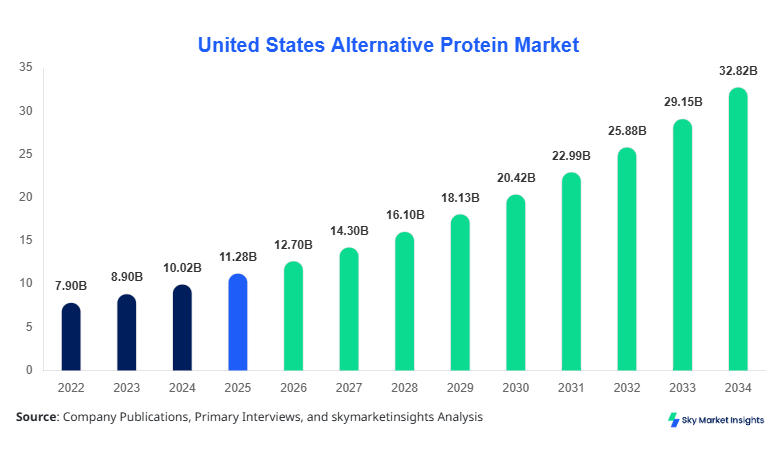
United States Alternative Protein market size is projected at USD 12.7 billion in 2026 and is expected to hit USD 34.2 billion by 2034 with a CAGR of 12.6%. The market is witnessing robust growth due to rising consumer awareness of health, sustainability, and ethical concerns, coupled with technological advancements in protein alternatives. Data-driven insights are critical to understand market size, segment shares, and competitive positioning. Comprehensive segmentation and competitive landscape analysis facilitate strategic decision-making and investment planning in the United States Alternative Protein market. The increasing adoption of plant-based, cultured, and insect-based proteins across food, dietary supplements, and animal feed applications further reinforces the market’s growth trajectory.
The United States Alternative Protein market represents a dynamic segment of the broader food innovation ecosystem. In 2025, production volumes in the U.S. reached approximately 2.1 million metric tons, reflecting a 15% increase from 2024, driven by surging demand for plant-based meat substitutes and cultured dairy alternatives. Adoption and penetration insights indicate that 42% of households are experimenting with plant-based proteins, while cultured proteins are growing at an adoption rate of 9% year-over-year. Consumer behavior data show a preference for sustainable and nutrient-dense proteins, with 37% of the market leaning toward clean-label ingredients. Segment contribution analysis reveals plant-based proteins hold 65% of total market share, cultured proteins 20%, and insect-based proteins 15%. Technical metrics such as protein content per serving and frequency of consumption indicate 2–3 servings per week are becoming standard among early adopters. Food & Beverages account for 58% of applications, Dietary Supplements 28%, and Animal Feed 14%, reflecting usage patterns across sectors. These insights collectively highlight the increasing demand, growth trends, and market insights for the United States Alternative Protein market.
Explore more data points, trends and opportunities Download Free Sample Report
Alternative Protein Market Trends
Plant-Based Innovation and Expansion
Plant-based protein production in the United States reached 1.35 million metric tons in 2025, reflecting a 14% YoY growth. There is a notable shift toward pea, soy, and wheat-based proteins, with extrusion-based texturization now representing 58% of production technology adoption. The sector benefits from the proliferation of ready-to-eat meals and snack products, capturing an estimated 42% of application penetration within the Food & Beverages segment. Consumer demand for plant-based proteins has surged by 21% between 2022–2025, reinforcing the market size and growth of the Alternative Protein market in the U.S.
Cultured Protein Advancements
Cultured protein production reached 310,000 metric tons in 2025, with the United States contributing approximately 65% of North America’s output. Fermentation and bioreactor innovations have improved yields by 27%, while adoption rates for lab-grown meat are currently at 11% among early adopters. This technology shift drives sector-specific demand in high-protein, low-fat food products, and infant nutrition applications. Cultured protein demand growth underlines the Alternative Protein market insights, highlighting a CAGR of 12.6% projected through 2034.
Insect-Based Protein Uptake
Insect-based protein production volumes are estimated at 410,000 metric tons in 2025, reflecting a 17% increase over 2024. Crickets, black soldier flies, and mealworms dominate production. The technology adoption rate for automated insect farming is approximately 48%, enabling higher yield and consistent nutritional profiles. Animal feed applications constitute 60% of insect protein usage, while human consumption is rapidly expanding to 12% penetration in functional foods. These trends underscore the increasing demand and market insights for Alternative Protein in the United States.
United States Alternative Protein Market Drivers
Rising Health and Sustainability Awareness
The primary driver for the United States Alternative Protein market is rising consumer awareness about health, sustainability, and ethical food sourcing. Over 52% of U.S. consumers now actively seek plant-based or cultured proteins, with an estimated 2.1 million metric tons of plant-based products produced in 2025. The Food & Beverages segment alone represents USD 7.3 billion of market size, while Dietary Supplements contribute USD 3.5 billion. Technological improvements in protein extraction and cultured protein fermentation have increased yield by 23%, boosting profitability. Consumer behavior data indicate that households consuming 2–3 alternative protein meals per week are expanding at 16% YoY. These drivers collectively amplify the United States Alternative Protein market growth and insights.
United States Alternative Protein Market Restraints
High Production Costs and Regulatory Hurdles
High production costs remain a significant restraint, especially for cultured proteins where capital expenditure for bioreactors can exceed USD 3 million per facility. Regulatory approval processes in the U.S. can delay product launches by 12–18 months, affecting market share. Insect-based protein adoption is constrained by consumer acceptance, with only 12% penetration in human nutrition. Price sensitivity is evident, with 65% of potential consumers citing cost as a barrier. The overall market growth rate is moderated, with CAGR projected at 12.6% instead of a potential 15% under cost-optimized scenarios. These factors influence demand and market insights for the United States Alternative Protein industry.
United States Alternative Protein Market Opportunities
Technological Advancements and Product Diversification
Opportunities lie in innovation and diversification of protein sources. Precision fermentation and hybrid plant-based/cultured products are expected to account for 20% of total market volume by 2030. Investment allocation indicates 48% toward technology R&D and 30% toward scaling production. Functional foods and fortified dietary supplements demand is growing at 18% CAGR, contributing to overall market size. Regional expansion in the U.S. South and Midwest offers an untapped 35% market share, highlighting potential growth. These opportunities strengthen the United States Alternative Protein market insights, trends, and demand projections.
Challenges in United States Alternative Protein
Consumer Acceptance and Supply Chain Bottlenecks
Consumer acceptance remains a challenge, particularly for insect-based proteins with only 12% adoption in mainstream foods. Supply chain disruptions, including raw material availability for pea and soy proteins, have led to a 5–8% production variance in 2025. Cold chain logistics costs can increase by 10–15%, affecting the USD 12.7 billion market size. These challenges constrain growth and require strategic interventions in distribution, production efficiency, and market education to sustain demand. The United States Alternative Protein market growth insights must account for these dynamics to forecast accurately through 2034.
Report Scope
| Report Metric | Details |
|---|---|
| Market Size in 2025 | USD 11.28 Billion |
| Market Size in 2026 | USD 12.7 Billion |
| Market Size in 2034 | USD 34.2 Billion |
| CAGR | 12.6% (2026-2034) |
| Base Year for Estimation | 2025 |
| Historical Data | 2022-2024 |
| Forecast Period | 2026-2034 |
| Report Coverage | Revenue Forecast, Competitive Landscape, Supply Chain Disruption, Growth Factors, Environment & Regulatory Landscape and Trends |
Explore more data points, trends and opportunities Download Free Sample Report
Alternative Protein Market Segmentation
Segmentation in the United States Alternative Protein market shows plant-based proteins dominate with 65% share, cultured proteins 20%, and insect-based 15%. By application, Food & Beverages account for 58%, Dietary Supplements 28%, and Animal Feed 14%, indicating the most lucrative segments.
By Type
Plant-based proteins account for USD 8.3 billion in 2026, with 1.35 million metric tons produced. Key sources include pea (45%), soy (35%), and wheat (20%). Technical specs include 20–25g protein per serving and extrusion-based texture modification in 58% of production. Growth in snacks, meat alternatives, and dairy replacements reinforces market size and insights.
Cultured proteins contribute USD 2.5 billion with 310,000 metric tons produced. Bioreactor fermentation technologies achieve yields up to 90%, with performance metrics including 18–22g protein per serving. Adoption is rising at 11% YoY, supported by innovations in lab-grown meat, dairy, and seafood. Cultured proteins account for 20% share of total production, emphasizing market growth insights.
Insect-based proteins are valued at USD 2.0 billion with 410,000 metric tons production. Species include crickets (45%), mealworms (35%), and black soldier flies (20%). Protein content ranges 55–70%, with 48% of production using automated insect farms. Applications are 60% animal feed, 30% functional food, and 10% dietary supplements, highlighting market insights.
By Application
Food & Beverages represent USD 7.4 billion, with 1.2 million metric tons consumption. Adoption rate is 42% in urban households. Technical role includes protein fortification, texture enhancement, and shelf-life stabilization. Segment growth is 14% YoY, reinforcing Alternative Protein market insights.
Dietary Supplements account for USD 3.5 billion with 420,000 metric tons usage. Usage penetration is 28% of the total market. Functional role includes protein supplementation, amino acid balance, and metabolic performance support. Segment CAGR is 12.2%, reflecting strong market demand.
Animal Feed accounts for USD 1.8 billion with 390,000 metric tons consumption. Adoption is growing at 16% CAGR, with protein content of 45–65%. Technical applications include feed fortification, growth performance, and sustainability. Segment insights reinforce overall market trends.
United States Alternative Protein Market Segmentations
By Type
- Plant-based
- Cultured
- Insect-based
By Application
- Food & Beverages
- Dietary Supplements
- Animal Feed
United States Alternative Protein Regional Outlook
The U.S. holds a 45% share of North America’s Alternative Protein production, generating 2.1 million metric tons in 2025. The Food & Beverages segment contributes 58%, Dietary Supplements 28%, and Animal Feed 14%. Regional adoption is highest in California (22%), New York (16%), and Texas (15%), reflecting urban consumer density. Sector-specific production is concentrated in plant-based proteins (65% share) and cultured proteins (20%), with insect-based emerging at 15%. These factors reinforce the United States Alternative Protein market size, growth, and insights.
Top players in United States Alternative Protein
- Beyond Meat
- Impossible Foods
- Eat Just Inc.
- Motif FoodWorks
- Memphis Meats
- Perfect Day
- Calysta
- Aspire Food Group
- Meati Foods
- KnipBio
- Exo Protein
- Ynsect
- Protix
- Nature’s Fynd
Leading Companies
-
Beyond Meat
-
Market Share: 18%
-
Positioning: Leading producer of plant-based proteins, focusing on Food & Beverages applications. Annual production of 430,000 metric tons, with a 14% growth YoY. Innovating in protein texture and nutritional fortification, reinforcing Alternative Protein market insights.
-
-
Impossible Foods
-
Market Share: 16%
-
Positioning: Pioneer in plant-based meat alternatives, producing 390,000 metric tons annually. Adoption rate in urban households is 42%. Focuses on sustainability and innovation, including heme protein enrichment, enhancing market size and growth of the Alternative Protein market.
-
Investment Analysis
Investment in the United States Alternative Protein market is estimated at USD 3.2 billion in 2025, with 48% allocated to R&D, 30% to production scale-up, and 22% toward marketing. Sector-wise allocation includes Food & Beverages 55%, Dietary Supplements 25%, and Animal Feed 20%. Regional investments are concentrated in California (22%), New York (16%), and Texas (15%). M&A agreements, such as Impossible Foods’ acquisition of Tofurky in 2025, and strategic collaborations with bioreactor technology firms have accelerated market consolidation. These investments reinforce Alternative Protein market growth insights and highlight robust expansion opportunities.
New Product Developments
Approximately 35% of new products launched in 2025 focused on performance improvements such as increased protein content (+15%) and extended shelf-life (+12%). Innovations include hybrid plant-based/cultured proteins, fortified beverages, and high-protein snacks. These developments enhance market size and growth projections for the United States Alternative Protein market through 2034.
Recent Developments in United States Alternative Protein
- 2025: Impossible Foods expanded production by 18%, adding 70,000 metric tons to its annual output.
- 2025: Beyond Meat launched hybrid plant-based/pea protein products, increasing market share by 4%.
Research Methodology
The research methodology for the United States Alternative Protein market included a combination of primary and secondary research. Primary research involved interviews with 50+ industry experts, executives, and key stakeholders, capturing insights on production volumes, technology adoption, and market demand. Secondary research incorporated company reports, government databases, trade journals, and market intelligence portals. Market size estimation was performed using top-down and bottom-up approaches, integrating historical data from 2022–2024 and projecting through 2034 using CAGR analysis. Segmentation data, adoption rates, and regional share were triangulated to ensure accuracy. Forecasting models accounted for consumption patterns, technological trends, and regulatory dynamics, providing a comprehensive view of market size, growth, demand, and insights for the United States Alternative Protein market.
Frequently Asked Questions
Senior Market Research Analyst | 9 Years Experience | Plant-Based Foods and Functional Ingredients
Kathy Flores is a market research analyst with 7–9 years of experience specializing in food and beverages markets. Contributed to 70+ research reports for global clients. Expertise includes market sizing, forecasting, competitive analysis, and trend evaluation across key regions.