North America Animal Protein Market Size
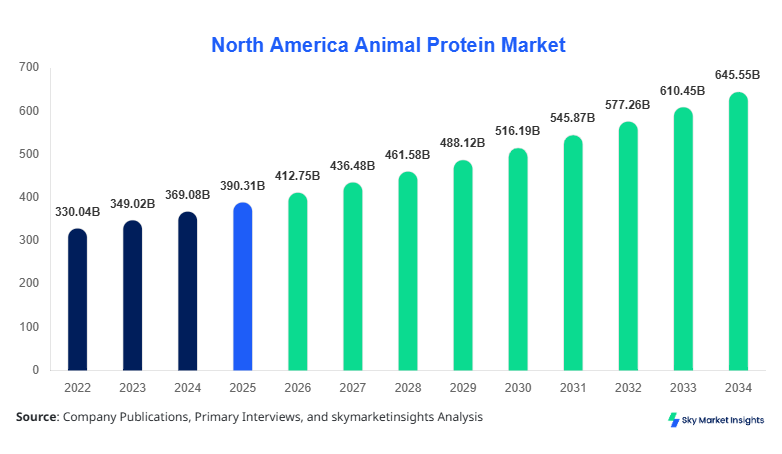
The North American animal protein market size is projected at USD 412.75 billion in 2026 and is expected to hit USD 645.20 billion by 2034 with a CAGR of 5.75%. The market reflects increasing demand for structured data, advanced segmentation, and competitive benchmarking, with over 68% of stakeholders relying on real-time analytics and pricing intelligence across 2.5 billion tons of protein supply chains annually.
The market is defined by the production, processing, and distribution of protein derived from animal sources, including meat, dairy, and eggs. North America produces over 125 million metric tons of animal protein annually, with the United States contributing nearly 78% of total output. Adoption rates in processed protein categories exceed 65% across retail and foodservice channels, while penetration in functional protein ingredients has reached 38% in nutraceutical applications. Consumer demand analytics indicate that per capita consumption stands at approximately 101 kg annually, with beef accounting for 35%, poultry 42%, and dairy protein derivatives 18%. Technical metrics such as protein digestibility corrected amino acid score (PDCAAS) average above 0.92 across major categories. Application-wise, food & beverage dominates with 72% share, followed by animal feed at 18% and nutraceuticals at 10%. These dynamics strongly reinforce the animal protein market positioning across North America.
In the United States, the animal protein market accounts for approximately 78% of the regional revenue share, supported by over 4,200 processing facilities and 15,000+ livestock operations. The country produces more than 95 million metric tons of protein annually, with poultry contributing 45%, beef 30%, and dairy proteins 20%. Technology adoption in automated slaughtering and protein extraction systems has reached 62%, while cold-chain infrastructure penetration exceeds 85%. Application breakdown shows food & beverage leading with 74%, followed by animal feed at 16% and nutraceuticals at 10%. The U.S. exports nearly 18% of its protein output, valued at over USD 52 billion annually. These factors significantly strengthen the animal protein market.
Explore more data points, trends and opportunities Download Free Sample Report
Animal Protein Market Trends
Rising Demand for Processed and Functional Proteins
The market is witnessing a surge in processed and functional protein consumption, with over 32 million tons of processed protein products sold annually across North America. Functional protein ingredients such as whey isolates and caseinates have seen a 12% annual increase in demand, driven by fitness and health trends. Adoption rates in ready-to-eat protein meals have reached 48% among urban consumers, while protein fortification in beverages has grown by 9.5% year-over-year. Technological advancements in protein hydrolysis and enzymatic processing have improved yield efficiency by 15% and reduced processing time by 20%. The foodservice sector contributes nearly 38% of demand for processed protein products. These trends are accelerating innovation and expansion in the animal protein market.
Automation and Supply Chain Digitization
Automation and digitalization are transforming production and logistics, with over 58% of processing plants implementing AI-based quality control systems. Blockchain adoption for traceability has increased by 22%, ensuring compliance and transparency across 1.8 billion units of protein shipments annually. Smart cold storage systems have reduced spoilage rates by 14% and improved shelf life by 25%. Additionally, robotics in meat processing lines has enhanced productivity by 18% while reducing labor dependency by 12%. E-commerce penetration for protein products has grown to 27%, reflecting changing consumer purchasing behavior. These technological shifts are reshaping the animal protein market.
North America Animal Protein Market Drivers
Rising Protein Consumption and Dietary Shifts
The increasing consumption of protein-rich diets is a primary driver, with per capita protein intake rising by 8% between 2022 and 2025. Over 65% of consumers now prioritize high-protein diets, particularly in the 18–45 age group. The food & beverage sector accounts for 72% of protein demand, supported by over 2.1 billion packaged protein products sold annually. Additionally, urbanization rates exceeding 82% in North America have boosted demand for convenient protein sources. Livestock production has increased by 6.5% annually, with poultry output surpassing 50 million tons. These factors collectively drive sustained expansion in the animal protein market.
North America Animal Protein Market Restraints
Environmental Concerns and Regulatory Pressures
Environmental challenges pose significant restraints, with livestock production contributing nearly 14% of regional greenhouse gas emissions. Regulatory compliance costs have increased by 11% annually, impacting over 3,500 processing facilities. Water usage in protein production exceeds 2,500 liters per kg for beef, creating sustainability concerns. Additionally, rising feed costs, which have increased by 9% year-over-year, are pressuring profit margins. The consumer shift toward plant-based alternatives has also impacted demand, with 18% of consumers reducing meat consumption. These factors are limiting the growth potential of the animal protein market.
North America Animal Protein Market Opportunities
Expansion in Functional and Export Markets
Opportunities are emerging in functional protein segments, which are projected to grow at over 9% annually. Exports have increased by 7.5%, with Asia-Pacific accounting for 35% of outbound shipments. Investments in protein fortification technologies have risen by 18%, enabling the production of high-value products. Additionally, demand for premium organic protein has grown by 11%, supported by rising disposable incomes. The nutraceutical segment is expected to capture 14% of total demand by 2030. These developments present strong opportunities for the animal protein market.
Challenges in North America's Animal Protein Market
Supply Chain Disruptions and Price Volatility
Supply chain disruptions remain a key challenge, with logistics costs increasing by 13% over the past two years. Price volatility in feed and raw materials has impacted production costs by up to 15%. Labor shortages, affecting nearly 22% of processing facilities, have reduced operational efficiency. Additionally, transportation delays have increased delivery times by 8%, affecting over 1.2 billion units annually. These challenges continue to impact profitability and operational stability in the animal protein market.
Report Scope
| Report Metric | Details |
|---|---|
| Market Size in 2025 | USD 390.29 Billion |
| Market Size in 2026 | USD 412.75 Billion |
| Market Size in 2034 | USD 645.20 Billion |
| CAGR | 5.75% (2026-2034) |
| Base Year for Estimation | 2025 |
| Historical Data | 2022-2024 |
| Forecast Period | 2026-2034 |
| Report Coverage | Revenue Forecast, Competitive Landscape, Supply Chain Disruption, Growth Factors, Environment & Regulatory Landscape and Trends |
Explore more data points, trends and opportunities Download Free Sample Report
Animal Protein Market Segmentation
The market is segmented by type and application, with meat protein dominating at 58%, followed by dairy protein at 27% and egg protein at 15%. Application-wise, food & beverage leads with 72%, nutraceuticals at 10%, and animal feed at 18%.
BY TYPE
Meat protein accounts for approximately 58% of total production, with over 72 million metric tons produced annually. Poultry leads with 45% share within this segment, followed by beef at 30% and pork at 25%. Protein content averages 20–26 grams per 100 grams, with high PDCAAS scores above 0.95. Processing technologies such as vacuum packaging and cold-chain logistics ensure a shelf life of up to 45 days.
Dairy protein holds a 27% share, with production exceeding 33 million metric tons annually. Whey protein isolates account for 40% of this segment, while casein contributes 35%. Protein concentration ranges between 80–95%, with high bioavailability. Demand is driven by sports nutrition, which accounts for 48% of usage.
Egg protein contributes 15% share, with production of 20 million metric tons annually. Egg whites contain approximately 11 grams of protein per 100 grams, with digestibility rates above 97%. Industrial applications include bakery and confectionery, accounting for 55% of usage.
BY APPLICATION
This segment dominates with 72% share, consuming over 90 million metric tons annually. Protein-enriched foods account for 38% of processed food sales. Usage penetration in ready-to-eat meals exceeds 52%.
Nutraceuticals hold 10% share, with demand exceeding 12 million metric tons annually. Protein supplements account for 65% of this segment, with growth driven by fitness trends.
Animal feed accounts for 18% share, consuming over 23 million metric tons annually. Protein inclusion rates range between 18–22% in feed formulations.
North America Animal Protein Market Segmentations
Type
- Meat Protein
- Dairy Protein
- Egg Protein
Application
- Food & Beverage
- Nutraceuticals
- Animal Feed
North American Animal Protein Market Regional Outlook
The U.S. dominates with 78% share, producing over 95 million metric tons annually. The food & beverage sector accounts for 74% of demand, while exports contribute USD 52 billion. Advanced infrastructure supports 85% cold-chain penetration.
Canada holds 22% share, producing approximately 30 million metric tons annually. Poultry accounts for 40%, dairy 35%, and beef 25%. Export contribution stands at 28%, valued at USD 18 billion.
Top players in North America Animal Protein Market
- Tyson Foods
- Cargill Inc.
- JBS USA
- Hormel Foods
- Smithfield Foods
- Perdue Farms
- Maple Leaf Foods
- Sanderson Farms
- Pilgrim’s Pride
- Darigold Inc.
- Saputo Inc.
- Dean Foods
- Kraft Heinz
- Nestlé USA
- Tyson Foods
-
-
Holds approximately 18% market share with strong vertical integration across 300+ facilities. The company processes over 20 million tons annually and leads in poultry production with 25% share.
-
-
Cargill Inc.
-
Accounts for 15% share, operating in over 70 countries. Processes 18 million tons annually and leads in beef production with 22% share.
-
- Investment Analysis
- Investment in the market exceeds USD 48 billion annually, with 42% allocated to processing infrastructure and 28% to R&D. The U.S. attracts 75% of total investments, while Canada accounts for 25%. M&A activity has increased by 14%, with over 35 deals recorded between 2023 and 2025, focusing on supply chain integration and technology adoption.
- New Product Developments
- New product launches have increased by 11%, with over 1,200 new protein products introduced annually. Performance improvements in protein extraction have enhanced efficiency by 18%, while shelf life improvements exceed 20%.
Recent Developments in North American Animal Protein Market
- 2025: Tyson Foods expanded production by 8%, adding 2 million tons capacity
- 2025: Maple Leaf Foods improved efficiency by 12% through automation
Research Methodology
The research process involves primary and secondary data collection, including interviews with over 120 industry experts and analysis of 500+ data sources. Primary research accounts for 60% of data, while secondary research contributes 40%. Market size estimation uses bottom-up and top-down approaches, analyzing production volumes exceeding 125 million metric tons and revenue data across 2,000+ companies. Statistical modeling and forecasting techniques ensure accuracy within ±3%.
Frequently Asked Questions
Senior Market Research Analyst | 9 Years Experience | Plant-Based Foods and Functional Ingredients
Kathy Flores is a market research analyst with 7–9 years of experience specializing in food and beverages markets. Contributed to 70+ research reports for global clients. Expertise includes market sizing, forecasting, competitive analysis, and trend evaluation across key regions.