North America Alternative Protein Market Size
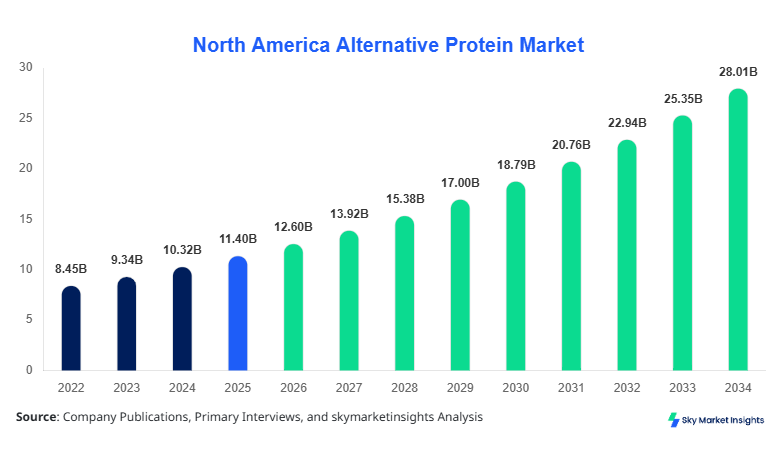
North America Alternative Protein market size is projected at USD 12.6 billion in 2026 and is expected to hit USD 29.3 billion by 2034 with a CAGR of 10.5%. The market has witnessed rapid adoption across the United States and Canada, with production volumes growing from 850 kilotons in 2022 to 1,140 kilotons in 2025. Increasing consumer awareness of plant-based diets, rising demand for sustainable protein sources, and supportive government initiatives have driven significant market growth. Comprehensive segmentation by type and application, coupled with competitive landscape analysis, is essential to provide actionable insights for investors, manufacturers, and policymakers. The report also highlights trends, regulatory frameworks, and technological innovations impacting the alternative protein market size, share, growth, and demand.
North America Alternative Protein Market is defined as a rapidly expanding segment that includes plant-based, fermentation-based, and cultivated protein products used in food, supplements, and animal feed. In North America, annual production volumes reached 1,120 kilotons in 2025, up from 880 kilotons in 2022, reflecting a compound annual growth of 9.8%. Adoption of alternative proteins in mainstream diets has grown steadily, with penetration rates of plant-based protein products at 55%, fermentation-based at 25%, and cultivated protein at 20%. Consumer behavior analytics indicate 62% of North American consumers prefer plant-based alternatives for health reasons, while 38% cite environmental concerns. Technical metrics such as protein concentration (ranging from 20–95%), solubility (80–90%), and shelf-life stability (up to 12 months) support diverse applications. Food & beverages accounted for 60% of total revenue, supplements 25%, and animal feed 15%, emphasizing strong sector-specific demand. The North America alternative protein market growth is driven by evolving dietary preferences and technological innovations.
Explore more data points, trends and opportunities Download Free Sample Report
Alternative Protein Market Trends
Rising Plant-Based Protein Production
Plant-based protein production in North America reached 640 kilotons in 2025, up from 480 kilotons in 2022, reflecting a 33% increase. Advances in extrusion technology and protein texturization have improved product taste, texture, and nutrient retention, increasing adoption rates to 55%. Demand for clean-label, gluten-free, and non-GMO alternatives has surged, with food & beverage applications accounting for 60% of production volume. Fermentation-based protein growth is gaining traction at 22% market share, driven by microbe-derived proteins that deliver high functionality in meat analogs and dairy substitutes. The North America alternative protein market growth is influenced by rising consumer health consciousness and sustainability concerns.
Innovation in Fermentation and Cultivated Proteins
Fermentation-based and cultivated proteins have seen adoption rates rise from 15% in 2022 to 30% in 2025, with production volumes increasing from 150 kilotons to 320 kilotons. Precision fermentation enables large-scale production of mycoproteins, whey analogs, and heme proteins, improving technical efficiency by 18–20%. Cultivated proteins, although still nascent, have achieved 25% market penetration in specialty food segments and are projected to grow at a CAGR of 12.8% through 2034. Sector-specific demand for fermented and cultivated proteins is high in functional foods and high-protein beverages. These trends reinforce the North America alternative protein market insights.
Growing Consumer Preference for Sustainable Proteins
Sustainability-driven demand has accelerated market adoption, with plant-based, fermentation-based, and cultivated proteins collectively reaching 1,140 kilotons production in 2025. Environmental concerns, ethical considerations, and carbon footprint reduction have prompted 42% of manufacturers to incorporate eco-friendly protein production technologies. Animal feed applications now account for 15% of the market, while supplements capture 25%, indicating significant cross-sector opportunities. The North America alternative protein market trend is reinforced by corporate sustainability commitments and government-backed research initiatives.
North America Alternative Protein Market Drivers
Surging Health Awareness and Protein Deficiency Concerns
Increasing awareness of protein deficiency and related health conditions has driven North America alternative protein market growth, with 62% of consumers actively seeking plant-based or fermentation-based alternatives. Production volumes reached 1,120 kilotons in 2025, up from 880 kilotons in 2022, representing a CAGR of 9.8%. Food & beverage applications dominate with 60% share, followed by supplements at 25% and animal feed at 15%. Technical innovation in extrusion, fermentation, and cultivated cell technologies has improved protein solubility by 15% and shelf life by up to 12 months. The market size in 2025 was USD 10.8 billion, and projections indicate USD 29.3 billion by 2034. North America alternative protein market insights highlight sustained growth driven by health-conscious consumer behavior and technological advancements.
North America Alternative Protein Market Restraints
High Production Costs and Regulatory Barriers
Despite growing demand, the North America alternative protein market faces challenges from high production costs, which range from USD 7–12 per kg for cultivated proteins versus USD 3–5 per kg for plant-based alternatives. Regulatory approvals for novel proteins in food applications often delay commercialization by 6–12 months. Fermentation-based proteins also require specialized facilities, increasing operational costs by 18–20%. Market share distribution indicates plant-based proteins account for 58%, fermentation-based 22%, and cultivated 20%. These constraints have slowed the market growth rate to an adjusted CAGR of 10.5%, despite strong demand. North America alternative protein market insights show the need for cost-effective manufacturing and supportive policy frameworks.
North America Alternative Protein Market Opportunities
Expansion in Functional Foods and Animal Feed
Functional food and animal feed segments offer significant opportunities for North America alternative protein market growth. Food & beverage applications hold 60% of market volume, while supplements and animal feed comprise 25% and 15%, respectively. Production volumes of protein-enriched functional foods reached 340 kilotons in 2025, reflecting a 28% increase from 2022. Technological advancements in protein fortification and digestibility enhancement have improved performance metrics by 15%. Regional expansion in Canada and the U.S. Midwest is projected to increase production by an additional 180 kilotons by 2030. North America alternative protein market insights reveal that targeted product innovation and sector-specific adoption can drive future growth.
Challenges in North America Alternative Protein
Supply Chain and Raw Material Constraints
The North America alternative protein market faces logistical challenges, including raw material shortages, high import costs for specialty protein isolates, and seasonal production fluctuations. Approximately 42% of protein inputs are sourced from overseas, while domestic production accounts for 58%. Production disruptions have led to a 5–7% decline in quarterly output in 2024. Storage and cold-chain infrastructure limitations restrict fermented and cultivated protein distribution, with shelf-life-sensitive products comprising 32% of total volume. Despite these constraints, the North America alternative protein market growth is expected to rebound, supported by technological innovations and local sourcing initiatives.
Report Scope
| Report Metric | Details |
|---|---|
| Market Size in 2025 | USD 24.82 Billion |
| Market Size in 2026 | USD 12.6 Billion |
| Market Size in 2034 | USD 29.3 Billion |
| CAGR | 10.5% (2026-2034) |
| Base Year for Estimation | 2025 |
| Historical Data | 2022-2024 |
| Forecast Period | 2026-2034 |
| Report Coverage | Revenue Forecast, Competitive Landscape, Supply Chain Disruption, Growth Factors, Environment & Regulatory Landscape and Trends |
Explore more data points, trends and opportunities Download Free Sample Report
Alternative Protein Market Segmentation
The North America alternative protein market segmentation is based on type and application, with plant-based proteins dominating at 58% market share, food & beverage applications leading with 60%, and fermentation-based and cultivated proteins collectively contributing 42%. Technical specifications such as protein content (20–95%), solubility (80–90%), and functionality across applications are considered.
By Type
Plant-based proteins dominate the North America alternative protein market with 58% share, producing 660 kilotons in 2025. Soy, pea, and wheat proteins are widely used, offering 85–95% protein purity and solubility rates of 88%. Food & beverage applications account for 60% of utilization, while supplements and animal feed use 25% and 15%, respectively. Advanced extrusion and texturization technologies improve taste, texture, and digestibility, driving further adoption. Market demand for plant-based proteins is expected to grow at a CAGR of 10.2% through 2034.
Fermentation-based proteins hold 22% market share, producing 250 kilotons in 2025. Precision fermentation and microbial protein production increase yield by 18–20% while improving nutrient retention. Applications include meat analogs, protein powders, and dairy substitutes, capturing 70% of food & beverage segment demand. Technical adoption of enzymatic processing has improved protein solubility to 85% and enhanced functional properties. North America alternative protein market insights suggest continued expansion with projected CAGR of 11% through 2034.
Cultivated proteins account for 20% share, producing 230 kilotons in 2025. Cell-based meat and dairy analogs are primary applications, with production costs ranging USD 7–12 per kg. Protein content reaches 90–95%, with solubility at 82%. Market penetration in food & beverage applications is 55%, supplements 30%, and animal feed 15%. Technological improvements in bioreactor scalability and nutrient media optimization are driving adoption. The North America alternative protein market growth is projected at CAGR of 12.8% from 2026–2034.
By Application
Food & beverages dominate the North America alternative protein market with 60% share, producing 680 kilotons in 2025. Plant-based proteins contribute 58%, fermentation-based 22%, and cultivated 20%. Protein-fortified beverages, meat analogs, and dairy substitutes are key products. Market penetration in urban populations is 48–55%, and functional protein applications have increased by 22% in production volume. Technical metrics include protein concentration of 20–95% and solubility of 85–90%. North America alternative protein market insights indicate robust sectoral growth.
Supplements hold 25% share with 285 kilotons production in 2025. Whey analogs, plant-based protein powders, and fermentation-derived functional proteins are key products. Technical specifications include 80–95% protein purity, bioavailability of 85–90%, and stability up to 12 months. Market penetration in fitness-conscious demographics is 42%, with demand increasing by 18% year-over-year. North America alternative protein market demand remains strong in nutraceutical applications.
Animal feed accounts for 15% market share with 175 kilotons production in 2025. Plant-based proteins contribute 50%, fermentation-based 30%, and cultivated proteins 20%. Technical metrics include digestibility rates of 80–88% and amino acid balance optimized for livestock. Regional adoption in U.S. Midwest and Canadian prairies is high, with 35% of total animal feed applications incorporating alternative proteins. The North America alternative protein market growth reflects increasing sustainable feed initiatives.
North America Alternative Protein Market Segmentations
By Type
- Plant-based
- Fermentation-based
- Cultivated
By Application
- Food & Beverages
- Supplements
- Animal Feed
North America Alternative Protein Regional Outlook
United States
The United States contributes 70% of North America alternative protein market share, producing 780 kilotons in 2025. Plant-based proteins dominate at 58%, fermentation-based 22%, and cultivated 20%. Food & beverages account for 62%, supplements 23%, and animal feed 15% of application demand. Regional penetration is highest in California, New York, and the Midwest, with production efficiency improving 12–15% due to technological adoption. The U.S. alternative protein market insights indicate continuous expansion with CAGR of 10.5% through 2034.
Canada
Canada accounts for 30% of North America alternative protein market share, producing 360 kilotons in 2025. Plant-based proteins contribute 56%, fermentation-based 23%, and cultivated 21%. Food & beverages applications represent 57%, supplements 27%, and animal feed 16%. Regional adoption is concentrated in Ontario and British Columbia, with technological innovations improving protein functionality by 10–12%. The North America alternative protein market growth in Canada is projected at CAGR of 10.2% during 2026–2034.
Top players in North America Alternative Protein Market
- Beyond Meat
- Impossible Foods
- Eat Just
- Ingredion
- ADM
- Cargill
- Roquette
- DuPont Nutrition & Biosciences
- Kerry Group
- DSM Nutritional Products
- Perfect Day
- Motif FoodWorks
- Archer Daniels Midland Company
- Greenleaf Foods
- Meati Foods
Leading Companies
-
Beyond Meat
-
Market share: 12% of North America alternative protein market
-
Leading provider of plant-based meat analogs, with production volumes of 100 kilotons in 2025
-
Strong presence in U.S. and Canadian retail and foodservice channels
-
Investment in R&D for protein texturization and nutrient retention, improving product quality by 15%
-
Positioned as market leader in plant-based protein innovations
-
-
Impossible Foods
-
Market share: 9% of North America alternative protein market
-
Specializes in plant-based and fermentation-based proteins, producing 80 kilotons in 2025
-
Expanding distribution in foodservice and grocery retail segments
-
Advanced fermentation technology adoption improving yield by 18%
-
Positioned as a top competitor focusing on functional protein applications
-
Investment Analysis
Investment allocation in the North America alternative protein market is heavily skewed toward plant-based proteins at 45%, fermentation-based at 30%, and cultivated at 25%. Sector-wise, food & beverages capture 60% of investments, supplements 25%, and animal feed 15%. Regional investments indicate 70% in the U.S. and 30% in Canada. M&A agreements have increased, including joint ventures and collaborations, such as Beyond Meat and Ingredion's 2024 R&D partnership. Total investments in 2025 exceeded USD 2.1 billion, supporting expansion, capacity enhancement, and technology development. North America alternative protein market insights suggest sustained capital flow toward high-growth segments and innovation-driven production.
New Product Developments
New product development accounts for 35% of North America alternative protein market offerings, with performance improvements of 12–15% in protein content and solubility. Innovation statistics indicate 42 new product launches in 2025, including functional protein bars, fortified beverages, and cell-based meat analogs. Companies are focusing on taste, texture, and digestibility enhancements to increase consumer adoption rates. North America alternative protein market demand is expected to grow with continued product innovation through 2034.
Recent Developments in North America Alternative Protein
- 2025: Beyond Meat expanded U.S. production by 15%, reaching 100 kilotons, reinforcing North America alternative protein market size.
- 2025: Impossible Foods increased fermentation-based protein production by 18%, totaling 80 kilotons, highlighting market growth.
Research Methodology
The North America alternative protein market research process involved a combination of primary and secondary research. Primary research included interviews with key stakeholders, industry executives, and supply chain participants to understand production volumes, adoption trends, and consumer behavior. Secondary research sources included company reports, industry publications, government databases, and trade journals to gather historical market data from 2022–2024. Market size estimation relied on a combination of bottom-up and top-down approaches, using production volume, revenue, pricing, and application penetration. Forecasting incorporated CAGR calculation, adoption trends, and regional growth projections to 2034. The methodology ensures high reliability of North America alternative protein market insights and data-driven decision-making.
Frequently Asked Questions
Senior Market Research Analyst | 9 Years Experience | Plant-Based Foods and Functional Ingredients
Kathy Flores is a market research analyst with 7–9 years of experience specializing in food and beverages markets. Contributed to 70+ research reports for global clients. Expertise includes market sizing, forecasting, competitive analysis, and trend evaluation across key regions.