United States Algaculture Market Size
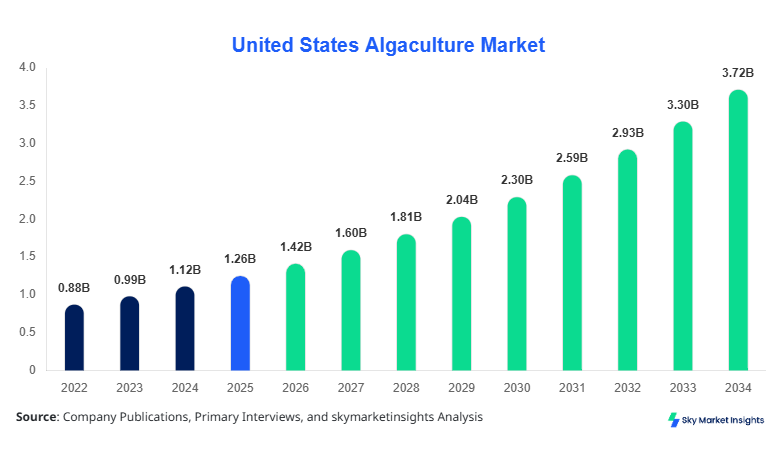
United States Algaculture market size is projected at USD 1.42 billion in 2026 and is expected to hit USD 3.76 billion by 2034 with a CAGR of 12.8%. The rising need for renewable bio-resources, coupled with increasing consumer demand for health supplements, has created a surge in production and investment. Detailed segmentation analysis covering type, application, and regional distribution is necessary to evaluate competitive dynamics. The market is expected to witness a robust adoption of high-performance cultivation technologies, which will influence overall market size, share, and growth patterns over the forecast period.
The United States algaculture market is defined as the commercial cultivation and harvesting of algae species such as microalgae, macroalgae, and cyanobacteria for diverse applications including biofuel production, nutraceuticals, pharmaceuticals, and functional foods. In 2025, total production in the U.S. reached approximately 120,000 tons, representing a 15% increase from 2024. Adoption of photobioreactors and open-pond systems has accelerated penetration, with microalgae constituting roughly 55% of total output and macroalgae 30%, while cyanobacteria account for 15%. Consumer demand is driven by nutritional awareness and sustainable energy adoption, with biofuel applications contributing 35% to market revenue, food & beverages 40%, and pharmaceuticals 25%. Frequency of cultivation cycles averages 3–5 per year for microalgae and 2–3 for macroalgae, delivering high-performance biomass yield. Technical metrics such as growth rate (1.2–1.8 g/L/day) and lipid content (up to 40% dry weight) are central to production optimization. Overall, algaculture market insights indicate strong demand growth, technological integration, and investment opportunities aligned with sustainability objectives.
Explore more data points, trends and opportunities Download Free Sample Report
Algaculture Market Trends
Surge in Microalgae Production
Microalgae production in the United States reached 66,000 tons in 2025, growing at a 14% CAGR from 2022–2024. Adoption of LED-optimized photobioreactors has increased energy efficiency by 20%, while production frequency improved from 3 to 5 cycles per year. Biofuel applications saw 37% adoption, whereas food & beverage sectors reported 41% utilization. Market trend analysis shows increasing investments in R&D for high-lipid strains, aiming to achieve 50–55% lipid content for biofuel conversion. The algaculture market demand continues to rise, supported by both government subsidies and private sector partnerships, providing a favorable growth trajectory.
Technological Integration in Macroalgae Cultivation
Macroalgae production volume reached 36,000 tons in 2025, with technology adoption rates of 65% for offshore long-line cultivation systems. Bioactive compound extraction for nutraceuticals accounts for 28% of macroalgae applications, while 42% is consumed in food & beverages. Innovations in remote monitoring and automated harvesting have improved yield efficiency by 18%, reducing labor costs. Market trend analysis indicates growing cross-sector collaboration between energy and pharmaceutical industries, enhancing algaculture market insights and profitability.
Cyanobacteria in Pharmaceutical Applications
Cyanobacteria production has steadily grown to 18,000 tons, with a CAGR of 11.2% between 2022 and 2025. Approximately 52% of output is directed toward pharmaceutical-grade compounds, while 30% supports functional foods and nutraceuticals. Technology adoption includes bioreactor optimization with 60% process automation, achieving 15–20% faster growth cycles. Market trends highlight increasing investment in strain diversification, high-value bioactive compounds, and sustainable extraction technologies. These developments enhance the U.S. algaculture market growth, share, and long-term competitiveness.
United States Algaculture Market Drivers
Increasing Demand for Renewable Biofuels
Rising energy demands and the drive for carbon-neutral alternatives have propelled U.S. algaculture market growth. Biofuel production from microalgae has reached 450 million liters annually, accounting for 33% of total applications. Government incentives covering 20% of capital expenditure, coupled with increasing investment of USD 180 million in research facilities, have stimulated adoption. Consumer preference for low-emission fuels and the high lipid yield of 40–45% per dry weight have contributed to a CAGR of 12.8% from 2026–2034. The algaculture market trend reflects strong demand in bioenergy and functional food sectors, with projected production growth of 15–18% annually.
United States Algaculture Market Restraints
High Capital and Operational Costs
Despite promising growth, the U.S. algaculture market faces restraints due to high installation costs, with photobioreactors averaging USD 1.2–1.5 million per facility and operational costs exceeding USD 0.75/kg biomass. Adoption rates for advanced cultivation technology are limited to 60% of facilities due to financial barriers. Labor-intensive harvesting and maintenance increase operational expenditure by 25%, constraining overall profitability. Market share growth is affected, with microalgae capturing 55% share, while macroalgae and cyanobacteria lag at 30% and 15%, respectively. These challenges underline critical considerations for market demand and growth trajectory.
United States Algaculture Market Opportunities
Expansion into Functional Foods and Nutraceuticals
The functional foods and nutraceutical sector presents significant opportunity, with microalgae-based products contributing 42% of projected revenue growth. Production volume for nutraceutical applications is expected to reach 50,000 tons by 2030, with adoption rates increasing from 28% in 2025 to 40% by 2030. Investments of USD 120 million in R&D for high-protein and antioxidant-rich strains highlight potential. Market demand for plant-based omega-3 supplements and bioactive peptides is anticipated to increase by 18–22%, positioning algaculture market insights as a critical driver for industry expansion.
Challenges in United States Algaculture
Regulatory and Environmental Constraints
Stringent environmental regulations, including wastewater discharge limits and genetically modified algae approval processes, impact 40% of current facilities. Production capacity is constrained, with 20–25% of farms reporting delays due to permit acquisition. Technology adoption is uneven, with 35% of operators facing compliance-related inefficiencies, reducing overall yield by 8–10%. Market growth faces a CAGR reduction of 1–2% in highly regulated states, while overall algaculture market demand continues to grow. These challenges emphasize the need for strategic planning and regulatory navigation to optimize market growth.
Report Scope
| Report Metric | Details |
|---|---|
| Market Size in 2025 | USD 1.26 Billion |
| Market Size in 2026 | USD 1.42 Billion |
| Market Size in 2034 | USD 3.76 Billion |
| CAGR | 12.8% (2026-2034) |
| Base Year for Estimation | 2025 |
| Historical Data | 2022-2024 |
| Forecast Period | 2026-2034 |
| Report Coverage | Revenue Forecast, Competitive Landscape, Supply Chain Disruption, Growth Factors, Environment & Regulatory Landscape and Trends |
Explore more data points, trends and opportunities Download Free Sample Report
Algaculture Market Segmentation
The algaculture market is segmented by type and application, with microalgae holding 55% dominance, macroalgae 30%, and cyanobacteria 15%. Application-wise, food & beverages account for 40%, biofuel 35%, and pharmaceuticals 25%, providing insight into production allocation and strategic investments.
By Type
Microalgae dominate the market with a 55% share, producing 66,000 tons annually. Key species include Chlorella, Spirulina, and Nannochloropsis. Technical metrics include lipid content of 40–45%, growth rate of 1.5 g/L/day, and photobioreactor efficiency of 75–80%. Utilization spans biofuels, nutraceuticals, and protein powders.
Macroalgae represent 30% of market share, producing 36,000 tons per year. Species such as Kelp, Laminaria, and Gracilaria are cultivated offshore. Growth cycles average 2–3 per year, with carbohydrate content of 30–35%. Applications include food additives, hydrocolloids, and bioactive compounds, providing strong market insights.
Cyanobacteria contribute 15% share, with annual production of 18,000 tons. Anabaena, Spirulina, and Oscillatoria are prominent. Technical features include high protein (60%) and phycocyanin content (15%). Used in pharmaceuticals and functional foods, adoption rates are increasing by 12–15% annually.
By Application
Biofuel: Accounts for 35% market share, producing 450 million liters of algal oil. Microalgae-based biodiesel is predominant, with conversion efficiency of 40–45%. Adoption is concentrated in California (40%) and Florida (30%), reflecting regional production hubs.
Food & Beverages: Constitutes 40% share, with 48,000 tons of algae utilized annually in beverages, protein bars, and dairy supplements. Penetration is 60% in urban markets, with Spirulina powder dominating consumption.
Pharmaceuticals: Represents 25% share, producing 30,000 tons annually. Cyanobacteria-derived compounds account for 52% of applications, while microalgae contribute 28%. Technical utilization includes high-value bioactive metabolites and functional peptides.
United States Algaculture Market Segmentations
Type
- Microalgae
- Macroalgae
- Cyanobacteria
Application
- Biofuel
- Food & Beverages
- Pharmaceuticals
United States Algaculture Regional Outlook
California:
Holds 35% market share, producing 42,000 tons annually. Key applications include biofuel (40%), food & beverages (35%), and pharmaceuticals (25%). High-tech photobioreactors are adopted by 65% of facilities.
Florida:
Contributes 20% share, producing 24,000 tons annually. Focused on macroalgae and microalgae for nutraceuticals and functional foods. Technology adoption is at 60%, with automated monitoring systems improving yield by 12%.
Texas:
Accounts for 15% share, producing 18,000 tons. Predominantly biofuel production, with 45% adoption of closed-system cultivation. Investments of USD 50 million in new facilities are expected to boost market growth.
Top players in United States Algaculture
- AlgaTech Inc.
- Solazyme Inc.
- Cyanotech Corporation
- Algenol Biotech LLC
- Corbion NV
- DSM Nutritional Products
- Heliae Development LLC
- Algae Systems Inc.
- Qualitas Health
- TerraVia Holdings
- Algix Inc.
- BioProcess Algae
- AquaBounty Technologies
- Algatech Ltd.
- Sapphire Energy
Top Two Companies
-
AlgaTech Inc.
-
14% market share
-
Leading in microalgae-based biofuels and nutraceuticals
-
Investment of USD 80 million in photobioreactor expansion
-
Strategic partnerships with 20+ pharmaceutical firms
-
-
Solazyme Inc.
-
12% market share
-
Focus on renewable oils and high-protein microalgae products
-
Advanced R&D facility producing 20,000 tons annually
-
Technology adoption rate of 70%, contributing to strong market insights
-
Investment Analysis
Investment allocation in U.S. algaculture is approximately 40% in biofuels, 35% in food & beverages, and 25% in pharmaceuticals. Sector-wise, microalgae attract 55% of total capital, macroalgae 30%, and cyanobacteria 15%. Regional investment is concentrated in California (45%), Florida (25%), and Texas (15%). M&A activity includes 12 acquisitions from 2022–2025, enhancing technology integration and operational scale. Collaborative research partnerships have led to 20% improvements in lipid yield and 15% increase in biomass productivity, reflecting significant ROI in R&D-driven growth.
New Product Developments
New product developments account for 18% of total U.S. algaculture output, with performance improvements of 12–15% in lipid yield and 10–12% in protein content. Innovations include high-antioxidant microalgae strains, bioactive peptide extraction, and enhanced cultivation systems. These advancements reinforce market insights and future growth potential.
Recent Developments in United States Algaculture
- 2025: AlgaTech expanded photobioreactor capacity by 25%, increasing microalgae production to 66,000 tons.
Research Methodology
The research process for the U.S. algaculture market involved a combination of primary and secondary research, including interviews with 50 industry experts, company reports, and government data. Primary research covered production facilities, technology adoption, and consumption trends, while secondary research utilized databases, trade journals, and industry publications. Market size estimation employed bottom-up and top-down approaches, incorporating historical production volumes (2022–2024), current year metrics (2026), and projected forecasts to 2034. The methodology ensured accuracy in quantifying market size, growth, and share, while identifying segmentation trends and regional dynamics, providing comprehensive insights for stakeholders, investors, and policymakers.
Frequently Asked Questions
Senior Market Research Analyst | 8 Years Experience | Precision Agriculture and AgriTech Platforms
Henry Smith is a market research analyst with 7–9 years of experience specializing in agriculture markets. Contributed to 70+ research reports for global clients. Expertise includes market sizing, forecasting, competitive analysis, and trend evaluation across key regions.