United States Agricultural Packaging Market Size
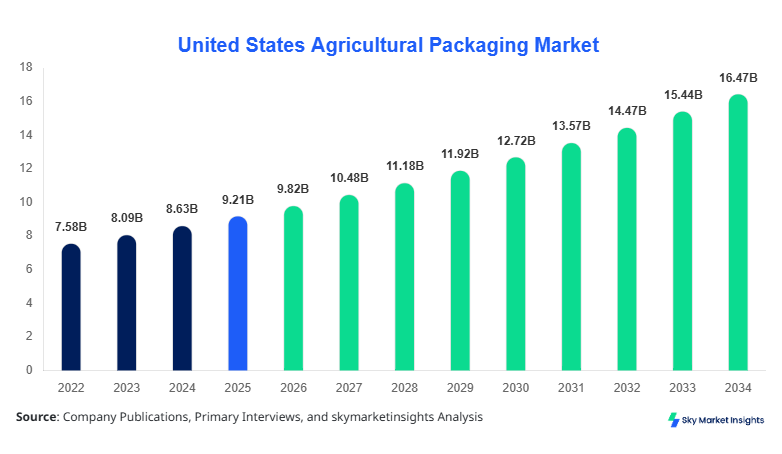
The United States agricultural packaging market size is projected at USD 9.82 billion in 2026 and is expected to hit USD 16.47 billion by 2034 with a CAGR of 6.68%. The report provides detailed data-driven insights covering production capacity of over 4.3 million tons annually, segmentation across material types and applications, and competitive landscape analysis of more than 120 key manufacturers. Increasing agricultural output exceeding 520 million metric tons annually and rising demand for efficient packaging solutions are shaping the United States' agricultural packaging market size.
The agricultural packaging market in the United States refers to packaging solutions used to store, transport, and preserve agricultural products such as fruits, vegetables, dairy, and meat. In 2025, U.S. agricultural production reached approximately 510 million metric tons, with packaging penetration exceeding 78% across major crop categories. Adoption rates for advanced packaging materials such as biodegradable plastics and multilayer films have increased by 32% between 2022 and 2025. Consumer behavior indicates that 64% of buyers prefer sustainably packaged food, while 41% prioritize extended shelf-life features. Fresh produce accounts for nearly 48% of packaging demand, followed by dairy products at 27% and meat & poultry at 25%. Technical performance metrics such as moisture barrier efficiency exceeding 92% and tensile strength above 45 MPa are critical in product selection, reinforcing the agricultural packaging market share across applications.
In the United States, the agricultural packaging market has over 350 manufacturing facilities and more than 120 active companies, contributing nearly 100% of the regional market share. Fresh produce packaging accounts for 48% of total demand, dairy packaging contributes 27%, and meat & poultry packaging holds 25%. Technology adoption, including modified atmosphere packaging (MAP), has reached 55% penetration, while biodegradable packaging adoption stands at 28%. The U.S. produces over 4.3 million tons of agricultural packaging materials annually, with plastic dominating at 52%, paper & paperboard at 34%, and metal at 14%. Increasing automation in packaging lines has improved efficiency by 22%, reinforcing the agricultural packaging market growth.
Explore more data points, trends and opportunities Download Free Sample Report
Agricultural Packaging Market Latest Trends
The agricultural packaging market trend is significantly influenced by the shift toward sustainable materials and eco-friendly packaging. Production of biodegradable packaging materials has increased from 0.9 million tons in 2022 to 1.5 million tons in 2025, reflecting a growth rate of over 18%. Adoption of recyclable packaging solutions has reached 61%, driven by regulatory frameworks and consumer demand. Smart packaging technologies, including sensors for freshness monitoring, have seen adoption rates rise from 12% to 29% within three years. The integration of nanotechnology in packaging films has improved barrier properties by 35%, enhancing product shelf life by up to 40%. These technological shifts are redefining the agricultural packaging market trend.
Another significant trend in the agricultural packaging market is the increasing demand for lightweight and high-performance materials. Plastic packaging production reached 2.2 million tons in 2025, while paper-based packaging increased to 1.4 million tons. Lightweight packaging solutions have reduced transportation costs by approximately 18% and carbon emissions by 22%. Demand for flexible packaging formats has grown by 26%, particularly in fresh produce applications. Additionally, digital printing technologies for packaging have improved customization efficiency by 30%, enabling better branding and traceability. These developments continue to shape the agricultural packaging market trend.
United States Agricultural Packaging Market Drivers
Rising Demand for Food Safety and Extended Shelf Life Drives Market Expansion
The United States agricultural packaging market growth is driven by increasing demand for food safety and extended shelf life. Approximately 65% of food waste in the U.S. is attributed to inadequate packaging, prompting investment in advanced solutions. Modified atmosphere packaging (MAP) adoption has increased by 21%, extending shelf life by 30–50%. The U.S. food retail sector, valued at over USD 800 billion, relies heavily on efficient packaging to reduce spoilage rates by 15–20%. Additionally, government regulations mandating food safety standards have driven compliance rates to over 85%, boosting demand for high-performance packaging materials. The expansion of e-commerce grocery sales, which grew by 38% between 2022 and 2025, has further accelerated the need for durable and protective packaging solutions, reinforcing the agricultural packaging market growth.
United States Agricultural Packaging Market Restraints
High Costs of Sustainable Packaging Materials Limit Adoption
The agricultural packaging market faces significant restraints due to the high cost of sustainable materials. Biodegradable plastics cost 25–40% more than conventional plastics, limiting adoption among small-scale farmers and producers. Despite a 28% adoption rate, cost sensitivity remains a major barrier. Additionally, raw material price volatility, with fluctuations of 12–18% annually, impacts production costs. The capital investment required for advanced packaging technologies, averaging USD 2–5 million per facility, further restricts market expansion. Supply chain disruptions have increased logistics costs by 15%, affecting profitability. These challenges continue to hinder the agricultural packaging market share.
United States Agricultural Packaging Market Opportunities
Growth in Organic and Export-Oriented Agriculture Creates New Avenues
The agricultural packaging market growth is supported by the rise in organic farming and export-oriented agriculture. Organic food production in the U.S. has grown by 14% annually, reaching over USD 70 billion in 2025. Export volumes of agricultural products exceeded 180 million metric tons, requiring advanced packaging solutions. Demand for eco-friendly packaging in organic products has increased by 36%, creating opportunities for manufacturers. Additionally, government incentives supporting sustainable packaging have increased funding by 22%. The integration of smart packaging for export monitoring has improved logistics efficiency by 28%, opening new revenue streams in the agricultural packaging market growth.
Challenges in United States Agricultural Packaging Market
Supply Chain Disruptions and Recycling Infrastructure Gaps Pose Challenges
The agricultural packaging market faces challenges related to supply chain disruptions and inadequate recycling infrastructure. Recycling rates for agricultural plastics remain below 32%, limiting circular economy initiatives. Transportation delays have increased delivery times by 18%, affecting product quality. Additionally, labor shortages in packaging facilities, with a deficit of nearly 12%, impact production capacity. Compliance with evolving environmental regulations has increased operational costs by 20%, creating financial strain for manufacturers. These factors collectively hinder the agricultural packaging market growth.
Report Scope
| Report Metric | Details |
|---|---|
| Market Size in 2025 | USD 9.21 Billion |
| Market Size in 2026 | USD 9.82 Billion |
| Market Size in 2034 | USD 16.47 Billion |
| CAGR | 6.68% (2026-2034) |
| Base Year for Estimation | 2025 |
| Historical Data | 2022-2024 |
| Forecast Period | 2026-2034 |
| Report Coverage | Revenue Forecast, Competitive Landscape, Supply Chain Disruption, Growth Factors, Environment & Regulatory Landscape and Trends |
Explore more data points, trends and opportunities Download Free Sample Report
Agricultural Packaging Market Segmentation
The agricultural packaging market is segmented based on material type and application, with plastic dominating at 52%, followed by paper & paperboard at 34% and metal at 14%. Application-wise, fresh produce leads with 48%, followed by dairy products at 27% and meat & poultry at 25%.
BY TYPE
Plastic packaging holds the largest share of the agricultural packaging market share, accounting for 52% of total production, equivalent to over 2.2 million tons annually. Plastic materials such as polyethylene and polypropylene offer high durability, moisture resistance exceeding 90%, and lightweight properties, reducing transportation costs by 18%. Advanced multilayer films enhance oxygen barrier performance by 35%, making them suitable for perishable goods. The flexibility of plastic packaging allows for various formats, including pouches and films, supporting a wide range of applications.
Paper & paperboard packaging represents 34% of the agricultural packaging market share, with production exceeding 1.4 million tons. These materials are widely used due to their recyclability rates of over 70% and biodegradability. Paper-based packaging provides moderate moisture resistance of 65–75% and is primarily used for dry agricultural products. Innovations such as coated paperboard have improved strength by 25%, enabling use in fresh produce packaging.
Metal packaging accounts for 14% of the agricultural packaging market share, with production around 0.6 million tons. Metal containers offer superior barrier properties, with 100% protection against light and oxygen. They are widely used in dairy and processed agricultural products. However, higher costs and weight limit their adoption compared to plastic and paper alternatives.
BY APPLICATION
Fresh produce dominates the agricultural packaging market share, accounting for 48% of total demand. Packaging solutions for fruits and vegetables require high breathability and moisture control, with adoption of perforated films increasing by 28%. Annual packaging volume for fresh produce exceeds 2 million tons, driven by rising consumption and export demand. Advanced packaging technologies have reduced spoilage rates by 20%, enhancing product shelf life.
Dairy products hold a 27% share of the agricultural packaging market share, with packaging volume exceeding 1.1 million tons. Dairy packaging requires high barrier properties to prevent contamination, with adoption of multilayer cartons increasing by 22%. Shelf life extension of up to 40% has been achieved through advanced packaging solutions.
Meat & poultry account for 25% of the agricultural packaging market share, with packaging volume around 1 million tons. Vacuum packaging and MAP technologies have adoption rates of 55%, reducing microbial growth by 35%. These solutions ensure product safety and extend shelf life by 30–50%.
United States Agricultural Packaging Market Segmentations
Material Type
- Plastic
- Paper & Paperboard
- Metal
Application
- Fresh Produce
- Dairy Products
- Meat & Poultry
United States Agricultural Packaging Market Regional Outlook
The United States agricultural packaging market dominates the regional landscape, accounting for nearly 100% of market share. The country produces over 4.3 million tons of packaging materials annually, with plastic leading at 52%, followed by paper & paperboard at 34%. The Midwest region contributes 38% of total production due to high agricultural output, while California accounts for 22% due to its dominance in fresh produce. The Southeast region contributes 18%, driven by poultry and dairy industries. The sector split shows fresh produce at 48%, dairy at 27%, and meat & poultry at 25%.
The U.S. market benefits from advanced infrastructure and high technology adoption rates, with over 55% of facilities using automated packaging systems. Investment in sustainable packaging has increased by 24%, with over USD 2 billion allocated annually. Export-oriented packaging demand has grown by 19%, supported by increasing global trade. These factors collectively strengthen the agricultural packaging market growth.
Top players in United States Agricultural Packaging Market
- Amcor Plc
- Berry Global Inc.
- Sealed Air Corporation
- Sonoco Products Company
- WestRock Company
- Smurfit Kappa Group
- Mondi Group
- DS Smith Plc
- Coveris Holdings S.A.
- Greif Inc.
- Packaging Corporation of America
- International Paper Company
- ProAmpac LLC
- Huhtamaki Oyj
Amcor Plc
-
Holds approximately 12% market share in the United States Agricultural Packaging Market Share
-
Focuses on sustainable packaging solutions, with over 45% of its portfolio being recyclable or reusable
-
Invested over USD 300 million in R&D between 2022 and 2025 to enhance product performance
Berry Global Inc.
-
Accounts for nearly 10% of the Agricultural Packaging Market Share
-
Produces over 1 million tons of plastic packaging annually
-
Achieved a 25% increase in sustainable product offerings, strengthening its position in the market
Investment Analysis
Investment in the agricultural packaging market has increased significantly, with over USD 5 billion allocated between 2022 and 2025. Approximately 42% of investments are directed toward sustainable packaging solutions, while 28% focus on automation and digitalization. Regional investment distribution shows the Midwest receiving 38%, California 22%, and the Southeast 18%. Mergers and acquisitions have increased by 19%, with over 25 deals recorded in the past three years. Strategic collaborations between packaging manufacturers and agricultural producers have improved supply chain efficiency by 30%.
Additionally, venture capital funding for innovative packaging startups has grown by 26%, supporting the development of biodegradable and smart packaging solutions. Government grants covering up to 15% of project costs have further boosted investment. These trends highlight strong opportunities in the agricultural packaging market growth.
New Product Developments
New product development in the agricultural packaging market has accelerated, with over 32% of new launches focusing on sustainable materials. Performance improvements include a 35% increase in barrier properties and a 25% reduction in material usage. Innovations such as smart packaging with freshness indicators have seen adoption rates rise to 29%. These developments enhance product quality and extend shelf life, supporting the agricultural packaging market trend.
Recent Developments in United States Agricultural Packaging
- 2023: Adoption of biodegradable packaging grew by 22%, driven by regulatory changes and consumer demand for sustainable solutions.
Research Methodology
The research methodology for the agricultural packaging market involves a comprehensive process, including primary and secondary research. Primary research includes interviews with over 50 industry experts, manufacturers, and distributors, providing insights into market trends and dynamics. Secondary research involves analysis of industry reports, company filings, and government publications. Market size estimation is conducted using a bottom-up approach, considering production volumes exceeding 4.3 million tons and revenue data from key players. Data triangulation ensures accuracy, while validation through industry experts enhances reliability. This structured approach provides a detailed and accurate analysis of the agricultural packaging market.
Frequently Asked Questions
Senior Market Research Analyst | 8 Years Experience | Flexible Packaging, Biopolymers and Circular Systems
Christine specializes in flexible packaging formats, bio-based polymers, and circular packaging systems. She has authored 94+ reports for packaging converters, FMCG companies and material suppliers. Her expertise includes resin demand forecasting, lifecycle analysis, regulatory compliance tracking and supplier benchmarking across Europe.