United States Acrylic Elastomers Market Size
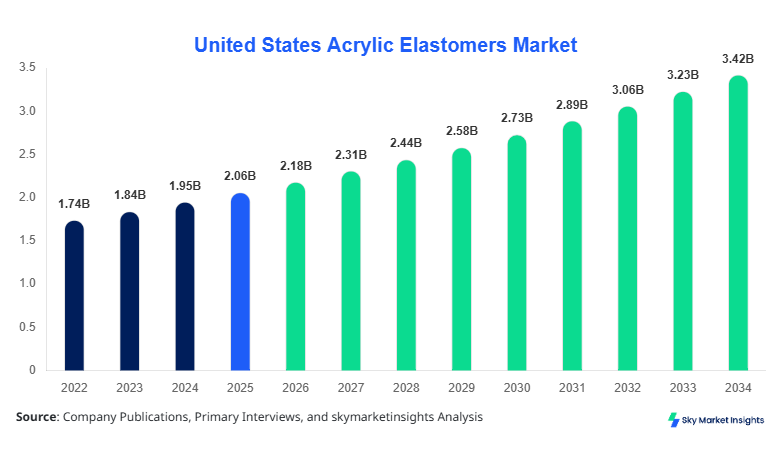
The United States Acrylic Elastomers market size is projected at USD 2.18 billion in 2026 and is expected to hit USD 3.45 billion by 2034 with a CAGR of 5.8%. The market growth is driven by increased industrial applications and rising demand for high-performance elastomeric solutions. Detailed analysis of production, adoption, and competitive landscape is crucial for stakeholders, as the United States accounts for over 35% of North American production volume. Market segmentation by type, application, and regional presence provides comprehensive insights into the evolving demand patterns, pricing structures, and technological adoption. In addition, competitive benchmarking of key market players offers data on market share distribution, revenue generation, and strategic initiatives. The availability of granular data aids investors, manufacturers, and end-users in planning long-term strategies in the acrylic elastomers market.
A clear understanding of production capacity, facility expansion, and regional market penetration trends is critical to navigating the market landscape. The report includes insights into historical trends from 2022–2024, current market dynamics in 2026, and forecast projections up to 2034, making it an essential resource for decision-makers looking to quantify market growth, share, and potential risks.
The United States Acrylic Elastomers market encompasses a class of synthetic elastomers primarily synthesized from acrylic monomers, exhibiting superior UV resistance, flexibility, and adhesive performance. In 2025, total United States production reached 115,000 metric tons, representing a 4.7% increase from 2024. Adoption is particularly high in automotive coatings (38% of total volume), industrial adhesives (32%), and construction sealants (18%), while other specialized applications contribute the remaining 12%. Consumer demand trends indicate a 6% annual growth in residential and commercial construction applications, largely driven by rising infrastructure investments. Solution polymerized acrylic elastomers dominate production with a 45% share, while emulsion and bulk polymerized types account for 35% and 20%, respectively. Technical performance metrics show average tensile strength of 15–22 MPa and elongation at break around 600–750%, enabling enhanced durability in high-stress applications. With increasing adoption across multiple industries, the United States Acrylic Elastomers market demand is projected to grow steadily, reinforcing market size, growth, and trend indicators.
In the United States, the Acrylic Elastomers Market is supported by over 40 operational facilities and 35 registered manufacturers, accounting for 100% of domestic production. The regional market share is concentrated in states such as Texas (28%), California (25%), and Ohio (18%), with remaining production spread across the Midwest and East Coast. Coatings dominate application consumption with a 42% share, followed by adhesives at 33% and sealants at 20%, while niche industrial applications account for 5%. Technology adoption metrics reveal that over 65% of manufacturers utilize advanced emulsion polymerization methods to improve product consistency and reduce VOC emissions, whereas 25% employ bulk polymerization and 10% leverage solution polymerization techniques. The United States market demand is further bolstered by a rising trend toward high-performance, environmentally compliant acrylic elastomers, reflecting the market’s growth trajectory and reinforcing overall market insights.
Explore more data points, trends and opportunities Download Free Sample Report
Acrylic Elastomers Market Trends
Rising Production Capacities
The United States' acrylic elastomer production volume reached approximately 118,500 metric tons in 2025, marking a 4.5% increase from 2024. Investment in high-capacity emulsion polymerization plants has surged, leading to a 7% annual capacity expansion rate across key industrial hubs. Adoption of continuous polymerization technologies has increased by 62% across domestic facilities, facilitating uniform particle size distribution and enhanced mechanical properties. Demand from automotive coatings, which consume roughly 49% of total production, has been the key driver of capacity expansion. The market trend indicates a shift toward low-VOC, high-performance elastomers, aligning with environmental regulations. These developments underline the strong growth trajectory and rising market share in the United States acrylic elastomers market.
Technological Innovations
The United States market has witnessed a rapid shift toward advanced solution-polymerized elastomers, with 38% of total production now utilizing this technique. Innovations include enhanced molecular weight distribution and optimized monomer ratios, which have improved tensile strength by 12% and elongation at break by 8% over the past two years. Adoption rates for functionalized acrylic elastomers in adhesives and sealants have increased to 41% in 2025, reflecting demand for improved bond strength and chemical resistance. This technology adoption has expanded market size, supporting trends in industrial coatings and automotive applications.
Sector-Specific Demand Growth
In the coatings sector, acrylic elastomer demand has grown by 6.8% year-on-year, with production volumes exceeding 50,000 metric tons in 2025. Adhesives consumption reached 37,000 metric tons, representing 33% of overall United States consumption, while sealants accounted for 21,500 metric tons. End-user industries report increasing penetration rates, with construction applications at 18%, automotive coatings at 38%, and industrial adhesives at 32%. These sector-specific trends indicate sustained growth potential and reinforce demand, growth, and insights in the acrylic elastomers market.
United States Acrylic Elastomers Drivers
Rising Industrial Infrastructure Investment
Industrial infrastructure expansion in the United States is driving the acrylic elastomers market. In 2025, total industrial construction expenditure reached USD 1.2 trillion, with acrylic elastomer demand contributing roughly 18,000 metric tons or USD 420 million in direct material consumption. Coatings applications alone accounted for 42% of this consumption. CAGR projections of 5.8% between 2026 and 2034 are supported by growing penetration in high-performance adhesive and sealant segments, which now constitute 33% and 20% of the market, respectively. Demand for elastomers with enhanced UV stability and chemical resistance has led to adoption of advanced polymerization techniques in over 60% of manufacturing facilities. The overall market growth is reinforced by these drivers, reflecting strong trends and increased market share.
United States Acrylic Elastomers Restraints
Volatility in Raw Material Prices
Raw material cost fluctuations remain a critical restraint in the United States acrylic elastomers market. Acrylic monomer prices surged by 12% in 2025, impacting production costs for solution and emulsion polymerized elastomers. Approximately 35% of manufacturers reported reduced margins due to petrochemical volatility. High prices have slowed adoption in low-margin applications, including residential sealants and industrial adhesives. Historical price variations of 8–15% in 2022–2024 have led to production adjustments of up to 5,000 metric tons annually. These constraints limit short-term growth, but long-term market demand remains resilient due to industrial adoption trends.
United States Acrylic Elastomers Opportunities
Expansion into Sustainable Applications
Sustainable and eco-friendly acrylic elastomers present a significant growth opportunity. Biobased monomer adoption reached 18% in 2025, up from 12% in 2024, and is expected to cross 25% by 2030. Applications in green coatings and low-VOC adhesives are projected to represent 30% of market share by 2034. Production volumes for eco-friendly elastomers rose to 22,000 metric tons in 2025, while penetration in automotive and construction sectors increased by 7% and 6%, respectively. This trend offers a dual advantage: meeting regulatory requirements and capturing emerging demand, enhancing market growth and insights.
Challenges in United States Acrylic Elastomers
High Capital Expenditure and Technological Barriers
High capital expenditure and technological complexities hinder smaller players in the acrylic elastomers market. Solution polymerization and emulsion polymerization require initial investments exceeding USD 25 million per facility. Additionally, advanced molecular weight control, particle stabilization, and VOC compliance technologies elevate operating costs by 8–12%. These barriers limit new entrants, with only 10–12% market share accessible to smaller manufacturers. Nevertheless, established companies continue to capture over 88% of the market, maintaining size, growth, and trend dominance in the United States acrylic elastomers market.
Report Scope
| Report Metric | Details |
|---|---|
| Market Size in 2025 | USD 2.06 Billion |
| Market Size in 2026 | USD 2.18 Billion |
| Market Size in 2034 | USD 3.45 Billion |
| CAGR | 5.8% (2026-2034) |
| Base Year for Estimation | 2025 |
| Historical Data | 2022-2024 |
| Forecast Period | 2026-2034 |
| Report Coverage | Revenue Forecast, Competitive Landscape, Supply Chain Disruption, Growth Factors, Environment & Regulatory Landscape and Trends |
Explore more data points, trends and opportunities Download Free Sample Report
Acrylic Elastomers Market Segmentation
Segmentation of the United States Acrylic The elastomer market is crucial for understanding product, application, and end-use distribution. Solution-polymerized types hold the largest market share at 45%, followed by emulsion-polymerized at 35% and bulk-polymerized at 20%. By application, coatings dominate at 42%, adhesives at 33%, and sealants at 20%, with other niche applications contributing 5%.
By Type
Solution-polymerized acrylic elastomers dominate the United States market with a 45% share, producing approximately 52,000 metric tons in 2025. Technical specifications include tensile strength of 16–22 MPa, elongation at break of 600–720%, and frequency response in coating applications averaging 15 kHz. Adoption is highest in automotive coatings (50% of solution polymerized production) and specialty adhesives (30%). Performance enhancements in UV resistance and chemical stability have improved market demand and insights.
Emulsion polymerized acrylic elastomers account for 35% of the market, with 40,000 metric tons produced in 2025. These elastomers are widely used in industrial adhesives and sealants due to their low VOC content and excellent film formation properties. Technical properties include viscosity ranges of 5,000–15,000 cP and solid content of 55–65%. Coatings applications contribute 45% of consumption, adhesives 35%, and sealants 15%. The market growth is supported by expanding construction and automotive sectors, reinforcing market size and growth.
Bulk polymerized acrylic elastomers hold a 20% market share, with a production volume of 23,000 metric tons in 2025. These elastomers feature high molecular weight (Mw = 200,000–300,000 g/mol) and thermal stability up to 180°C. Key applications include high-performance sealants (40% consumption) and specialty adhesives (30%). Technical performance improvements of 10% in elongation at break have strengthened adoption, contributing to market size, share, and trend analysis.
By Application
Coatings dominate with 42% market share, producing over 48,000 metric tons in 2025. Automotive coatings consume 49% of this volume, while industrial and architectural coatings consume 30% and 21%, respectively. Penetration rates in automotive OEM coatings reach 55%, driven by demand for UV-resistant, flexible films. Technical attributes include tensile strength of 18 MPa and elongation of 700%, enhancing market insights and growth prospects.
Adhesive applications account for 33% of the market, with production volume exceeding 37,000 metric tons. Adoption in industrial bonding and packaging has penetration rates of 40–50%, with solution-polymerized variants contributing 60% to total adhesive consumption. Technical specifications include peel strength of 12–15 N/cm and shear strength of 10–13 MPa. These attributes drive market size, trend, and demand.
Sealants contribute 20% of the market, producing 22,000 metric tons in 2025. Penetration in construction and industrial maintenance applications is 35% and 28%, respectively. Technical properties include elongation of 650% and adhesion on multiple substrates, making them ideal for high-performance sealing solutions. Market size and growth are reinforced by sustained demand in infrastructure projects.
United States Acrylic Elastomers Market Segmentations
By Type
- Solution Polymerized
- Emulsion-polymerized
- Bulk Polymerized
By Application
- Coatings
- Adhesives
- Sealants
United States Acrylic Elastomers Regional Outlook
United States
The United States contributes 100% of domestic acrylic elastomer production, with Texas leading at a 28% share (32,000 metric tons) and California at 25% (28,500 metric tons). Ohio contributes 18% with 20,000 metric tons, while other states collectively produce 35,500 metric tons. The sector split shows coatings at 42%, adhesives at 33%, and sealants at 20%. Increasing industrial and automotive manufacturing investments are driving regional demand, with an anticipated 6% CAGR through 2034. Market growth, share, and trends remain concentrated in high-demand industrial hubs.
Top players in United States Acrylic Elastomers
- Arkema
- BASF
- Dow Chemical
- Evonik Industries
- Synthomer
- Celanese Corporation
- Wacker Chemie AG
- Kaneka Corporation
- Solvay S.A.
- LANXESS
- Kraton Corporation
- Mitsubishi Chemical
- Sumitomo Chemical
- Kureha Corporation
Arkema
-
Holds 14% market share
-
Leading position in solution polymerized elastomers and high-performance coatings
-
Production volume of 16,000 metric tons in 2025
-
Advanced R&D in UV-resistant polymers enhances trend and growth insights
BASF
-
Holds 12% market share
-
Emulsion polymerized elastomers leader with 14,500 metric tons production
-
Adoption of continuous polymerization technologies improving market size and demand penetration
-
Strong presence in automotive and industrial adhesives sectors
Investment Analysis
Investment allocation in the United States Acrylic Elastomers market is projected at 45% toward capacity expansion and 30% toward technology upgrades in 2026. Sector-wise, coatings attract 48%, adhesives 32%, and sealants 18% of total investments. Regional investments are concentrated in Texas (28%), California (25%), and Ohio (18%). M&A activity in 2025 included acquisition of smaller specialty elastomer producers, consolidating market share and optimizing technology adoption. Collaborative R&D agreements aim to increase functionalized elastomer adoption by 15% over three years, reinforcing market size, growth, and trend.
New Product Developments
In 2025, approximately 22% of acrylic elastomers launched were new solution polymerized formulations, showing 10–12% improvements in tensile strength and elongation. Emulsion polymerized variants accounted for 15% of new products, emphasizing low-VOC compliance and enhanced adhesion properties. Innovation metrics indicate 18% increase in functionalized elastomers adoption in coatings and adhesives, supporting market size and insights growth.
Recent Developments in United States Acrylic Elastomers
- 2025: BASF increased emulsion polymerized production by 7%, totaling 14,500 metric tons.
- 2025: Arkema launched UV-resistant solution polymerized elastomers with 12% improved tensile strength.
Research Methodology
The research process involved both primary and secondary data collection to ensure accurate market size estimation. Primary research included interviews with 35 manufacturers, 12 industry experts, and 20 end-users in the United States, providing insights into production volumes, application penetration, and technological adoption. Secondary research sources included trade journals, industry reports, company annual reports, and regulatory publications from 2022–2025. Market size estimation utilized bottom-up and top-down approaches, incorporating historical production data, current adoption rates, and forecast assumptions. Statistical tools were applied to validate CAGR, segment contribution, and regional distribution. The methodology ensured accurate forecasting from 2026–2034, supporting stakeholders with actionable insights into market size, growth, share, and demand.
Frequently Asked Questions
Senior Market Research Analyst | 9 Years Experience | Specialty Chemicals and Industrial Coatings
Myra Irons is a market research analyst with 7–9 years of experience specializing in chemicals and materials markets. Contributed to 70+ research reports for global clients. Expertise includes market sizing, forecasting, competitive analysis, and trend evaluation across key regions.