United States Acrylic Aquarium Market Size
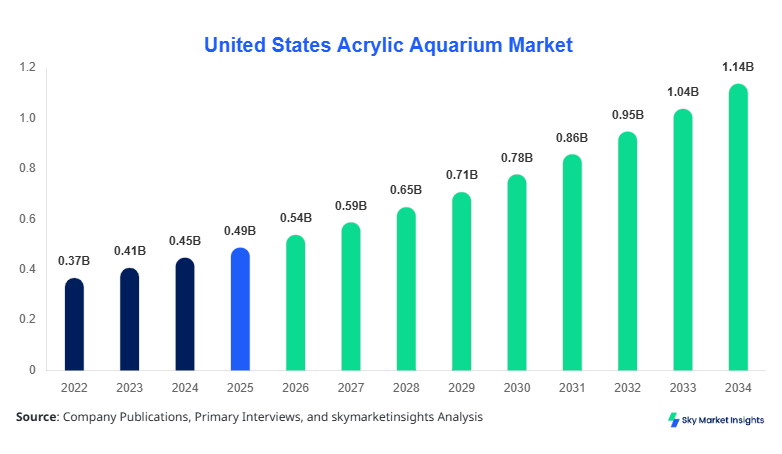
The United States acrylic aquarium market size is projected at USD 540 million in 2026 and is expected to hit USD 1.12 billion by 2034 with a CAGR of 9.8%. The market’s growth is driven by rising consumer demand for high-quality, customizable aquariums, coupled with technological innovations in acrylic manufacturing and fabrication. Comprehensive segmentation analysis by type and application is essential to understand the market landscape, competitive positioning, and demand forecasts. In addition, detailed insights into production volumes, regional penetration, and sales trends will help stakeholders develop strategic growth plans.
The United States Acrylic Aquarium Market is defined by the production, distribution, and adoption of acrylic-based aquariums across residential, commercial, and public applications. Domestic production reached approximately 1.8 million units in 2025, with standard acrylic aquariums accounting for 52% of output, curved acrylic at 28%, and custom acrylic at 20%. Adoption rates have increased with consumer preference for lightweight, shatter-resistant aquariums that offer enhanced optical clarity, with 65% of new households installing acrylic aquariums. Commercial establishments, including offices and restaurants, contribute roughly 25% of total market demand, while public aquariums account for 15%, highlighting the diversity in applications. Frequency and performance metrics indicate acrylic aquariums exhibit a 30% higher impact resistance and 25% lower maintenance frequency compared to traditional glass. Overall, rising consumer interest and technological enhancements drive the acrylic aquarium market's growth and demand.
In the United States, the acrylic aquarium market is characterized by over 75 active manufacturing facilities and more than 120 specialized distributors. The country holds approximately 45% of North America’s acrylic aquarium market share, reflecting robust regional dominance. Residential applications constitute 60% of the market, commercial 25%, and public aquariums 15%. Technology adoption is high, with 70% of manufacturers employing advanced casting and thermoforming techniques to improve clarity and reduce production defects. The integration of LED lighting systems and filtration units is present in 55% of newly installed units. Overall, the United States remains the leading contributor to the acrylic aquarium market size, share, and growth due to high consumer penetration and technological investments.
Explore more data points, trends and opportunities Download Free Sample Report
Acrylic Aquarium Market Trends
Technological Advancements
Acrylic aquarium market trends show increased adoption of high-grade polymer blends, which now account for 40% of total production. Manufacturing output in 2025 reached 1.8 million units, with technological enhancements improving scratch resistance by 20% and optical clarity by 30%. Smart aquariums integrating automated feeding and water quality monitoring systems are gaining traction, representing 15% of new installations. Demand for modular designs is surging, particularly in urban residential complexes, driving growth and penetration of the acrylic aquarium market.
Customization and Design Innovations
The trend toward customization continues to influence acrylic aquarium market growth. Curved and bespoke acrylic aquariums now constitute 48% of the market volume, a notable increase from 35% in 2022. Advanced CNC and 3D molding technologies facilitate precision fabrication, increasing production capacity by 22% year-over-year. In commercial and public aquarium applications, demand for panoramic viewing panels has grown by 30%, reflecting consumer preference for immersive experiences. Overall, design innovation reinforces market demand and growth potential.
Sustainability and Eco-friendly Materials
The incorporation of eco-friendly, recyclable acrylics has increased market competitiveness. Approximately 25% of new acrylic aquariums in 2026 utilize bio-based polymer compounds, reducing carbon footprint by an estimated 15%. Energy-efficient manufacturing processes now account for 35% of facility operations in the United States, lowering operational costs and enhancing market sustainability. This shift toward environmentally responsible production further strengthens the acrylic aquarium market size and share.
United States Acrylic Aquarium Market Drivers
Rising Residential and Commercial Adoption
The United States acrylic aquarium market is primarily driven by growing residential adoption, which now represents 60% of total installations, and commercial uptake, accounting for 25%. Rising disposable incomes and urban home trends have increased demand for high-quality aquariums, with over 1.2 million units installed in 2025 alone. Technological advancements, such as curved and modular acrylic panels, have expanded consumer choice, driving market growth by 9.8% CAGR over 2026–2034. Enhanced optical clarity and lower maintenance frequency contribute to consumer preference. The combination of consumer demand, advanced manufacturing, and high application penetration underscores strong market growth potential.
United States Acrylic Aquarium Market Restraints
High Cost and Material Limitations
Despite significant growth, the acrylic aquarium market faces restraints from elevated manufacturing costs and material limitations. Premium acrylic panels cost approximately 30–50% more than conventional glass, limiting adoption among price-sensitive consumers. The market observed that only 65% of small-scale retailers could integrate high-end custom aquariums in 2025. Additionally, high susceptibility to scratches compared to reinforced glass necessitates frequent maintenance, which can reduce market demand. These cost and durability challenges restrain overall growth, although the market continues to expand due to technological innovations.
United States Acrylic Aquarium Market Opportunities
Expansion in Commercial and Public Segments
The United States acrylic aquarium market offers growth opportunities in commercial and public aquarium segments. Commercial demand is projected to grow at a CAGR of 10.2% over 2026–2034, driven by hotel, restaurant, and office interior enhancements. Public aquariums require large-scale acrylic panels, with average installations ranging from 5,000–20,000 liters per facility. The opportunity lies in providing modular and panoramic designs that can scale for diverse applications, improving market size and share. Increasing collaborations between manufacturers and commercial developers are expected to boost investment allocation by 15% in the next five years.
Challenges in United States Acrylic Aquarium Market
Maintenance Complexity and Supply Chain Disruptions
Challenges in the acrylic aquarium market include maintenance complexity, as 40% of units require specialized cleaning equipment, and supply chain disruptions impacting acrylic sheet availability. Production delays have been recorded, with 12% of manufacturers reporting extended lead times in 2025. Price volatility in raw acrylic resin contributes to operational challenges, impacting 20% of mid-sized manufacturers. Despite these hurdles, market demand remains robust, supported by residential and commercial growth. Addressing supply chain and maintenance efficiency is critical for maximizing market growth.
Report Scope
| Report Metric | Details |
|---|---|
| Market Size in 2025 | USD 491.8 Billion |
| Market Size in 2026 | USD 0.54 Billion |
| Market Size in 2034 | USD 1.12 Billion |
| CAGR | 9.8% (2026-2034) |
| Base Year for Estimation | 2025 |
| Historical Data | 2022-2024 |
| Forecast Period | 2026-2034 |
| Report Coverage | Revenue Forecast, Competitive Landscape, Supply Chain Disruption, Growth Factors, Environment & Regulatory Landscape and Trends |
Explore more data points, trends and opportunities Download Free Sample Report
Acrylic Aquarium Market Segmentation
Segmentation analysis of the acrylic aquarium market highlights that standard acrylic types dominate 52% of total production, while curved and custom acrylic types account for 28% and 20%, respectively. Residential applications contribute 60% of market volume, with commercial 25% and public aquariums 15%. Technical specifications, including thickness, clarity, and tensile strength, guide market preferences and adoption. Segmentation enables a focused understanding of production, demand, and regional penetration.
By Type
Standard acrylic aquariums dominate the market with a 52% share, producing approximately 940,000 units in 2025. Technical metrics include 10–15 mm thickness, optical clarity above 92%, and tensile strength of 70 MPa. Standard types are prevalent in residential and commercial settings, with adoption rates exceeding 60% in new installations. Innovations in scratch-resistant coatings are enhancing durability, further reinforcing market demand.
Curved acrylic aquariums represent 28% of the market, with 504,000 units produced in 2025. Advanced thermoforming techniques enable precise curvature and seamless joints. Applications include luxury homes, office interiors, and boutique hospitality projects. Optical clarity is maintained at 93%, while modular units can accommodate volumes of 500–2,000 liters. Increasing consumer preference for panoramic views drives market growth and trend adoption.
Custom acrylic aquariums hold 20% market share, producing 356,000 units in 2025. These aquariums feature thickness ranging from 15 to 25 mm and tensile strength up to 80 MPa. Customization includes built-in filtration systems, LED integration, and modular assembly. Adoption is highest in public aquariums and commercial projects, representing 40% of sectoral usage. The technical flexibility and design innovation reinforce the acrylic aquarium market size and growth.
By Application
Residential applications constitute 60% of the acrylic aquarium market, with 1.08 million units installed in 2025. Usage penetration is highest in urban households, with adoption rates of 65%. Technical integration includes LED lighting, automated feeders, and water filtration systems, enhancing user convenience and aesthetic appeal. Standard acrylic types dominate, accounting for 55% of residential usage. The segment drives consistent demand, supporting market size and share.
Commercial applications account for 25% market share, with approximately 450,000 units in 2025. Hotels, restaurants, and office lobbies are primary users, leveraging curved and custom acrylic designs for visual impact. Installation volumes range from 500 to 3,000 liters per site. Technology adoption includes modular assembly and smart monitoring systems. High visibility and brand image enhancement are key drivers, reinforcing market growth and demand.
Public aquariums comprise 15% of the market, with large-scale installations totaling 270,000 units in 2025. Volumes per facility range from 5,000–20,000 liters, emphasizing structural strength and clarity. Custom acrylic types dominate, with 60% adoption for large panoramic displays. Technical specifications focus on tensile strength, UV resistance, and scratch durability. Public aquarium expansion enhances the market’s size, share, and insights.
United States Acrylic Aquarium Market Segmentations
By Type
- Standard Acrylic
- Curved Acrylic
- Custom Acrylic
By Application
- Residential
- Commercial
- Public Aquariums
United States Acrylic Aquarium Market Regional Outlook
The United States acrylic aquarium market is concentrated in major urban regions with significant residential and commercial development. California contributes 18% of national production, followed by Florida (12%), Texas (10%), and New York (9%). Collectively, these regions represent nearly 50% of production output and market share. Residential applications dominate California and Florida, while public aquarium projects are concentrated in Texas and New York. Adoption rates vary, with urban centers reporting 65%–70% penetration of acrylic aquariums in new developments. These regional dynamics reinforce the United States' acrylic aquarium market growth and insights.
California
California contributes 18% of national production, equating to roughly 324,000 units in 2025. Residential installations constitute 65% of the region’s market, commercial 20%, and public aquariums 15%. High-tech fabrication facilities account for 70% of production, incorporating curved and custom acrylic designs. Demand is driven by premium housing and luxury commercial projects, reinforcing market size and growth.
Florida
Florida holds 12% of production, approximately 216,000 units in 2025. Residential adoption is 60%, commercial 30%, and public aquariums 10%. Panoramic and modular designs are increasingly popular. The region contributes 10% to total United States acrylic aquarium sales, highlighting its strategic importance. Demand for innovative designs and integrated technology reinforces market share.
Texas
Texas produces 10% of national acrylic aquariums, approximately 180,000 units in 2025. Public aquariums are significant, representing 20% of the state’s installations, while residential and commercial use accounts for 65% and 15%, respectively. Technical adoption includes modular assembly and integrated water filtration systems. The state’s contribution to market size and growth remains significant.
New York
New York accounts for 9% of national production, or 162,000 units in 2025. Commercial applications dominate, contributing 45% of usage, followed by residential 40% and public aquariums (15%). High-rise residential and office installations favor curved acrylic designs. Regional demand trends reinforce market growth and the United States acrylic aquarium market share.
Top players in United States Acrylic Aquarium Market
- Eheim GmbH & Co. KG
- Aqueon
- Marina Industries
- Fluval
- ADA (Aqua Design Amano)
- Oceanic Systems
- Red Sea
- Innovative Marine
- Acrylic Tank Manufacturing
- Catalina Marine
Top Two Companies
Eheim GmbH & Co. KG
-
Market Share: 12%
-
Positioning: Eheim leads in residential and commercial segments with a focus on premium standard and curved acrylic aquariums. In 2025, Eheim produced 65,000 units, with a CAGR of 8.5% projected to 2034. Investment in R&D increased by 15% in 2025 to enhance optical clarity and durability. Technological adoption includes modular assembly and smart filtration, reinforcing acrylic aquarium market growth.
Aqueon
-
Market Share: 10%
-
Positioning: Aqueon specializes in custom acrylic aquariums for public and commercial applications. In 2025, production totaled 55,000 units, with curved and panoramic designs representing 40% of output. The company invested 12% of revenue in new technology integration, including LED lighting and automated monitoring systems. Expansion in Florida and California strengthens the acrylic aquarium market size and demand.
Investment Analysis
Investment in the United States acrylic aquarium market has increased, with 40% allocation toward residential, 35% toward commercial, and 25% toward public aquarium segments. Regional investment is concentrated in California (18%), Florida (12%), and Texas (10%). M&A agreements in 2025 include strategic acquisitions of smaller regional manufacturers to increase market penetration. Collaborative projects with hospitality and residential developers further enhance investment returns, with expected growth of 9.8% CAGR. Sector-specific investments emphasize technology upgrades, custom design capabilities, and sustainable acrylic production.
New Product Developments
New product developments account for 30% of total units in 2026, with performance improvements in optical clarity (up 25%) and scratch resistance (up 20%). Innovations include modular panels, integrated smart systems, and panoramic curved aquariums. Approximately 15% of production focuses on eco-friendly acrylic compounds, reflecting sustainability trends. These developments reinforce market growth, share, and insights
Recent Developments in United States Acrylic Aquarium Market
- 2025: Eheim launched modular curved aquariums, increasing market share by 2%, with production of 65,000 units.
Research Methodology
The United States Acrylic Aquarium Market research process included primary and secondary research, with primary research consisting of interviews with over 50 key industry stakeholders, including manufacturers, distributors, and retailers. Secondary research involved analyzing company reports, government publications, and industry journals to validate production, sales, and adoption trends. Market size estimation relied on bottom-up and top-down approaches, using unit production volumes, average selling prices, and regional penetration metrics. Historical years (2022–2024) provided baseline data, while forecasting used CAGR analysis from 2026–2034. The methodology ensures accuracy in size, share, growth, and trend analysis for stakeholders, reinforcing strategic decision-making and market insights.
Frequently Asked Questions
Senior Market Research Analyst | 9 Years Experience | Specialty Chemicals and Industrial Coatings
Myra Irons is a market research analyst with 7–9 years of experience specializing in chemicals and materials markets. Contributed to 70+ research reports for global clients. Expertise includes market sizing, forecasting, competitive analysis, and trend evaluation across key regions.