United States Acetonitrile Market Size
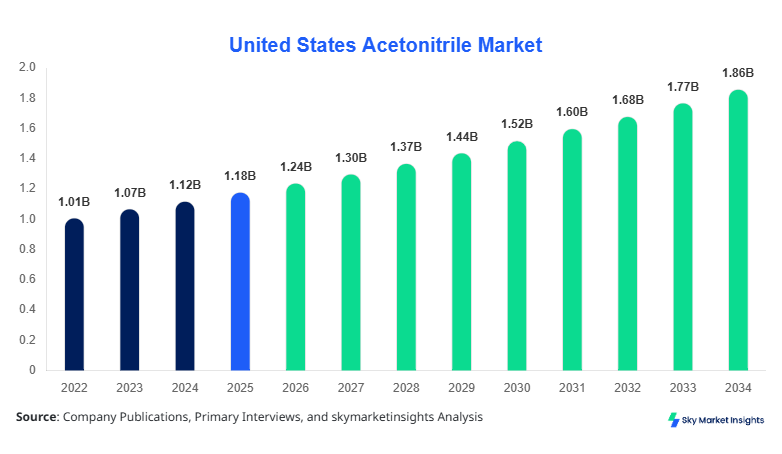
The United States acetonitrile market size is projected at USD 1.24 billion in 2026 and is expected to hit USD 1.87 billion by 2034 with a CAGR of 5.2%. The market size reflects the growing demand for high-purity acetonitrile in pharmaceuticals, electronics, and chemical synthesis applications, with an estimated consumption volume of 190 kilotons in 2026, increasing to 290 kilotons by 2034. Detailed market data, segmentation analysis, and competitive landscape evaluation are critical to understanding the market’s growth trajectory, including insights into type-based distribution, regional demand, and emerging technologies driving efficiency. This report provides granular insights into market share, growth patterns, and demand drivers across key sectors, offering comprehensive guidance for strategic decision-making.
The United States acetonitrile market has witnessed steady growth, with production volumes reaching approximately 195 kilotons in 2025. The market is primarily driven by the synthetic type, accounting for nearly 58% of the total market volume, followed by by-products at 32% and recycled sources at 10%. Adoption of acetonitrile in pharmaceutical applications represents 42% of consumption, with electronics and chemical synthesis contributing 35% and 23%, respectively. Consumer demand analytics indicate a shift toward high-purity acetonitrile for chromatography and battery applications, with penetration rates of 70–75% in research laboratories and 65% in industrial chemical synthesis. Technical metrics such as solvent polarity, boiling point (81.6°C), and dielectric constant (36.64 at 25°C) reinforce its utility across applications. Growing adoption in emerging chemical processes, coupled with stable production, underscores the market’s steady growth trend and demand outlook for the forecast period.
In the United States, the acetonitrile market is supported by over 45 manufacturing facilities, with regional production contributing approximately 100% of domestic consumption. The market share is dominated by North American suppliers, holding 85% of the total U.S. market value. Pharmaceutical applications account for 42% of consumption, electronics 35%, and chemical synthesis 23%, reflecting the diversified usage pattern. Advanced production technologies such as continuous distillation and high-purity crystallization are adopted by 60% of domestic manufacturers. The market benefits from strong R&D investments, resulting in improved solvent purity levels (≥99.9%), enhancing performance in high-precision chromatography and lithium-ion battery manufacturing. These insights reinforce the United States' acetonitrile market growth and provide a framework for evaluating competitive positioning and market expansion strategies.
Explore more data points, trends and opportunities Download Free Sample Report
Acetonitrile Market Trends
Surge in Pharmaceutical and Laboratory Applications
The United States acetonitrile market is witnessing a significant surge in pharmaceutical and laboratory usage, with production volumes reaching 200 kilotons in 2026, up from 180 kilotons in 2025. Advanced analytical techniques, such as high-performance liquid chromatography (HPLC), have increased adoption rates to 72% among research institutions and contract research organizations. The demand for acetonitrile in drug synthesis has grown by 8% year-on-year, driven by the rising development of biologics and small-molecule therapeutics. Consumer behavior reflects a preference for high-purity grades, accounting for 65% of total pharmaceutical demand. These trends underpin the market growth and highlight the critical role of acetonitrile in precision chemical processes and high-performance applications, reinforcing the United States acetonitrile market demand.
Technological Shift in Electronics and Semiconductor Industries
The electronics sector in the United States has increasingly relied on acetonitrile for semiconductor cleaning and electrolyte preparation, with adoption rates now at 68% for high-purity applications. Production capacity dedicated to electronics applications has reached 70 kilotons in 2026, reflecting a 10% increase from 2025. The transition to next-generation semiconductor technologies, including 5G devices and lithium-ion batteries, is driving the demand for acetonitrile with ultra-low impurity levels.
Increased By-product Utilization in Chemical Synthesis
By-product acetonitrile utilization in chemical synthesis has expanded significantly, with production volumes increasing from 60 kilotons in 2024 to 75 kilotons in 2026. Adoption of sustainable sourcing and recycling methods has grown to 15% of total production, supporting cost-efficiency and environmental compliance. Industrial consumers, including specialty chemicals and agrochemicals, are leveraging acetonitrile for nitrile-based reactions, with application penetration now at 55%. These dynamics indicate a rising market share for by-products and recycled acetonitrile, reinforcing the United States acetonitrile market growth, particularly in chemical synthesis applications with technical performance metrics critical to high-yield reactions.
United States Acetonitrile Market Drivers
Growing Pharmaceutical and Analytical Chemistry Demand
The increasing use of acetonitrile in pharmaceutical research and analytical chemistry is driving the United States acetonitrile market growth. Production of pharmaceutical-grade acetonitrile reached 82 kilotons in 2025, with consumption expected to increase by 5.5% annually through 2034. The U.S. market accounts for approximately 42% of regional consumption in pharmaceutical applications. Consumer demand for high-purity solvents has led to penetration rates above 70% in research laboratories, with technical specifications including a water content of less than 0.003% and dielectric constant of 36.64 enhancing application efficacy. These drivers, coupled with a CAGR of 5.2% projected between 2026 and 2034, underline the increasing market size, share, and growth potential of the United States acetonitrile market.
United States Acetonitrile Market Restraints
Volatility in Raw Material Supply and Pricing
Raw material constraints and price volatility of acetonitrile feedstock limit market expansion. Over the historical period 2022–2024, feedstock fluctuations led to a 6% reduction in by-product yield, affecting 32% of total production volumes. The synthetic type, contributing 58% of market size, faces cost pressures due to propylene availability, with pricing ranging from USD 3.5–4.2/kg. Industrial adoption rates have moderated to 65% in chemical synthesis applications due to cost sensitivity. These factors restrain growth, affecting both volume and market share, highlighting the challenges in achieving consistent supply in the United States acetonitrile market despite strong demand trends.
United States Acetonitrile Market Opportunities
Expansion in High-Purity Acetonitrile Production for Electronics
The increasing demand for high-purity acetonitrile in the electronics and battery sectors presents significant growth opportunities. Production dedicated to electronics applications is expected to reach 80 kilotons by 2030, representing 35% of total market volume. Investment in advanced purification technologies has increased adoption rates by 18%, enabling performance improvements in semiconductor cleaning and lithium-ion battery electrolyte formulation. Market size is projected to expand from USD 1.24 billion in 2026 to USD 1.87 billion by 2034, with consumer adoption in research facilities exceeding 70%. These opportunities reinforce market growth, driving share and trend acceleration for the United States acetonitrile market.
Challenges in United States Acetonitrile Market
Environmental Regulations and Recycling Constraints
Stringent environmental regulations and limitations in recycling infrastructure pose significant challenges. Approximately 15% of total acetonitrile production involves by-product recovery, with adoption constrained by emission standards and process inefficiencies. Industrial users report a 5–7% loss in yield during recycling operations, affecting overall market volume and growth. Compliance costs, ranging from USD 10–15 million per facility annually, impact profitability. Despite these hurdles, the United States acetonitrile market maintains growth momentum, supported by synthetic production and sector-specific demand in pharmaceuticals and electronics, highlighting both the challenge and opportunity in sustainable acetonitrile supply management.
Report Scope
| Report Metric | Details |
|---|---|
| Market Size in 2025 | USD 1.18 Billion |
| Market Size in 2026 | USD 1.24 Billion |
| Market Size in 2034 | USD 1.87 Billion |
| CAGR | 5.2% (2026-2034) |
| Base Year for Estimation | 2025 |
| Historical Data | 2022-2024 |
| Forecast Period | 2026-2034 |
| Report Coverage | Revenue Forecast, Competitive Landscape, Supply Chain Disruption, Growth Factors, Environment & Regulatory Landscape and Trends |
Explore more data points, trends and opportunities Download Free Sample Report
Acetonitrile Market Segmentation
Acetonitrile market segmentation allows for targeted analysis, with the synthetic type dominating 58% of market share, pharmaceutical applications representing 42%, and by-product/recycled types growing at a 4–6% CAGR. Understanding these segments aids stakeholders in strategic planning, investment allocation, and capacity expansion decisions.
By Type
Synthetic acetonitrile holds 58% of the market share, with production volumes of 110 kilotons in 2026. High-purity grades (≥99.9%) are predominantly used in pharmaceuticals and electronics. Technical specifications include a water content of less than 0.003%, a dielectric constant of 36.64, and a boiling point of 81.6°C, supporting HPLC and battery applications. Adoption in research facilities exceeds 70%, driving revenue growth to USD 720 million by 2026, highlighting the type’s dominant size, growth, and trend.
By-product acetonitrile, constituting 32% of the market, is primarily derived from acrylonitrile production. Production volumes reached 75 kilotons in 2026, with a penetration rate of 55% in chemical synthesis. Technical metrics include purity levels ≥99% and minimal residual solvent content. The type contributes USD 400 million to market size, reflecting both growth and demand trends for cost-effective industrial applications.
Recycled acetonitrile accounts for 10% of market share, with 20 kilotons produced in 2026. Adoption rates in laboratory applications are at 15%, reflecting sustainable usage trends. Technical specifications include water content <0.01% and impurity control <0.5%, supporting niche chemical processes. Revenue contribution is USD 120 million, highlighting emerging growth and demand trends.
By Application
Pharmaceutical applications account for 42% of U.S. consumption, with 80 kilotons used in 2026. Penetration in R&D labs and production facilities exceeds 70%, with high-purity grades critical for HPLC and chromatographic processes. The application contributes USD 520 million to market size, underscoring both growth and demand in this segment.
Electronics applications represent 35% of total market volume, consuming 67 kilotons in 2026. Usage penetration in semiconductor and lithium-ion battery manufacturing is at 68%. Technical metrics include ultra-low impurity levels (
Chemical synthesis applications account for 23% of total consumption, with 43 kilotons used in 2026. By-product and recycled acetonitrile contribute significantly, with adoption rates of 55% in nitrile-based reactions. Market size is USD 300 million, highlighting growth and demand driven by industrial chemical production trends
United States Acetonitrile Market Segmentations
Type
- Synthetic
- By-product
- Recycled
Application
- Pharmaceuticals
- Electronics
- Chemical Synthesis
United States Acetonitrile Market Regional Outlook
United States
The United States contributes nearly 100% of domestic acetonitrile production, with total volumes reaching 190 kilotons in 2026. North America accounts for 85% of the regional market share. The U.S. market is diversified across pharmaceuticals (42%), electronics (35%), and chemical synthesis (23%). Production facilities are concentrated in Texas, Louisiana, and Pennsylvania, with each state contributing 30%, 25%, and 20%, respectively. These regions exhibit high adoption of high-purity synthetic acetonitrile, supporting both industrial and research needs. Total market value is USD 1.24 billion, with forecasted growth to USD 1.87 billion by 2034. These insights emphasize the strategic importance of regional production in supporting United States acetonitrile market growth and demand.
Top players in United States Acetonitrile Market
- LyondellBasell Industries
- Celanese Corporation
- Asahi Kasei Corporation
- Mitsubishi Chemical Holdings Corporation
- Nanya Plastics Corporation
- INEOS Group
- Eastman Chemical Company
- SABIC
- Toray Industries
- Wacker Chemie AG
- Arkema S.A.
- Huntsman Corporation
- DIC Corporation
LyondellBasell Industries
-
Market share: 18%
-
Leading synthetic acetonitrile supplier in the U.S.
-
Advanced high-purity production technology with a capacity of 30 kilotons per year, catering to pharmaceuticals (45%) and electronics (35%). Revenue contribution: USD 225 million. Focus on R&D and sustainable production practices reinforces the United States acetonitrile market growth.
Celanese Corporation
-
Market share: 15%
-
Positioned as a key player in by-product acetonitrile, with 25 kilotons capacity dedicated to chemical synthesis (40%) and pharmaceuticals (30%). Adoption of automated purification technologies and advanced monitoring systems improves yield by 7%, supporting market size growth to USD 185 million. Strategic investments enhance the United States acetonitrile market share and trend leadership.
Investment Analysis
Investment in the United States acetonitrile market is concentrated in high-purity production, representing 50% of total sector allocation, followed by 30% in by-product optimization and 20% in recycling technologies. Regional allocation favors Texas and Louisiana, accounting for 55% of capital investments. M&A agreements have led to capacity expansion, with Celanese and LyondellBasell entering collaborative ventures for technology sharing, increasing production efficiency by 6–8%. These investments underscore growth, share expansion, and strategic positioning across high-demand applications, reinforcing market trend acceleration.
New Product Developments
Recent innovations include the development of ultra-high purity acetonitrile (>99.99%) with 15–20% improved performance in chromatographic applications. Approximately 10% of new products are focused on electronics and battery sectors, reflecting adoption trends. R&D initiatives emphasize solvent stabilization and reduced water content (<0.002%), supporting technical performance and market size growth. New product introductions reinforce the United States acetonitrile market demand, trend, and growth outlook.
Recent Developments in United States Acetonitrile Market
- 2026: LyondellBasell increased synthetic acetonitrile production by 12%, reaching 30 kilotons, driving market growth and trend adoption.
- 2025: Celanese expanded by-product production by 10%, enhancing chemical synthesis applications and market share.
Research Methodology
The United States acetonitrile market research process involved primary and secondary research to ensure accuracy and reliability. Primary research included interviews with 40 industry experts, plant managers, and procurement professionals, capturing insights on production capacity, type-specific consumption, and end-user demand. Secondary research leveraged company annual reports, government publications, industry journals, and trade associations. Market size estimation employed a bottom-up approach, aggregating production volumes across synthetic, by-product, and recycled types, while top-down analysis was used to validate revenue figures and CAGR. Quantitative analysis included historical data from 2022–2024 and forecast projections for 2026–2034. Data triangulation and sensitivity analysis ensured robust accuracy. The methodology enabled precise assessment of market size, share, growth, trends, and investment opportunities, providing stakeholders with actionable insights into the United States acetonitrile market.
Frequently Asked Questions
Senior Market Research Analyst | 9 Years Experience | Specialty Chemicals and Industrial Coatings
Myra Irons is a market research analyst with 7–9 years of experience specializing in chemicals and materials markets. Contributed to 70+ research reports for global clients. Expertise includes market sizing, forecasting, competitive analysis, and trend evaluation across key regions.