Europe Lignin Based Resins Market Size
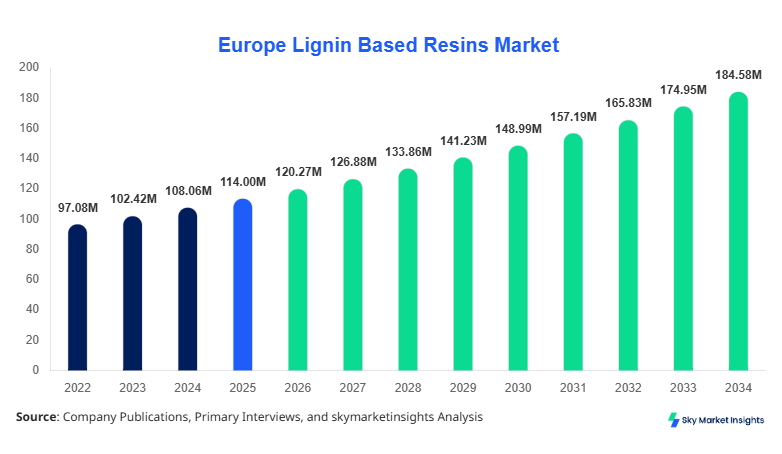
Europe Lignin Based Resins Market size is projected at USD 120.27 million in 2026 and is expected to hit USD 187.95 million by 2034 with a CAGR of 5.5%. The industry is moving from conventional petroleum-derived resin systems toward formulations incorporating renewable lignin, particularly in wood panels, adhesives, coatings, composites, and polyurethane systems. Market assessment requires country-level data, product segmentation, application adoption patterns, feedstock availability, and competitive positioning to evaluate commercialization opportunities through 2034.
Key Takeaways
- Germany dominates the country landscape with USD 31.10 million in 2026, equivalent to approximately 25.9% of the European total, and is forecast to reach USD 48.86 million by 2034 at a 5.81% CAGR.
- The United Kingdom is the fastest-growing listed major country at a 5.88% CAGR, expanding from USD 24.81 million in 2026 to USD 39.18 million in 2034.
- LPF resins dominate product types at USD 39.84 million in 2026, representing approximately 33.2% of the product-type total, and are forecast at USD 62.73 million by 2034 with a 5.84% CAGR.
- Others, including lignin–tannin resins, are the fastest-growing product category at 5.97% CAGR, increasing from USD 6.43 million in 2026 to USD 10.23 million by 2034.
- France is projected to rise from USD 18.06 million in 2026 to USD 28.46 million in 2034 at 5.85% CAGR, maintaining its position among Europe's three largest country markets.
The lignin-based resin industry comprises thermosetting and thermoplastic resin formulations in which technical lignin replaces or modifies fossil-derived phenols, polyols, and other polymer constituents. Europe generated USD 113.74 million across the listed countries in 2025 and USD 120.27 million in 2026. Germany contributes approximately 25.9% of 2026 country revenue, followed by the United Kingdom at 20.6% and France at 15.0%. By product type, LPF resins account for approximately 33.2% of the USD 120.16 million product total, while LUF resins contribute 20.6%, reflecting established penetration in adhesive and engineered-wood formulations.
Explore more data points, trends and opportunities Download Free Sample Report
Europe Lignin Based Resins Market Trends
Bio-based substitution and higher-value lignin conversion accelerate commercialization
European resin producers are increasingly moving technical lignin from low-value combustion into polymer applications. Commercial formulations can substitute meaningful portions of fossil-derived aromatic inputs, while advanced purification and fractionation technologies target lignin streams with purity levels above 90%. Pilot and commercial operations increasingly process lignin in thousand-ton annual volumes, while pulp operations collectively provide potential feedstock measured in millions of tonnes, supporting scale-up in adhesives, coatings, foams, and composites.
Technology development is concentrating on controlled molecular weight, lower sulfur content, improved hydroxyl functionality, and predictable curing. Manufacturers are targeting bio-based content exceeding 20%–50% in selected formulations, while process optimization can reduce dependence on fossil phenol or polyol inputs by double-digit percentages. Wood panels remain a major demand center because industrial lines process hundreds of thousands to millions of cubic meters annually, creating substantial potential consumption when lignin-modified binders achieve performance parity.
Europe Lignin Based Resins Market Drivers
Decarbonization of adhesives and polymers strengthens renewable resin adoption
European manufacturers face increasingly stringent requirements for carbon reduction, renewable content, and circular material use. Replacing 20%–50% of selected fossil-derived resin constituents with lignin can materially increase renewable carbon content, while large wood-processing facilities consuming tens of thousands of tonnes of binders annually provide scalable demand. Construction products, furniture panels, insulation, automotive composites, and coatings collectively represent high-volume outlets, and formulations exceeding 90% purified lignin feedstock quality are improving consistency for industrial conversion.
Europe Lignin Based Resins Market Restraints
Feedstock variability and processing complexity restrict rapid substitution
Technical lignin differs substantially by pulping route, sulfur concentration, molecular weight, hydroxyl functionality, and ash content. Variations of more than 10%–20% in critical feedstock properties can affect viscosity, cure speed, and final mechanical performance. Resin producers therefore require purification, fractionation, or chemical modification, adding processing stages and capital requirements. At industrial plants producing thousands of tonnes annually, even a 5%–10% yield or formulation penalty can materially affect economics compared with mature petrochemical resin systems.
Europe Lignin Based Resins Market Opportunities
High-performance bio-resins open opportunities beyond traditional wood adhesives
Lignin functionalization is expanding potential utilization into polyurethane foams, epoxy systems, thermoplastics, anti-corrosion coatings, and additive manufacturing. Formulations containing 20%–40% renewable aromatic content can address corporate decarbonization targets while preserving thermal and mechanical characteristics. Automotive lightweighting and construction insulation provide particularly attractive pathways because individual industrial programs can consume hundreds or thousands of tonnes of polymers, and a 10%–20% lignin substitution rate creates meaningful incremental feedstock demand.
Challenges in Europe Lignin Based Resins Market
Performance standardization remains critical for large-scale industrial qualification
Commercial customers require repeatable curing, moisture resistance, strength, thermal stability, and shelf life across thousands of production batches. Variations as small as 5%–15% in functional characteristics can require reformulation or process adjustments. Qualification cycles in automotive, construction, and electronics can extend beyond 12–24 months, while industrial resin plants operate at utilization levels frequently exceeding 70%–80%, leaving limited tolerance for processing disruption. Standardized lignin specifications therefore remain central to wider commercialization.
Report Scope
| Report Metric | Details |
|---|---|
| Market Size in 2025 | USD 114.00 Million |
| Market Size in 2026 | USD 120.27 Million |
| Market Size in 2034 | USD 187.95 Million |
| CAGR | 5.5% (2026-2034) |
| Base Year for Estimation | 2025 |
| Historical Data | 2022-2024 |
| Forecast Period | 2026-2034 |
| Report Coverage | Revenue Forecast, Competitive Landscape, Supply Chain Disruption, Growth Factors, Environment & Regulatory Landscape and Trends |
Explore more data points, trends and opportunities Download Free Sample Report
Europe Lignin Based Resins Market Segmentation
The industry is segmented by product type, lignin source, application, and end-use industry. Product data show LPF resins commanding approximately 33.2% of 2026 product revenue, followed by LUF at approximately 20.6%. Adhesives and binders remain the principal commercial application, supported by construction and furniture/wood-product consumption.
By Product Type
LPF resins are the largest category, increasing from USD 37.64 million in 2025 to USD 39.84 million in 2026 and USD 62.73 million in 2034 at 5.84% CAGR. Their approximately 33.2% 2026 contribution reflects compatibility with phenolic adhesive chemistry and opportunities to replace fossil phenol in wood and industrial binders.
Others, including lignin–tannin resins, record the fastest 5.97% CAGR, reaching USD 10.23 million by 2034 from USD 6.43 million in 2026. LUF, LMF, lignin-modified epoxy, lignin-polyol polyurethane, and lignin–acrylic systems record CAGRs of 5.39%, 5.65%, 5.69%, 5.52%, and 5.65%, respectively.
By Source of Lignin
Kraft lignin represents the leading commercial source, supported by Europe's established kraft pulp infrastructure and availability of industrial-scale technical lignin. Purity levels can exceed 90% after upgrading, and industrial facilities can provide feedstock in thousand-ton quantities, favoring phenolic resins, polyurethane polyols, and composites.
Organosolv lignin is positioned among the faster-developing sources because its comparatively low sulfur content and controlled chemistry facilitate higher-value polymers. Adoption remains smaller than kraft routes, but applications targeting 20%–50% renewable substitution create increasing opportunities alongside lignosulfonates, soda lignin, hydrolysis lignin, and other technical lignins.
By Application
Adhesives and binders constitute the leading application, particularly wood adhesives and particleboard, MDF, and plywood binders. LPF and LUF together generate USD 64.60 million in 2026, approximately 53.8% of reported product revenue, illustrating the commercial importance of formaldehyde-based binder chemistry.
Foams, composites, coatings, plastics, paints, varnishes, 3D-printing materials, and anti-corrosion systems represent diversification routes. Lignin-modified epoxy grows at 5.69%, lignin-polyol polyurethane at 5.52%, and lignin–acrylic systems at 5.65%, indicating broadly distributed development across non-wood applications.
By End Use Industry
Construction and furniture/wood products form the principal end-use base because engineered panels, insulation, coatings, and structural composites consume resin systems in high volumes. The USD 39.84 million LPF category in 2026 provides a key commercial proxy for lignin's established relevance to wood-related manufacturing.
Automotive, packaging, textiles, electronics, industrial manufacturing, and agriculture provide emerging diversification. Lignin-modified epoxy expands at 5.69% CAGR through 2034, while polyurethane systems advance at 5.52%, supporting applications requiring thermal stability, lightweight structures, insulation, and renewable polymer content.
Europe Lignin Based Resins Market Segmentations
By Product Type
- Lignin–Phenol–Formaldehyde (LPF) Resins
- Lignin–Urea–Formaldehyde (LUF) Resins
- Lignin–Melamine–Formaldehyde (LMF) Resins
- Epoxy Resins Modified with Lignin
- Polyurethane Resins Using Lignin Polyols
- Lignin–Acrylic Blended Resins
- Others (e.g., Lignin–Tannin Resins)
By Source of Lignin
- Kraft Lignin
- Organosolv Lignin
- Lignosulfonates
- Soda Lignin
- Hydrolysis Lignin
- Other Technical Lignins
By Application
-
Adhesives and Binders
- Wood adhesives
- Particleboard/MDF/plywood binders
-
Composites
- Automotive composites
- Building materials
-
Coatings
- Industrial coatings
- Decorative coatings
- Foams and Insulation (Polyurethane foams)
-
Plastics and Polymers
- Thermoplastic composites
- Bioplastics
- Paints and Varnishes
-
Others
- 3D printing filaments
- Anti-corrosion materials
By End Use Industry
- Construction
- Furniture and Wood Products
- Automotive
- Packaging
- Textiles
- Electronics
- Industrial Manufacturing
- Agriculture
- Others
Europe Lignin Based Resins Market Country Outlook
U.K.
The U.K. contributes approximately 20.6% of the 2026 European country total, with revenue of USD 24.81 million versus USD 23.43 million in 2025. It is projected to reach USD 39.18 million by 2034 at 5.88% CAGR, supported by construction materials, engineered wood, coatings, and low-carbon polymer adoption.
Germany
Germany leads Europe at USD 31.10 million in 2026, representing approximately 25.9% of the total. Revenue rises to USD 48.86 million by 2034 at 5.81% CAGR, with automotive composites, industrial manufacturing, construction products, and furniture forming important consumption channels.
France
France accounts for approximately 15.0% of 2026 revenue at USD 18.06 million, increasing from USD 17.06 million in 2025. The country reaches USD 28.46 million by 2034 at 5.85% CAGR, with construction, wood products, coatings, and composites supporting consumption.
Spain
Spain generates USD 10.24 million in 2026, or approximately 8.5% of the European total, and reaches USD 15.93 million by 2034 at 5.68% CAGR. Construction materials, furniture, coatings, and industrial binders underpin demand.
Italy
Italy contributes approximately 10.0% in 2026 with USD 11.98 million, advancing to USD 18.24 million by 2034 at 5.39% CAGR. Furniture manufacturing, wood products, coatings, construction materials, and specialty polymers provide the principal sector mix.
Russia
Russia records USD 12.07 million in 2026, approximately 10.0% of the European total, and is forecast at USD 18.81 million by 2034 with 5.70% CAGR. Wood processing, construction materials, binders, and industrial manufacturing provide major application channels.
Nordic
Nordic countries generate USD 6.02 million in 2026, approximately 5.0% of the total, increasing to USD 9.41 million by 2034 at 5.75% CAGR. Strong pulp and forestry value chains support lignin availability for wood adhesives, composites, and renewable polymer development.
Benelux
Benelux contributes approximately 5.0% with USD 5.99 million in 2026 and is forecast at USD 9.06 million by 2034 at 5.30% CAGR. Chemicals, coatings, industrial manufacturing, logistics-linked packaging, and construction materials support consumption.
Top players in Europe Lignin Based Resins Market
- Stora Enso
- UPM
- Sappi
- Ingevity
- Borregaard
- Rayonier Advanced Materials
- Nippon Paper Industries
- West Fraser
- Domtar
- GreenValue
- Lignin Industries
- Bloom Biorenewables
Top Two Companies
-
Stora Enso
Positioned prominently in Europe's commercial lignin ecosystem through industrial lignin production and renewable-material development. Its competitive position benefits from integrated forestry and pulp operations, which provide large-volume feedstock access and facilitate movement from combustion applications toward adhesives, binders, and polymer intermediates. While verified company-specific resin revenue share is not supplied in the mandatory dataset, the company operates within a European industry worth USD 120.27 million in 2026 and forecast to reach USD 187.95 million by 2034.
-
Borregaard
Maintains a strong position in lignin chemistry through longstanding expertise in lignosulfonates and specialty bio-based products. Its portfolio orientation supports higher-value applications where functionality, consistency, dispersibility, and renewable content command importance. The company participates in an industry where LPF alone represents approximately 33.2% of reported 2026 product revenue and lignin-modified epoxy systems grow at 5.69% CAGR. A defensible company-specific percentage share cannot be calculated from the supplied numerical tables.
Recent Developments in Europe Lignin Based Resins Market
- 2026: European commercialization efforts increasingly emphasize higher-purity technical lignin and resin formulations capable of replacing double-digit percentages of fossil-derived aromatic inputs.
- 2025: Resin development programs intensified around lignin-based phenolic adhesives, polyurethane polyols, epoxy modifiers, and renewable coatings as manufacturers pursued lower-carbon material portfolios.
Research Methodology
The analysis uses 2025 as the base year, 2026 as the current year, 2022–2024 as the historical period, and 2026–2034 as the forecast horizon. Mandatory supplied tables form the primary quantitative basis for country and product calculations, including the USD 120.27 million European value in 2026, USD 187.95 million 2034 forecast, and 5.5% headline CAGR. Derived percentages, including Germany's approximately 25.9% country contribution and LPF's approximately 33.2% product contribution, are calculated directly from supplied values. Qualitative assessment evaluates lignin chemistry, feedstock availability, resin substitution, applications, end-use industries, technology development, and competitive positioning; unsupported company-specific revenue shares are not fabricated.
Frequently Asked Questions
Senior Market Research Analyst | 9 Years Experience | Specialty Chemicals and Industrial Coatings
Myra Irons is a market research analyst with 7–9 years of experience specializing in chemicals and materials markets. Contributed to 70+ research reports for global clients. Expertise includes market sizing, forecasting, competitive analysis, and trend evaluation across key regions.