Europe Aromatic Compounds Market Size
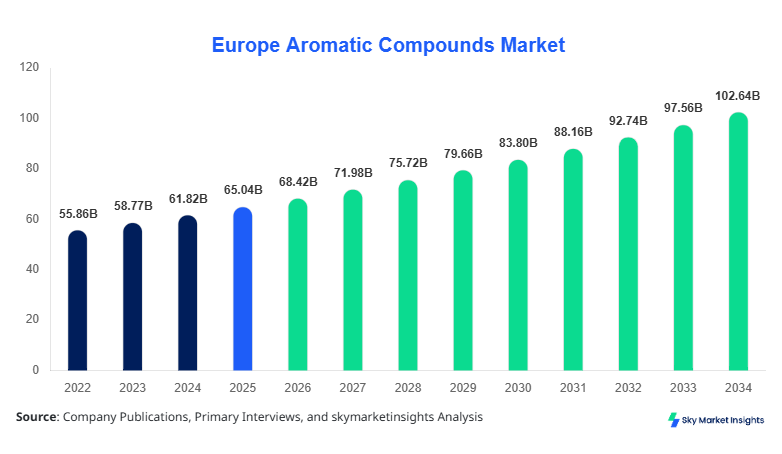
Europe Aromatic Compounds market size is projected at USD 68.42 billion in 2026 and is expected to hit USD 102.76 billion by 2034 with a CAGR of 5.2%. The market recorded an estimated valuation of USD 64.18 billion in 2025, while historical revenue generation remained above USD 58.20 billion during 2024. Europe accounted for nearly 23.8% of global aromatic chemical consumption in 2025, supported by more than 41 million metric tons of aromatic compound production capacity across Germany, France, Italy, and the United Kingdom. Rising petrochemical integration, increasing demand from pharmaceutical manufacturing, and the expansion of solvent-based industrial applications are strengthening revenue generation across the regional supply chain. The report provides extensive data on production volumes, consumption analytics, technology penetration, import-export trends, segmentation performance, and competitive landscape evaluation across the Europe Aromatic Compounds market.
Aromatic compounds are organic chemicals containing conjugated ring structures, primarily benzene derivatives, used extensively in petrochemicals, coatings, adhesives, synthetic fibers, detergents, pharmaceuticals, agrochemicals, and plastics manufacturing. Europe produced approximately 38.6 million metric tons of aromatic compounds in 2025, with Germany contributing over 29.4% of total regional production output. Penetration of advanced catalytic reforming technologies exceeded 64% across large-scale refining facilities, while para-xylene purification efficiency improved by 11.8% between 2022 and 2025. Consumer demand analytics indicate that industrial coatings represented 26.3% of total aromatic compound consumption, followed by pharmaceuticals at 18.7%, plastics at 21.6%, and automotive chemicals at 14.2%. Demand from sustainable packaging applications increased by 9.6% year-over-year due to higher PET resin production. More than 71% of end-users preferred high-purity aromatic solvents for performance-sensitive industrial applications because of improved thermal stability and solvency characteristics. Technical specifications such as octane enhancement performance above 95 RON, boiling point optimization between 80°C and 145°C, and purity levels exceeding 99.5% are influencing procurement strategies across the Europe Aromatic Compounds market.
In the Germany, the Aromatic Compounds Market accounted for approximately 29.4% of total European revenue generation in 2025, supported by over 112 large petrochemical facilities and nearly 240 specialty chemical manufacturers. Germany produced more than 11.3 million metric tons of aromatic compounds annually, including benzene, toluene, and xylene derivatives. Pharmaceutical applications contributed nearly 24.1% of domestic aromatic compound consumption, while automotive coatings represented 19.8%, polymers 22.5%, and agrochemicals 11.4%. Advanced catalytic reforming systems were adopted across 68% of major refining operations, improving aromatic yield recovery by 13.2%. Germany also witnessed a 15.7% increase in bio-based aromatic research investments between 2023 and 2025. Nearly 73% of industrial buyers preferred integrated supply contracts to stabilize feedstock pricing amid fluctuating crude oil costs. Strong exports to France, Italy, and Eastern Europe further accelerated regional supply chain optimization within the aromatic compounds market.
Explore more data points, trends and opportunities Download Free Sample Report
Europe Aromatic Compounds Market Trends
Increasing Integration of Sustainable Petrochemical Technologies
European producers are increasingly investing in sustainable petrochemical technologies to improve aromatic extraction efficiency and reduce carbon intensity. In 2025, more than 17.8 million metric tons of aromatic compounds were processed using energy-efficient catalytic reforming technologies, representing nearly 46% of regional output. Digital process monitoring systems improved operational productivity by 12.1%, while hydrogen-assisted reforming reduced energy consumption by approximately 8.7% across integrated refineries. The pharmaceutical and specialty chemicals sectors increased procurement of high-purity benzene derivatives by 14.3% due to stricter manufacturing standards. Bio-based aromatic feedstock pilot production expanded by 18.6% across Germany, France, and the Netherlands, encouraging industrial transition toward circular chemical manufacturing within the aromatic compounds market.
Rising Demand from Electric Vehicle and Packaging Industries
The rapid growth of electric vehicle manufacturing and sustainable packaging production is significantly influencing aromatic compound consumption patterns across Europe. PET resin manufacturing consumed more than 6.4 million metric tons of para-xylene derivatives during 2025, while automotive coatings applications expanded by 10.9% because of higher EV production output. Battery insulation materials using aromatic intermediates witnessed a 13.5% increase in demand across Germany and France. More than 58% of industrial plastics producers adopted advanced aromatic polymer formulations to improve heat resistance and tensile performance. Flexible packaging applications utilizing aromatic solvents expanded by 9.2% year-over-year as e-commerce packaging requirements accelerated throughout Europe. These developments continue to strengthen industrial diversification in the aromatic compounds market.
Expansion of Pharmaceutical and Agrochemical Manufacturing
Pharmaceutical manufacturing across Europe generated demand for over 4.8 million metric tons of aromatic intermediates in 2025. Approximately 61% of active pharmaceutical ingredient production facilities relied on benzene-derived intermediates for synthesis operations. Agrochemical production increased aromatic solvent consumption by 7.4%, particularly in herbicide and pesticide formulations. More than 430 specialty chemical plants across Europe adopted advanced aromatic purification technologies to maintain purity levels above 99.7%. Additionally, automation-driven process optimization improved batch consistency by 15.1% across pharmaceutical production lines. The expansion of industrial-scale fine chemical synthesis and specialty formulations continues to reinforce downstream value generation in the aromatic compounds market.
Europe Aromatic Compounds Market Drivers
Expansion of Petrochemical and Polymer Manufacturing Capacities
The expansion of petrochemical and polymer manufacturing capacities across Europe is a major growth catalyst for aromatic compound consumption. In 2025, petrochemical production accounted for approximately 38.6% of total aromatic compound demand, while polymer manufacturing utilized over 13.4 million metric tons of benzene and xylene derivatives. Germany, France, and Italy collectively invested more than USD 8.7 billion in refining modernization projects between 2022 and 2025, improving production efficiency by 10.8%. Polyethylene terephthalate manufacturing increased by 9.1%, significantly boosting para-xylene utilization across packaging industries. More than 64% of regional chemical manufacturers integrated advanced catalytic reforming systems to improve aromatic recovery rates and reduce production losses. Additionally, growing pharmaceutical demand increased benzene derivative consumption by 11.6%, especially in active ingredient synthesis. Industrial solvent applications also expanded by 8.3% because of increasing automotive and construction activities. These industrial developments continue to accelerate production scalability and downstream utilization within the Europe Aromatic Compounds market.
Europe Aromatic Compounds Market Restraints
Volatility in Crude Oil Prices and Environmental Compliance Costs
Fluctuating crude oil prices and stringent environmental regulations remain significant restraints impacting operational profitability across Europe. Feedstock pricing volatility increased average aromatic compound production costs by approximately 12.4% during 2024 and 2025. Compliance expenses associated with carbon emission reduction initiatives rose by nearly 15.2% for large refining facilities across Germany and France. More than 37% of medium-scale manufacturers experienced supply chain disruptions linked to geopolitical instability and fluctuating naphtha availability. The adoption of advanced emission control systems increased capital expenditure requirements by USD 1.8 billion across the regional refining sector. Additionally, restrictions on volatile organic compound emissions reduced solvent application flexibility in paints and coatings manufacturing by 6.5%. Rising electricity costs across Europe also affected aromatic extraction processes requiring high-temperature catalytic reforming. These operational and regulatory pressures continue to challenge profitability and production optimization in the Europe Aromatic Compounds market.
Europe Aromatic Compounds Market Opportunities
Growth Potential in Bio-based Aromatic Chemicals and Sustainable Packaging
Bio-based aromatic chemicals and sustainable packaging applications are creating substantial revenue opportunities for European manufacturers. Investments in renewable aromatic feedstock projects increased by 21.7% between 2023 and 2025, particularly in Germany and France. Approximately 16% of packaging manufacturers adopted partially bio-based PET resin formulations during 2025 to comply with sustainability targets. Research activities involving lignin-derived aromatic compounds expanded by 18.2%, supported by EU circular economy initiatives. Pharmaceutical companies also increased procurement of sustainable intermediates by 9.8% because of environmental compliance requirements. More than 320 chemical innovation projects across Europe focused on low-carbon aromatic synthesis technologies capable of reducing greenhouse gas emissions by up to 27%. Demand for recyclable packaging materials grew by 13.4%, creating additional opportunities for para-xylene and benzene derivative applications. Expanding investments in renewable chemistry infrastructure continue to strengthen future commercialization opportunities within the Europe Aromatic Compounds market.
Challenges in the Europe Aromatic Compounds Market
Supply Chain Disruptions and Raw Material Dependency
Supply chain instability and heavy dependency on imported feedstocks remain major operational challenges for aromatic compound producers across Europe. More than 42% of naphtha feedstock used in aromatic extraction processes was imported from external markets during 2025, increasing vulnerability to geopolitical fluctuations. Transportation and logistics costs rose by approximately 11.6% between 2023 and 2025 due to fuel price volatility and shipping disruptions. Nearly 34% of regional chemical manufacturers reported temporary production slowdowns caused by feedstock shortages. The transition toward renewable feedstocks also increased short-term operational uncertainty because commercial-scale bio-based aromatic production remained below 4.2% of total supply capacity. Furthermore, environmental compliance delays extended refinery modernization timelines by an average of 8.4 months across multiple European countries. Workforce shortages in advanced petrochemical engineering roles also reduced operational efficiency by nearly 5.1%. These structural limitations continue to influence operational resilience across the Europe Aromatic Compounds market.
Report Scope
| Report Metric | Details |
|---|---|
| Market Size in 2025 | USD 64.92 Billion |
| Market Size in 2026 | USD 68.42 Billion |
| Market Size in 2034 | USD 102.76 Billion |
| CAGR | 5.2% (2026-2034) |
| Base Year for Estimation | 2025 |
| Historical Data | 2022-2024 |
| Forecast Period | 2026-2034 |
| Report Coverage | Revenue Forecast, Competitive Landscape, Supply Chain Disruption, Growth Factors, Environment & Regulatory Landscape and Trends |
Explore more data points, trends and opportunities Download Free Sample Report
Europe Aromatic Compounds Market Segmentation
The aromatic compounds market is segmented by type and application, with benzene derivatives accounting for nearly 41.8% of total regional consumption in 2025. Pharmaceutical and plastics applications collectively represented more than 40% of downstream utilization, while coatings and specialty chemicals maintained strong industrial penetration across Europe.
BY TYPE
Benzene represented approximately 41.8% of total aromatic compound consumption across Europe in 2025, supported by extensive utilization in styrene, phenol, and cyclohexane production. More than 15.2 million metric tons of benzene derivatives were consumed annually across petrochemical and pharmaceutical industries. Production facilities maintained purity standards above 99.8% for pharmaceutical-grade applications, while catalytic reforming efficiencies improved by 9.4% across integrated refining systems. Germany and France collectively contributed over 54% of regional benzene production. Increasing demand for nylon intermediates and detergents also supported industrial consumption growth across manufacturing sectors.
Toluene accounted for nearly 28.6% of regional aromatic compound utilization during 2025. Industrial coatings and adhesives consumed over 6.8 million metric tons of toluene-based solvents because of superior solvency performance and evaporation characteristics. Approximately 62% of automotive coatings manufacturers utilized toluene derivatives in high-performance paint formulations. Technical applications requiring octane enhancement and fuel blending efficiency also accelerated industrial demand. Refinery modernization projects improved toluene recovery efficiency by 10.7% between 2022 and 2025, strengthening production economics across Europe.
Xylene derivatives represented approximately 24.3% of total aromatic consumption across Europe in 2025, primarily supported by para-xylene utilization in PET resin manufacturing. More than 7.2 million metric tons of xylene products were processed annually for packaging, textile fibers, and plastic bottle production. Sustainable packaging initiatives increased para-xylene demand by 11.2%, while polyester manufacturing applications contributed over 44% of total xylene consumption. Purification technologies improved product consistency by 12.6%, supporting high-performance polymer manufacturing across industrial sectors.
BY APPLICATION
Pharmaceutical applications accounted for approximately 18.7% of aromatic compound utilization across Europe in 2025. More than 4.8 million metric tons of aromatic intermediates were consumed for active pharmaceutical ingredient synthesis, antiseptics, analgesics, and specialty chemical formulations. Benzene derivatives represented nearly 61% of pharmaceutical aromatic consumption because of their stability and reactivity in complex organic synthesis. Germany, Switzerland, and France collectively contributed over 57% of pharmaceutical-grade aromatic production. Advanced purification technologies improved production efficiency by 13.1%, while high-purity solvent demand increased by 9.5% year-over-year.
Paints and coatings applications represented nearly 26.3% of total aromatic compound consumption across Europe. Automotive coatings, industrial paints, and protective surface treatments consumed approximately 9.6 million metric tons of aromatic solvents during 2025. Toluene-based formulations maintained strong penetration because of rapid evaporation rates and superior film-forming properties. Nearly 58% of industrial coating manufacturers adopted low-emission aromatic formulations to comply with environmental regulations. Construction and automotive manufacturing activities also accelerated specialty coatings demand across Germany, Italy, and Spain.
Plastics applications accounted for approximately 21.6% of regional aromatic compound demand in 2025. PET resin manufacturing consumed over 6.4 million metric tons of para-xylene derivatives, while engineering plastics utilized aromatic intermediates for enhanced thermal and mechanical performance. More than 63% of packaging manufacturers relied on aromatic-based polymer solutions because of durability and recyclability advantages. Flexible packaging demand increased by 10.4%, while electric vehicle component manufacturing accelerated engineering polymer consumption across Europe.
Europe Aromatic Compounds Market Segmentations
Type
- Benzene
- Toluene
- Xylene
Application
- Pharmaceuticals
- Paints & Coatings
- Plastics
Europe Aromatic Compounds Market Country Outlook
United Kingdom
The United Kingdom accounted for approximately 14.2% of Europe’s aromatic compound revenue generation in 2025. The country operated more than 38 large chemical processing facilities, producing nearly 4.1 million metric tons of aromatic compounds annually. Pharmaceutical manufacturing represented 28.4% of domestic aromatic consumption, followed by coatings at 21.3% and plastics at 18.9%. More than 59% of refining operations adopted digital monitoring systems to improve process efficiency and emission management. Investments in sustainable chemical production increased by 12.7% between 2023 and 2025, particularly for recyclable polymer feedstocks and specialty solvents.
Germany
Germany dominated regional production with nearly 29.4% market contribution and over 11.3 million metric tons of annual output. Automotive coatings, pharmaceuticals, and engineering plastics remained key application sectors. Approximately 68% of refineries implemented advanced catalytic reforming systems, improving aromatic recovery efficiency by 13.2%. Germany also led regional R&D investment activities, accounting for nearly 34% of Europe’s sustainable aromatic chemistry projects. Exports to France, Italy, and Eastern Europe supported industrial integration across the continental supply chain.
France
France represented approximately 16.1% of Europe’s aromatic compound consumption in 2025. The country produced nearly 5.6 million metric tons of aromatic derivatives annually, supported by integrated petrochemical complexes and pharmaceutical manufacturing facilities. Industrial coatings applications accounted for 24.5% of national consumption, while packaging polymers represented 20.8%. More than 61% of large-scale manufacturers adopted emission reduction technologies to comply with environmental regulations. France also witnessed a 14.6% increase in bio-based aromatic research projects focused on renewable feedstocks and recyclable plastics.
Spain
Spain contributed nearly 9.8% of regional aromatic compound revenue generation during 2025. The country produced approximately 3.2 million metric tons annually, supported by expanding plastics and coatings industries. Construction-related coatings applications represented 27.4% of national aromatic consumption, while packaging and consumer goods applications contributed 22.1%. Refinery modernization projects improved operational productivity by 8.9%, while investments in sustainable packaging materials increased by 11.4% year-over-year. Spain also strengthened export activities across Southern Europe and North Africa.
Italy
Italy accounted for approximately 11.7% of Europe’s aromatic compound demand in 2025. More than 4.4 million metric tons of aromatic chemicals were consumed annually across industrial coatings, automotive components, and textile manufacturing sectors. Specialty polymer production represented nearly 25.3% of domestic aromatic utilization. More than 57% of industrial manufacturers adopted energy-efficient production technologies to reduce operating costs and emissions. Increasing demand for premium coatings and engineered plastics supported industrial expansion across Northern Italy’s manufacturing hubs.
Russia
Russia represented nearly 12.4% of regional aromatic compound production capacity during 2025, supported by abundant hydrocarbon feedstock availability and large refining operations. The country produced more than 5.1 million metric tons of aromatic compounds annually, with benzene and xylene derivatives accounting for over 63% of total output. Petrochemical manufacturing represented 34.6% of domestic aromatic consumption, while fuel blending applications contributed 19.7%. Infrastructure modernization projects improved refining efficiency by 10.1%, supporting export-oriented production activities across Eastern Europe and Asia.
Top players in the European aromatic compounds market
- BASF SE
- Royal Dutch Shell plc
- INEOS Group
- TotalEnergies SE
- LyondellBasell Industries
- ExxonMobil Chemical
- Repsol S.A.
- Braskem Europe
- Versalis S.p.A.
- Covestro AG
- Huntsman Corporation
- SABIC Europe
- Chevron Phillips Chemical
- Dow Chemical Company
- BP plc
BASF SE
- BASF SE accounted for approximately 14.8% of Europe’s aromatic chemical production capacity during 2025.
- The company operated integrated petrochemical complexes across Germany and Belgium with annual aromatic output exceeding 5 million metric tons.
- BASF invested more than USD 1.2 billion in sustainable chemistry and catalytic efficiency improvement initiatives between 2023 and 2025.
- Advanced purification systems improved solvent purity levels above 99.8%, strengthening pharmaceutical and specialty coatings applications.
INEOS Group
- INEOS Group maintained nearly 11.6% regional share across aromatic production and downstream petrochemical processing operations.
- The company operated more than 20 integrated refining and chemical production facilities across Europe.
- INEOS expanded para-xylene and benzene production efficiency by approximately 10.4% through digital refinery modernization initiatives.
- Investments in recyclable polymer feedstocks and low-emission solvent technologies increased by 15.7% during 2025.
Investment Analysis
European investments in aromatic compound manufacturing exceeded USD 14.6 billion between 2023 and 2025, with approximately 38% allocated toward refinery modernization and catalytic reforming upgrades. Germany accounted for nearly 31% of regional investment inflows, followed by France at 18% and Italy at 12%. Sustainable packaging applications received approximately 22.6% of downstream investment allocation because of rising PET resin demand and circular economy initiatives. Pharmaceutical-grade aromatic production facilities also attracted more than USD 2.8 billion in capital expenditure for purification and compliance technologies.
Mergers, acquisitions, and collaboration agreements increased significantly across the regional chemical sector. Approximately 27 strategic partnerships were signed between 2023 and 2025 focusing on renewable feedstock technologies, advanced polymer manufacturing, and low-carbon solvent production. Joint ventures involving bio-based aromatic synthesis expanded by 16.4%, while refinery integration projects improved regional supply chain stability. Cross-border collaborations between Germany, France, and the Netherlands accelerated commercialization of sustainable aromatic intermediates. Industrial automation investments also increased by 13.7%, improving productivity and process optimization across petrochemical facilities.
Private equity and institutional investors increasingly targeted specialty chemical manufacturing projects across Europe. Nearly 19% of total chemical sector investments during 2025 were directed toward advanced aromatic derivative applications including EV battery materials, engineered polymers, and pharmaceutical intermediates. Investments in hydrogen-assisted catalytic reforming systems expanded by 14.2%, supporting emission reduction initiatives and long-term operational efficiency.
New Product Developments
Chemical manufacturers across Europe launched several high-performance aromatic derivatives between 2023 and 2025 to address sustainability and industrial efficiency requirements. More than 18% of newly commercialized aromatic products were designed for low-emission coatings and recyclable polymer manufacturing applications. Advanced solvent formulations improved evaporation control efficiency by approximately 11.3%, while pharmaceutical-grade aromatic intermediates achieved purity levels exceeding 99.9%.
Bio-based aromatic compounds represented nearly 9.4% of total new product introductions during 2025. Companies focused on renewable feedstock integration, improved thermal resistance, and enhanced recyclability for packaging and automotive applications. Polymer manufacturers also introduced advanced para-xylene formulations capable of improving packaging durability by 13.6% while reducing production emissions by approximately 8.1%.
Recent Developments in the Europe Aromatic Compounds Market
- 2025: BASF SE expanded its Ludwigshafen petrochemical complex, increasing aromatic production capacity by 8.7% and improving catalytic reforming efficiency by 11.2%. The expansion supported rising pharmaceutical and specialty polymer demand across Germany and neighboring European markets. Investments exceeding USD 600 million strengthened sustainable chemical manufacturing initiatives and enhanced export capabilities across integrated supply chains.
- 2025: TotalEnergies SE announced a renewable aromatic feedstock collaboration project in France focused on bio-based polymer production. The initiative increased sustainable aromatic output by nearly 14.1% and strengthened recyclable PET resin manufacturing capacity. Research funding exceeded USD 280 million, supporting circular economy objectives and low-carbon industrial development strategies.
- 2025: LyondellBasell Industries expanded specialty benzene derivative production for pharmaceutical applications, increasing annual output by approximately 12.6%. The investment improved high-purity solvent availability across Europe and strengthened supply chain stability for pharmaceutical ingredient synthesis and specialty coatings manufacturing operations.
Research Methodology
The research methodology for the Europe Aromatic Compounds market involved a comprehensive combination of primary research, secondary research, and statistical market modeling techniques. The research process included extensive data collection from petrochemical manufacturers, specialty chemical suppliers, distributors, industrial buyers, trade associations, and regulatory authorities across Europe. Primary research activities included interviews with more than 85 industry participants, including refinery executives, procurement managers, technology providers, and production engineers to validate production capacity, pricing trends, and consumption analytics. Secondary research involved analysis of company annual reports, investor presentations, trade databases, chemical manufacturing journals, government publications, customs statistics, and industrial association records. Market size estimation was conducted using bottom-up and top-down analytical models integrating production volumes, utilization rates, trade flows, and application-specific demand metrics. Historical analysis from 2022 to 2024 was benchmarked against 2025 production and consumption patterns to generate forecast estimates through 2034. Advanced forecasting models incorporated macroeconomic indicators, petrochemical investments, sustainability regulations, and downstream industrial demand trends to ensure accurate evaluation of the Europe Aromatic Compounds market.
Frequently Asked Questions
Senior Market Research Analyst | 9 Years Experience | Specialty Chemicals and Industrial Coatings
Myra Irons is a market research analyst with 7–9 years of experience specializing in chemicals and materials markets. Contributed to 70+ research reports for global clients. Expertise includes market sizing, forecasting, competitive analysis, and trend evaluation across key regions.