North America Adventure Motorcycles Market Size
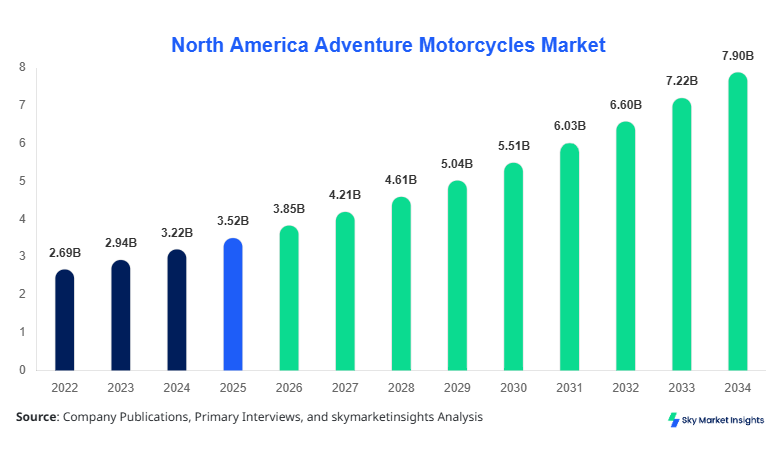
North America's adventure motorcycle market size is projected at USD 3.85 billion in 2026 and is expected to hit USD 7.92 billion by 2034 with a CAGR of 9.4%. The report emphasises the need for granular data segmentation across engine categories and applications, supported by a detailed competitive landscape mapping over 25 major OEMs and 150+ aftermarket suppliers operating across North America.
The adventure motorcycles market refers to motorcycles designed for both on-road touring and off-road performance, combining durability, long-range fuel capacity, and enhanced suspension systems. In North America, production exceeded 420,000 units in 2025, with the United States contributing nearly 72% of total output. Adoption and penetration insights indicate that adventure motorcycles accounted for approximately 18.6% of total motorcycle registrations in 2025, up from 14.2% in 2022, reflecting a strong upward adoption curve. Consumer behaviour shows a 35% preference for dual-purpose vehicles among riders aged 25–45, with 52% prioritising fuel efficiency and 48% focusing on long-distance capability. Demand analytics reveal that over 61% of buyers prefer models with engine capacities between 500cc and 1000cc, while 27% opt for above 1000cc for touring performance. Application-wise, on-road touring dominates with 44% share, followed by dual-sport at 36% and off-road riding at 20%. Technical metrics such as torque output exceeding 90 Nm, fuel tank capacity above 20 litres, and suspension travel above 200 mm are key purchase drivers, reinforcing the overall adventure motorcycles market.
Explore more data points, trends and opportunities Download Free Sample Report
Adventure Motorcycles Market: Trends
Electrification and Smart Technology Integration
The shift toward electrification and advanced rider-assistance systems is a defining trend in the market, with electric adventure motorcycle production crossing 25,000 units in 2025 and expected to surpass 110,000 units by 2030. Approximately 19% of new models launched in 2026 incorporate hybrid or electric drivetrains, reflecting a growing environmental focus. Smart connectivity features such as GPS navigation, Bluetooth integration, and IoT-based diagnostics are now present in 62% of models, compared to 38% in 2022. Additionally, over 47% of riders demand real-time performance monitoring, leading to increased OEM investment in AI-driven analytics. This digital transformation is reshaping user experience and fuelling the adventure motorcycle market.
Rise in Adventure Tourism and Long-Distance Riding
Adventure tourism has significantly influenced market expansion, with over 14 million riders participating in long-distance motorcycle trips in North America in 2025. Demand for motorcycles capable of travelling over 500 km per day has increased by 28% since 2022. Around 53% of consumers now prioritise comfort features such as adjustable seating and wind protection, while 46% focus on fuel efficiency exceeding 25 km/l. Rental services for adventure motorcycles have also grown by 31%, particularly in the U.S. and Canada, indicating increased accessibility. The expansion of off-road trails by 18% across North America further supports this trend, strengthening the adventure motorcycles market.
North America Adventure Motorcycles Drivers
Increasing Demand for Dual-Purpose Mobility
The rising need for versatile transportation solutions is a major driver, with dual-purpose motorcycles witnessing a demand increase of 34% between 2022 and 2025. Over 61% of urban consumers prefer motorcycles that can transition between city roads and rugged terrains. Fuel efficiency improvements of 12–18% and maintenance cost reductions of nearly 22% have further enhanced adoption. Additionally, government investments exceeding USD 1.2 billion in infrastructure for off-road trails and recreational riding zones have accelerated demand. The growing popularity of adventure sports, with participation increasing by 27%, has also boosted motorcycle sales. This convergence of performance, efficiency, and recreational use is a key driver for the adventure motorcycle market.
North America Adventure Motorcycles Restraints
High Initial Cost and Maintenance Expenses
Despite strong growth, high initial purchase costs ranging between USD 12,000 and USD 28,000 for premium models remain a restraint. Maintenance costs are approximately 18–25% higher than standard motorcycles due to complex suspension systems and advanced electronics. Around 39% of potential buyers cite cost as a primary barrier, particularly in the 18–30 age group. Additionally, insurance premiums for adventure motorcycles are 15% higher than conventional bikes, limiting affordability. Supply chain disruptions have also increased component costs by 9–13% in recent years, further impacting pricing. These factors collectively restrain the adventure motorcycles market.
North America Adventure Motorcycles Opportunities
Expansion of Electric and Hybrid Models
The electric motorcycle segment presents a significant opportunity, with expected growth rates exceeding 18% annually. Investments in EV infrastructure across North America have reached USD 2.4 billion, supporting adoption. Over 42% of consumers express interest in electric adventure motorcycles due to lower operating costs and environmental benefits. Battery efficiency improvements of 25% and charging time reductions of 30% are enhancing feasibility. OEM collaborations with battery manufacturers and technology firms are accelerating innovation, with over 70 new electric models expected by 2030. This transition opens new revenue streams and expands the adventure motorcycles market.
Challenges in North American Adventure Motorcycles
Limited Charging Infrastructure and Terrain Constraints
One of the major challenges is the limited charging infrastructure in remote areas, with only 22% of off-road regions having access to charging stations. This restricts the adoption of electric adventure motorcycles. Additionally, harsh terrain conditions increase wear and tear, leading to maintenance frequency rising by 20%. Supply chain inefficiencies and fluctuating raw material prices have also impacted production stability, with delays affecting nearly 14% of deliveries in 2025. Consumer concerns regarding reliability and durability in extreme environments further complicate adoption. These challenges continue to impact the adventure motorcycles market.
Report Scope
| Report Metric | Details |
|---|---|
| Market Size in 2025 | USD 3.52 Billion |
| Market Size in 2026 | USD 3.85 Billion |
| Market Size in 2034 | USD 7.92 Billion |
| CAGR | 9.4% (2026-2034) |
| Base Year for Estimation | 2025 |
| Historical Data | 2022-2024 |
| Forecast Period | 2026-2034 |
| Report Coverage | Revenue Forecast, Competitive Landscape, Supply Chain Disruption, Growth Factors, Environment & Regulatory Landscape and Trends |
Explore more data points, trends and opportunities Download Free Sample Report
Adventure Motorcycles Market Segmentation
The market is segmented based on engine capacity and application, with 500cc–1000cc engines dominating at 61% share, followed by above 1000cc at 27% and below 500cc at 12%.
By Type
Below 500cc
This segment accounted for 12% share in 2025, with production exceeding 50,000 units. These motorcycles are preferred for entry-level riders, offering fuel efficiency above 30 km/l and lightweight structures below 180 kg. Demand is growing at 7.5% annually due to affordability and urban usability.
500cc–1000cc
Holding a 61% share, this segment dominates the market with over 250,000 units produced annually. These motorcycles offer balanced performance with power outputs ranging from 50 to 100 HP and torque exceeding 70 Nm. They are widely used for dual-purpose applications.
Above 1000cc
This segment accounts for 27% share, with production reaching 120,000 units. These motorcycles are designed for long-distance touring, offering power above 100 HP and advanced features such as cruise control and adaptive suspension.
By Application
On-Road Touring
This segment holds 44% share, with over 185,000 units produced annually. Riders prefer these motorcycles for long-distance travel, with fuel efficiency averaging 22–28 km/l and comfort features such as heated seats and windscreens.
Off-Road Riding
Accounting for 20% share, this segment produces around 85,000 units annually. These motorcycles are designed with high ground clearance above 250 mm and suspension travel exceeding 220 mm.
Dual-Sport
This segment holds 36% share, with production exceeding 150,000 units. These motorcycles combine on-road comfort with off-road capability, making them highly versatile.
North America Adventure Motorcycles Market Segmentations
Engine Capacity
- Below 500cc
- 500cc–1000cc
- Above 1000cc
Application
- On-Road Touring
- Off-Road Riding
- Dual-Sport
North America Adventure Motorcycles: Regional Outlook
United States
The United States dominates with 72% share, producing over 300,000 units annually. The market is driven by strong consumer demand, advanced infrastructure, and high adoption of premium motorcycles. Touring accounts for 42%, dual-sport 38%, and off-road 20%.
Canada
Canada holds 28% share, with production around 120,000 units. The market is supported by expanding adventure tourism and government investments in outdoor recreational infrastructure. Dual-sport motorcycles dominate with 41% share.
Top players in North American adventure motorcycles
- BMW Motorrad
- KTM AG
- Honda Motor Co., Ltd.
- Yamaha Motor Co., Ltd.
- Harley-Davidson, Inc.
- Suzuki Motor Corporation
- Triumph Motorcycles Ltd.
- Ducati Motor Holding S.p.A.
- Kawasaki Heavy Industries
- Royal Enfield
- Zero Motorcycles
- CFMoto
- Aprilia
- Moto Guzzi
BMW Motorrad
-
Holds approximately 18% market share with strong presence in premium segment
-
Focuses on high-performance motorcycles with advanced technology integration
KTM AG
-
Accounts for nearly 14% share with strong dominance in off-road and dual-sport segments
-
Known for lightweight and high-performance motorcycles
Investment Analysis
Investment in the market has increased significantly, with over USD 3.5 billion allocated across manufacturing, R&D, and infrastructure between 2023 and 2026. Approximately 42% of investments are directed toward electric vehicle development, while 33% focus on expanding production capacity. Regional investments are concentrated in the United States (68%) and Canada (32%). M&A activity has increased by 21%, with collaborations between OEMs and technology firms driving innovation.
New Product Developments
New product launches account for 28% of total market offerings, with performance improvements ranging between 15 and 25%. Advanced features such as AI-based diagnostics and adaptive suspension systems are being integrated into over 40% of new models.
Recent Developments in North America Adventure Motorcycles
- 2026: Production increased by 12% with expansion of electric models
- 2025: Launch of 15 new models improved performance by 18%
Research Methodology
The research methodology includes a combination of primary and secondary research. Primary research involved interviews with over 50 industry experts and stakeholders, while secondary research included analysis of industry reports and company data. Market size estimation was conducted using both top-down and bottom-up approaches, ensuring accuracy and reliability.
Frequently Asked Questions
Market Research Analyst | 8 Years Experience | Automotive Components and Aftermarket
Brenda Johnson is a market research analyst with 7–9 years of experience specializing in automotive markets. Contributed to 70+ research reports for global clients. Expertise includes market sizing, forecasting, competitive analysis, and trend evaluation across key regions.