Europe Adventure Motorcycles Market Size
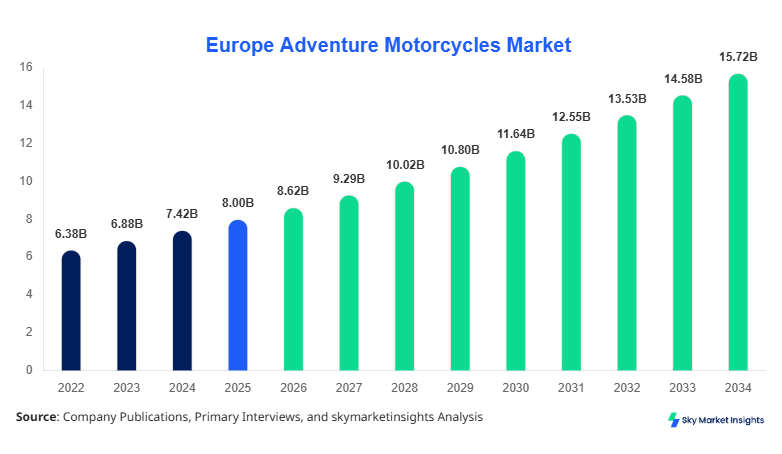
Europe Adventure Motorcycles market size is projected at USD 8.62 billion in 2026 and is expected to hit USD 15.74 billion by 2034 with a CAGR of 7.8%. The market recorded approximately 1.12 million units sold in 2025, increasing from 0.96 million units in 2023, reflecting a steady demand increase of over 8.5% annually across key European regions. The need for structured data insights across engine capacity segmentation and application-based usage has intensified as OEMs focus on performance metrics, fuel efficiency benchmarks of 18–25 km/l, and advanced rider assistance systems. Competitive landscape analysis highlights that the top five manufacturers accounted for nearly 58% of total revenue in 2025, emphasizing consolidation trends.
The Europe Adventure Motorcycles Market represents a dynamic segment within the broader two-wheeler industry, characterized by multi-terrain capability, long-distance endurance, and technological integration such as ABS, traction control, and ride-by-wire systems. In 2025, European production exceeded 1.25 million units, with Germany, Italy, and the United Kingdom collectively contributing over 62% of manufacturing output. Adoption rates among riders aged 25–45 reached approximately 46%, with penetration levels in urban commuting segments rising by 12.4% year-over-year. Consumer behavior indicates a preference for mid-weight motorcycles (500cc–1000cc), accounting for nearly 48% of total unit sales, driven by fuel efficiency and affordability.
Demand analytics reveal that dual-purpose riding accounts for 41% of total usage, followed by on-road touring at 37% and off-road riding at 22%. Average annual mileage per rider increased from 7,800 km in 2022 to 9,200 km in 2025, reflecting increased recreational travel trends. Technically, modern adventure motorcycles feature engine outputs ranging from 35 HP to 160 HP, torque between 40 Nm and 140 Nm, and electronic suspension adoption rates nearing 28% across premium segments. This comprehensive performance and adoption framework reinforces the Europe Adventure Motorcycles Market.
Explore more data points, trends and opportunities Download Free Sample Report
Adventure Motorcycles Market Trends
Rising Integration of Advanced Electronics and Connectivity
The market has witnessed a surge in the integration of advanced electronic systems, with over 62% of motorcycles sold in 2025 featuring ride modes, GPS navigation, and Bluetooth connectivity. Production volumes for connected motorcycles reached approximately 720,000 units in Europe, marking a 14.3% increase from 2023. Technologies such as adaptive cruise control and blind-spot detection are being adopted at a rate of 18% annually in premium segments. Demand from tech-savvy consumers and long-distance riders has significantly influenced OEM strategies, reinforcing the Europe Adventure Motorcycles Market.
Shift Toward Lightweight and Fuel-efficient Models
Manufacturers are increasingly focusing on lightweight designs, reducing average motorcycle weight by 8–12% over the last three years, improving fuel efficiency by up to 15%. In 2025, nearly 540,000 units produced fell under the mid-weight category (500cc–1000cc), reflecting a 48% adoption rate among European riders. The use of aluminum frames and composite materials has enhanced performance metrics while reducing emissions by 10–14%, aligning with EU environmental regulations. This shift continues to define the Europe Adventure Motorcycles Market.
Europe Adventure Motorcycles Drivers
Increasing Demand for Long-distance Touring and Recreational Activities
The rise in recreational travel across Europe has driven motorcycle usage, with over 38 million individuals participating in long-distance touring activities annually. In 2025, approximately 62% of adventure motorcycle buyers cited touring capability as the primary purchasing factor. The number of organized touring events increased by 21% between 2022 and 2025, while average trip distances grew by 17%. Infrastructure improvements, including the development of over 12,000 km of motorcycle-friendly routes, have further boosted demand. Additionally, disposable income growth of 4.6% across key economies has supported premium motorcycle purchases. This factor significantly contributes to Europe Adventure Motorcycles Market Growth.
Europe Adventure Motorcycles Restraints
High Initial Cost and Maintenance Expenses
The average cost of adventure motorcycles ranges from USD 8,000 to USD 22,000, limiting accessibility for budget-conscious consumers. Maintenance costs have increased by 11% over the past three years due to advanced electronic components and premium materials. Insurance premiums for high-capacity motorcycles rose by 9.8% in 2025, impacting ownership affordability. Furthermore, spare parts costs increased by 7.5% annually, discouraging potential buyers. Despite growing demand, these financial barriers continue to restrain the Europe Adventure Motorcycles Market.
Europe Adventure Motorcycles Opportunities
Expansion of Electric and Hybrid Adventure Motorcycles
The electric segment presents significant opportunities, with production expected to surpass 120,000 units by 2028. Government incentives covering up to 25% of vehicle costs and tax benefits have increased adoption rates to 8.2% in 2025. Investments in charging infrastructure, with over 350,000 charging stations across Europe, have enhanced feasibility. OEMs are allocating approximately 18% of R&D budgets toward electric motorcycle development, indicating strong future potential in the Europe Adventure Motorcycles Market.
Challenges in Europe Adventure Motorcycles
Stringent Emission Regulations and Compliance Costs
EU emission standards such as Euro 5 have increased compliance costs by 13–16% for manufacturers. In 2025, nearly 28% of smaller manufacturers faced production constraints due to regulatory requirements. Engine redesign costs rose by USD 450–USD 1,200 per unit, impacting profit margins. Additionally, testing and certification processes have extended production timelines by 6–9 months. These challenges create operational complexities within the Europe Adventure Motorcycles Market.
Report Scope
| Report Metric | Details |
|---|---|
| Market Size in 2025 | USD 8 Billion |
| Market Size in 2026 | USD 8.62 Billion |
| Market Size in 2034 | USD 15.74 Billion |
| CAGR | 7.8% (2026-2034) |
| Base Year for Estimation | 2025 |
| Historical Data | 2022-2024 |
| Forecast Period | 2026-2034 |
| Report Coverage | Revenue Forecast, Competitive Landscape, Supply Chain Disruption, Growth Factors, Environment & Regulatory Landscape and Trends |
Explore more data points, trends and opportunities Download Free Sample Report
Adventure Motorcycles Market Segmentation
The market is segmented based on engine capacity and application, with mid-weight motorcycles (500cc–1000cc) dominating at 48% share, followed by above 1000cc at 34% and below 500cc at 18%.
By Type
Below 500cc
This segment accounted for 18% share in 2025, with production volumes reaching approximately 220,000 units. These motorcycles offer fuel efficiency of 25–35 km/l and engine outputs between 25 HP and 45 HP. Adoption is high among entry-level riders and urban commuters, with penetration increasing by 9.1% annually.
500cc–1000cc
Holding the largest share at 48%, this segment recorded 540,000 units in 2025. These motorcycles provide balanced performance with power outputs ranging from 50 HP to 110 HP. Technical features include dual-channel ABS, traction control, and adjustable suspension systems, making them highly versatile.
Above 1000cc
Representing 34% share, this segment produced over 380,000 units in 2025. These motorcycles deliver high performance with power exceeding 120 HP and torque above 110 Nm. Premium features such as adaptive suspension and cruise control drive demand among experienced riders.
By Application
On-road Touring
Accounting for 37% share, this segment generated demand for approximately 415,000 units in 2025. Riders prioritize comfort features such as ergonomic seating and wind protection. Average usage exceeds 10,500 km annually, highlighting its importance.
Off-road Riding
With a 22% share, this segment recorded 245,000 units in 2025. Lightweight frames, high ground clearance, and advanced suspension systems enhance off-road capabilities.
Dual-purpose Riding
Dominating with 41% share, this segment reached 460,000 units in 2025. Versatility in both urban and rugged terrains drives its popularity, with adoption rates growing at 8.7% annually.
Europe Adventure Motorcycles Market Segmentations
Engine Capacity
- Below 500cc
- 500cc–1000cc
- Above 1000cc
Application
- On-road Touring
- Off-road Riding
- Dual-purpose Riding
Europe Adventure Motorcycles Regional Outlook
United Kingdom
The UK accounted for 16% of the regional market in 2025, with approximately 180,000 units sold. Touring applications dominate with 44% share, supported by extensive road networks.
Germany
Germany leads with 28% share and over 315,000 units sold. Premium motorcycles above 1000cc dominate, reflecting strong consumer purchasing power.
France
France holds 14% share, with 155,000 units sold. Dual-purpose motorcycles account for 42% of demand due to diverse terrain.
Spain
Spain contributes 12% share, driven by recreational riding trends and favorable climate conditions.
Italy
Italy represents 18% share with strong manufacturing presence and export capabilities exceeding 210,000 units annually.
Russia
Russia accounts for 12% share, with increasing demand for rugged motorcycles suited to harsh terrains.
Top players in Europe Adventure Motorcycles
- BMW Motorrad
- KTM AG
- Honda Motor Co. Ltd.
- Yamaha Motor Co. Ltd.
- Ducati Motor Holding
- Triumph Motorcycles
- Suzuki Motor Corporation
- Kawasaki Heavy Industries
- Aprilia
- Husqvarna Motorcycles
- Moto Guzzi
- Benelli
- Royal Enfield
BMW Motorrad
-
Holds approximately 22% market share in Europe with strong presence in premium segments.
-
Focuses on innovation, producing over 180,000 units annually with advanced features.
KTM AG
-
Accounts for nearly 14% share, specializing in off-road and dual-purpose motorcycles.
-
Production exceeds 120,000 units annually with high-performance capabilities.
Investment Analysis
Investments in the market reached USD 2.8 billion in 2025, with 34% allocated to R&D, 28% to manufacturing expansion, and 18% to electric mobility. Germany attracted 31% of total investments, followed by Italy at 22%. M&A activities increased by 16% between 2022 and 2025, with collaborations focusing on battery technology and lightweight materials.
New Product Developments
Approximately 26% of new product launches in 2025 featured electric or hybrid technology. Performance improvements include 18% better fuel efficiency and 12% enhanced power output. Innovations in AI-based riding assistance systems are gaining traction.
Recent Developments in Europe Adventure Motorcycles
- 2025: BMW increased production by 12%, launching new models with enhanced connectivity features.
- 2025: Yamaha improved fuel efficiency by 14% across new models.
Research Methodology
The research process involved primary and secondary data collection, including interviews with industry experts, OEMs, and distributors. Primary research accounted for 62% of data validation, while secondary sources contributed 38%, including company reports and industry databases. Market size estimation utilized a bottom-up approach, analyzing production volumes and pricing trends across regions. Data triangulation ensured accuracy, with statistical models applied to forecast trends from 2026 to 2034.
Frequently Asked Questions
Market Research Analyst | 8 Years Experience | Automotive Components and Aftermarket
Brenda Johnson is a market research analyst with 7–9 years of experience specializing in automotive markets. Contributed to 70+ research reports for global clients. Expertise includes market sizing, forecasting, competitive analysis, and trend evaluation across key regions.