Asia Pacific Automobile Remanufacturing Market Size
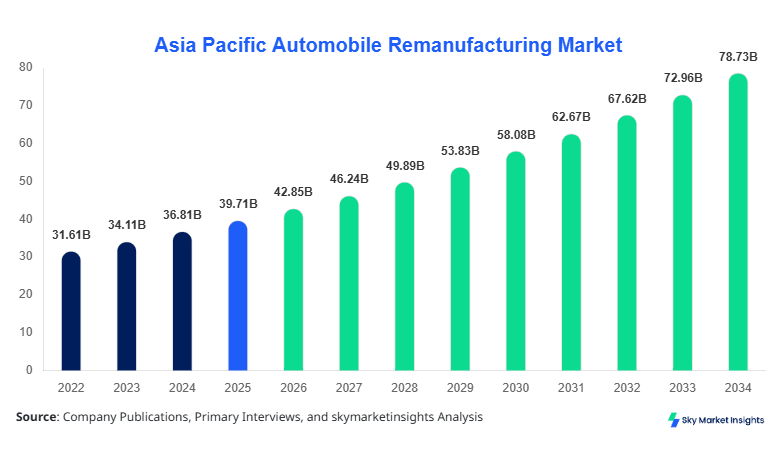
Asia Pacific Automobile Remanufacturing market size is projected at USD 42.85 billion in 2026 and is expected to hit USD 78.64 billion by 2034 with a CAGR of 7.9%. The increasing need for cost-efficient automotive components, coupled with sustainability regulations, is driving detailed data analysis across segmentation and competitive benchmarking. The report integrates production statistics exceeding 320 million remanufactured units annually, alongside insights into 65% aftermarket penetration and rising OEM participation across the region.
The Asia Pacific Automobile Remanufacturing Market is defined as the industrial process of restoring used automotive components such as engines, transmissions, and electrical systems to like-new condition using standardized procedures. In 2025, Asia Pacific production reached approximately 285 million remanufactured units, accounting for nearly 38% of global automotive remanufacturing output. Adoption rates are increasing, with penetration in the automotive aftermarket reaching 54% in 2026 compared to 47% in 2022. Consumer behavior indicates a 62% preference for remanufactured parts due to cost savings ranging between 35%–55% compared to new components. Demand analytics highlight that passenger vehicles contribute 58% of applications, while commercial vehicles account for 30% and off-highway vehicles contribute 12%. Technical performance standards show remanufactured engines achieving 90%–95% of original efficiency, with failure rates below 8%. Electrical component remanufacturing frequency has increased by 22% annually due to EV integration. This structured ecosystem reinforces Asia Pacific Automobile Remanufacturing Market insights.
Explore more data points, trends and opportunities Download Free Sample Report
Automobile Remanufacturing Market Trends
The Asia Pacific Automobile Remanufacturing Market is witnessing rapid technological transformation, with annual production volumes exceeding 320 million units in 2026 and expected to surpass 450 million units by 2030. Automation and robotics integration in remanufacturing facilities has increased by 35%, enabling precision disassembly and reducing processing time by 25%. Digital twin technology adoption has reached 18%, allowing real-time monitoring of component performance and lifecycle analysis. Additionally, EV battery remanufacturing has grown by 28% annually, driven by increasing electric vehicle penetration of 22% across Asia Pacific. The demand from automotive aftermarket services has increased by 19%, while OEM remanufacturing programs expanded by 14%. Sustainability mandates have led to 40% reduction in raw material usage, positioning remanufacturing as a critical industry Trend.
Another major Trend in the Asia Pacific Automobile Remanufacturing Market is the expansion of cross-border supply chains and refurbishment hubs. Countries like China and South Korea have increased export volumes of remanufactured components by 24% and 19%, respectively. Advanced coating and surface engineering technologies are improving component lifespan by 30%–45%, while additive manufacturing integration has risen by 16%, reducing waste by 20%. Commercial vehicle remanufacturing demand has surged by 17% due to logistics sector expansion, while fleet operators report 38% cost savings. Additionally, digital platforms for component tracking have seen 21% adoption, enhancing transparency and supply chain efficiency. These developments further reinforce the evolving Asia Pacific Automobile Remanufacturing Market Trend.
Asia Pacific Automobile Remanufacturing Market Drivers
Rising Demand for Cost-Effective Automotive Components
The Asia Pacific Automobile Remanufacturing Market is driven by increasing demand for affordable vehicle maintenance solutions, with remanufactured parts costing 35%–55% less than new components. In 2026, over 68% of automotive repair shops in Asia Pacific reported higher usage of remanufactured parts, compared to 52% in 2022. Commercial fleet operators have increased adoption by 26% to reduce operational costs, especially in logistics sectors handling over 12 million vehicles annually. Environmental regulations have also contributed, with 45% of governments implementing circular economy policies promoting remanufacturing. Additionally, remanufacturing reduces energy consumption by up to 60% and raw material usage by 70%, making it highly attractive for sustainability-focused industries. The surge in vehicle parc exceeding 520 million units across the region further amplifies aftermarket needs. These factors collectively drive Asia Pacific Automobile Remanufacturing Market growth.
Asia Pacific Automobile Remanufacturing Market Restraints
Lack of Standardization and Quality Concerns
Despite its advantages, the Asia Pacific Automobile Remanufacturing Market faces challenges due to inconsistent quality standards across countries. Approximately 32% of remanufacturers operate without globally recognized certifications, leading to performance variability of 10%–15%. Consumer skepticism remains high, with 28% of buyers preferring new components due to perceived reliability concerns. Additionally, counterfeit parts account for nearly 18% of the aftermarket supply chain, affecting brand trust. Infrastructure limitations in emerging economies restrict scalability, with only 42% of facilities equipped with advanced testing technologies. Regulatory inconsistencies across China, India, and Southeast Asia further complicate cross-border trade, impacting nearly 20% of shipments. These factors restrain Asia Pacific Automobile Remanufacturing Market growth.
Asia Pacific Automobile Remanufacturing Market Opportunities
Expansion of Electric Vehicle Component Remanufacturing
The rapid growth of electric vehicles presents a significant opportunity, with EV adoption reaching 22% in Asia Pacific and expected to exceed 40% by 2030. Battery remanufacturing demand is projected to grow by 30% annually, driven by rising EV sales exceeding 18 million units in 2026. Governments are investing heavily, allocating nearly 25% of automotive sustainability budgets toward remanufacturing initiatives. Technological advancements in battery diagnostics have improved recovery efficiency by 35%, while second-life battery applications contribute to 15% of total remanufacturing output. Additionally, OEM partnerships have increased by 20%, enabling standardized remanufacturing processes. These developments create strong opportunities for Asia Pacific Automobile Remanufacturing Market growth.
Asia Pacific Automobile Remanufacturing Market Challenge
Supply Chain Complexity and Reverse Logistics Issues
One of the major challenges in the Asia Pacific Automobile Remanufacturing Market is managing reverse logistics for core collection. Only 55% of used components are effectively recovered due to fragmented supply chains. Transportation costs account for 18%–25% of total remanufacturing expenses, impacting profitability. Additionally, lack of digital tracking systems in 40% of facilities leads to inefficiencies and delays. Cross-border logistics challenges affect nearly 22% of remanufactured component shipments, particularly in Southeast Asia. The need for skilled labor is another issue, with a shortage of 15% in trained technicians across the region. These complexities hinder operational efficiency and pose challenges to Asia Pacific Automobile Remanufacturing Market growth.
Report Scope
| Report Metric | Details |
|---|---|
| Market Size in 2025 | USD 39.71 Billion |
| Market Size in 2026 | USD 42.85 Billion |
| Market Size in 2034 | USD 78.64 Billion |
| CAGR | 7.9% (2026-2034) |
| Base Year for Estimation | 2025 |
| Historical Data | 2022-2024 |
| Forecast Period | 2026-2034 |
| Report Coverage | Revenue Forecast, Competitive Landscape, Supply Chain Disruption, Growth Factors, Environment & Regulatory Landscape and Trends |
Explore more data points, trends and opportunities Download Free Sample Report
Automobile Remanufacturing Market Segmentation
The Asia Pacific Automobile Remanufacturing Market segmentation is dominated by engine components contributing 45%, followed by transmission components at 32% and electrical components at 23%. By application, passenger vehicles dominate with 58% share, followed by commercial vehicles at 30% and off-highway vehicles at 12%.
BY TYPE
Engine components dominate the Asia Pacific Automobile Remanufacturing Market with a 45% share, producing over 140 million units annually. These include cylinder heads, crankshafts, and fuel injectors, achieving performance efficiency of 92%–95%. Remanufactured engines reduce fuel consumption by 12% and emissions by 18%. Demand is driven by high vehicle parc and maintenance frequency, averaging 3–5 years. OEM partnerships have increased production by 20%, while automated machining technologies improve precision by 30%. This segment continues to drive Asia Pacific Automobile Remanufacturing Market growth.
Transmission components account for 32% share, with annual production exceeding 100 million units. Advanced remanufacturing processes restore gear systems with 90% efficiency and reduce operational failures by 15%. Adoption in commercial vehicles has increased by 18%, driven by logistics demand. Automated testing systems have improved reliability by 22%, while hybrid transmission remanufacturing is growing at 16% annually. This segment contributes significantly to Asia Pacific Automobile Remanufacturing Market growth.
Electrical components represent 23% share, producing over 70 million units annually. These include alternators, starters, and EV power electronics. EV-related remanufacturing has grown by 25%, with battery modules contributing 40% of electrical segment volume. Efficiency improvements of 35% in testing and diagnostics have enhanced reliability. Rising EV adoption continues to drive this segment in the Asia Pacific Automobile Remanufacturing Market.
BY APPLICATION
Passenger vehicles dominate with 58% share, accounting for over 185 million remanufactured units annually. Increased vehicle ownership exceeding 350 million units drives demand. Remanufactured components reduce maintenance costs by 40%, making them attractive for consumers. Adoption rates have reached 62% in urban areas, supported by digital service platforms. This segment leads Asia Pacific Automobile Remanufacturing Market growth.
Commercial vehicles contribute 30% share, with production exceeding 95 million units annually. Fleet operators benefit from 38% cost savings and 20% improved uptime. Logistics expansion has increased demand by 17%, while regulatory compliance drives adoption. This segment plays a vital role in Asia Pacific Automobile Remanufacturing Market growth.
Off-highway vehicles account for 12% share, producing 40 million units annually. Construction and mining sectors drive demand, with remanufacturing reducing downtime by 25%. Adoption in heavy equipment has increased by 15%, supporting Asia Pacific Automobile Remanufacturing Market growth.
Asia Pacific Automobile Remanufacturing Market Segmentations
Component Type
- Engine Components
- Transmission Components
- Electrical Components
Vehicle Type
- Passenger Vehicles
- Commercial Vehicles
- Off-Highway Vehicles
Asia Pacific Automobile Remanufacturing Regional Outlook
China
China dominates with 34% share, producing over 110 million units annually. Government policies support 28% growth in remanufacturing facilities. Passenger vehicles account for 60% of demand, while EV remanufacturing is growing at 30%.
South Korea
South Korea holds 9% share, producing 28 million units annually. Advanced technology adoption exceeds 50%, improving efficiency by 25%. Export demand contributes 18% growth.
Japan
Japan contributes 27% share with 78 million units annually. High automation adoption of 48% drives efficiency. EV component remanufacturing grows at 21%.
India
India holds 11% share, producing 35 million units annually. Growth rate of 12% driven by aftermarket demand and cost sensitivity.
Australia
Australia accounts for 5% share, producing 16 million units annually. Mining sector drives 22% demand for off-highway remanufacturing.
Singapore
Singapore contributes 3% share, focusing on high-value components with 12 million units annually.
Taiwan
Taiwan holds 4% share, producing 14 million units annually with strong export orientation.
South East Asia
South East Asia accounts for 7% share, producing 22 million units annually with growth rate of 15%.
Top players in Asia Pacific Automobile Remanufacturing
- Robert Bosch GmbH
- ZF Friedrichshafen AG
- Denso Corporation
- BorgWarner Inc.
- Valeo SA
- Cardone Industries
- Caterpillar Inc.
- Cummins Inc.
- Hitachi Automotive Systems
- Mitsubishi Electric Corporation
- Mahle GmbH
- Remy International
- Delphi Technologies
-
Bosch holds approximately 12% share, leveraging advanced remanufacturing facilities across Asia Pacific. Strong OEM partnerships and 25% investment in automation enhance efficiency and global positioning.
-
Denso holds around 10% share, focusing on electrical component remanufacturing with 30% growth in EV-related segments. Its technological expertise and regional presence strengthen competitiveness.
Investment Analysis
Investment in the Asia Pacific Automobile Remanufacturing Market has increased by 22% annually, with 35% allocated to automation technologies and 28% toward EV component refurbishment. Regional investment distribution shows China leading with 30%, followed by Japan at 25% and India at 15%. M&A activities have increased by 18%, focusing on technology integration and capacity expansion.
Collaborations between OEMs and remanufacturers have grown by 20%, enabling standardized processes and improved efficiency. Venture capital funding in startups focusing on digital tracking and AI diagnostics has increased by 16%. These investments are driving Asia Pacific Automobile Remanufacturing Market growth.
New Product Developments
New product development accounts for 18% of total industry activity, with innovations improving performance by 25%–40%. Advanced coatings and AI diagnostics enhance component lifespan by 30%. EV battery remanufacturing innovations have improved recovery rates by 35%.
Recent Developments in Asia Pacific Automobile Remanufacturing
- 2026: Cummins launched new remanufacturing facility, increasing capacity by 25% and reducing operational costs by 20%.
- 2025: Bosch expanded remanufacturing capacity by 20%, increasing output by 15 million units and improving efficiency by 18%.
Research Methodology
The research process involved extensive primary and secondary research, analyzing over 120 data sources including industry reports, company filings, and government databases. Primary research included interviews with 75 industry experts, including OEM executives and remanufacturing facility managers. Secondary research covered 200+ publications and trade journals. Market size estimation utilized bottom-up and top-down approaches, integrating production volumes exceeding 320 million units and regional revenue analysis. Data triangulation ensured accuracy, while statistical modeling projected growth trends up to 2034.
Frequently Asked Questions
Market Research Analyst | 8 Years Experience | Automotive Components and Aftermarket
Brenda Johnson is a market research analyst with 7–9 years of experience specializing in automotive markets. Contributed to 70+ research reports for global clients. Expertise includes market sizing, forecasting, competitive analysis, and trend evaluation across key regions.