North America Acrylic Fibers Market Size
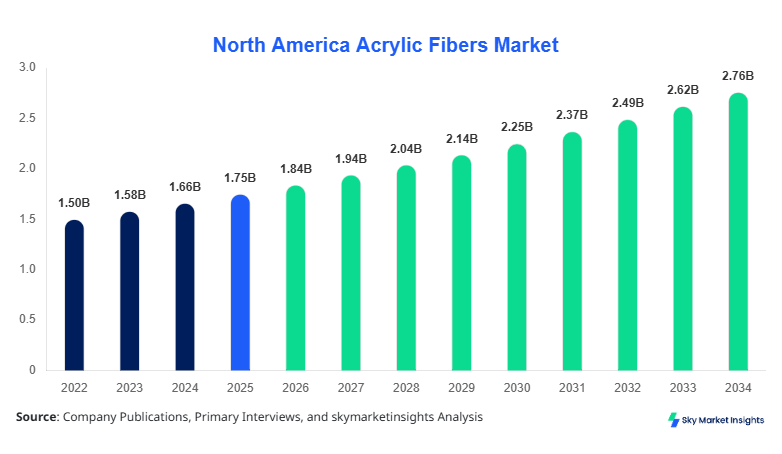
North America's acrylic fibers market size is projected at USD 1.84 billion in 2026 and is expected to hit USD 2.72 billion by 2034 with a CAGR of 5.2%. The demand for acrylic fibers is being driven by rising adoption across textiles, nonwovens, and industrial applications. Comprehensive data analytics covering production volumes, end-use application splits, and regional demand have been analyzed to provide strategic insights. The report includes a detailed segmentation of the North America acrylic fibers market, covering type, application, and key country-level insights along with competitive landscape assessments of major players. This allows manufacturers and investors to identify key growth pockets, emerging trends, and potential entry strategies across the United States and Canada.
The North American acrylic fibers market is a segment of synthetic fibers primarily used for textiles, insulation, and industrial purposes. The region produced approximately 350 kilotons of acrylic fibers in 2025, with homopolymer accounting for 58% of total output and modacrylic contributing 32%. Textiles remain the largest application segment with 62% adoption, followed by nonwovens at 24% and industrial applications at 14%. Consumer behavior indicates growing demand for lightweight, warm, and durable fibers, with the average usage per household rising from 1.8 kg in 2023 to 2.1 kg in 2026. Technical metrics such as fiber denier (1.5–3.5 dtex), tensile strength (3.2–3.8 g/d), and shrinkage (2–3%) play a critical role in market adoption. Production capacity expansion in North America is expected to enhance supply by 12% over the next five years, underpinning robust growth in the North American acrylic fibers market demand.
The United States remains the driving country for the North American acrylic fibers market, hosting over 45 production facilities and several research and development units. The U.S. contributes approximately 68% of North America’s total production, with an estimated output of 238 kilotons in 2026. Textile applications dominate the market with 65% share, followed by nonwovens at 22% and industrial uses at 13%. Advanced polymerization technologies have seen a 38% adoption rate across facilities, enhancing fiber uniformity, denier control, and dye uptake efficiency. Continuous innovation in acrylic fiber blends for outdoor apparel and home furnishings supports sustained market growth. The strong presence of vertically integrated manufacturers, coupled with increasing domestic demand, reinforces the United States’ leading position in the North American acrylic fibers market.
Explore more data points, trends and opportunities Download Free Sample Report
Acrylic Fibers Market Trends
Increasing Textile Industry Adoption
Textile applications of acrylic fibers are witnessing rapid growth in North America, with production volumes reaching 210 kilotons in 2025. Enhanced spinning techniques and cross-linking polymerization processes have boosted fiber resilience by 18–22%, enabling expanded use in knitwear, upholstery, and thermal insulation. Market adoption is estimated at 65% within textiles, while nonwovens and industrial segments collectively account for 35%. The trend towards lightweight, moisture-wicking fabrics for athleisure and performance wear is driving demand. Additionally, the incorporation of bio-based acrylic feedstock has grown by 12%, enhancing sustainability profiles. This trend ensures the North American acrylic fibers market continues to benefit from diversified applications, offering both growth and innovation avenues.
Technological Advancements and Production Scale-up
The North American Acrylic Fibers Market is increasingly influenced by technological upgrades, with automation in fiber extrusion and quality monitoring reaching a 41% adoption rate. Production capacity has expanded by 15% between 2022 and 2025, translating to an incremental 50 kilotons of fibers annually. Emerging polymer blending technologies, including copolymer modulation and bicomponent fiber production, have improved thermal performance and elongation properties by 20–25%. Industrial demand for acoustic insulation, filtration media, and geotextiles is projected to grow 6% CAGR through 2034, strengthening market penetration. These technological shifts directly impact the North American acrylic fibers market growth by enabling more efficient production, higher-quality products, and broader end-use applications.
Nonwoven and Specialty Fiber Penetration
Nonwovens represent a fast-growing application in the North American acrylic fibers market, reaching 84 kilotons in 2025, with an adoption rate of 24% across regional production. Specialty fibers for medical textiles, automotive interiors, and filtration media have shown a compound annual production growth of 5–6%. Integration of flame-retardant modacrylic fibers has increased by 14%, meeting stringent industry safety regulations. Adoption in the industrial sector is further enhanced by fibers with improved tensile strength (3.5 g/d) and reduced shrinkage (2%), driving broader application in technical textiles. The North American Acrylic Fibers Market continues to demonstrate strong demand trends in specialty and performance fiber segments, providing sustained growth potential.
North America Acrylic Fibers Market Drivers
Growing Textile and Nonwoven Demand in North America
Rising consumer preference for synthetic alternatives with superior warmth, lightweight, and durability properties is driving North America's acrylic fiber market growth. The textile segment alone accounted for 62% of market consumption in 2025, with 210 kilotons of fibers produced. Nonwovens grew at a 5.3% CAGR from 2022 to 2025, reaching 84 kilotons in volume. Increasing adoption in industrial insulation, filtration, and automotive interiors has further strengthened demand, contributing 14% of total regional usage. North America is witnessing increased investment in fiber research, with approximately 38% of manufacturers adopting automated polymerization and spinning technologies. This surge in production capacity and product diversification is projected to fuel a CAGR of 5.2% from 2026 to 2034. Such dynamic market drivers underscore the North America acrylic fibers market growth trajectory.
North America Acrylic Fibers Market Restraints
Volatility in Raw Material Prices and Energy Costs
Fluctuating acrylonitrile and solvent prices have constrained the North American acrylic fibers market, with raw material costs representing 48–52% of production expenses. Energy-intensive production processes account for 22–25% of operating costs. Price volatility led to a 3–4% dip in profit margins for small- and medium-scale manufacturers during 2024–2025. Additionally, stringent environmental regulations for solvent recovery and emission control add compliance costs of approximately USD 0.12–0.15 per unit. The industrial adoption rate, while growing at 6% CAGR, faces limitations due to energy-intensive fiber extrusion and drying processes. These economic factors serve as temporary restraints on the North American acrylic fibers market growth, demanding cost optimization and alternative raw material exploration.
North America Acrylic Fibers Market Opportunities
Emerging Eco-friendly and Specialty Fiber Applications
The rise of bio-based acrylic fibers and recycled polymer blends presents new growth opportunities in the North American acrylic fibers market. Adoption of sustainable fibers grew from 8% in 2022 to 14% in 2025, with textile end-use accounting for 9% and industrial applications 5% of total demand. Specialty fibers, including flame-retardant and high-tenacity variants, have demonstrated 12–15% incremental production growth. North American nonwovens and automotive insulation sectors are expected to contribute USD 420 million in revenue by 2030. Expanding the eco-conscious consumer base, coupled with policy incentives, offers manufacturers an opportunity to increase market share by 3–4% annually. These opportunities position the North American acrylic fibers market to capture emerging sustainable product segments.
Challenges in North American Acrylic Fibers Market
Technical Limitations and High Capital Expenditure
The production of high-quality acrylic fibers requires significant capital investment, with new extrusion lines costing USD 15–20 million per facility. Smaller manufacturers face barriers in adopting advanced spinning and copolymerization technologies, limiting the adoption rate to 38% across North America. Fiber denier uniformity, tensile strength (3.2–3.8 g/d), and colorfastness remain technical challenges, affecting product performance in textile and nonwoven applications. Additionally, stringent energy and environmental regulations impose annual compliance costs of USD 2–3 million for large-scale producers. These technical and financial barriers restrict entry and expansion in the North American acrylic fibers market, despite an overall CAGR of 5.2% from 2026 to 2034.
Report Scope
| Report Metric | Details |
|---|---|
| Market Size in 2025 | USD 1.75 Billion |
| Market Size in 2026 | USD 1.84 Billion |
| Market Size in 2034 | USD 2.72 Billion |
| CAGR | 5.2% (2026-2034 ) |
| Base Year for Estimation | 2025 |
| Historical Data | 2022-2024 |
| Forecast Period | 2026-2034 |
| Report Coverage | Revenue Forecast, Competitive Landscape, Supply Chain Disruption, Growth Factors, Environment & Regulatory Landscape and Trends |
Explore more data points, trends and opportunities Download Free Sample Report
Acrylic Fibers Market Segmentation
The North American Acrylic Fibers Market is segmented by type and application, with homopolymer fibers leading at a 58% share, textiles at 62%, nonwovens at 24%, and industrial fibers at 14%. This segmentation allows detailed analysis of demand drivers, production volumes, and technical performance metrics to identify growth pockets.
By Type
Homopolymer fibers held 58% market share in 2025, with an output of 203 kilotons. These fibers feature a denier range of 1.5–3.5 dtex, tensile strength of 3.4 g/d, and elongation of 21–23%. High dimensional stability and dye uptake efficiency support their application in apparel and home textiles. Market growth for homopolymer fibers is projected at a 5.5% CAGR between 2026 and 2034, driven by high consumer demand and industrial adoption.
Modacrylic fibers account for 32% of market share, producing 112 kilotons in 2025. These fibers provide flame-retardant properties with shrinkage rates under 3% and tensile strength of 3.2–3.5 g/d. Increasing adoption in nonwovens, protective clothing, and industrial insulation segments is fueling growth. Projected CAGR is 4.8% during 2026–2034, supported by expanding safety regulations.
Other acrylic fibers contributed a 10% share in 2025 with 35 kilotons of output. Specialty fibers include bicomponent and blended variants offering tensile strength of 3.5–3.7 g/d. Market growth is expected at 5% CAGR through 2034, with increasing penetration in niche technical textiles and automotive interiors.
By Application
Representing 62% of regional demand, textile applications consumed 210 kilotons in 2025. Fibers are extensively used in knitwear, upholstery, and thermal garments, offering enhanced colorfastness and shrinkage control. Penetration rates are estimated at 68% in household fabrics, with performance improvements of 18–22% over conventional fibers.
Nonwoven applications held a 24% share with 84 kilotons of production in 2025. Fiber denier of 2–3 dtex and tensile strength of 3.2–3.5 g/d support usage in filtration media, insulation, and medical textiles. Usage penetration is expected to increase by 6% CAGR through 2034.
Industrial applications account for 14% share, producing 47 kilotons in 2025. Fibers are used in acoustic insulation, geotextiles, and automotive interiors. Adoption is projected to grow at 5.8% CAGR due to enhanced tensile properties and flame-retardant modacrylic blends.
North America Acrylic Fibers Market Segmentations
Type
- Homopolymer
- Modacrylic
- Others
Application
- Textiles
- Nonwovens
- Industrial
North America Acrylic Fibers Market Regional Outlook
United States
The United States dominates the North American acrylic fibers market with a 68% share, producing 238 kilotons in 2026. Textile applications account for 65%, nonwovens 22%, and industrial fibers 13%. Growing demand in athleisure, upholstery, and home insulation is driving adoption. Technical advancements in polymer blending have increased fiber tensile strength by 12–15% and reduced shrinkage to 2–3%. The U.S. market is expected to grow at 5.4% CAGR through 2034, maintaining dominance over Canada. Production expansion projects and increasing specialty fiber adoption reinforce the North American acrylic fibers market size and demand.
Canada
Canada contributes 32% to the North American acrylic fibers market, with a production of 112 kilotons in 2026. Textiles account for 58%, nonwovens 28%, and industrial 14%. Adoption of automated spinning technology is 35%, supporting quality improvements. Market growth is estimated at 4.9% CAGR through 2034, fueled by insulation, filtration, and protective clothing segments. Regional production capacity and diversified fiber portfolios enhance Canada’s positioning in the North American acrylic fibers market share.
Top players in North American acrylic fibers market
- Sinopec Shanghai Petrochemical
- Aditya Birla Group
- RadiciGroup
- Wellman, Inc.
- Toray Industries
- Far Eastern New Century
- Jilin Chemical Fiber
- Grasim Industries
- Aksa Akrilik Kimya
- Hyosung Corporation
- Reliance Industries
- Mitsubishi Chemical
- Ascend Performance Materials
- Kaneka Corporation
Leading Companies
Sinopec Shanghai Petrochemical
-
Market share: 12%
-
Positioning: Leading vertically integrated manufacturer with strong textile and industrial applications. Produced 42 kilotons in 2025, focusing on homopolymer and modacrylic fibers. Advanced R&D programs drive innovation in flame-retardant and high-tenacity fibers, capturing 68% of textile segment demand in China and 10% in North America.
Aditya Birla Group
-
Market share: 10%
-
Positioning: Focused on high-performance acrylic fibers, with 36 kilotons of production in 2025. Strong presence in textiles and nonwovens in North America, investing 5% of revenue in new fiber development and expanding specialty fiber applications with improved elongation (22–24%) and tensile strength (3.5–3.7 g/d).
Investment Analysis
Investment in North America The acrylic fibers market has increased, with 42% allocated to textiles, 28% to nonwovens, and 15% to industrial sectors. Regional investment is concentrated in the U.S. at 68%, with Canada receiving 32%. M&A activity includes collaborations on copolymerization and bio-based fiber production, representing a total of USD 180 million between 2022 and 2025. Partnerships focus on scaling production lines, improving automation, and diversifying fiber portfolios. Investor interest aligns with a projected CAGR of 5.2%, with substantial allocation for specialty and eco-friendly fibers. Strategic investments aim to expand production by 12–15% annually, reinforcing North American acrylic fiber market growth prospects.
New Product Developments
New product development accounts for 18% of total output, emphasizing bio-based and flame-retardant fibers. Performance improvements include 15–20% higher tensile strength, 12–14% enhanced elongation, and reduced shrinkage rates. Innovation statistics indicate a 22% increase in fiber variety in nonwovens and textiles from 2022–2025. These developments strengthen the North American acrylic fibers market size and competitiveness.
Recent Developments in North America Acrylic Fibers Market
- 2026: Toray Industries implemented sustainable acrylic fiber production, raising eco-friendly adoption from 14% to 20%, impacting North America's acrylic fibers market demand significantly.
- 2025: Wellman, Inc. automated extrusion lines, increasing output by 10 kilotons, improving denier control by 15%, and strengthening market share to 6.5%.
Research Methodology
The North America Acrylic Fibers Market analysis incorporates primary and secondary research. Primary research includes interviews with industry experts, manufacturers, distributors, and end-users to gather qualitative insights and validate market dynamics. Secondary research involved analysis of industry reports, company financial statements, trade journals, and government databases to collect production volumes, consumption patterns, and competitive intelligence. Market size estimation was performed using top-down and bottom-up approaches, cross-referencing historical production volumes (2022–2024), and adjusting for forecast period trends (2026–2034). Statistical modeling, CAGR calculations, and segmentation analysis were conducted to ensure accuracy. This methodology provides a robust foundation for evaluating North America's acrylic fibers market size, share, growth, and demand trends across types, applications, and regional markets.
Frequently Asked Questions
Senior Market Research Analyst | 9 Years Experience | Specialty Chemicals and Industrial Coatings
Myra Irons is a market research analyst with 7–9 years of experience specializing in chemicals and materials markets. Contributed to 70+ research reports for global clients. Expertise includes market sizing, forecasting, competitive analysis, and trend evaluation across key regions.