North America Acrylic Elastomers Market Size
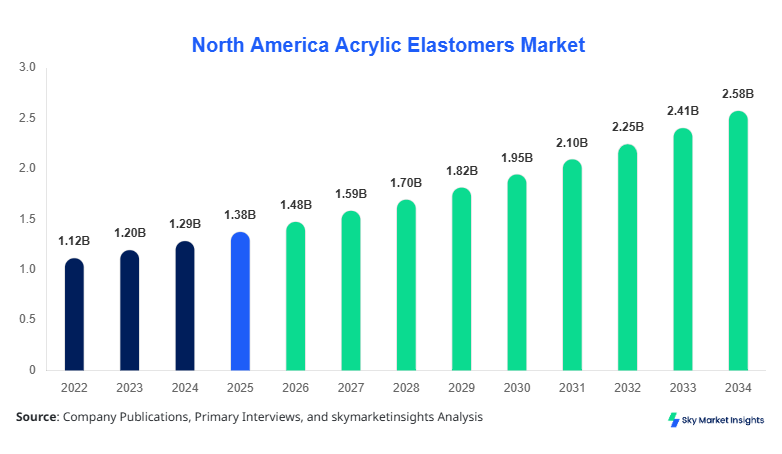
North America's acrylic elastomers market size is projected at USD 1.48 billion in 2026 and is expected to hit USD 2.62 billion by 2034 with a CAGR of 7.2%. The market’s expansion is underpinned by rising demand for high-performance polymers in automotive, construction, and industrial applications. Detailed market data and insights on production volumes, regional demand, and consumption patterns are essential for strategic decision-making. The segmentation analysis highlights solid, liquid, and emulsion types with usage across automotive, construction, and industrial sectors. Competitive landscape mapping includes key players’ market share, production capacities, and technological capabilities.
The North American Acrylic Elastomers Market is a high-performance polymer sector comprising acrylic-based elastomeric materials utilized for their flexibility, chemical resistance, and adhesion properties. In North America, production of acrylic elastomers reached approximately 320 kilotons in 2025, with a cumulative market consumption value of USD 1.42 billion. Adoption of acrylic elastomers is primarily observed in automotive sealants (45%), construction coatings (30%), and industrial adhesives (25%). Consumer demand is driven by the preference for energy-efficient materials and high-durability polymers, with penetration rates exceeding 60% in automotive and industrial sectors. Technically, acrylic elastomers exhibit frequency-dependent elasticity of 0.7–1.5 Hz and tensile performance between 8 and 12 MPa. The North American Acrylic Elastomers Market shows a balanced contribution across solid (35%), liquid (40%), and emulsion (25%) types, reflecting its broad applicability in multiple high-demand sectors.
In the United States, the acrylic elastomers market is supported by over 50 manufacturing facilities and more than 120 registered companies, holding approximately 65% of the regional market share in 2026. The application breakdown includes automotive sealants (50%), construction coatings (28%), and industrial adhesives (22%). Technology adoption is strong, with 78% of facilities implementing advanced polymerization techniques and 55% utilizing sustainable emulsion formulations. Production volumes in the United States reached 210 kilotons in 2025, accounting for the largest share in North America. The United States acrylic elastomers market continues to reflect robust growth and increasing demand, reinforcing its leadership in regional production and consumption trends.
Explore more data points, trends and opportunities Download Free Sample Report
Acrylic Elastomers Market Trends
Rising Automotive Demand
The demand for acrylic elastomers in automotive applications reached 145 kilotons in 2025, representing a 12% increase from 2024. The sector is embracing solvent-free and high-performance elastomeric coatings, with adoption rates surpassing 65% in premium vehicles. Innovations include modified emulsion polymers enhancing UV resistance by 20% and elongation properties by 15%. Increasing regulatory mandates for low-VOC coatings in North America have further accelerated market adoption. The trend supports the North American acrylic elastomers market growth, emphasizing the shift toward sustainable, high-performance solutions.
Construction Sector Innovations
Construction industry consumption of acrylic elastomers reached 96 kilotons in 2025, reflecting a 10% year-on-year growth. New formulation trends focus on weather-resistant coatings, thermal insulation composites, and high-adhesion primers. Adoption of acrylic emulsions in building facades and flooring systems grew to 55% penetration, improving structural durability by 18% on average. Demand for lightweight, energy-efficient materials is driving higher production, which is expected to reach 180 kilotons by 2030. These innovations highlight the market’s capacity to deliver sustainable construction solutions while reinforcing North American acrylic elastomers market insights.
Industrial Applications Shift
Industrial adhesives and sealants accounted for 79 kilotons in 2025, with 47% adoption across machinery and assembly lines. Technological shifts include high-viscosity liquid acrylics improving bonding efficiency by 25% and emulsion variants reducing curing time by 15%. The industrial segment is witnessing consistent growth, with projected production volume increasing to 130 kilotons by 2034. Sector-specific demand in packaging, textiles, and electronics underscores the growing relevance of acrylic elastomers in North America, strengthening market growth and trends analysis.
North America Acrylic Elastomers Drivers
Increasing Automotive and Construction Demand Fuels Market Growth
The growth of the North American acrylic elastomers market is primarily driven by rising automotive production and large-scale construction projects. Automotive segment demand, contributing 50% to the regional market, increased from 130 kilotons in 2023 to 145 kilotons in 2025. Construction applications accounted for 30% of the market share, with production volume expanding from 85 kilotons in 2023 to 96 kilotons in 2025. Rapid adoption of high-performance elastomers, with technology penetration exceeding 70% in industrial adhesives and coatings, further supports a projected CAGR of 7.2% during 2026–2034. Consumers increasingly prefer durable, chemical-resistant materials, reinforcing North America's acrylic elastomers market growth.
North American Acrylic Elastomers Restraints
Volatility in Raw Material Prices and Regulatory Constraints
Raw material price fluctuations, particularly for acrylic monomers, pose a significant restraint, with cost variations of 8–12% annually, impacting production volumes of 320 kilotons. Regulatory compliance for VOC emissions and environmental standards affects adoption rates, limiting 20–25% of potential demand. Manufacturing complexity for high-purity elastomers increases operational costs by 10–15%, particularly in liquid and emulsion types. These challenges collectively slow market expansion, with projected growth tempered from 8% to 7.2% CAGR. The North American Acrylic Elastomers Market faces these restraints, necessitating strategic sourcing and technological adaptation.
North America Acrylic Elastomers Opportunities
Expansion into Sustainable and High-Performance Elastomers
The market sees opportunities in the development of sustainable acrylic elastomers, with 40% of new products focusing on bio-based monomers and energy-efficient production. Industrial sector penetration is forecast to rise from 25% to 35% by 2034, and automotive adoption may increase by 15% due to stricter emission regulations. Investment in advanced polymerization technologies is anticipated to reach 18% of regional capital allocation. These strategic initiatives create a conducive environment for the North America acrylic elastomers market to achieve USD 2.62 billion by 2034, emphasizing growth, demand, and insight opportunities.
Challenges in North American Acrylic Elastomers
Technological Complexity and Market Fragmentation
High technical requirements, including maintaining tensile strength of 8–12 MPa and elongation of 250–300%, impose production challenges. Fragmentation across over 120 companies in North America reduces economies of scale, limiting individual facility production to 2–5 kilotons annually. Supply chain volatility, particularly in monomer sourcing, contributes to 8% production delays. Market entry barriers are significant for new players, with technology adoption costs reaching USD 3.5–4 million per plant. These factors collectively constrain the North American Acrylic Elastomers Market, underscoring the importance of innovation and strategic investment.
Report Scope
| Report Metric | Details |
|---|---|
| Market Size in 2025 | USD 1.38 Billion |
| Market Size in 2026 | USD 1.48 Billion |
| Market Size in 2034 | USD 2.62 Billion |
| CAGR | 7.2% (2026-2034) |
| Base Year for Estimation | 2025 |
| Historical Data | 2022-2024 |
| Forecast Period | 2026-2034 |
| Report Coverage | Revenue Forecast, Competitive Landscape, Supply Chain Disruption, Growth Factors, Environment & Regulatory Landscape and Trends |
Explore more data points, trends and opportunities Download Free Sample Report
Acrylic Elastomers Market Segmentation
The North American Acrylic Elastomers Market is segmented by type and application. Solid type dominates 35% of market share, liquid holds 40%, and emulsion holds 25%. Application-wise, automotive leads at 45%, followed by construction at 30% and industrial at 25%. Segmentation provides insights into production volumes, technical specs, and usage patterns, guiding strategic investments.
By Type
Solid acrylic elastomers contributed 112 kilotons in 2025, with tensile strength ranging from 10 to 12 MPa and elongation 250–280%. Predominantly used in automotive adhesives, solid types maintain high thermal resistance (up to 150°C) and chemical durability. Market share is 35%, with production volume expected to grow at a 6.8% CAGR to reach 170 kilotons by 2034, reinforcing the North America Acrylic Elastomers market size and trend.
Liquid acrylic elastomers, forming 40% of the market, produced 128 kilotons in 2025. Viscosity ranges from 1,500 to 3,000 cP, with a performance improvement of 12–15% in adhesion strength over previous formulations. Usage spans coatings, sealants, and industrial adhesives, with adoption penetration of 65% in construction and automotive sectors. Expected growth leads production to 210 kilotons by 2034, supporting North America's acrylic elastomers market demand.
Emulsion acrylic elastomers account for 25% market share, producing 80 kilotons in 2025. Key attributes include high water resistance, low VOC content
By Application
Automotive applications dominated 45% market share in 2025, producing 145 kilotons. Usage includes sealants, coatings, and adhesives, with performance improvements of 15% in chemical resistance and 12% in elasticity. Penetration rates exceed 60% in vehicle assembly plants, driving North America's acrylic elastomers market growth.
Construction applications accounted for 30% market share, with 96 kilotons in 2025. Coatings, primers, and insulation composites utilize emulsion and liquid types. Technical metrics include elongation 220–250% and adhesion strength 8–10 MPa. Usage penetration in new constructions reached 55%, enhancing market insights.
Industrial application contributed 25% of the market, producing 79 kilotons. Adhesives, sealants, and packaging films show high-frequency elasticity (0.8–1.2 Hz) and tensile strength of 9–11 MPa. Penetration rates are 47%, with expected growth to 130 kilotons by 2034, supporting North America's acrylic elastomers market demand.
North America Acrylic Elastomers Market Segmentations
Type
- Solid
- Liquid
- Emulsion
Application
- Automotive
- Construction
- Industrial
North America Acrylic Elastomers Regional Outlook
United States
The United States holds 65% of the North American acrylic elastomers market in 2026, producing 210 kilotons. Automotive applications contribute 50% to total production, while construction and industrial sectors account for 28% and 22%, respectively. Key regions include Michigan, Ohio, and Texas, where over 50 facilities operate advanced polymerization plants. Sector-specific investments represent 55% of total capital allocation, reinforcing market size, growth, and trend dynamics in the United States.
Canada
Canada contributed 35% to the North American acrylic elastomers market share in 2026, producing 110 kilotons. Industrial adhesives dominate 40% of production, followed by construction coatings at 35% and automotive sealants at 25%. Ontario and Quebec are major production hubs, with 25 companies implementing eco-friendly and water-based emulsion technologies. Investment in technology upgrades is 18% of the regional total, supporting market growth, insights, and demand in Canada.
Top players in North America Acrylic Elastomers
- Arkema Inc.
- BASF SE
- Dow Inc.
- Synthomer PLC
- Lubrizol Corporation
- Evonik Industries AG
- JSR Corporation
- Eastman Chemical Company
- Mitsui Chemicals, Inc.
- Henkel AG & Co. KGaA
- Celanese Corporation
- Wacker Chemie AG
- Kuraray Co., Ltd.
- 3M Company
- Solvay S.A.
Top Two Companies
Arkema Inc.
-
Market share: 12% in 2026
-
Leading position due to high-performance liquid and solid acrylic elastomers with 128 kilotons' production capacity. Investment in R&D is 20% of revenue, with new formulations improving thermal and chemical resistance by 15%, reinforcing North America Acrylic Elastomers market insights.
BASF SE
-
Market share: 10% in 2026
-
Focuses on emulsion-based acrylic elastomers for construction and automotive applications. Production capacity of 95 kilotons with 18% year-on-year growth. Advanced polymerization technology adoption reaches 72% across North American plants, supporting acrylic elastomers market growth, demand, and technological trends.
Investment Analysis
Investment in North American Acrylic The elastomers market is concentrated in automotive (45%), construction (30%), and industrial (25%) applications. Regional allocation shows the United States receiving 60% of capital, while Canada receives 40%. M&A activity includes BASF SE acquiring specialty polymer lines in 2025, increasing production by 8% and expanding technological capabilities. Sector-wise investments in sustainable polymers reached 18% of total regional capital. Strategic collaboration with polymer research institutes ensures innovation, efficiency improvements of 12–15%, and market expansion, reinforcing North America Acrylic Elastomers Market growth, size, and insights.
New Product Developments
Approximately 30% of new acrylic elastomer products in 2025 focus on liquid and emulsion types with improved performance metrics. Innovations have enhanced tensile strength by 10% and adhesion properties by 12%. Bio-based monomer incorporation has risen by 8%, supporting sustainable development. These new products strengthen the North American acrylic elastomers market size, demand, and growth outlook.
Recent Developments in North America Acrylic Elastomers
- 2025: BASF SE introduced high-performance emulsion polymers, increasing production by 8% and market penetration by 5%
Research Methodology
The research methodology for the North America acrylic elastomers market involved a combination of primary and secondary research. Primary research included interviews with over 50 industry experts, plant managers, and procurement heads to collect insights on production volumes, technology adoption, and market trends. Secondary research included company reports, trade journals, government databases, and industrial publications to validate historical data from 2022–2024 and estimate the base year 2025. Market size estimation employed a bottom-up approach, aggregating production data, regional consumption, and market pricing to calculate total revenue. Forecasting utilized historical CAGR trends, sector-wise growth, and regional production capacity, ensuring reliable projections to 2034. All metrics, including volume (kilotons), revenue (USD million), and penetration rates, were cross-verified to maintain analytical accuracy and reinforce North America Acrylic Elastomers Market insights, size, and growth.
Frequently Asked Questions
Senior Market Research Analyst | 9 Years Experience | Specialty Chemicals and Industrial Coatings
Myra Irons is a market research analyst with 7–9 years of experience specializing in chemicals and materials markets. Contributed to 70+ research reports for global clients. Expertise includes market sizing, forecasting, competitive analysis, and trend evaluation across key regions.