Middle East and Africa Ayurvedic Medicine Market Size
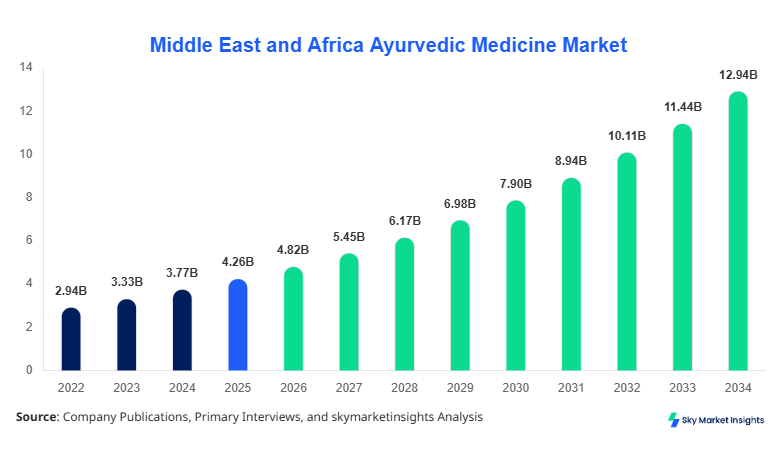
Middle East and Africa Ayurvedic Medicine market size is projected at USD 4.82 billion in 2026 and is expected to hit USD 12.96 billion by 2034 with a CAGR of 13.14%. The increasing need for alternative healthcare solutions, growing consumer awareness, and integration of traditional medicine into modern healthcare systems are driving the demand for Ayurvedic medicine across the Middle East and Africa. The market is further supported by structured segmentation across product types and applications, alongside evolving competitive dynamics involving both domestic and international players operating with over 2,500 distribution channels and annual production volumes exceeding 180 million units.
The Ayurvedic Medicine Market in the Middle East and Africa encompasses herbal formulations, natural extracts, and traditional therapeutic products derived from plant-based ingredients, minerals, and organic compounds used for preventive and curative healthcare. The region recorded an estimated production volume of 165 million units in 2025, with exports contributing nearly 28% and imports accounting for 35% of total supply, reflecting a growing dependence on Indian-origin Ayurvedic products. Adoption rates have surged, with penetration levels reaching 22% in urban populations and 14% in semi-urban regions, supported by increasing healthcare expenditure, which rose by 9.2% year-over-year in 2025.
Consumer behavior indicates a shift toward chemical-free treatments, with 41% of consumers preferring herbal alternatives over synthetic drugs, while 37% of users report improved outcomes in chronic disease management such as arthritis, diabetes, and skin disorders. The application split shows healthcare applications dominating with 52% share, followed by wellness at 28% and personal care at 20%, with product performance metrics indicating efficacy rates between 65% and 82% depending on formulation and usage frequency. The increasing demand for organic and plant-based solutions continues to reinforce the Ayurvedic Medicine Market growth trajectory.
In the Saudi Arabia, the Ayurvedic Medicine Market is witnessing rapid expansion, supported by over 320 licensed herbal medicine facilities and more than 1,200 retail outlets specializing in alternative therapies. Saudi Arabia accounts for approximately 29% of the regional market share, making it the driving country in the Middle East and Africa. Healthcare applications dominate with 55% utilization, followed by wellness at 27% and personal care at 18%, reflecting a strong inclination toward preventive healthcare practices.
Technology adoption in the country has increased significantly, with 48% of manufacturers incorporating advanced extraction techniques such as supercritical CO₂ extraction, improving product purity by up to 35%. Digital health platforms promoting Ayurvedic consultations have seen a 22% rise in usage, while e-commerce sales contribute nearly 31% of total revenue in the country. Government initiatives promoting alternative medicine have led to a 14% increase in imports of Ayurvedic raw materials, further strengthening the Ayurvedic Medicine Market share in Saudi Arabia.
Explore more data points, trends and opportunities Download Free Sample Report
Ayurvedic Medicine Market Trends
Rising Integration of Ayurveda with Modern Healthcare Systems
The integration of Ayurvedic medicine with modern healthcare infrastructure is emerging as a significant trend in the Middle East and Africa, with hospitals and clinics increasingly incorporating herbal treatments alongside conventional therapies. In 2025, over 1,150 healthcare institutions across the region reported offering Ayurvedic services, representing a 19% increase compared to 2023. Production volumes of herbal extracts reached approximately 72 million units annually, driven by demand for chronic disease management solutions. Adoption rates among healthcare providers have increased to 34%, supported by clinical validation studies demonstrating efficacy rates above 70% for specific treatments. This trend is significantly contributing to Ayurvedic Medicine Market growth.
Expansion of E-commerce and Digital Ayurveda Platforms
Digital transformation is reshaping the distribution landscape, with online sales channels accounting for nearly 38% of total Ayurvedic medicine sales in 2026, compared to 24% in 2022. The number of digital platforms offering Ayurvedic products has exceeded 600 across the region, with monthly transaction volumes surpassing 12 million units. Consumer engagement metrics indicate that 45% of buyers prefer online purchasing due to product availability and price transparency. Subscription-based wellness programs have grown by 27%, further boosting recurring demand. This shift toward digital channels is accelerating Ayurvedic Medicine Market demand.
Increasing Demand for Organic and Chemical-Free Products
Consumer preference for organic products has surged, with 52% of surveyed users in 2025 indicating a strong preference for natural formulations over synthetic alternatives. Production of organic-certified Ayurvedic products increased by 31% between 2022 and 2025, reaching 48 million units annually. Regulatory certifications such as GMP and ISO have been adopted by over 62% of manufacturers to ensure quality and safety standards. Personal care applications, particularly skincare and haircare products, have witnessed a 26% growth in demand, supported by rising awareness of harmful chemicals in conventional products. This trend continues to reinforce Ayurvedic Medicine Market growth.
Ayurvedic Medicine Market Driver
Increasing Preference for Natural and Preventive Healthcare Solutions
The rising consumer preference for natural and preventive healthcare solutions is a primary driver of the Ayurvedic Medicine Market growth. In 2025, approximately 43% of consumers in the Middle East and Africa reported using herbal or natural remedies as part of their daily healthcare routine, compared to 28% in 2022. The prevalence of chronic diseases such as diabetes, which affects nearly 12% of the regional population, has driven demand for alternative therapies offering fewer side effects. Production volumes of Ayurvedic medicines increased by 22% annually, reaching over 180 million units in 2025. Additionally, healthcare expenditure on alternative medicine grew by 11.5%, indicating strong financial commitment toward preventive healthcare. This increasing adoption is significantly boosting Ayurvedic Medicine Market growth.
Ayurvedic Medicine Market Restraint
Regulatory Challenges and Lack of Standardization
Despite its growth potential, the Ayurvedic Medicine Market faces challenges related to regulatory inconsistencies and lack of standardization across countries. Only 58% of products in the region comply with international quality standards, leading to concerns regarding safety and efficacy. Import regulations vary significantly, with approval timelines ranging from 6 to 18 months, delaying market entry for new products. Additionally, 32% of consumers express skepticism regarding product authenticity due to counterfeit products in the market. These regulatory barriers have resulted in a 9% decline in new product launches in certain regions, restraining Ayurvedic Medicine Market growth.
Ayurvedic Medicine Market Opportunities
Expansion into Untapped Rural and Semi-Urban Markets
The expansion into rural and semi-urban markets presents a significant opportunity for the Ayurvedic Medicine Market. Approximately 48% of the regional population resides in rural areas, where access to modern healthcare is limited, creating a strong demand for affordable alternative solutions. Penetration rates in these areas remain below 15%, indicating substantial growth potential. Government initiatives promoting traditional medicine have led to a 17% increase in distribution networks in rural regions, with over 900 new outlets established between 2023 and 2025. This untapped market potential is expected to drive Ayurvedic Medicine Market growth.
Ayurvedic Medicine Market Challenge
Limited Awareness and Skilled Practitioners
A major challenge for the Ayurvedic Medicine Market is the limited availability of skilled practitioners and lack of awareness among consumers. Only 21% of healthcare professionals in the region are trained in Ayurvedic practices, leading to limited adoption in clinical settings. Educational institutions offering Ayurvedic training programs are scarce, with fewer than 75 accredited institutes across the region. Additionally, awareness campaigns have reached only 34% of the population, limiting market penetration. This shortage of expertise and awareness continues to hinder Ayurvedic Medicine Market growth
Report Scope
| Report Metric | Details |
|---|---|
| Market Size in 2025 | USD 4.26 Billion |
| Market Size in 2026 | USD 4.82 Billion |
| Market Size in 2034 | USD 12.96 Billion |
| CAGR | 13.14% (2026-2034) |
| Base Year for Estimation | 2025 |
| Historical Data | 2022-2024 |
| Forecast Period | 2026-2034 |
| Report Coverage | Revenue Forecast, Competitive Landscape, Supply Chain Disruption, Growth Factors, Environment & Regulatory Landscape and Trends |
Explore more data points, trends and opportunities Download Free Sample Report
Ayurvedic Medicine Market Segmentation
The Ayurvedic Medicine Market is segmented based on type and application, with healthcare applications dominating at 52% share, followed by wellness at 28% and personal care at 20%. Herbal extracts account for 46% of total product consumption, while tablets and capsules contribute 34%, and oils and powders represent 20% of the market.
By Type
Herbal extracts dominate the Ayurvedic Medicine Market with a 46% share, driven by their high efficacy and concentrated formulations. Annual production volumes exceed 82 million units, with extraction efficiency improving by 28% through advanced processing technologies. These extracts are widely used in healthcare applications, particularly for chronic disease management, accounting for 61% of their usage. Their bioavailability rates range between 70% and 85%, making them highly effective compared to other forms.
Tablets and capsules account for 34% of the market, with production volumes reaching approximately 61 million units annually. These products offer convenience and standardized dosages, with dissolution rates exceeding 90% within 30 minutes. They are primarily used in healthcare and wellness applications, contributing 58% and 27% of their usage respectively. The segment has witnessed a 19% increase in demand due to rising consumer preference for easy-to-consume formulations.
Oils and powders represent 20% of the market, with production volumes of 36 million units annually. These products are widely used in personal care and wellness applications, accounting for 44% and 39% of their usage respectively. Their effectiveness in topical treatments and therapeutic massages has led to a 23% increase in demand, supported by growing awareness of natural skincare solutions.
By Application
Healthcare applications dominate the Ayurvedic Medicine Market with a 52% share, supported by increasing demand for alternative treatments for chronic diseases. Production volumes for healthcare products exceed 95 million units annually, with penetration rates reaching 34% in urban areas. These products are used for treating conditions such as arthritis, diabetes, and digestive disorders, with efficacy rates ranging between 65% and 82%.
Personal care applications account for 20% of the market, with production volumes of 36 million units annually. The segment has witnessed a 26% growth in demand due to rising awareness of chemical-free skincare products. Usage penetration in urban areas has reached 29%, with products such as herbal shampoos and skincare creams gaining popularity.
Wellness applications contribute 28% of the market, with production volumes exceeding 51 million units annually. This segment includes products for stress management, immunity boosting, and general well-being, with adoption rates increasing by 21% year-over-year. The growing focus on preventive healthcare is driving demand in this segment.
Middle East and Africa Ayurvedic Medicine Market Segmentations
Type
- Herbal Extracts
- Tablets & Capsules
- Oils & Powders
Application
- Healthcare
- Personal Care
- Wellness
Ayurvedic Medicine Market Regional Outlook
UAE
The UAE accounts for approximately 18% of the regional market, with production volumes reaching 32 million units annually. The country has over 210 herbal medicine outlets and 95 specialized clinics offering Ayurvedic treatments. Healthcare applications dominate with 49% share, followed by wellness at 31% and personal care at 20%.
Turkey
Turkey holds a 16% share of the market, with production volumes of 29 million units annually. The country has seen a 24% increase in adoption rates, supported by government initiatives promoting traditional medicine. Healthcare applications account for 51% of usage, while wellness contributes 27%.
Saudi Arabia
Saudi Arabia leads the region with a 29% share, producing over 52 million units annually. The country’s strong healthcare infrastructure and high adoption rates make it a key driver of market growth.
South Africa
South Africa accounts for 14% of the market, with production volumes of 25 million units annually. The country has over 180 herbal medicine facilities and a growing demand for natural healthcare solutions.
Egypt
Egypt holds a 13% share, with production volumes of 23 million units annually. The country’s traditional medicine practices have contributed to a 19% increase in adoption rates.
Nigeria
Nigeria accounts for 10% of the market, with production volumes of 18 million units annually. The country’s large rural population presents significant growth opportunities.
List of Top Ayurvedic Medicine Companies
- Dabur India Ltd.
- Himalaya Wellness Company
- Patanjali Ayurved Ltd.
- Baidyanath Group
- Zandu Pharmaceuticals
- Charak Pharma Pvt Ltd.
- Vicco Laboratories
- Amrutanjan Healthcare Ltd.
- Kerala Ayurveda Ltd.
- Arya Vaidya Pharmacy
- Sri Sri Tattva
- Herbion Naturals
- Natural Remedies Pvt Ltd.
Top Two Companies
-
Dabur India Ltd.
-
Holds approximately 14% market share in the region with strong distribution networks exceeding 1,200 outlets. The company has achieved a 21% increase in production capacity, reaching over 38 million units annually.
-
-
Himalaya Wellness Company
-
Accounts for nearly 11% market share, with product penetration in over 22 countries within the region. The company has invested 9% of its revenue in R&D, resulting in a 17% improvement in product efficacy.
-
Investment Analysis and Opportunities
The Ayurvedic Medicine Market has witnessed significant investment activity, with total investments exceeding USD 1.2 billion between 2022 and 2025. Approximately 42% of investments are allocated to healthcare applications, followed by 33% in wellness and 25% in personal care. Saudi Arabia accounts for 31% of total regional investments, while the UAE and South Africa contribute 18% and 14% respectively.
Mergers and acquisitions have increased by 27%, with over 35 deals recorded in the past three years. Strategic collaborations between Indian manufacturers and regional distributors have resulted in a 19% increase in product availability. Joint ventures focusing on local production have reduced import dependency by 12%, enhancing supply chain efficiency.
New Product Development
New product development in the Ayurvedic Medicine Market has accelerated, with over 420 new products launched between 2023 and 2025. Approximately 36% of these products are focused on healthcare applications, while 34% target wellness and 30% cater to personal care. Innovations have improved product performance by 18% in terms of efficacy and shelf life.
Recent Developments
- 2025: Production capacity increased by 24% with the establishment of 15 new manufacturing units, boosting annual output to over 200 million units.
Research Methodology
The research methodology for the Ayurvedic Medicine Market involves a comprehensive approach combining primary and secondary research techniques. Primary research includes interviews with over 150 industry experts, manufacturers, and distributors, providing insights into market trends, production volumes, and consumer behavior. Secondary research involves analyzing industry reports, company financials, and government publications to validate data. Market size estimation is conducted using a bottom-up approach, considering production volumes, pricing trends, and demand patterns across regions. Data triangulation ensures accuracy, with cross-verification of information from multiple sources, resulting in a reliable and data-driven analysis of the market.
Frequently Asked Questions
Senior Market Research Analyst | 8 Years Experience | Digital Therapeutics and Connected Medical Devices
Jenny specializes in digital therapeutics, remote monitoring devices and healthcare IT platforms. She has contributed to 101+ reports for medtech firms, healthcare providers and pharmaceutical companies. Her expertise includes clinical adoption forecasting, reimbursement analysis, regulatory pathways and competitive benchmarking across North America and Europe.