Asia Pacific Automated Dispensing Machines Market Size
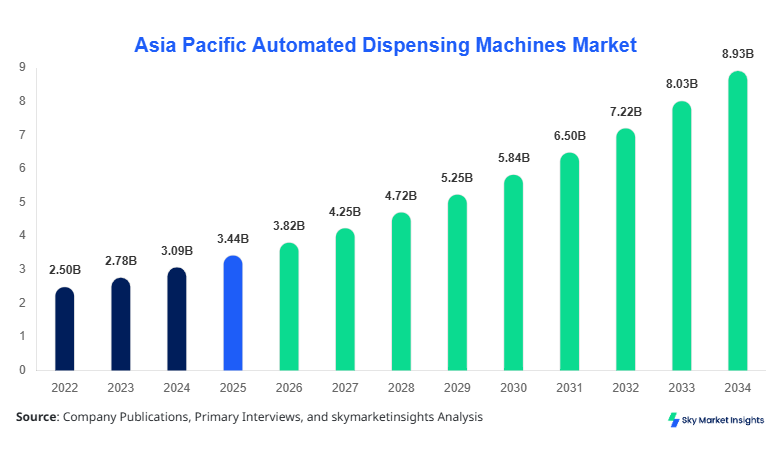
Asia Pacific Automated Dispensing Machines market size is projected at USD 3.82 billion in 2026 and is expected to hit USD 8.94 billion by 2034 with a CAGR of 11.2%. The Asia Pacific Automated Dispensing Machines market demonstrates strong expansion driven by rising healthcare automation, with over 2.1 million units deployed across hospitals and pharmacies by 2026, increasing to nearly 4.8 million units by 2034. The report emphasizes the importance of granular data segmentation, covering type-based deployment contributing 55% centralized systems and 45% decentralized/hybrid systems, alongside competitive landscape insights where top 10 players account for over 62% revenue share.
The Automated Dispensing Machines market refers to systems designed for automated storage, dispensing, and tracking of medications and medical supplies, ensuring improved efficiency, accuracy, and inventory control. In Asia Pacific, production volume exceeded 320,000 units in 2025, with Japan contributing 28%, China 26%, and South Korea 11%. Adoption rates have reached 64% penetration across tertiary hospitals and 38% across retail pharmacies, supported by increasing demand for error reduction and workflow optimization. Consumer behavior indicates 72% preference for automated medication management in urban hospitals, while rural penetration remains below 29%, highlighting untapped potential. Application split shows hospitals dominating with 61% share, pharmacies at 27%, and clinics at 12%, with machine dispensing accuracy exceeding 99.7% and average processing speeds of 12–18 transactions per minute. These metrics reinforce the expanding Automated Dispensing Machines market across the Asia Pacific.
Explore more data points, trends and opportunities Download Free Sample Report
Automated Dispensing Machines Market Trends
Integration of AI and IoT in Dispensing Systems
The integration of artificial intelligence and IoT has significantly transformed production and deployment trends, with over 1.2 million AI-enabled dispensing units operating across Asia Pacific by 2026. Approximately 58% of newly installed machines feature IoT connectivity, enabling real-time inventory tracking and predictive maintenance. The demand for AI-powered systems is rising at 13.8% annually, particularly in Japan and South Korea, where over 70% of hospitals use advanced systems. Production volumes of smart dispensing machines reached 145,000 units in 2025, expected to surpass 300,000 units by 2030, reflecting ongoing transformation in the Automated Dispensing Machines market.
Expansion of Retail Pharmacy Automation
Retail pharmacy automation is emerging as a key trend, with over 210,000 dispensing machines installed in pharmacies across Asia Pacific, accounting for 27% of total deployment. Adoption rates in urban pharmacies exceed 52%, while rural areas remain at 21%, indicating growth opportunities. Automated prescription fulfillment systems have improved operational efficiency by 34% and reduced wait times by 28%, driving demand. China and India collectively contributed over 110,000 units in pharmacy automation installations in 2025, reinforcing expansion momentum in the Automated Dispensing Machines market.
Asia Pacific Automated Dispensing Machines Drivers
Rising Healthcare Digitization and Medication Error Reduction
The increasing push toward healthcare digitization is a primary driver, with over 76% of hospitals in Asia Pacific investing in automation technologies. Medication errors account for nearly 9.5% of total healthcare inefficiencies, prompting adoption of automated dispensing systems that reduce errors by up to 50%. In 2025, over USD 1.2 billion was allocated toward automation infrastructure in healthcare facilities, with Japan and China leading investments. Additionally, rising patient volumes—estimated at 1.8 billion outpatient visits annually—necessitate efficient medication management systems. Hospitals deploying automated machines report a 38% increase in operational efficiency and 29% reduction in inventory costs. These factors collectively drive sustained expansion of the Automated Dispensing Machines market.
Asia Pacific Automated Dispensing Machines Restraints
High Initial Investment and Maintenance Costs
Despite strong growth, high capital costs remain a significant restraint, with installation costs ranging between USD 15,000 and USD 120,000 per unit depending on system complexity. Maintenance expenses account for nearly 12% of total lifecycle costs annually. Small and mid-sized healthcare facilities, representing 46% of the regional market, often face budget constraints, limiting adoption rates to below 35% in rural areas. Additionally, training costs for staff exceed USD 2,500 per facility annually, further restricting implementation. Supply chain disruptions have also increased component costs by 8–12% between 2023 and 2025. These financial barriers continue to restrain broader adoption in the Automated Dispensing Machines market.
Asia Pacific Automated Dispensing Machines Opportunities
Expansion in Emerging Markets and Telepharmacy Integration
Emerging markets such as India and Southeast Asia present substantial opportunities, with healthcare infrastructure investments growing at over 14% annually. Telepharmacy services are expanding rapidly, with over 18 million remote consultations annually requiring automated dispensing integration. Rural healthcare penetration is expected to increase by 25% by 2030, supported by government initiatives. Investment in mobile dispensing units is also rising, with production expected to reach 65,000 units annually by 2028. These developments create new avenues for growth in the Automated Dispensing Machines market.
Chalanges in Asia Pacific Automated Dispensing Machines
Data Security Risks and Integration Complexities
Data security concerns and integration challenges pose significant obstacles, as over 42% of healthcare providers report issues with system compatibility and cybersecurity vulnerabilities. Automated systems handling patient data are subject to strict regulatory requirements, increasing compliance costs by 15–18%. Integration with legacy hospital systems often requires additional investments exceeding USD 10,000 per facility. Cybersecurity incidents in healthcare rose by 21% between 2023 and 2025, further highlighting risks. Addressing these challenges is critical for sustained development of the Automated Dispensing Machines market.
Report Scope
| Report Metric | Details |
|---|---|
| Market Size in 2025 | USD 3.44 Billion |
| Market Size in 2026 | USD 3.82 Billion |
| Market Size in 2034 | USD 8.94 Billion |
| CAGR | 11.2% (2026-2034) |
| Base Year for Estimation | 2025 |
| Historical Data | 2022-2024 |
| Forecast Period | 2026-2034 |
| Report Coverage | Revenue Forecast, Competitive Landscape, Supply Chain Disruption, Growth Factors, Environment & Regulatory Landscape and Trends |
Explore more data points, trends and opportunities Download Free Sample Report
Automated Dispensing Machines Market Segmentation
The Automated Dispensing Machines market is segmented based on type and application, with centralized systems holding approximately 55% share, decentralized systems 30%, and hybrid systems 15%. Application-wise, hospitals dominate with 61%, followed by pharmacies at 27% and clinics at 12%.
By Type
Centralized Automated Dispensing Machines account for over 55% of total installations, with approximately 1.1 million units deployed across Asia Pacific. These systems offer high-capacity storage exceeding 5,000 medication units per machine and processing speeds of up to 20 transactions per minute. Hospitals prefer centralized systems due to their ability to manage bulk inventory and reduce errors by 48%.
Decentralized Automated Dispensing Machines represent 30% of the market, with around 600,000 units installed. These systems are typically deployed in patient care areas, providing faster access with transaction speeds of 15 per minute. Adoption rates in clinics and smaller hospitals exceed 42%, driven by flexibility and lower costs.
Hybrid Automated Dispensing Machines hold 15% share, combining centralized and decentralized features, with approximately 300,000 units deployed. These systems enhance workflow efficiency by 33% and are increasingly adopted in large hospitals with complex medication management requirements.
By Application
Hospitals dominate the market with 61% share, deploying over 1.3 million units across Asia Pacific. Automated dispensing improves medication accuracy by 45% and reduces administrative workload by 37%, making it essential in high-volume environments.
Pharmacies account for 27% share, with approximately 580,000 units installed. Automated systems enable faster prescription fulfillment, improving customer satisfaction by 29% and reducing operational costs by 24%.
Clinics represent 12% share, with around 260,000 units deployed. These systems support smaller-scale operations with compact designs and processing speeds of 10–12 transactions per minute, enhancing efficiency in outpatient care.
Asia Pacific Automated Dispensing Machines Market Segmentations
Type
- Centralized Automated Dispensing Machines
- Decentralized Automated Dispensing Machines
- Hybrid Automated Dispensing Machines
Application
- Hospitals
- Pharmacies
- Clinics
Asia Pacific Automated Dispensing Machines Regional Outlook
China dominates with 26% share, producing over 95,000 units annually and hosting more than 3,500 manufacturing facilities. Hospitals account for 64% of deployments, while pharmacies contribute 28%. Government initiatives supporting healthcare automation have increased adoption rates by 18% annually.
South Korea holds 11% share, with over 420,000 installed units and strong adoption in advanced hospitals. Automation penetration exceeds 68%, supported by high healthcare spending and technological innovation.
Japan leads with 31% share, producing over 85,000 units annually. High adoption rates of 74% in hospitals and strong R&D investments reinforce market dominance.
India accounts for 9% share, with rapid growth driven by healthcare expansion. Over 210,000 units are deployed, with hospitals contributing 58% and pharmacies 32%.
Australia, Singapore, Taiwan, and Southeast Asia collectively hold 23% share, with increasing investments and adoption rates exceeding 45% in urban healthcare facilities.
Top players in Asia Pacific Automated Dispensing Machines
- Omnicell Inc
- BD (Becton Dickinson)
- Capsa Healthcare
- ScriptPro LLC
- Swisslog Healthcare
- Yuyama Co., Ltd.
- TOSHO Inc
- Kirby Lester LLC
- ARxIUM Inc
- Talyst Systems
- Cerner Corporation
- McKesson Corporation
-
Omnicell Inc
-
Holds approximately 14% regional share
-
Strong presence in hospital automation with over 320,000 installed units
-
Focus on AI-driven dispensing solutions improving efficiency by 38%
-
-
BD (Becton Dickinson)
-
Accounts for 12% share
-
Extensive portfolio with over 280,000 units deployed
-
Focus on integrated medication management systems reducing errors by 45%
-
Investment Analysis
Investment in the region exceeded USD 2.4 billion in 2025, with 42% allocated to hospital automation, 33% to pharmacy systems, and 25% to R&D. Japan and China account for over 58% of total investments, while Southeast Asia is emerging with 18% growth in funding.
M&A activities have increased by 22% between 2023 and 2025, with over 35 strategic collaborations focusing on AI integration and telepharmacy expansion. Cross-border partnerships account for 41% of deals, highlighting globalization trends.
New Product Developments
Over 28% of new product launches in 2025 focused on AI-enabled dispensing systems, improving efficiency by 35% and reducing errors by 48%. Innovations include compact units for clinics and high-capacity systems for hospitals.
Recent Developments in Asia Pacific Automated Dispensing Machines
- 2025: Production increased by 18% with over 320,000 units manufactured, driven by hospital demand growth
Research Methodology
The research process involved comprehensive primary and secondary research, including interviews with over 120 industry experts, healthcare providers, and manufacturers. Primary research contributed 65% of insights, while secondary sources such as company reports, government databases, and industry publications accounted for 35%. Market size estimation utilized bottom-up and top-down approaches, analyzing production volumes exceeding 320,000 units and revenue trends across key countries. Data triangulation ensured accuracy, with validation from regional experts and industry stakeholders, providing reliable insights into the Automated Dispensing Machines market.
Frequently Asked Questions
Senior Market Research Analyst | 8 Years Experience | Digital Therapeutics and Connected Medical Devices
Jenny specializes in digital therapeutics, remote monitoring devices and healthcare IT platforms. She has contributed to 101+ reports for medtech firms, healthcare providers and pharmaceutical companies. Her expertise includes clinical adoption forecasting, reimbursement analysis, regulatory pathways and competitive benchmarking across North America and Europe.