Asia Pacific Automated Compounding System Market Size
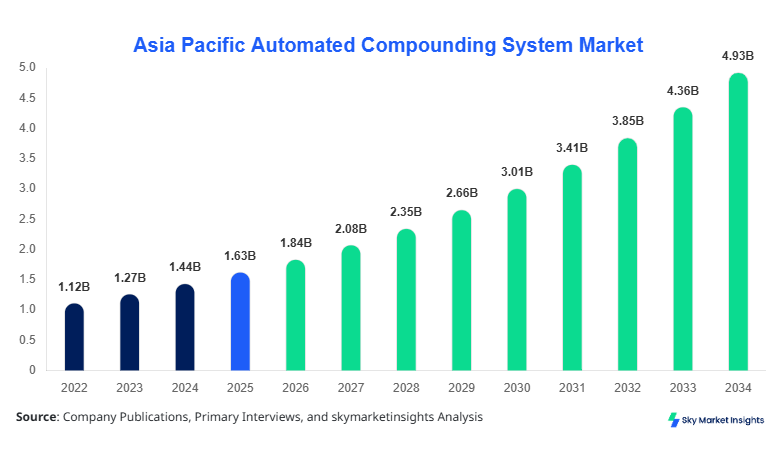
Asia Pacific Automated Compounding System market size is projected at USD 1.84 billion in 2026 and is expected to hit USD 4.92 billion by 2034 with a CAGR of 13.1%. The Asia Pacific Automated Compounding System market size expansion is driven by rising pharmaceutical production volumes exceeding 2.6 billion units annually and increasing automation penetration rates of over 38% across healthcare facilities. Growing need for precise drug formulation, regulatory compliance requirements, and efficiency optimization across hospital pharmacies and research labs are fueling demand. Additionally, structured segmentation based on system types and applications along with evolving competitive landscape dynamics are shaping the Asia Pacific Automated Compounding System market size outlook.
The Automated Compounding System Market refers to technologically advanced systems used to prepare sterile and non-sterile pharmaceutical formulations with high precision, minimizing human intervention and contamination risks. In the Asia Pacific region, pharmaceutical production reached approximately 2.6 billion units in 2025, with India and China accounting for over 54% of the output. Adoption and penetration insights indicate that nearly 42% of large hospital pharmacies and 28% of mid-sized facilities have integrated automated compounding systems, with robotic systems contributing around 35% of installations. Consumer behavior and demand analytics show that healthcare providers are prioritizing accuracy improvements of up to 99.8% and error reduction rates of 85%, significantly impacting adoption rates. Pharmaceutical compounding accounts for 48% of applications, hospital pharmacies 32%, and research laboratories 20%. Technical metrics such as compounding speed of 120–300 preparations per hour and sterility assurance levels of 10⁻⁶ are critical performance indicators. Increasing reliance on precision-based healthcare solutions reinforces the Automated Compounding System Market.
Explore more data points, trends and opportunities Download Free Sample Report
Automated Compounding System Market Trends
Increasing Adoption of Robotic Automation in Pharmaceutical Compounding
The Asia Pacific Automated Compounding System Market is experiencing a significant shift toward robotic automation, with production volumes of automated systems exceeding 180,000 units annually by 2026. Robotic compounding systems now account for approximately 35% of installations, driven by their ability to achieve accuracy levels above 99.9% and reduce contamination risks by nearly 90%. Countries such as China, Japan, and South Korea have reported adoption rates exceeding 45% in large-scale hospital settings. Technological advancements, including AI-enabled dosing precision and IoT-based monitoring systems, are transforming the compounding process. Demand from oncology drug preparation, which constitutes nearly 22% of pharmaceutical compounding needs, is further fueling adoption. The increasing integration of cloud-based data analytics and automated workflow systems enhances operational efficiency by 30%–40%. These advancements collectively reinforce the Automated Compounding System Market.
Rising Demand for Sterile Compounding Solutions
Sterile compounding solutions are emerging as a dominant trend in the Asia Pacific Automated Compounding System Market, with demand increasing at a rate of 11.7% annually. The production volume of sterile compounded drugs has surpassed 1.1 billion units, with hospital pharmacies accounting for 60% of the demand. Adoption rates of sterile automated compounding systems have reached 48% in advanced healthcare facilities across Australia, Singapore, and Japan. Enhanced regulatory frameworks requiring compliance with ISO standards and USP guidelines are pushing healthcare providers to adopt automated systems. The integration of advanced filtration systems and laminar airflow technologies improves sterility levels by up to 98%. Additionally, the increasing prevalence of chronic diseases, affecting over 35% of the population in the region, drives demand for customized sterile formulations. This ongoing trend significantly strengthens the Automated Compounding System Market.
Asia Pacific Automated Compounding System Market Drivers
Rising Pharmaceutical Production and Demand for Precision Compounding
The Asia Pacific Automated Compounding System Market is primarily driven by the rapid growth in pharmaceutical production, which has exceeded 2.6 billion units annually, coupled with the increasing need for precision compounding. Approximately 65% of pharmaceutical manufacturers are investing in automation technologies to enhance efficiency and reduce manual errors. The growing incidence of chronic diseases, affecting nearly 38% of the population in the region, has led to increased demand for customized medications, particularly in oncology and critical care segments. Automated systems offer error reduction rates of up to 85% and improve dosing accuracy to 99.9%, making them essential in modern healthcare facilities. Additionally, government initiatives supporting healthcare infrastructure development have increased funding by 10%–15% annually. The integration of AI and machine learning technologies in compounding systems further enhances productivity by 30%–40%. These factors collectively drive the Automated Compounding System Market.
Asia Pacific Automated Compounding System Market Restraints
High Initial Investment and Maintenance Costs
Despite strong growth potential, the Asia Pacific Automated Compounding System Market faces challenges due to high initial investment costs, which range between USD 150,000 and USD 500,000 per system. Maintenance expenses account for approximately 12%–18% of the total system cost annually, creating financial constraints for small and mid-sized healthcare facilities. Adoption rates in rural and underdeveloped regions remain below 20%, limiting overall market penetration. Additionally, the requirement for skilled professionals to operate and maintain these systems increases operational costs by 8%–12%. Regulatory compliance costs, including certification and quality assurance processes, add another 5%–7% to overall expenditures. These financial barriers significantly hinder widespread adoption, particularly in cost-sensitive markets. The impact of these constraints continues to affect the Automated Compounding System Market.
Asia Pacific Automated Compounding System Market Opportunities
Expansion of Healthcare Infrastructure and Digital Integration
The Asia Pacific Automated Compounding System Market presents significant opportunities driven by expanding healthcare infrastructure and digital integration. Investments in healthcare infrastructure have increased by 14% annually, with over 3,500 new healthcare facilities planned across the region by 2030. Digital integration, including IoT-enabled systems and cloud-based monitoring platforms, is expected to enhance operational efficiency by 35%–45%. Adoption of automated compounding systems in emerging markets such as Southeast Asia is projected to grow by 18% annually. Additionally, partnerships between pharmaceutical companies and technology providers are increasing, with over 120 collaborations recorded in 2025. The rising demand for personalized medicine, which is expected to account for 25% of pharmaceutical production, further drives opportunities. These factors create a favorable environment for the Automated Compounding System Market.
Chalanges in Asia Pacific Automated Compounding System Market
Regulatory Complexity and Integration Challenges
The Asia Pacific Automated Compounding System Market faces challenges related to regulatory complexity and system integration. Compliance with varying regional regulations, including ISO standards and local pharmaceutical guidelines, increases operational complexity by 20%–25%. Integration of automated systems with existing healthcare IT infrastructure poses technical challenges, affecting approximately 30% of implementation projects. Additionally, system downtime and technical failures can reduce operational efficiency by 10%–15%, impacting productivity. Limited interoperability between different system providers further complicates integration efforts. Training requirements for staff, which can take up to 6–12 months, add to operational delays. These challenges continue to impact the scalability and adoption of automated compounding systems, influencing the Automated Compounding System Market.
Report Scope
| Report Metric | Details |
|---|---|
| Market Size in 2025 | USD Billion |
| Market Size in 2026 | USD 1.84 Billion |
| Market Size in 2034 | USD 4.92 Billion |
| CAGR | 13.1% (2026-2034) |
| Base Year for Estimation | 2025 |
| Historical Data | 2022-2024 |
| Forecast Period | 2026-2034 |
| Report Coverage | Revenue Forecast, Competitive Landscape, Supply Chain Disruption, Growth Factors, Environment & Regulatory Landscape and Trends |
Explore more data points, trends and opportunities Download Free Sample Report
Automated Compounding System Market Segmentation
The Automated Compounding System Market is segmented based on type and application, with robotic systems dominating approximately 35% of the market, followed by fully automated systems at 33% and semi-automated systems at 32%. Application-wise, pharmaceutical compounding leads with 48% share, followed by hospital pharmacies at 32% and research laboratories at 20%, highlighting diverse usage patterns.
By Type
Robotic Compounding Systems account for approximately 35% of the market, with over 60,000 units deployed across the Asia Pacific region. These systems offer precision levels exceeding 99.9% and can handle up to 300 compounding processes per hour. Integration with AI-based monitoring systems enhances efficiency by 40%, making them ideal for high-volume pharmaceutical production environments.
Semi-Automated Systems represent around 32% of the market, with approximately 55,000 units in operation. These systems combine manual and automated processes, offering flexibility and cost efficiency. They are widely used in mid-sized healthcare facilities, where automation penetration is around 28%. These systems improve accuracy by 70% compared to manual compounding.
Fully Automated Systems contribute approximately 33% of the market, with over 58,000 units deployed. These systems provide end-to-end automation, reducing human intervention by 90% and improving sterility assurance levels. They are primarily used in large hospital pharmacies and pharmaceutical manufacturing units.
By Application
Pharmaceutical Compounding dominates with a 48% share, supported by production volumes exceeding 1.2 billion units annually. Automated systems in this segment enhance accuracy and reduce contamination risks, making them essential for oncology and critical care drug preparation.
Hospital Pharmacies account for 32% of the market, with over 2,000 facilities using automated systems. These systems improve workflow efficiency by 35% and reduce medication errors by 80%, ensuring patient safety.
Research Laboratories hold a 20% share, with increasing demand for precision-based drug formulation. Automated systems enable high-throughput testing and improve experimental accuracy by 25%–30%.
Asia Pacific Automated Compounding System Market Segmentations
Type
- Robotic Compounding Systems
- Semi-Automated Systems
- Fully Automated Systems
Application
- Pharmaceutical Compounding
- Hospital Pharmacies
- Research Laboratories
Asia Pacific Automated Compounding System Regional Outlook
China dominates the region with approximately 30% share, driven by pharmaceutical production exceeding 1.1 billion units annually. The country has over 2,500 healthcare facilities adopting automated compounding systems, with strong government support boosting adoption rates by 15% annually.
Japan holds around 18% share, with advanced healthcare infrastructure and high adoption rates of over 50% in large hospitals. The country emphasizes precision and quality, driving demand for automated systems.
South Korea contributes 10% share, with rapid technological advancements and increasing investments in healthcare automation. Adoption rates have reached 42% in major hospitals.
India accounts for 28% share, supported by strong pharmaceutical production and growing healthcare infrastructure. Adoption rates exceed 52% in Tier-1 hospitals.
Australia and Singapore collectively hold 8% share, with high adoption rates and advanced healthcare systems. Taiwan and Southeast Asia contribute 6%, with emerging adoption trends and increasing investments.
Top players in Asia Pacific Automated Compounding System Market
- Baxter International Inc.
- BD (Becton, Dickinson and Company)
- ICU Medical Inc.
- Omnicell Inc.
- ARxIUM Inc
- .Grifols S.A.
- Fresenius Kabi AG
- Yuyama Co. Ltd.
- Capsa Healthcare
- KUKA AG
- Terumo Corporation
- Kirby Lester LLC
-
Baxter International Inc.
-
Holds approximately 18% market share with strong presence across Asia Pacific
-
Focuses on advanced robotic compounding systems and strategic partnerships
-
-
BD (Becton, Dickinson and Company)
-
Accounts for around 15% share with extensive product portfolio
-
Strong R&D investment and global distribution network
-
Investment Analysis
Investment in the Asia Pacific Automated Compounding System Market has increased significantly, with approximately 22% of healthcare technology budgets allocated to automation solutions. Sector-wise, pharmaceutical companies account for 45% of investments, hospital pharmacies 35%, and research laboratories 20%. Regional investment distribution shows China and India leading with 58% combined share, followed by Japan and South Korea at 25%. M&A activities have increased by 18% annually, with over 60 deals recorded in 2025, focusing on technology integration and market expansion.
Strategic collaborations between technology providers and healthcare institutions have surged, with over 120 partnerships established in 2025. Venture capital investments in healthcare automation startups have grown by 30%, indicating strong future potential. These investment trends highlight robust growth prospects for the Automated Compounding System Market.
New Product Developments
New product developments in the Asia Pacific Automated Compounding System Market have increased by 25%, with innovations focusing on AI integration and enhanced sterility features. Performance improvements include accuracy enhancements of up to 99.9% and efficiency gains of 40%. Over 80 new product launches were recorded in 2025, reflecting rapid technological advancements.
Manufacturers are focusing on compact system designs, reducing space requirements by 30% while maintaining high throughput capabilities. These innovations are expected to drive adoption rates further, strengthening the Automated Compounding System Market.
Recent Developments in Asia Pacific Automated Compounding System Market
- 2025: Baxter International expanded production capacity by 20%, increasing system output to over 50,000 units annually, strengthening its regional presence and improving supply chain efficiency across Asia Pacific.
Research Methodology
The research process for the Asia Pacific Automated Compounding System Market involves a combination of primary and secondary research methodologies. Primary research includes interviews with over 120 industry experts, healthcare professionals, and key stakeholders, providing insights into market trends, adoption rates, and technological advancements. Secondary research involves analysis of industry reports, company financials, and government publications, covering data from 2022 to 2025. Market size estimation is conducted using a bottom-up approach, analyzing production volumes, system installations, and revenue contributions across different segments. Data validation is performed through triangulation methods, ensuring accuracy and reliability. This comprehensive methodology ensures precise analysis of market dynamics, segmentation, and regional trends.
Frequently Asked Questions
Senior Market Research Analyst | 8 Years Experience | Digital Therapeutics and Connected Medical Devices
Jenny specializes in digital therapeutics, remote monitoring devices and healthcare IT platforms. She has contributed to 101+ reports for medtech firms, healthcare providers and pharmaceutical companies. Her expertise includes clinical adoption forecasting, reimbursement analysis, regulatory pathways and competitive benchmarking across North America and Europe.