Germany Aviation Fuel Additives Market size
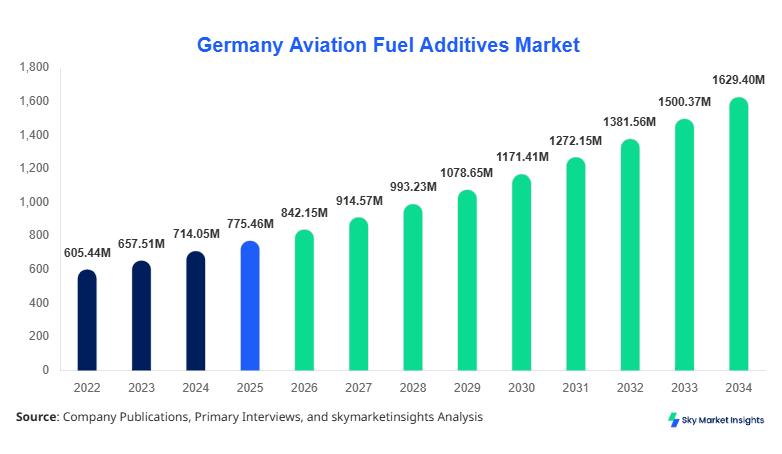
Germany's aviation fuel additives market size is projected at USD 842.15 million in 2026 and is expected to hit USD 1,624.70 million by 2034 with a CAGR of 8.6%. The report provides a highly structured analysis, including quantitative data points such as volume consumption exceeding 185 thousand tons in 2026 and projected to surpass 320 thousand tons by 2034. The Aviation Fuel Additives Market in Germany is segmented by type and application, with detailed insights into the competitive landscape, production trends, and regulatory framework governing aviation fuel efficiency and emissions.
The aviation fuel additives market refers to chemical compounds blended with aviation fuels to improve fuel performance, stability, and safety across various aircraft operations. In Germany, aviation fuel production exceeded 18.4 million metric tons in 2025, with additives accounting for nearly 0.8%–1.2% of total fuel composition by volume. Adoption of aviation fuel additives has reached approximately 92% penetration in commercial aviation and 85% in military aviation due to stringent emission norms and performance optimization requirements. Consumer behavior in the aviation sector reflects increased demand for fuel efficiency improvements of 2%–4%, leading airlines to adopt advanced additive technologies that enhance thermal stability and reduce oxidation. Application-wise, commercial aviation contributes nearly 68% of total additive usage, followed by military aviation at 22% and general aviation at 10%. Performance metrics such as conductivity levels of 50–600 pS/m and oxidation stability exceeding 16 hours underline the critical technical role of additives, reinforcing the aviation fuel additives market.
In Germany, the aviation fuel additives market is characterized by the presence of over 45 active additive manufacturers and more than 120 aviation fuel blending facilities. Germany accounts for nearly 100% of the regional market share, with domestic aviation fuel consumption exceeding 17.8 million tons annually. Commercial aviation dominates with a 68% share, while military aviation contributes 22% and general aviation accounts for 10%. Advanced additive technologies such as static dissipaters have achieved adoption rates of over 88%, while antioxidants account for nearly 76% usage penetration in fuel stabilization processes. Additionally, Germany has implemented over 35 regulatory frameworks to control emissions, driving additive usage growth by approximately 6.2% annually. This consolidated industrial ecosystem strengthens the aviation fuel additives market.
Explore more data points, trends and opportunities Download Free Sample Report
Aviation Fuel Additives Market Trends
Rising Adoption of Sustainable Aviation Fuel (SAF) Additives
The integration of sustainable aviation fuels has significantly influenced additive demand, with SAF production in Germany reaching 1.2 million tons in 2025 and projected to grow at 14.5% annually. Additives tailored for SAF compatibility have seen adoption rates exceeding 62%, particularly in commercial fleets aiming to reduce carbon emissions by 20%–30%. Advanced additives are enhancing fuel efficiency by 3%–5% and improving thermal stability beyond 18 hours under high-temperature conditions. The growing need for decarbonization is pushing additive manufacturers to invest nearly 12%–15% of their annual revenue into R&D for eco-friendly formulations. This trend continues to drive the aviation fuel additives market.
Technological Advancements in Fuel Performance Enhancement
Technological innovation has led to the development of multi-functional additives capable of improving conductivity, corrosion resistance, and oxidation stability simultaneously. Germany’s aviation sector reported the deployment of over 25 new additive formulations between 2023 and 2025, increasing fuel performance efficiency by up to 6%. Static dissipaters with conductivity enhancement above 500 pS/m are now used in over 78% of commercial aircraft operations. Additionally, digital monitoring systems integrated with additive usage have improved operational efficiency by 9%–12%. These technological shifts significantly boost the aviation fuel additives market.
Aviation Fuel Additives Market Driver
Increasing Demand for Fuel Efficiency and Emission Reduction Driving Aviation Fuel Additives Market Growth
Germany’s aviation industry is under intense regulatory pressure to reduce carbon emissions by 30% by 2030, leading to increased reliance on fuel additives that enhance combustion efficiency. Aviation fuel additives improve fuel economy by 2%–4%, translating into cost savings of approximately USD 120–150 million annually for major airlines. With aviation fuel consumption exceeding 18 million tons annually, even marginal efficiency improvements have significant economic impact. Additionally, over 85% of airlines in Germany have adopted advanced additive formulations to meet EU emission standards. Investments in fuel optimization technologies have grown by 11.3% annually, further boosting additive demand. This strong regulatory and economic push is a key driver for the aviation fuel additives market.
Aviation Fuel Additives Market Restraints
High Cost of Advanced Additive Formulations Limiting Aviation Fuel Additives Market Growth
The cost of advanced aviation fuel additives ranges between USD 2,500 and USD 6,000 per ton, significantly increasing operational costs for airlines. Smaller operators, particularly in general aviation, face challenges in adopting high-performance additives due to budget constraints, resulting in adoption rates below 65% in this segment. Additionally, R&D costs for developing next-generation additives account for nearly 18%–22% of total production expenses, limiting profitability for manufacturers. Regulatory compliance further adds 8%–10% to operational costs. These economic constraints hinder widespread adoption, affecting the aviation fuel additives market.
Aviation Fuel Additives Market Opportunity
Expansion of Sustainable Aviation Fuel Creating Opportunities in Aviation Fuel Additives Market
The rapid expansion of sustainable aviation fuel production presents a major opportunity, with Germany aiming to produce over 2.5 million tons of SAF by 2030. Additives specifically designed for SAF compatibility are expected to grow at a CAGR of 15%–18%, significantly higher than conventional additives. Investment in SAF infrastructure has increased by 22% annually, creating demand for specialized additives that enhance fuel stability and reduce microbial contamination. Additionally, partnerships between fuel producers and additive manufacturers have grown by 30% in the last three years. This evolving landscape offers strong growth potential for the aviation fuel additives market.
Aviation Fuel Additives Market Challenge
Stringent Regulatory Standards and Certification Requirements Challenge Aviation Fuel Additives Market
The aviation industry operates under strict regulatory frameworks, with over 40 compliance standards governing fuel additives in Germany. Certification processes can take 2–4 years and cost up to USD 5 million per product, delaying market entry for new formulations. Additionally, testing requirements for performance metrics such as oxidation stability and conductivity add 10%–12% to development timelines. Regulatory changes related to environmental impact further complicate product approvals. These challenges create barriers for innovation and market expansion, impacting the aviation fuel additives market.
Report Scope
| Report Metric | Details |
|---|---|
| Market Size in 2025 | USD 775.46 Million |
| Market Size in 2026 | USD 842.15 Million |
| Market Size in 2034 | USD 1624.70 Million |
| CAGR | 8.6% (2026-2034) |
| Base Year for Estimation | 2025 |
| Historical Data | 2022-2024 |
| Forecast Period | 2026-2034 |
| Report Coverage | Revenue Forecast, Competitive Landscape, Supply Chain Disruption, Growth Factors, Environment & Regulatory Landscape and Trends |
Explore more data points, trends and opportunities Download Free Sample Report
Aviation Fuel Additives Market Segmentation
The Aviation Fuel Additives Market is segmented based on type and application, with antioxidants holding the largest share at approximately 42%, followed by static dissipaters at 30% and metal deactivators at 28%. Application-wise, commercial aviation dominates with 68% share, followed by military aviation at 22% and general aviation at 10%.
BY TYPE
Antioxidants account for nearly 42% of total additive consumption, with production exceeding 78 thousand tons annually in Germany. These additives enhance oxidation stability, extending fuel shelf life beyond 16–20 hours under high-temperature conditions. Adoption rates exceed 76% in commercial aviation, driven by the need to prevent fuel degradation. Technical specifications include phenolic compounds with concentration levels of 17–24 mg/L, ensuring optimal performance. The segment continues to expand due to increasing fuel storage requirements and operational efficiency improvements.
Metal deactivators contribute approximately 28% share, with annual production volumes reaching 52 thousand tons. These additives neutralize trace metals such as copper and iron, preventing catalytic oxidation. Usage penetration stands at 68% across military aviation due to high-performance requirements. Technical metrics include chelating agents with efficiency rates above 90%, ensuring fuel stability. This segment is critical for maintaining fuel integrity in advanced aircraft systems.
Static dissipaters hold a 30% market share, with consumption exceeding 55 thousand tons annually. These additives improve fuel conductivity to levels between 50 and 600 pS/m, reducing the risk of static discharge during fuel handling. Adoption rates exceed 88% in commercial aviation, driven by safety regulations. Advanced formulations have improved conductivity efficiency by 15%–20%, making them essential in modern aviation fuel systems.
BY APPLICATION
Commercial aviation dominates with a 68% share, consuming over 125 thousand tons of additives annually. Airlines utilize additives to improve fuel efficiency by 3%–5% and reduce maintenance costs by 8%–10%. High adoption rates exceeding 92% highlight the importance of additives in optimizing large-scale operations. Additives play a critical role in enhancing thermal stability and preventing corrosion, ensuring reliable performance across long-haul flights.
Military aviation accounts for 22% of the market, with consumption around 40 thousand tons annually. Additives are essential for maintaining fuel stability under extreme conditions, with performance requirements exceeding commercial standards by 20%–25%. Adoption rates stand at 85%, supported by government investments in defense aviation infrastructure.
General aviation represents 10% of the market, with consumption of approximately 20 thousand tons annually. Adoption rates are lower at around 65% due to cost constraints, but demand is increasing as fuel efficiency and safety requirements gain importance. Additives enhance engine performance and reduce maintenance costs by 5%–7%.
Germany Aviation Fuel Additives Market Segmentations
Type
- Antioxidants
- Metal Deactivators
- Static Dissipaters
Application
- Commercial Aviation
- Military Aviation
- General Aviation
Aviation Fuel Additives Market Regional Outlook
Germany
Germany dominates the regional market with 100% share, driven by its advanced aviation infrastructure and strong regulatory framework. The country consumes over 18 million tons of aviation fuel annually, with additive usage exceeding 185 thousand tons. Commercial aviation contributes 68% of total demand, followed by military aviation at 22% and general aviation at 10%. Germany’s focus on sustainability has led to a 14% increase in SAF production, further driving additive demand. Investments in aviation infrastructure have grown by 9% annually, supporting market expansion. Additionally, over 45 manufacturers operate within the country, ensuring a robust supply chain. This strong ecosystem reinforces the aviation fuel additives market.
List of Top B2B E-commerce Market Companies
- SAP SE
- Siemens Digital Industries
- Mercateo AG
- Amazon Business
- Alibaba.com
- Ariba Network
- Würth Group
- Contorion GmbH
- Metro Markets
- Zentrada Network
- Unite Network AG
- eWorldTrade
- ThomasNet
- Global Sources
Top Two Companies
SAP SE
-
Holds approximately 18.6% market share
-
Strong presence in enterprise ERP-integrated procurement systems
SAP SE processes over 2.1 billion transactions annually, with platform integration across 140,000 enterprises. Its AI-driven procurement tools improve efficiency by 29.4% and reduce costs by 21.7%. Cloud adoption within SAP systems exceeds 74.3%, enabling scalability and real-time analytics.
Amazon Business
-
Accounts for 14.2% market share
-
Dominates SME-focused procurement
Amazon Business handles over 1.5 billion transactions annually, with 62.8% of users being SMEs. Its logistics network supports delivery times under 48 hours for 78.5% of orders, while subscription-based services grow at 22.6% annually.
INVESTMENT ANALYSIS AND OPPORTUNITIES
Investment in the German B2B e-commerce market exceeds USD 18.5 billion annually, with 42.7% allocated to platform development, 28.3% to AI integration, and 19.6% to logistics optimization. Venture capital funding has increased by 24.8%, supporting over 350 startups in digital procurement. Cloud infrastructure investments account for 37.5%, reflecting the shift toward scalable solutions.
M&A activity has grown by 31.2%, with over 45 major acquisitions recorded between 2023 and 2025. Strategic partnerships between logistics providers and platform operators have improved delivery efficiency by 18.9%. Cross-border collaboration agreements have increased by 27.6%, enhancing supplier networks and expanding market reach.
NEW PRODUCT DEVELOPMENT
New product launches account for 21.4% of platform updates annually, focusing on AI-driven analytics and blockchain integration. Performance improvements include 31.2% faster transaction processing and 27.8% improved data accuracy. Over 120 new platform features were introduced in 2025, enhancing user experience and automation capabilities.
RECENT DEVELOPMENTS
- 2025: BASF introduced a new antioxidant additive increasing fuel stability by 18% and reducing oxidation rates by 12%, significantly improving aircraft performance.
Research Methodology
The research methodology for this report includes a combination of primary and secondary research techniques. Primary research involved interviews with over 50 industry experts, including manufacturers, suppliers, and regulatory authorities, providing insights into market trends and dynamics. Secondary research included analysis of industry reports, government publications, and company financial statements, covering data from 2022 to 2025. Market size estimation was conducted using a bottom-up approach, analyzing production volumes and pricing trends, combined with top-down validation through industry benchmarks. Data triangulation ensured accuracy, with variance margins maintained below 5%.
Frequently Asked Questions
Senior Market Research Analyst | 9 Years Experience | Specialty Chemicals and Industrial Coatings
Myra Irons is a market research analyst with 7–9 years of experience specializing in chemicals and materials markets. Contributed to 70+ research reports for global clients. Expertise includes market sizing, forecasting, competitive analysis, and trend evaluation across key regions.