Europe Aquarium Power Filter Market Size
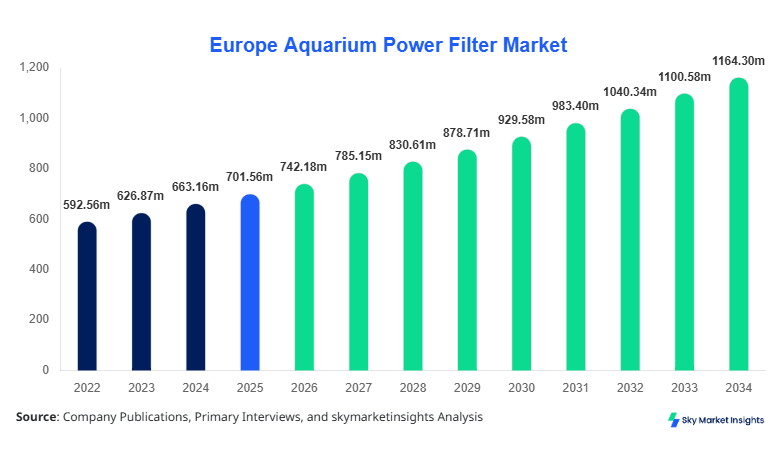
Europe Aquarium Power Filter market size is projected at USD 742.18 million in 2026 and is expected to hit USD 1,164.52 million by 2034 with a CAGR of 5.79%.
The market expansion is supported by increasing aquarium ownership across Europe, rising expenditure on ornamental fish care products, and growing technological integration in filtration systems. More than 18.6 million aquarium units were operational across Europe in 2025, while over 42% of consumers preferred automated filtration systems with biological and mechanical purification capabilities. The competitive landscape is characterized by the presence of multinational aquatic equipment manufacturers, regional suppliers, and specialized filtration technology providers focusing on energy-efficient systems and high-flow filtration performance.
The aquarium power filter industry refers to the manufacturing, distribution, and commercialization of electrically operated filtration systems designed to maintain water quality in freshwater and marine aquariums. These systems remove particulate matter, biological waste, ammonia, and dissolved contaminants using mechanical, chemical, and biological filtration technologies. In Europe, annual aquarium equipment production surpassed 12.4 million units in 2025, with Germany, the United Kingdom, and France accounting for nearly 63% of regional production volume. Internal power filters contributed approximately 38% of unit sales, while external canister filters represented 41% of premium revenue generation due to higher average selling prices exceeding USD 95 per unit.
Consumer adoption rates for smart aquarium equipment increased by 17.3% during 2024–2025 as aquarium owners shifted toward energy-efficient filtration systems consuming below 25 watts of electricity. Residential aquarium applications represented nearly 68% of total demand, while commercial aquarium stores and aquatic exhibition facilities accounted for 21% and 11%, respectively. Around 54% of European aquarium users replaced filtration cartridges every 30–45 days, driving recurring aftermarket revenue. Demand for silent-operation filters with noise levels below 30 dB grew by 22% in 2025, especially among urban consumers. Increasing awareness regarding aquatic pet health, water circulation efficiency above 600 liters/hour, and automated oxygenation systems continues to strengthen Europe Aquarium Power Filter market share.
Explore more data points, trends and opportunities Download Free Sample Report
Aquarium Power Filter Market Trends
Smart and Energy-Efficient Filtration Technologies
The European aquarium industry is witnessing a rapid transition toward smart filtration technologies integrated with IoT monitoring systems, automatic cleaning cycles, and energy-efficient pump motors. During 2025, more than 3.6 million smart aquarium power filters were sold across Europe, reflecting a 19.4% increase compared to 2023 volumes. Nearly 44% of premium aquarium owners preferred filters equipped with mobile application monitoring capabilities that tracked water pH, ammonia levels, and filter maintenance schedules. Manufacturers increasingly incorporated brushless DC motors capable of reducing electricity consumption by 18%–25% while maintaining water circulation rates above 1,200 liters per hour. Germany and the United Kingdom together accounted for over 52% of smart filtration demand due to higher adoption of connected home devices. Integration of multi-stage biological media chambers and UV sterilization modules has further accelerated Aquarium Power Filter market trends.
Rising Demand for Silent and Compact Aquarium Filters
Urbanization and smaller residential living spaces have significantly influenced demand for compact and low-noise aquarium power filters throughout Europe. Nearly 58% of apartment-based aquarium owners in France, Italy, and Spain preferred filtration systems operating below 28 dB noise levels during 2025. Manufacturers launched miniaturized hang-on-back filters capable of processing 350–500 liters per hour while occupying 30% less installation space than traditional systems. The residential nano-aquarium category expanded by 16.1% during 2024–2025, boosting demand for compact filtration solutions. Retail sales data indicated that aquarium tanks below 100 liters accounted for approximately 47% of aquarium equipment purchases in Europe. Simultaneously, sustainable filtration media usage increased by 21%, particularly reusable ceramic bio-rings and biodegradable filter cartridges. These developments continue shaping Aquarium Power Filter market demand.
Growth of E-commerce and Subscription-Based Maintenance
Digital retail transformation has become a significant trend influencing aquarium filtration product distribution across Europe. Online aquarium equipment transactions exceeded USD 248 million in 2025, accounting for nearly 37% of regional filtration product sales. Subscription-based maintenance services offering replacement cartridges every 30 or 60 days expanded by 13.5%, particularly in Germany and the United Kingdom. Around 41% of consumers purchasing external canister filters also subscribed to recurring maintenance kits. Major e-commerce retailers introduced bundled offerings combining filters, water testing kits, and biological additives, increasing average order values by 22%. Rising social media influence and online aquarium hobbyist communities further boosted awareness regarding advanced filtration efficiency standards and water health optimization, positively affecting Aquarium Power Filter market trends.
Europe Aquarium Power Filter Drivers
Increasing Aquarium Ownership and Ornamental Fish Trade Expansion
Europe has experienced substantial growth in ornamental fish ownership and aquarium installations, driving demand for advanced filtration systems. During 2025, ornamental fish imports across Europe exceeded 1.1 billion units, while aquarium equipment expenditure surpassed USD 3.8 billion. Approximately 29% of European households owned at least one aquatic pet product, and nearly 64% of aquarium owners upgraded filtration systems within three years of purchase. The expansion of marine aquariums, which require high-capacity biological and chemical filtration, increased external power filter demand by 18.2% between 2023 and 2025. Public aquariums and aquatic exhibition facilities collectively operated more than 78,000 large-capacity tanks requiring filtration systems above 2,000 liters/hour throughput. Additionally, rising awareness regarding aquatic ecosystem stability and fish mortality prevention has accelerated replacement demand for premium filtration equipment. Growing consumer spending on aquarium aesthetics and automated maintenance technologies continues to support Aquarium Power Filter market growth.
Europe Aquarium Power Filter Restraints
High Maintenance Costs and Energy Consumption Concerns
Despite growing adoption, high maintenance expenses and electricity consumption remain significant barriers for aquarium power filter adoption in Europe. External canister filters often require replacement media costing USD 45–USD 90 annually per unit, while premium marine aquarium systems may exceed USD 180 in yearly maintenance expenses. Approximately 32% of entry-level aquarium owners reported concerns regarding recurring operational costs during 2025. In addition, power filters operating above 40 watts increased annual electricity expenditure by 12%–18% for commercial aquarium operators. Strict European energy efficiency regulations have further increased manufacturing compliance costs by nearly 9.4% since 2023. Small-scale aquarium retailers in Eastern Europe also faced inventory constraints due to fluctuating raw material costs affecting plastic housing and motor component production. These factors continue limiting Aquarium Power Filter market growth.
Europe Aquarium Power Filter Opportunities
Expansion of Smart Aquarium Ecosystems and Sustainable Filtration
The growing popularity of automated smart aquariums presents substantial opportunities for filtration system manufacturers across Europe. Nearly 46% of aquarium enthusiasts under the age of 40 expressed willingness to invest in app-connected filtration systems during 2025. Sustainable filtration technologies using recyclable filter media and low-energy motors gained traction, with eco-certified products accounting for 28% of new launches. Investment in R&D for AI-based water quality monitoring increased by 16.7% between 2024 and 2025. Manufacturers also introduced modular filtration systems supporting both freshwater and marine environments, expanding customer flexibility and reducing replacement costs by nearly 20%. Commercial aquarium chains and luxury hospitality installations increasingly adopted centralized filtration systems capable of supporting tanks exceeding 5,000 liters. Such innovations are expected to create lucrative Aquarium Power Filter market opportunities.
Challenges in Europe Aquarium Power Filter Market
Counterfeit Products and Technical Compatibility Issues
The European aquarium filtration sector faces ongoing challenges from counterfeit low-cost imports and compatibility limitations among filtration accessories. Approximately 14% of online aquarium equipment listings in 2025 were associated with non-certified filtration products lacking European electrical compliance standards. These products often demonstrated motor failure rates exceeding 21% within 12 months of operation. Furthermore, compatibility issues between filter cartridges, pump motors, and aquarium tank dimensions created operational inefficiencies for nearly 26% of consumers. Commercial aquarium operators reported that inconsistent flow distribution and inadequate biological media support caused water quality instability in tanks above 1,500 liters. Supply chain disruptions affecting electronic components and pump impellers also increased lead times by 11%–15% during 2024. These factors continue creating operational complexities within Aquarium Power Filter market demand.
Report Scope
| Report Metric | Details |
|---|---|
| Market Size in 2025 | USD 701.56 million |
| Market Size in 2026 | USD 742.18 million |
| Market Size in 2034 | USD 1,164.52 million |
| CAGR | 5.79% (2026-2034) |
| Base Year for Estimation | 2025 |
| Historical Data | 2022-2024 |
| Forecast Period | 2026-2034 |
| Report Coverage | Revenue Forecast, Competitive Landscape, Supply Chain Disruption, Growth Factors, Environment & Regulatory Landscape and Trends |
Explore more data points, trends and opportunities Download Free Sample Report
Aquarium Power Filter Market Segmentation
The Europe aquarium filtration industry is segmented by type and application based on product performance, installation structure, and end-user operational requirements. External canister filters dominated revenue contribution with approximately 41% share in 2025, while residential aquarium applications contributed nearly 68% of overall market consumption. Rising adoption of high-flow multi-stage filtration systems and smart aquarium integration continues influencing segment diversification.
By Type
Internal power filters accounted for nearly 38% of total unit sales in Europe during 2025 due to affordability and compact design suitability for tanks below 150 liters. More than 4.8 million internal filters were shipped across the region, particularly in France, Spain, and Italy. These systems generally operate at flow rates ranging from 300 to 800 liters/hour and consume between 5 and 20 watts of electricity. Internal filters are widely preferred for freshwater aquariums and beginner-level setups because installation complexity remains minimal. Approximately 62% of entry-level aquarium owners selected internal filtration systems owing to average pricing below USD 40 per unit. Manufacturers increasingly introduced dual-stage biological and mechanical filtration cartridges capable of improving water purification efficiency by 15%–18%. The growing popularity of nano aquariums further supports Aquarium Power Filter market demand.
External canister filters represented approximately 41% of Europe’s filtration equipment revenue due to premium pricing and advanced performance characteristics. More than 2.6 million units were sold in 2025, particularly among marine aquarium enthusiasts and public aquatic facilities. These systems typically deliver flow capacities between 1,000 and 2,500 liters/hour while supporting multi-stage filtration media configurations. Germany and the United Kingdom together accounted for over 49% of regional external filter consumption. High-capacity systems featuring UV sterilization and programmable flow controls experienced sales growth exceeding 17% during 2025. Commercial aquarium installations preferred canister systems due to their ability to maintain ammonia concentrations below 0.02 ppm. Increased consumer willingness to invest in silent operation filters with less than 30 dB noise output continues driving Aquarium Power Filter market share.
Hang-on-back filters gained considerable popularity among mid-sized residential aquariums and accounted for approximately 21% of Europe’s aquarium filtration installations during 2025. Nearly 1.9 million units were distributed across the region, especially in Spain and Italy where space-efficient aquarium equipment demand remained high. These filters generally process 400–1,000 liters/hour and are favored for easy maintenance accessibility. Manufacturers introduced compact designs with integrated protein skimmers and oxygenation systems, increasing operational efficiency by nearly 13%. Around 36% of consumers replacing traditional sponge filters transitioned toward hang-on-back systems because of improved water circulation and lower maintenance frequency. Enhanced cartridge replacement mechanisms and reusable biological media support continue improving Aquarium Power Filter market trends.
By Application
Residential aquariums represented the largest application segment with nearly 68% revenue contribution during 2025. Europe recorded more than 18.6 million household aquarium installations, with tanks below 120 liters accounting for 57% of residential demand. Approximately 72% of home aquarium owners utilized electrically powered filtration systems featuring biological purification media. Internal power filters dominated household installations due to affordability, while premium marine hobbyists increasingly adopted external canister systems. Residential consumers prioritized low-noise operation, compact dimensions, and energy efficiency below 20 watts. Online retail sales for residential filtration products expanded by 24% between 2024 and 2025. Increasing interest in aquascaping and exotic fish breeding further strengthened Aquarium Power Filter market demand.
Commercial aquariums, including aquatic retail stores, breeding centers, and hospitality installations, accounted for nearly 21% of market consumption during 2025. More than 14,000 commercial aquarium facilities operated across Europe, collectively requiring over 2.3 million filtration units annually. Commercial installations commonly utilized canister filtration systems delivering 1,500–3,000 liters/hour throughput. Retail aquarium outlets generated approximately 37% of commercial filtration equipment purchases due to recurring replacement cycles and demonstration tank installations. Demand for centralized filtration systems increased by 16.4% during 2025 as large aquatic retail chains optimized maintenance operations. Enhanced water circulation and nitrate reduction efficiency remain essential technical parameters supporting Aquarium Power Filter market share.
Public aquatic facilities, including educational aquariums, zoos, research institutions, and exhibition centers, represented approximately 11% of total market revenue in 2025. Europe operated more than 780 public aquatic facilities requiring industrial-grade filtration systems capable of processing above 5,000 liters/hour. Germany, France, and the United Kingdom together contributed nearly 58% of this segment’s demand. These facilities increasingly adopted automated monitoring systems integrating pH balancing, UV sterilization, and biological filtration modules. Approximately 44% of public aquarium operators upgraded filtration infrastructure between 2023 and 2025 to comply with water quality and aquatic biodiversity preservation standards. Advanced filtration performance and operational reliability continue strengthening Aquarium Power Filter market demand.
Europe Aquarium Power Filter Market Segmentations
Type
- Internal Power Filters
- External Canister Filters
- Hang-on-Back Filters
Application
- Residential Aquariums
- Commercial Aquariums
- Public Aquatic Facilities
Europe Aquarium Power Filter Regional Outlook
United Kingdom
The United Kingdom accounted for approximately 24% of Europe’s total aquarium filtration revenue in 2025 due to strong consumer spending on aquatic pet products and premium filtration technologies. More than 4.2 million households owned aquariums, while annual filtration equipment sales exceeded 2.1 million units. Residential aquarium applications contributed 71% of national demand. Smart filtration systems with app-based monitoring capabilities achieved adoption rates above 33% among premium consumers. Marine aquarium installations increased by 12.5% during 2025, accelerating demand for high-capacity canister filters.
Germany
Germany represented nearly 22% of regional revenue and remained Europe’s leading aquarium equipment manufacturing hub. More than 3.4 million filtration units were produced domestically during 2025, while exports accounted for 46% of national production. Commercial aquarium installations represented 24% of German demand owing to strong aquatic retail infrastructure. Approximately 41% of consumers preferred eco-certified low-energy filtration systems. High investment in engineering innovation and smart motor technologies continues supporting Aquarium Power Filter market share.
France
France contributed around 15% of Europe’s aquarium filtration consumption during 2025. The country operated nearly 1,800 aquatic retail outlets and recorded residential aquarium penetration above 17% among urban households. Internal power filters accounted for approximately 44% of domestic unit sales due to popularity among beginner aquarium owners. French consumers increasingly preferred silent-operation systems below 28 dB, while online aquarium equipment transactions expanded by 18% during 2025. Growing freshwater aquascaping communities continue supporting Aquarium Power Filter market trends.
Spain
Spain accounted for approximately 11% of regional revenue during 2025, supported by rising urban pet ownership and increasing interest in compact aquariums. More than 1.3 million filtration units were sold nationally, with hang-on-back filters contributing 29% of demand. Residential applications represented nearly 74% of total consumption. Tourism-related hospitality aquariums also expanded commercial demand for advanced biological filtration systems. Smart aquarium accessory adoption increased by 14% during 2025, positively affecting Aquarium Power Filter market demand.
Italy
Italy represented nearly 10% of Europe’s filtration equipment revenue in 2025. More than 980,000 aquarium filters were distributed nationwide, while marine aquarium installations increased by 11.2%. Residential aquariums accounted for 69% of market consumption. Italian consumers increasingly preferred compact energy-efficient filtration systems consuming less than 18 watts. E-commerce distribution channels contributed approximately 35% of national aquarium equipment transactions. Strong demand for aesthetically integrated filtration products supports Aquarium Power Filter market growth.
Russia
Russia accounted for approximately 8% of Europe’s aquarium filtration revenue during 2025. The country operated more than 1,200 aquatic retail facilities and generated rising demand for large-capacity filtration systems suited for cold-water aquariums. External canister filters contributed nearly 46% of premium segment sales due to high demand for durable high-flow systems. Domestic production increased by 9.7% during 2025 as local manufacturers expanded cost-effective filtration offerings. Increasing adoption of imported marine aquarium technologies continues supporting Aquarium Power Filter market share.
Top players in Europe Aquarium Power Filter
- EHEIM GmbH & Co. KG
- Fluval
- Tetra GmbH
- Aquael
- Juwel Aquarium AG & Co. KG
- OASE GmbH
- Sera GmbH
- Resun Aquarium
- SunSun Group
- Hagen Group
- Aqua One
- Boyu Group
- Marineland
- Penn-Plax
- Interpet Limited
EHEIM GmbH & Co. KG
-
EHEIM GmbH & Co. KG accounted for approximately 14% of Europe’s premium aquarium filtration revenue during 2025.
-
The company maintained strong positioning in Germany, the United Kingdom, and France due to its advanced external canister filtration portfolio.
-
EHEIM produced more than 1.1 million filtration units annually and invested nearly 8% of annual revenue into R&D activities focused on silent-operation pump technologies and energy-efficient motor systems.
-
The company’s premium biological filtration media and modular canister systems supported high penetration within marine aquariums and public aquatic facilities.
-
More than 39% of EHEIM’s European sales originated from external canister filters with flow capacities exceeding 1,500 liters/hour.
Fluval
-
Fluval held approximately 11% share of Europe’s aquarium filtration revenue in 2025.
-
The company strengthened market positioning through smart filtration integration, app-enabled monitoring systems, and premium marine aquarium solutions.
-
Fluval’s external filtration systems achieved strong adoption among commercial aquariums, accounting for nearly 31% of the company’s European sales.
-
The company expanded distribution partnerships with online retailers across Germany, France, and the United Kingdom, increasing digital sales contribution to 43%.
-
Fluval introduced high-efficiency brushless motor systems reducing energy consumption by nearly 22% compared to conventional aquarium filters.
Investment Analysis
Investment activities within the European aquarium filtration industry increased significantly during 2024–2025 as manufacturers focused on smart technologies, sustainable materials, and advanced biological filtration systems. Approximately 34% of total investment allocation targeted energy-efficient motor technologies, while 26% supported smart aquarium automation platforms. Germany accounted for nearly 31% of regional investment inflows, followed by the United Kingdom at 24% and France at 15%. Venture funding for connected aquarium ecosystems increased by 18.9% during 2025. Public aquarium modernization projects across Europe collectively exceeded USD 120 million in filtration infrastructure investments.
Mergers, acquisitions, and collaborative agreements also intensified across the industry. More than 14 strategic partnerships related to aquarium automation and water treatment technologies were recorded between 2023 and 2025. Manufacturers collaborated with IoT software providers to integrate cloud-based aquarium monitoring systems capable of reducing maintenance frequency by nearly 21%. Cross-border manufacturing agreements between German engineering firms and Eastern European production facilities improved supply chain efficiency and lowered operational costs by 11%. Investment in recyclable filtration cartridges and biodegradable filter media increased by 16.5%, particularly among sustainability-focused manufacturers. These developments continue supporting long-term Aquarium Power Filter market growth.
New Product Developments
Manufacturers across Europe launched several advanced filtration products during 2025 focused on energy efficiency, noise reduction, and smart monitoring integration. Approximately 29% of newly introduced aquarium filtration systems incorporated app-controlled maintenance alerts and automated water quality diagnostics. Brushless motor integration improved operational efficiency by nearly 24%, while next-generation biological media increased ammonia reduction performance by 17%.
Several companies introduced modular filtration systems supporting both freshwater and marine aquarium applications. Compact hang-on-back filters with integrated UV sterilization expanded by 14% in new product launches. Sustainable product development also accelerated, with nearly 21% of new filtration cartridges manufactured using biodegradable or recyclable materials. These innovations continue strengthening Aquarium Power Filter market trends.
Recent Developments in Europe Aquarium Power Filter
- 2025: EHEIM expanded its German manufacturing facility, increasing annual production capacity by 18% and enabling shipment of more than 1.3 million filtration systems annually. The expansion included automated motor assembly lines and enhanced biological media production capabilities designed to improve premium canister filter availability across Europe.
- 2025: Fluval introduced a next-generation smart aquarium filtration platform featuring app-based monitoring, automated maintenance notifications, and energy optimization technology. The product reduced electricity consumption by approximately 22% while increasing filtration efficiency by 16%, strengthening adoption within premium residential aquariums.
Research Methodology
The research process for this report involved extensive primary and secondary data collection focused on the European aquarium filtration industry. Primary research included interviews with aquarium equipment manufacturers, distributors, aquatic retail operators, public aquarium administrators, and technology providers operating across the United Kingdom, Germany, France, Spain, Italy, and Russia. More than 85 industry participants contributed insights regarding production volumes, technology adoption, pricing trends, distribution structures, and future demand forecasts.
Secondary research incorporated analysis of trade databases, company annual reports, investor presentations, aquarium industry associations, customs statistics, and technical publications related to aquatic filtration technologies. Market size estimation involved bottom-up and top-down analytical models integrating production capacity, retail sales data, average selling prices, and regional import-export statistics. Forecast calculations considered macroeconomic indicators, aquarium ownership trends, smart filtration adoption rates, and technological innovation cycles between 2026 and 2034. Data triangulation and validation techniques ensured high accuracy and consistency for all quantitative and qualitative findings presented within the report.
Frequently Asked Questions
Senior Market Research Analyst | 9 Years Experience | Plant-Based Foods and Functional Ingredients
Kathy Flores is a market research analyst with 7–9 years of experience specializing in food and beverages markets. Contributed to 70+ research reports for global clients. Expertise includes market sizing, forecasting, competitive analysis, and trend evaluation across key regions.