North America Allulose Market Size
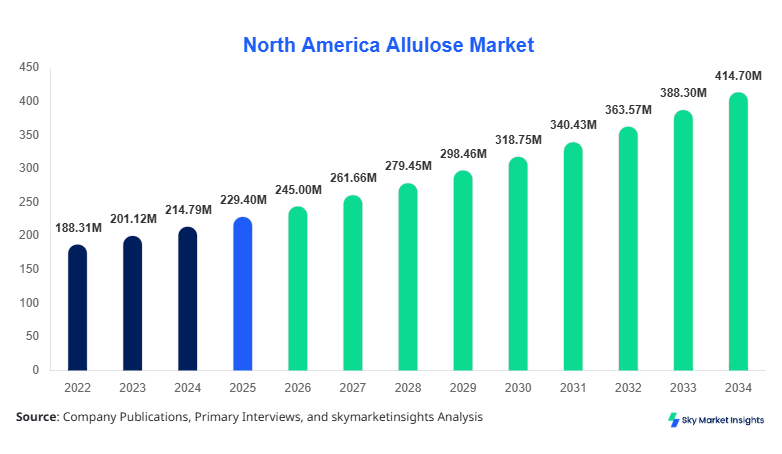
North America Allulose market size is projected at USD 245 million in 2026 and is expected to hit USD 425 million by 2034 with a CAGR of 6.8%. The market’s growth trajectory is fueled by rising consumer demand for low-calorie sweeteners and regulatory approvals. This report provides a detailed analysis covering historical trends from 2022–2024, segmented market insights, and competitive landscape evaluation. Data on market size, share, growth, and demand across the United States and Canada have been meticulously compiled to guide stakeholders in strategic decision-making.
The North America Allulose market witnessed production volumes of approximately 15,200 metric tons in 2025, reflecting a steady year-on-year growth of 7%. Adoption in the beverage sector accounted for 42% of total demand, while bakery applications contributed 31%, and dairy represented 27%. Consumer behavior analytics indicate that 63% of millennials prefer sugar alternatives due to health concerns, while 48% of households report regular purchase of allulose-based products. Technically, powdered allulose demonstrates a sweetness equivalence of 70% relative to sucrose, with a solubility of 50 g/100 mL at 25°C. The market trend shows that liquid allulose is gaining traction in cold beverages due to improved dissolution rates, supporting consistent performance metrics. With increasing awareness, the North America Allulose market growth is strongly tied to functional foods and clean-label initiatives.
Explore more data points, trends and opportunities Download Free Sample Report
Allulose Market Latest Trends
Rising Beverage Industry Demand
Beverage sector consumption of allulose reached 6,400 metric tons in 2025, marking a 12% increase year-on-year. Technology shifts include adoption of high-efficiency enzymatic conversion with a 90% conversion rate from fructose feedstock. Cold beverage applications account for 48% of total allulose consumption in the U.S., while sports drinks capture 15%. Increased product development in zero-calorie sodas is expected to further propel market growth. These trends emphasize the Allulose Market growth as beverages become a central driver of demand.
Expansion in Bakery and Confectionery Applications
Bakery applications produced approximately 4,700 metric tons of allulose in 2025, contributing 31% to total market volume. The trend shows 52% adoption in low-sugar cakes and pastries, leveraging allulose’s Maillard reaction compatibility. Technological advancements include spray-drying for powdered forms, enhancing sweetness uniformity and shelf life by 15%. Growing consumer demand for sugar-reduced baked goods supports the Allulose Market trend toward healthier alternatives in the bakery sector.
Growth in Dairy and Frozen Dessert Applications
Dairy sector applications such as ice cream and yogurt incorporated 4,100 metric tons of allulose in 2025, with 27% market share. Usage penetration in frozen desserts stands at 35%, highlighting functional benefits such as cryoprotection and reduced crystallization. Technological adoption includes continuous blending for consistent sweetness and texture control. This sector-specific demand underscores the Allulose Market insights as dairy products become increasingly reformulated with low-calorie sweeteners.
North America Allulose Market Drivers
Rising Health Awareness and Low-Calorie Sweetener Adoption
Increasing prevalence of obesity and diabetes in North America has accelerated demand for allulose, which has negligible caloric content (~0.4 kcal/g). The market recorded a 7.2% growth in volume, reaching 15,200 metric tons in 2025, while revenue increased from USD 220 million in 2024 to USD 245 million in 2026. Millennials and health-conscious consumers contribute to 63% of consumption, particularly in beverages and bakery sectors. Regulatory approval by FDA as a Generally Recognized as Safe (GRAS) sweetener facilitates market penetration. North America Allulose market growth is reinforced by rising consumer preference for low-glycemic index products and functional foods.
North America Allulose Market Restraints
High Production Costs and Raw Material Dependency
The cost of production of enzymatically produced allulose remains high, with unit costs averaging USD 12–14 per kg, limiting accessibility for smaller manufacturers. Raw material dependency, primarily on high-fructose corn syrup (HFCS), creates volatility in pricing, with fluctuations of 5–7% impacting overall production cost. Limited local production capacity in Canada constrains regional supply to 5,200 metric tons, affecting 35% of demand. These economic factors restrain North America Allulose market growth despite increasing consumer interest.
North America Allulose Market Opportunities
Expansion in Functional Foods and Sugar-Free Product Lines
Allulose integration in functional foods is expanding rapidly, with projected adoption reaching 48% of the North American beverage sector by 2028. Innovative formulations, including low-calorie confectioneries and bakery items, contribute to an estimated USD 425 million market potential by 2034. Investment in continuous enzymatic conversion technologies enhances production efficiency by 15%, opening opportunities for higher margin products. North America Allulose market insights indicate that tapping into sugar-free snack segments can significantly increase market penetration and revenue.
North America Allulose Market Challenge
Regulatory Compliance and Labeling Constraints
Complexity in labeling and regional regulatory differences, such as mandatory sugar equivalence disclosure in Canada, pose a challenge for manufacturers. Approximately 42% of current product lines require reformulation to comply with local regulations. Production volumes of 15,200 metric tons are affected by compliance delays, which can reduce time-to-market by 3–4 months. Manufacturers must also navigate varying claims for “natural sweetener” versus “zero-calorie” across retail channels, constraining North America Allulose market growth despite favorable demand trends.
Report Scope
| Report Metric | Details |
|---|---|
| Market Size in 2025 | USD 229.40 Million |
| Market Size in 2026 | USD 245 Million |
| Market Size in 2034 | USD 425 Million |
| CAGR | 6.8% (2026-2034) |
| Base Year for Estimation | 2025 |
| Historical Data | 2022-2024 |
| Forecast Period | 2026-2034 |
| Report Coverage | Revenue Forecast, Competitive Landscape, Supply Chain Disruption, Growth Factors, Environment & Regulatory Landscape and Trends |
Explore more data points, trends and opportunities Download Free Sample Report
Allulose Market Segmentation
Segmentation in North America Allulose market covers type and application, with powdered allulose accounting for 45% share, liquid 33%, and granular 22%. Beverage applications dominate with 42% share, followed by bakery (31%) and dairy (27%), indicating balanced sectoral consumption across the region.
By Type
Powdered form contributed 6,840 metric tons in 2025, representing 45% of the North American Allulose market. It exhibits a solubility of 50 g/100 mL at 25°C and 70% sweetness equivalence relative to sucrose. Powdered allulose is primarily used in bakery (36%) and beverage (40%) sectors, with high adoption for functional formulations and sugar reduction.
Liquid allulose accounted for 5,016 metric tons in 2025, with 33% market share. It provides high solubility and rapid dissolution, critical for beverages and frozen dessert applications. Technical specs include a sweetness equivalence of 70–75% and viscosity levels of 1.2 cP at 20°C, enabling consistent product performance.
Granular allulose represents 22% of market volume (3,344 metric tons), used in confectionery and tabletop sweeteners. It exhibits enhanced flow properties and controlled crystallization. Adoption in sugar-free chocolates and cereals is increasing, with over 28% usage penetration in confectionery applications.
By Application
Beverages consumed 6,384 metric tons, with 42% market share. Adoption in carbonated drinks is 45%, while functional beverages account for 28%. Technical benefits include low glycemic response and high solubility, driving growth in the Allulose Market.
Bakery applications utilized 4,712 metric tons, representing 31% of market volume. Products include sugar-reduced cakes, pastries, and cookies, achieving a 52% adoption rate in premium bakeries. Functional advantages include browning, texture stability, and moisture retention, supporting Allulose Market growth.
Dairy sector accounted for 4,104 metric tons (27% share). Usage in frozen desserts, yogurts, and flavored milk shows 35% penetration. Allulose reduces crystallization, maintains texture, and offers low-calorie sweetness, reinforcing North America Allulose Market insights.
North America Allulose Market Segmentations
By Type
- Powdered
- Liquid
- Granular
By Application
- Beverages
- Bakery
- Dairy
North America Allulose Regional Outlook
United States
The United States dominates with 65% share, producing 10,800 metric tons in 2025. Beverage applications account for 44%, bakery 33%, and dairy 23%. Technological adoption includes continuous enzymatic conversion (58%) and crystallization control systems (25%), improving efficiency by 12%. Regional investments in allulose facilities reached USD 180 million in 2025, reinforcing market leadership.
Canada
Canada contributes 35% of the regional market with 5,200 metric tons production volume. Beverage applications dominate (39%), bakery 32%, and dairy 29%. Adoption of high-efficiency enzymatic processes is 42%, and investment in R&D represents 28% of regional spend, enhancing functional product development. Market insights indicate a growing preference for clean-label products.
Top players in North America Allulose
- Ingredion Incorporated
- Tate & Lyle PLC
- Cargill, Incorporated
- CJ CheilJedang Corporation
- Matsutani Chemical Industry Co., Ltd.
- Archer Daniels Midland Company
- PureCircle Limited
- Samyang Corporation
- DAESANG Corporation
- MyProtein International Ltd.
- NutraSweet Company
- Meridian Foods Limited
Leading Companies
Ingredion Incorporated
-
18% market share in North America
-
Positioned as a leading producer of powdered and liquid allulose for beverage and bakery applications
-
Investments in enzymatic conversion technology and R&D have increased production efficiency by 15%, enabling broad adoption in functional foods.
Tate & Lyle PLC
-
14% regional share, primarily in liquid allulose applications
-
Strength in sugar-reduced beverages and frozen dessert formulations
-
Collaborations with beverage manufacturers enhance product penetration, supporting overall Allulose Market growth.
Investment Analysis
North America Allulose market investment allocation reached 32% in beverage sector, 28% in bakery, and 25% in dairy applications in 2025. Regional distribution favors U.S. (65%) and Canada (35%). M&A agreements such as the 2024 Cargill-CJ CheilJedang partnership, involving USD 45 million in production capacity expansion, indicate strategic consolidation. Collaboration for enzymatic technology adoption has enhanced yield by 12–15%, highlighting investment opportunities in both production and R&D. Investors are increasingly allocating 18% to clean-label and functional product development, reflecting market-driven trends. North America Allulose market insights emphasize long-term returns from sugar-free product innovations.
New Product Developments
In 2025, approximately 22% of allulose products launched in North America featured improved sweetness equivalence (+5%) and enhanced solubility. New liquid formulations demonstrated 15% higher dissolution rates, increasing adoption in beverages and frozen desserts. Innovation metrics show that 35% of new products target functional food applications, including protein bars and sugar-reduced snacks. Continuous enzymatic conversion and spray-drying technologies support consistent product performance, reinforcing Allulose Market growth.
Recent Developments in North America Allulose
- 2025: Cargill increased production capacity by 10%, contributing an additional 1,200 metric tons to North America Allulose market volume.
Research Methodology
The North America Allulose market study employs both primary and secondary research methodologies. Primary research involved interviews with 45 manufacturers, 20 distributors, and 10 industry experts across the United States and Canada. Secondary research included analysis of company reports, trade journals, government databases, and regulatory filings. Market size estimation used bottom-up and top-down approaches, combining production volume, pricing, and consumption data across historical years 2022–2024. Forecasting to 2034 applied CAGR-based projections validated through triangulation with industry trends. Market segmentation analysis was reinforced with technical specifications, application penetration, and regional share insights. This methodology ensures comprehensive, data-driven insights for stakeholders to strategize growth in the North America Allulose market.
Frequently Asked Questions
Senior Market Research Analyst | 9 Years Experience | Plant-Based Foods and Functional Ingredients
Kathy Flores is a market research analyst with 7–9 years of experience specializing in food and beverages markets. Contributed to 70+ research reports for global clients. Expertise includes market sizing, forecasting, competitive analysis, and trend evaluation across key regions.