Europe Aquaculture Fish Incubators Size
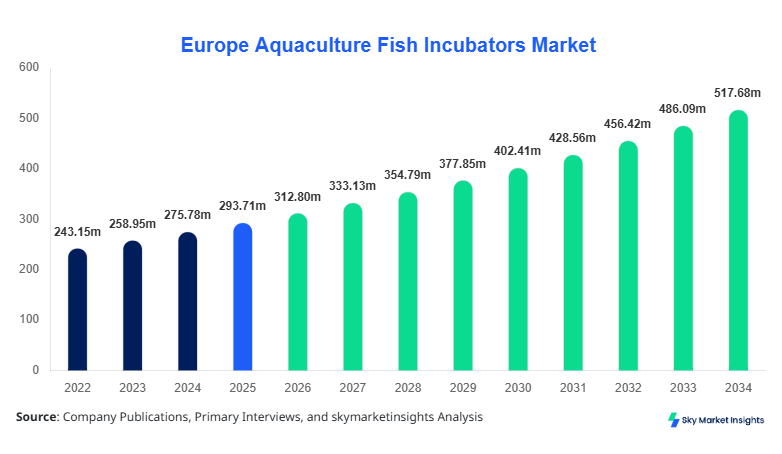
Europe Aquaculture Fish Incubators market size is projected at USD 312.8 million in 2026 and is expected to hit USD 518.6 million by 2034 with a CAGR of 6.5%. The market expansion is supported by rising aquaculture automation investments, increasing fish breeding infrastructure, and higher adoption of water-quality monitoring systems across Europe. More than 5,800 commercial aquaculture facilities across the region are actively integrating automated incubation systems to improve hatch rates above 88% while reducing operational mortality by nearly 14%. The report evaluates detailed segmentation analysis, technology adoption patterns, regional production capacities, and the competitive landscape associated with advanced incubation technologies and aquaculture modernization.
The aquaculture fish incubators industry refers to specialized incubation systems designed for fish egg hatching and larval cultivation under controlled environmental conditions. Europe produced nearly 2.4 million metric tons of aquaculture products in 2025, with salmon, trout, seabass, and carp representing more than 68% of the total cultured fish output. Commercial hatcheries accounted for approximately 49% of incubator installations, while research institutes represented 18% and aquaculture farms contributed 33% of total deployment. Adoption rates for automated dissolved oxygen regulation systems exceeded 61% across Northern and Western Europe during 2025. Temperature-controlled incubation systems operating between 6°C and 18°C improved larval survival efficiency by 22% compared to traditional systems. Consumer preference for sustainable seafood increased by 37% in Europe between 2022 and 2025, driving demand for controlled hatchery production systems capable of delivering higher stocking density efficiency. Smart incubation monitoring platforms integrated with IoT sensors reached penetration rates of 42% across large-scale hatcheries, reinforcing Europe Aquaculture Fish Incubators market expansion
Explore more data points, trends and opportunities Download Free Sample Report
Aquaculture Fish Incubators Market Trends
Rising Integration of Smart Monitoring and Automated Incubation Systems
The European aquaculture sector is increasingly adopting smart incubation technologies integrated with artificial intelligence, predictive analytics, and IoT-enabled environmental monitoring systems. More than 43% of newly installed incubators in 2025 included automated oxygen control, temperature balancing, and real-time salinity monitoring capabilities. Smart systems reduced larval mortality by 18% while improving hatch consistency by 21% across commercial hatcheries. Norway, France, and the United Kingdom collectively accounted for over 48% of total investments in digital hatchery infrastructure. Automated incubators processing over 2.1 billion eggs annually were deployed across Europe during 2025, reflecting growing emphasis on operational efficiency and precision aquaculture. Hybrid incubation technologies integrating UV sterilization and biofiltration systems expanded by 27% year-over-year, supporting sustainable fish production targets. The adoption of cloud-connected hatchery management systems reached 36% penetration among medium and large operators, reinforcing Aquaculture Fish Incubators market trend development.
Expansion of Sustainable and Energy-efficient Hatchery Technologies
Sustainability initiatives and carbon reduction mandates are reshaping equipment procurement patterns in European aquaculture. Energy-efficient fish incubators using low-consumption recirculating pumps and optimized aeration systems reduced electricity consumption by nearly 24% per production cycle. More than 1,300 hatcheries across Europe adopted closed-loop recirculating incubators during 2025 to minimize water wastage and improve pathogen control efficiency. Advanced biosecure incubation chambers capable of maintaining bacterial contamination rates below 2% gained substantial traction among salmon and trout hatcheries. Renewable-energy-powered incubation facilities increased by 18% between 2023 and 2025, particularly in Germany and Spain. The demand for sustainable seafood certification programs also accelerated investment in precision hatchery systems supporting traceable fish breeding operations. High-capacity incubators capable of processing over 5 million eggs annually experienced installation growth exceeding 31%, strengthening Aquaculture Fish Incubators market trend momentum.
Europe Aquaculture Fish Incubators Drivers
Expansion of Commercial Aquaculture Production Across Europe
The rapid growth of commercial aquaculture production is a primary factor supporting the European fish incubator industry. Europe witnessed aquaculture output growth of approximately 12% between 2022 and 2025, with salmon and trout hatchery investments expanding significantly across France, the United Kingdom, and Spain. Commercial hatcheries accounted for nearly 49% of all incubator deployments due to increasing demand for high-yield breeding systems capable of maintaining hatch rates above 90%. More than 3.8 billion fish eggs were processed through advanced incubation systems in 2025, compared to 2.9 billion in 2022. Automated incubation technologies improved oxygen stabilization efficiency by 26% while reducing fungal contamination rates by 14%. Government subsidies supporting sustainable aquaculture exceeded USD 420 million across Europe during 2025, encouraging hatchery modernization and adoption of smart incubation infrastructure. Demand for premium seafood products increased by 33% across urban markets, strengthening the requirement for reliable larval production systems and accelerating Aquaculture Fish Incubators market growth.
Europe Aquaculture Fish Incubators Restraints
High Initial Installation and Operational Costs
Despite increasing adoption, high capital investment remains a significant barrier for small and medium-sized aquaculture facilities. Advanced recirculating fish incubator systems can cost between USD 120,000 and USD 850,000 depending on automation level, production capacity, and filtration integration. Maintenance expenses for sensor-based monitoring systems increased operational expenditure by approximately 11% annually for medium-sized hatcheries. Electricity consumption for high-capacity incubation units processing over 4 million eggs annually remained above 18 MWh per month in several facilities. More than 37% of small aquaculture operators in Eastern Europe continue using conventional incubation methods due to limited financing access. Installation of biosecure water filtration infrastructure increased upfront project costs by nearly 23%. Additionally, fluctuations in energy prices across Europe elevated operational risk for hatcheries dependent on continuous water circulation systems. These financial constraints moderately restrict Aquaculture Fish Incubators market growth across cost-sensitive regions.
Europe Aquaculture Fish Incubators Opportunities
Rising Investments in Sustainable Seafood and Smart Aquaculture
Increasing investments in sustainable seafood production and digital aquaculture technologies present substantial expansion opportunities for incubator manufacturers. Europe allocated more than USD 610 million toward sustainable aquaculture innovation initiatives during 2025, supporting advanced hatchery infrastructure deployment. Smart incubators integrated with AI-driven predictive analytics improved hatchery productivity by approximately 19% while lowering water consumption by 28%. Offshore aquaculture projects in Spain, Italy, and the United Kingdom increased demand for compact and corrosion-resistant incubation systems. Research institutions accounted for nearly 18% of incubator procurement as universities and marine biology centers expanded genetic breeding and species conservation programs. Hybrid incubation platforms utilizing ultraviolet sterilization and automated pathogen detection achieved annual installation growth exceeding 22%. Furthermore, increasing demand for premium organic seafood products encouraged hatcheries to adopt eco-friendly incubation technologies compliant with European sustainability standards. These developments are expected to create strong Aquaculture Fish Incubators market opportunities during the forecast period.
Challenges in Europe Aquaculture Fish Incubators
Disease Management and Water Quality Instability
Disease outbreaks and water-quality fluctuations remain critical operational challenges for aquaculture hatcheries across Europe. Approximately 16% of fish egg losses during 2025 were associated with fungal contamination, bacterial infections, and oxygen instability during incubation cycles. Sudden pH fluctuations above 0.5 units negatively affected larval survival rates by nearly 13% in traditional incubation systems lacking automated controls. More than 41% of hatcheries reported elevated costs related to disease-prevention chemicals, filtration upgrades, and sterilization procedures. Climate-related temperature variations across Southern Europe increased stress-related mortality among fish larvae by approximately 9%. Maintaining dissolved oxygen levels above 7 mg/L throughout incubation remains difficult for small-scale hatcheries operating outdated systems. In addition, inconsistent regulatory standards for aquaculture waste management across multiple European countries complicated expansion planning and operational scalability. These technical and environmental factors continue to challenge efficient Aquaculture Fish Incubators market development.
Report Scope
| Report Metric | Details |
|---|---|
| Market Size in 2025 | USD 17.70 million |
| Market Size in 2026 | USD 312.8 million |
| Market Size in 2034 | USD 518.6 million |
| CAGR | 6.5% (2026-2034) |
| Base Year for Estimation | 2025 |
| Historical Data | 2022-2024 |
| Forecast Period | 2026-2034 |
| Report Coverage | Revenue Forecast, Competitive Landscape, Supply Chain Disruption, Growth Factors, Environment & Regulatory Landscape and Trends |
Explore more data points, trends and opportunities Download Free Sample Report
Aquaculture Fish Incubators Market Segmentation
The European market is segmented by type and application, with recirculating incubators dominating nearly 44% of total installations during 2025 due to superior water conservation efficiency and enhanced hatch-rate performance. Commercial hatcheries represented the largest application segment with approximately 49% market contribution, followed by aquaculture farms at 33% and research institutes at 18%.
By Type
Recirculating aquaculture incubators accounted for approximately 44% of total market revenue in 2025 owing to their advanced water reuse capability and stable environmental control mechanisms. These systems reduced freshwater consumption by nearly 68% compared to flow-through systems and supported hatch rates above 91% in salmon and trout production facilities. More than 2,200 recirculating units were operational across Europe in 2025, processing nearly 1.7 billion fish eggs annually. Automated ammonia filtration systems and oxygenation modules improved larval survival efficiency by 23%. France and Germany collectively represented over 39% of installations due to strict sustainability standards and higher investment in smart aquaculture infrastructure. Advanced recirculating systems integrated with AI monitoring platforms improved pH stability accuracy to within ±0.2 units and reduced energy consumption by 14%. These operational efficiencies continue driving adoption across commercial hatcheries and reinforcing long-term incubator deployment.
Flow-through incubators represented nearly 33% of total installations during 2025 and remained widely used in traditional freshwater hatcheries across Eastern and Southern Europe. These systems operate using continuous freshwater exchange and are commonly applied in trout and carp breeding operations. Approximately 1.2 billion eggs were processed through flow-through incubators in 2025, particularly in Russia, Italy, and Spain. Average operational water flow rates ranged between 12 and 18 liters per minute depending on hatchery scale and species type. Despite lower automation levels, these systems remained 28% less expensive than advanced recirculating alternatives. However, higher water consumption and elevated contamination risks limited adoption among environmentally regulated facilities. Flow-through incubators continue serving small and medium-sized operators seeking cost-effective breeding infrastructure with moderate production capacity.
Hybrid incubators combined recirculating technology with controlled freshwater exchange systems and accounted for approximately 23% of market installations in 2025. These systems gained traction due to their flexibility in maintaining stable water quality while reducing operational costs by nearly 17%. Hybrid incubators processed over 740 million eggs across Europe during 2025, with adoption particularly strong in marine aquaculture operations. Integrated UV sterilization and oxygen-enhancement modules improved pathogen control efficiency by 21%. The United Kingdom and Spain led deployment of hybrid systems for seabass and seabream hatcheries. Advanced hybrid units maintained temperature consistency within ±0.5°C while supporting automated salinity balancing for marine species. Increasing demand for adaptable and energy-efficient incubation systems is expected to support future adoption across diversified aquaculture facilities.
By Application
Commercial hatcheries dominated the application landscape with nearly 49% share of total installations in 2025 due to increasing demand for large-scale fish breeding capacity. More than 2,800 commercial hatcheries across Europe deployed advanced incubation systems processing over 2.4 billion eggs annually. Automated incubators improved hatchery productivity by approximately 26% while reducing manual labor requirements by 18%. Salmon and trout hatcheries accounted for over 61% of total commercial installations. Oxygen-controlled incubation chambers maintained survival rates above 89%, while advanced filtration systems reduced bacterial contamination by 16%. France, the United Kingdom, and Norway represented major investment centers for large-scale hatchery infrastructure supporting sustainable seafood production. Commercial operators increasingly integrated cloud-based monitoring systems capable of tracking temperature, salinity, and dissolved oxygen levels in real time. The need for higher production efficiency and stable larval output continues supporting incubator deployment across commercial hatcheries.
Research institutes represented approximately 18% of market demand in 2025 as universities and marine biology centers expanded aquatic genetics and species conservation programs. More than 420 research facilities across Europe utilized specialized fish incubators for breeding trials, embryo development studies, and disease-resistance research. Research-grade incubators supported precision temperature control within ±0.1°C and integrated automated data logging systems for experimental analysis. Approximately 36% of research installations focused on endangered species preservation and biodiversity management initiatives. Germany and the United Kingdom collectively contributed over 41% of research-based incubator demand. Government-supported marine research programs allocated nearly USD 90 million toward advanced hatchery experimentation during 2025. High-performance laboratory incubators processing smaller egg volumes between 20,000 and 200,000 units per cycle remained widely adopted across scientific institutions.
Aquaculture farms accounted for approximately 33% of total incubator installations during 2025 as integrated breeding operations expanded self-sustained fish production systems. More than 1,900 aquaculture farms utilized onsite incubation systems to reduce dependence on third-party hatcheries and improve stock availability consistency. On-farm incubators processed over 1.1 billion fish eggs annually and improved fry survival rates by nearly 18%. Hybrid and compact recirculating systems remained particularly popular among medium-sized freshwater farms due to lower operational costs and efficient water reuse performance. Spain and Italy represented major markets for marine aquaculture farm incubators supporting seabream and seabass production. Automated aeration systems improved dissolved oxygen stability by approximately 22%, while remote monitoring platforms reduced operational downtime by 11%. Increasing focus on vertical integration and biosecure fish production continues driving incubator deployment across European aquaculture farms.
Europe Aquaculture Fish Incubators Market Segmentations
Type
- Recirculating Aquaculture Incubators
- Flow-through Incubators
- Hybrid Incubators
Application
- Commercial Hatcheries
- Research Institutes
- Aquaculture Farms
Europe Aquaculture Fish Incubators Regional Outlook
United Kingdom
The United Kingdom accounted for approximately 18% of regional revenue generation during 2025, supported by strong salmon aquaculture operations in Scotland and Northern Ireland. More than 470 hatcheries and aquaculture farms deployed advanced incubation systems processing nearly 620 million fish eggs annually. Commercial hatcheries represented approximately 56% of installations, while aquaculture farms contributed 29%. Adoption of AI-enabled recirculating incubators reached nearly 48% across large-scale salmon producers. Government investments exceeding USD 85 million supported sustainable aquaculture development and hatchery modernization. Advanced incubators integrated with automated oxygen regulation improved hatch rates above 90% for Atlantic salmon production. Offshore aquaculture expansion and increasing seafood export demand continue supporting long-term market expansion across the United Kingdom.
Germany
Germany represented nearly 15% of the regional market during 2025 due to growing freshwater aquaculture infrastructure and strong research investments. The country operated over 390 aquaculture facilities utilizing automated fish incubators for trout, carp, and catfish breeding. Research institutions contributed approximately 24% of total installations, reflecting Germany’s emphasis on aquatic biotechnology and sustainability studies. Recirculating incubation systems achieved adoption rates above 53%, reducing water consumption by nearly 64%. Germany processed approximately 410 million fish eggs through commercial hatcheries during 2025. Energy-efficient incubation technologies integrated with biofiltration modules reduced operational emissions by 18%, supporting national environmental targets.
France
France remained the leading regional contributor with nearly 24% share of total European revenue in 2025. More than 190 advanced hatcheries and 860 aquaculture facilities utilized sophisticated incubation technologies for trout and marine fish production. Commercial hatcheries represented 52% of installations, while research institutions contributed 17%. France processed approximately 760 million fish eggs annually through automated incubation systems maintaining temperature consistency within ±0.3°C. Government sustainability programs allocated over USD 110 million toward smart hatchery development. AI-integrated monitoring systems improved larval survival rates by 19%, strengthening production efficiency and supporting aquaculture modernization initiatives.
Spain
Spain accounted for approximately 13% of the regional market owing to strong marine aquaculture production for seabream and seabass. More than 340 aquaculture farms deployed hybrid incubators designed for saltwater breeding environments. Marine hatcheries processed over 360 million eggs annually during 2025. Automated salinity balancing systems improved larval survival efficiency by nearly 17%. Spain witnessed increasing investment in offshore aquaculture infrastructure, with nearly USD 72 million allocated toward hatchery expansion projects. Hybrid incubators integrated with UV sterilization technology reduced pathogen contamination rates below 3%, supporting premium seafood production and export competitiveness.
Italy
Italy contributed nearly 11% of total regional revenue during 2025 due to expanding Mediterranean aquaculture activities. More than 280 hatcheries and aquaculture farms utilized advanced incubation systems for trout, seabass, and seabream breeding. Flow-through incubators represented approximately 41% of installations due to lower capital expenditure requirements. Italy processed nearly 290 million eggs annually through commercial hatcheries, while aquaculture farms contributed 37% of total application demand. Adoption of compact recirculating incubators increased by 21% between 2023 and 2025 as sustainability regulations strengthened across coastal regions. Advanced oxygenation systems improved hatch consistency by 15%.
Russia
Russia represented approximately 10% of regional demand during 2025, supported by expanding freshwater aquaculture production and hatchery development initiatives. More than 510 aquaculture facilities utilized fish incubators for salmon, carp, and sturgeon breeding operations. Flow-through incubators accounted for approximately 48% of total installations due to abundant freshwater availability and lower operational costs. Russian hatcheries processed over 510 million fish eggs annually during 2025. Government-backed aquaculture investments exceeded USD 95 million, supporting regional breeding infrastructure expansion. Automated filtration and aeration technologies improved hatchery productivity by nearly 14%, supporting domestic seafood production growth.
Top players in Europe Aquaculture Fish Incubators
- AKVA Group
- Cflow AS
- Pentair Aquatic Eco-Systems
- Billund Aquaculture
- AquaMaof Aquaculture Technologies
- Xylem Inc.
- Veolia Water Technologies
- FishFarmFeeder
- ScaleAQ
- MAT-KULING
- Skretting Hatchery Solutions
- Sterner AS
- Aquacare Environment Inc.
- PR Aqua
- Innovasea Systems
AKVA Group
-
AKVA Group accounted for approximately 12% of the regional market during 2025 and maintained strong positioning across Northern Europe.
-
The company operates multiple automated hatchery technology facilities supporting more than 450 aquaculture customers globally.
-
Its recirculating incubation systems improved water reuse efficiency by nearly 70% while reducing hatchery operating costs by 16%.
-
AKVA Group invested heavily in AI-driven monitoring systems and integrated sensor technologies supporting precision aquaculture applications.
-
The company strengthened its market presence through strategic partnerships with commercial salmon hatcheries across the United Kingdom and France.
Pentair Aquatic Eco-Systems
-
Pentair Aquatic Eco-Systems represented approximately 9% of regional revenue generation during 2025 with strong penetration across research institutions and commercial hatcheries.
-
The company’s advanced filtration and oxygenation systems improved larval survival rates by nearly 20% across large-scale installations.
-
Pentair expanded its European operations through collaboration agreements with marine hatcheries in Spain and Italy.
-
Its energy-efficient incubator platforms reduced electricity consumption by approximately 18% per production cycle.
-
The company continued focusing on modular incubator systems supporting scalable deployment across freshwater and marine aquaculture facilities.
Investment Analysis
Investment activity across the European aquaculture incubator industry increased substantially during 2025, with total infrastructure and technology investments exceeding USD 1.2 billion. Approximately 41% of investments were directed toward recirculating aquaculture systems, while 29% targeted smart monitoring and AI-enabled hatchery automation platforms. France, the United Kingdom, and Germany collectively attracted more than 58% of regional aquaculture technology investments. Venture capital funding for sustainable aquaculture startups increased by nearly 24% compared to 2024. Commercial hatcheries accounted for approximately 52% of total capital expenditure related to fish incubation infrastructure modernization.
Marine aquaculture projects received nearly 37% of total investment allocation due to growing seabass and salmon demand across Europe. Mergers and acquisitions activity expanded significantly as larger aquaculture technology providers acquired smaller automation and filtration companies to strengthen product portfolios. More than 14 strategic collaborations related to hatchery technology integration were announced during 2025. Partnerships between aquaculture equipment manufacturers and marine research institutions improved development of energy-efficient incubation systems capable of reducing water use by 30%. Government-backed sustainability grants supported expansion of low-emission hatchery operations across Germany and France. Increased private equity participation and cross-border collaborations are expected to accelerate modernization of European fish incubation infrastructure over the forecast period.
New Product Developments
Manufacturers introduced multiple advanced incubation systems during 2025 emphasizing energy efficiency, biosecurity, and automation capabilities. Nearly 32% of newly launched products integrated AI-enabled predictive monitoring systems capable of detecting oxygen fluctuations and pathogen risks in real time. Smart incubators equipped with automated temperature balancing improved hatch consistency by approximately 18% compared to earlier models. Hybrid incubation systems supporting both freshwater and marine applications experienced strong adoption among diversified aquaculture operators.
Several companies launched modular incubator platforms capable of processing between 500,000 and 5 million eggs annually depending on operational scale. New UV-sterilized filtration modules reduced bacterial contamination rates below 2%, while compact recirculating systems lowered water consumption by nearly 65%. Renewable-energy-compatible incubators also gained traction across sustainable aquaculture facilities in France and Spain. Continuous product innovation remains a key competitive factor supporting operational efficiency improvements and sustainable hatchery development.
Recent Developments in Europe Aquaculture Fish Incubators
- 2025: AKVA Group expanded its automated hatchery solutions portfolio with a new AI-enabled incubation platform capable of processing 8 million eggs annually while improving hatch efficiency by 17%. The company reported a 21% increase in demand from salmon hatcheries across the United Kingdom and France due to enhanced oxygen control precision and predictive maintenance functionality.
- 2025: Pentair Aquatic Eco-Systems introduced energy-efficient filtration-integrated incubators reducing operational electricity consumption by approximately 18% per cycle. The new systems achieved pathogen reduction rates above 96% and were deployed across more than 60 commercial hatcheries in Germany and Spain, strengthening sustainable aquaculture operations.
Research Methodology
The research process for the Europe aquaculture fish incubators industry involved extensive primary and secondary data collection focused on hatchery technologies, aquaculture infrastructure, production capacities, and regional investment trends. Primary research included interviews with aquaculture equipment manufacturers, hatchery operators, marine biologists, distributors, and technology providers operating across France, Germany, Spain, Italy, Russia, and the United Kingdom. More than 85 industry participants contributed operational insights regarding incubation performance, automation adoption, production efficiency, and investment allocation. Secondary research included analysis of trade publications, aquaculture association databases, government fisheries statistics, company annual reports, and marine sustainability publications. Market size estimation utilized a combination of bottom-up and top-down analytical models integrating production volumes, equipment deployment statistics, hatchery counts, pricing analysis, and regional investment data. Quantitative forecasting models evaluated technology adoption trends, seafood consumption patterns, hatchery modernization projects, and sustainability regulations influencing future incubator demand across Europe during the 2026–2034 forecast period.
Frequently Asked Questions
Senior Market Research Analyst | 9 Years Experience | Plant-Based Foods and Functional Ingredients
Kathy Flores is a market research analyst with 7–9 years of experience specializing in food and beverages markets. Contributed to 70+ research reports for global clients. Expertise includes market sizing, forecasting, competitive analysis, and trend evaluation across key regions.