Europe Air Fryers Market Size
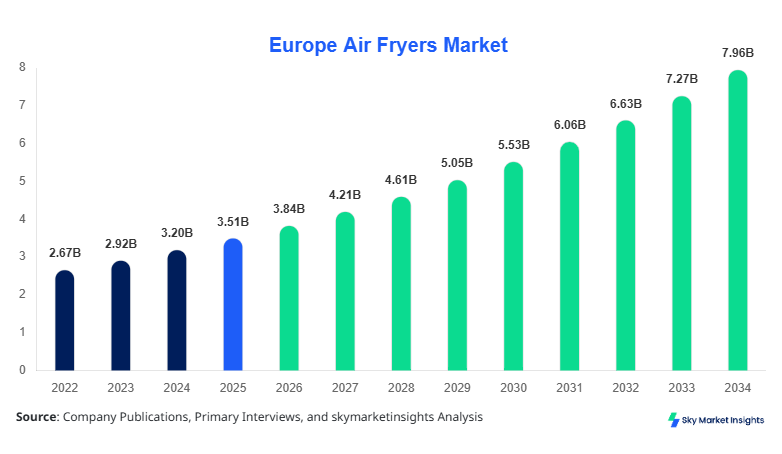
Europe's air fryer market size is projected at USD 3.84 billion in 2026 and is expected to hit USD 7.96 billion by 2034 with a CAGR of 9.54%.
The European air fryer market has witnessed accelerated product penetration across residential and commercial food preparation sectors due to increasing consumer preference for low-oil cooking technologies and energy-efficient kitchen appliances. The market evaluation includes extensive data mapping of production volumes, retail channel performance, consumer purchasing behavior, import-export movement, and competitive benchmarking across major European economies. The study further analyzes segmentation trends by type, application, distribution channel, and country-level adoption patterns while assessing the evolving competitive landscape among multinational appliance manufacturers and regional brands operating in the European air fryer market.
The air fryer industry refers to the manufacturing, distribution, and commercialization of compact convection-based cooking appliances designed to fry, roast, grill, and bake food using rapid hot-air circulation technology. Europe produced more than 18.7 million air fryer units in 2025, compared to 15.2 million units in 2023, reflecting strong appliance replacement cycles and rising demand for healthier cooking alternatives. Household penetration across Europe reached approximately 32.4% in 2025, while urban household penetration exceeded 41.8% in France, Germany, and the United Kingdom combined. Digital connectivity integration increased significantly, with nearly 28.6% of newly sold air fryer units supporting Wi-Fi or smart-app compatibility.
Consumer purchasing patterns indicate that nearly 64.3% of buyers prefer multifunctional cooking systems capable of grilling, baking, and dehydrating. Basket capacities between 4 liters and 7 liters accounted for nearly 48.7% of total unit shipments in 2025, whereas compact air fryers below 4 liters contributed 31.2% of sales volume. Residential applications dominated the industry with a 78.5% contribution, while commercial foodservice establishments represented 16.4% of overall demand. Institutional applications including cafeterias, schools, and healthcare facilities accounted for 5.1% of total consumption. Energy consumption efficiency improved by approximately 21.5% compared to conventional electric ovens, reinforcing sustained European air fryer market expansion across health-conscious and energy-sensitive consumers.
In France, the air fryer market recorded substantial expansion supported by strong consumer inclination toward healthy cooking technologies, premium kitchen appliances, and smart-home integration. France accounted for nearly 22.6% of the European air fryer market revenue in 2025, supported by more than 126 domestic appliance manufacturing facilities and over 1,800 organized retail distribution outlets. Residential usage represented approximately 74.8% of national demand, while quick-service restaurants and cafés contributed 18.2% of product utilization. Smart-enabled digital air fryers represented 39.7% of French unit sales in 2025, compared to 25.3% in 2022.
The adoption of high-capacity air fryers above 6 liters increased by 17.8% year-over-year due to rising family-sized consumption patterns and increasing frozen food preparation demand. More than 4.3 million air fryer units were sold in France during 2025, while online retail channels contributed 46.5% of nationwide sales. French consumers increasingly prioritized low-energy cooking solutions, with energy-efficient models contributing nearly 58.4% of new purchases. Product replacement cycles shortened from 6.1 years in 2021 to 4.8 years in 2025 due to rapid innovation in touchscreen interfaces, dual-basket systems, and app-controlled cooking programs, strengthening Europe's air fryer market penetration.
Explore more data points, trends and opportunities Download Free Sample Report
Air Fryers Market: Trends
Smart Connectivity and Multifunction Integration
The integration of artificial intelligence-enabled cooking presets and smartphone-controlled interfaces has emerged as one of the strongest technology shifts within the air fryer industry. More than 5.6 million smart-enabled air fryer units were shipped across Europe in 2025, reflecting a 31.4% increase from the previous year. Wi-Fi-enabled cooking appliances accounted for 28.6% of overall industry sales, while touchscreen-based control panels represented 52.7% of premium product installations. Manufacturers increasingly introduced dual-zone cooking systems capable of preparing two separate meals simultaneously, improving operational efficiency by nearly 37.2% compared to single-basket models. The commercial foodservice segment also adopted programmable air frying systems with automated temperature calibration and energy-saving functions. Germany, France, and the United Kingdom collectively represented more than 61.3% of smart air fryer consumption across Europe, reinforcing long-term Europe air fryer market expansion.
Sustainable and Energy-Efficient Appliance Manufacturing
Energy-efficient cooking appliances became a central purchasing criterion across European households due to increasing electricity prices and sustainability awareness. Manufacturers reduced average power consumption from 1.9 kWh to nearly 1.4 kWh per cooking cycle between 2022 and 2025. Recyclable plastic utilization in air fryer manufacturing increased from 18.4% to 36.9% during the same period, while stainless-steel component adoption rose by 24.5%. More than 48% of European consumers actively compared appliance energy ratings before purchase, significantly influencing premium product demand. Commercial kitchens increasingly transitioned toward large-capacity air fryers capable of reducing oil consumption by approximately 82.6% compared to conventional deep-frying systems. Sustainable packaging adoption exceeded 41.7% among leading manufacturers in 2025, while carbon-neutral logistics initiatives expanded across regional supply chains, accelerating Europe's air fryer market adoption.
Expansion of E-Commerce and Direct-to-Consumer Channels
Online appliance retailing transformed the purchasing structure of air fryers across Europe. E-commerce channels contributed approximately 44.2% of total air fryer sales in 2025 compared to 29.8% in 2022. Flash sales, influencer-led marketing campaigns, and digital product demonstrations significantly increased consumer engagement rates. Subscription-based warranty services and bundled recipe ecosystems supported repeat purchases and brand retention. More than 11.3 million consumers researched air fryer products online before purchasing, while nearly 38.7% of shoppers relied on social-media-driven product recommendations. Direct-to-consumer distribution networks expanded by 26.1% year-over-year among major appliance brands, strengthening Europe's air fryer market competitiveness.
Europe Air Fryers Drivers
Growing Consumer Preference for Healthy Low-Oil Cooking Solutions
The increasing prevalence of obesity, cardiovascular disorders, and lifestyle-related health concerns across Europe has significantly accelerated consumer demand for healthier cooking technologies. More than 58.3% of European consumers actively sought low-fat cooking alternatives in 2025, while 46.7% preferred appliances capable of reducing oil usage by over 70%. Air fryers reduced oil consumption by approximately 80% to 85% compared to traditional deep-frying methods, making them increasingly attractive among urban households. Rising awareness regarding calorie intake and home-cooked meal preparation contributed to the shipment of over 18.7 million units across Europe in 2025. Residential kitchens represented nearly 78.5% of total appliance installations, while demand from fitness-oriented households grew by 23.4% annually. Digital recipe ecosystems, cooking automation, and rapid meal preparation times further improved consumer adoption. More than 63.1% of millennials and Generation Z consumers considered multifunctionality and health benefits as primary purchasing criteria. Strong consumer inclination toward healthy meal preparation continues to strengthen Europe's air fryer market expansion.
Europe Air Fryers Restraints
High Product Costs and Intense Market Saturation
Premium air fryer models equipped with smart connectivity, dual-basket systems, and multifunction cooking features continue to face pricing challenges among price-sensitive consumers. Advanced models cost between USD 180 and USD 420, while conventional fryer systems remain nearly 34% cheaper across Eastern Europe and Russia. Nearly 29.6% of consumers delayed replacement purchases due to inflationary pressure and rising electricity expenses during 2025. The rapid influx of low-cost imports intensified pricing competition, reducing average manufacturer margins by approximately 12.8%. Market saturation across urban centers in Germany, France, and the United Kingdom also limited incremental first-time purchases. Retail shelf competition increased substantially, with over 240 active product variants available across organized retail chains in Europe. Counterfeit appliances and low-quality imports contributed to consumer dissatisfaction rates exceeding 8.3%, affecting long-term brand trust. These economic and competitive limitations continue to restrain Europe's air fryer market acceleration.
Europe Air Fryers Opportunities
Expansion of Commercial Foodservice and Institutional Applications
Commercial kitchens, cafés, hospitals, educational institutions, and quick-service restaurant chains increasingly adopted large-capacity air fryer systems due to operational efficiency and reduced oil consumption. Commercial installations expanded by 19.8% during 2025, while institutional procurement budgets for energy-efficient cooking appliances rose by 14.6%. Large-capacity units above 10 liters represented approximately 21.3% of commercial shipments across Europe. Hotels and catering companies reduced food preparation time by nearly 27.5% through programmable air frying systems. More than 5,400 institutional kitchens across Western Europe upgraded to convection-based frying systems between 2023 and 2025. Automation technologies enabling programmable meal cycles and digital temperature monitoring significantly improved productivity levels. The integration of IoT-enabled monitoring systems and commercial-grade stainless-steel configurations is expected to generate substantial European air fryer market opportunities.
Challenges in Europe Air Fryers
Supply Chain Volatility and Component Cost Inflation
The European air fryer market continues to face operational disruptions associated with semiconductor shortages, logistics bottlenecks, and fluctuating raw material costs. Electronic component prices increased by approximately 18.4% during 2024–2025, while stainless-steel costs rose by 11.2%. Delays in shipping and container freight increased average lead times from 28 days to 41 days across several European import corridors. More than 36% of manufacturers reported disruptions in heating-element procurement during 2025. Dependence on Asian electronic suppliers exposed European appliance manufacturers to geopolitical uncertainties and import tariff fluctuations. Small and medium-sized manufacturers experienced inventory shortages exceeding 14.8% during seasonal demand peaks. Additionally, rising compliance costs related to European energy efficiency regulations and electronic waste recycling standards increased operational expenditure by nearly 9.5%. These structural supply chain inefficiencies continue to challenge Europe's air fryer market stability.
Report Scope
| Report Metric | Details |
|---|---|
| Market Size in 2025 | USD 3.51 Billion |
| Market Size in 2026 | USD 3.84 Billion |
| Market Size in 2034 | USD 7.96 Billion |
| CAGR | 9.54% (2026-2034) |
| Base Year for Estimation | 2025 |
| Historical Data | 2022-2024 |
| Forecast Period | 2026-2034 |
| Report Coverage | Revenue Forecast, Competitive Landscape, Supply Chain Disruption, Growth Factors, Environment & Regulatory Landscape and Trends |
Explore more data points, trends and opportunities Download Free Sample Report
Air Fryers Market Segmentation
The Europe air fryer market segmentation is structured by type and application, with digital air fryers accounting for nearly 46.8% of total revenue contribution during 2025. Residential applications dominated overall consumption with a 78.5% market contribution, while commercial usage expanded steadily due to increasing adoption among restaurants and catering businesses. Product differentiation based on basket size, energy efficiency, cooking automation, and multifunction capabilities significantly influenced segment-level performance.
Digital air fryers represented the leading product category with approximately 46.8% of Europe’s total unit shipments during 2025. More than 8.7 million digital units were sold across France, Germany, and the United Kingdom combined. Touchscreen interfaces, programmable cooking presets, smart connectivity, and temperature precision between 80°C and 220°C significantly improved consumer adoption. Smart-enabled models achieved nearly 39.2% penetration among urban households, while app-controlled cooking functionality increased by 27.6% year-over-year. Dual-zone cooking systems and AI-assisted meal programs improved operational flexibility for both residential and commercial kitchens. Premium digital models also reduced cooking time by approximately 22.5% compared to conventional ovens, strengthening demand across Europe.
Manual air fryers accounted for approximately 31.5% of total market consumption in 2025. These products remained highly preferred among budget-conscious consumers and rural households due to lower acquisition costs and simplified operating mechanisms. More than 5.9 million manual air fryer units were shipped across Europe in 2025. Temperature control ranges between 100°C and 200°C and timer configurations up to 60 minutes supported broad product acceptance. Eastern Europe and Russia collectively contributed nearly 41.3% of manual air fryer sales due to affordability advantages. Manufacturers increasingly improved basket coatings, heating efficiency, and compact designs to maintain competitiveness within the European air fryer market.
Oven air fryers contributed approximately 21.7% of total industry revenue and experienced strong adoption within premium residential kitchens and commercial establishments. Large-capacity systems between 10 liters and 25 liters enabled multifunction cooking, including roasting, dehydrating, baking, and grilling. More than 3.8 million oven air fryer units were distributed across Europe in 2025. Commercial-grade models achieved 18.9% penetration among restaurants and cafés due to reduced oil consumption and high-volume meal preparation efficiency. Stainless-steel heating chambers and convection-based airflow systems improved cooking consistency by nearly 28.4%, supporting sustained demand.
Residential applications dominated the European air fryer market with approximately 78.5% revenue contribution during 2025. More than 14.6 million household units were sold across Europe due to increasing home-cooking preferences and health-oriented consumer lifestyles. Urban apartment households represented nearly 57.3% of residential installations due to compact kitchen configurations and rapid meal preparation requirements. Basket capacities between 4 liters and 7 liters remained the most preferred category, accounting for 48.7% of residential consumption. Smart-enabled residential air fryers reduced meal preparation times by approximately 24.1%, while oil usage declined by over 80%. France, Germany, and the United Kingdom collectively represented 62.4% of household air fryer demand across Europe.
Commercial applications accounted for approximately 16.4% of total market revenue during 2025. Restaurants, cafés, quick-service outlets, and catering businesses increasingly adopted high-capacity air fryers due to energy efficiency and healthier food preparation. Commercial kitchens installed more than 2.9 million units across Europe, while oil consumption reduction exceeded 82.6% compared to traditional fryers. Quick-service restaurant chains represented nearly 43.5% of commercial demand. Commercial systems above 10 liters improved meal throughput by approximately 31.8%, while programmable cooking interfaces reduced labor dependency by 17.6%. Growth in food delivery platforms and fast-casual dining significantly contributed to commercial Europe's air fryer market expansion.
Institutional applications represented approximately 5.1% of overall market consumption. Hospitals, schools, universities, and workplace cafeterias increasingly adopted air fryer systems due to healthier cooking regulations and sustainability initiatives. Institutional procurement budgets for energy-efficient kitchen equipment increased by nearly 14.6% in 2025. More than 900,000 institutional air fryer units were operational across Europe during the year. Large-capacity systems between 15 liters and 30 liters dominated institutional procurement, while programmable cooking cycles improved meal standardization by 26.3%. Public-sector foodservice modernization projects in France, Germany, and Spain significantly supported institutional Europe air fryer market penetration.
Europe Air Fryers Market Segmentations
Type
- Digital Air Fryers
- Manual Air Fryers
- Oven Air Fryers
Application
- Residential
- Commercial
- Institutional
Europe Air Fryers: Regional Outlook
United Kingdom
The United Kingdom accounted for approximately 24.1% of total European air fryer market revenue during 2025. More than 4.8 million air fryer units were sold nationwide due to strong household appliance replacement cycles and increasing energy-conscious consumer behavior. Residential applications represented nearly 79.4% of national demand, while commercial kitchens contributed 15.9%. E-commerce channels generated approximately 51.2% of product sales across the country. Smart-enabled digital air fryers represented 42.5% of total UK shipments due to widespread adoption of connected home appliances. London, Manchester, and Birmingham collectively contributed over 46% of national consumption. Commercial restaurants increasingly adopted large-capacity oven air fryers capable of reducing energy consumption by nearly 23.4%.
Germany
Germany represented approximately 21.8% of Europe’s total air fryer consumption in 2025. The country produced nearly 3.7 million units domestically while importing additional premium appliance systems from Asian manufacturers. Smart kitchen adoption exceeded 37.6% among urban households, significantly supporting digital air fryer sales. Residential demand accounted for nearly 76.8% of total national utilization, while institutional demand expanded steadily due to sustainable foodservice initiatives. Germany also emerged as a leading innovation center for energy-efficient appliance engineering, with over 48 appliance research facilities engaged in smart cooking technologies. Commercial foodservice chains increasingly deployed programmable convection air fryers capable of handling over 120 meal portions daily.
France
France maintained a dominant position within Western Europe, accounting for approximately 22.6% of total European air fryer market revenue. More than 4.3 million units were sold across the country in 2025. Online sales channels contributed nearly 46.5% of appliance distribution, while premium multifunction systems represented 39.7% of total unit sales. Paris, Lyon, and Marseille collectively contributed more than 44% of national consumption. Energy-efficient product adoption exceeded 58.4%, while dual-basket systems witnessed 31.2% annual sales expansion. French commercial foodservice operators increasingly replaced conventional fryers with programmable convection systems capable of reducing oil consumption by over 80%.
Spain
Spain contributed approximately 11.4% of Europe’s total air fryer revenue in 2025. Rising tourism activity and expanding café culture significantly increased commercial kitchen adoption. More than 2.1 million air fryer units were sold nationwide, while residential demand represented nearly 74.2% of overall consumption. Smart-enabled systems accounted for 27.6% of national sales, reflecting increasing digital appliance adoption. Commercial restaurant chains adopted high-capacity oven air fryers to improve operational efficiency and reduce electricity consumption by approximately 18.5%. Urban consumers increasingly preferred compact multifunction models with capacities between 5 liters and 8 liters.
Italy
Italy represented approximately 10.7% of regional market consumption during 2025. Household appliance modernization and premium kitchen renovation projects significantly contributed to product demand. More than 1.9 million air fryer units were distributed nationwide, while residential applications accounted for 81.2% of usage. Northern Italian regions contributed over 58% of national demand due to higher disposable incomes and stronger smart-home adoption rates. Italian consumers increasingly preferred stainless-steel digital air fryers with touchscreen controls and programmable cooking systems. Commercial bakery chains also adopted oven air fryers to improve energy efficiency and reduce preparation time by nearly 21.4%.
Russia
Russia accounted for approximately 9.4% of Europe's air fryer market revenue during 2025. Manual air fryers represented nearly 53.6% of national demand due to affordability advantages and lower technology penetration. More than 1.6 million units were sold nationwide despite inflationary pressures and supply chain disruptions. Urban centers including Moscow and Saint Petersburg contributed over 49% of national consumption. Import dependence remained high, with approximately 71.8% of products sourced from international manufacturers. Commercial adoption increased steadily across fast-food chains and cafeterias seeking low-oil cooking alternatives.
Top players in Europe Air Fryers
- Philips Electronics
- Ninja Kitchen
- Tefal
- Cosori
- Instant Brands
- Breville
- DeLonghi
- Electrolux
- Russell Hobbs
- Xiaomi
- Severin
- Moulinex
- Kenwood
- Cecotec
- Ariete
Philips Electronics
-
Philips Electronics held approximately 18.6% of total European air fryer market revenue during 2025.
-
The company maintained leadership through premium digital product offerings, smart-app integration, and strong retail penetration across Western Europe.
-
Philips operated more than 220 distribution partnerships across Europe and produced over 3.1 million air fryer units annually.
-
Its Rapid Air Technology improved cooking efficiency by nearly 23.7% while reducing oil consumption by approximately 85%.
-
The company maintained dominant positioning in France, Germany, and the United Kingdom through premium branding and multifunction appliance innovation.
Ninja Kitchen
-
Ninja Kitchen accounted for nearly 12.9% of Europe’s total air fryer revenue during 2025.
-
The company achieved strong commercial and residential growth through dual-zone cooking systems and multifunction cooking appliances.
-
Ninja sold more than 2.2 million units across Europe during 2025, supported by aggressive e-commerce expansion and influencer-led marketing.
-
Smart cooking presets and high-capacity basket systems improved consumer retention rates by approximately 19.4%.
-
The company maintained strong positioning within the premium mid-range appliance segment across the European air fryer market.
Investment Analysis
Investment activity within the European air fryer market accelerated considerably due to increasing consumer preference for energy-efficient kitchen appliances and smart cooking technologies. Approximately 38.6% of appliance-sector investments during 2025 were directed toward digital cooking systems, while nearly 27.2% targeted smart-home connectivity integration. Western Europe attracted more than 68% of total regional investments, with France, Germany, and the United Kingdom accounting for the largest manufacturing modernization projects. Venture capital funding for IoT-enabled kitchen appliance startups increased by approximately 22.8% year-over-year. Manufacturers allocated nearly 14.5% of annual operating budgets toward research and development activities focusing on AI-assisted cooking, energy optimization, and multifunction capabilities.
Mergers, acquisitions, and strategic collaborations also intensified across the regional appliance sector. More than 16 strategic supply-chain agreements were signed during 2024–2025 to stabilize electronic component procurement and heating-element manufacturing. Appliance manufacturers increasingly collaborated with smart-home ecosystem providers to improve interoperability and mobile application integration. Approximately 31.7% of strategic partnerships involved software-enabled cooking automation technologies. Commercial kitchen equipment suppliers invested heavily in high-capacity air frying systems capable of serving institutional foodservice operations. Sustainability-oriented manufacturing investments also expanded significantly, with nearly 26.4% of production investments allocated toward recyclable material integration and carbon-neutral logistics infrastructure.
New Product Developments
Manufacturers across Europe introduced a substantial number of multifunction and AI-enabled air fryer models during 2025. Approximately 34.8% of newly launched products incorporated smart connectivity, voice-command functionality, or app-controlled cooking programs. Dual-basket systems represented nearly 21.6% of new product launches, while multifunction oven air fryers accounted for 17.4%. Cooking efficiency improvements averaged 24.5% compared to previous-generation models, while energy consumption declined by approximately 18.7%. Premium manufacturers increasingly focused on transparent viewing windows, odor-reduction filtration systems, and self-cleaning basket technologies.
Innovation activity also intensified in commercial-grade systems designed for quick-service restaurants and institutional kitchens. High-capacity programmable air fryers above 20 liters improved meal throughput by nearly 32.4%, while automated temperature calibration reduced operational errors by approximately 15.8%. Manufacturers also introduced recyclable packaging materials and modular component systems to improve sustainability performance within the European air fryer market.
Recent Developments in Europe's Air Fryers
- 2025: Philips Electronics expanded its European production capacity by approximately 18.2% through manufacturing upgrades in France and Germany. The company introduced AI-assisted cooking systems capable of reducing meal preparation times by nearly 22.7% while improving energy efficiency by 17.6%. Expansion initiatives strengthened premium appliance distribution across Western Europe and improved production scalability within the European air fryer market.
- 2025: Ninja Kitchen launched a new dual-zone air fryer platform across Europe featuring independent cooking chambers and synchronized meal preparation technology. The company increased annual production volume by nearly 21.4% and expanded smart-app integration capabilities. Online sales contribution exceeded 54% during the launch quarter, reflecting growing digital retail adoption.
- 2025: Electrolux partnered with smart-home software providers to develop integrated kitchen ecosystems supporting Wi-Fi-enabled cooking synchronization. The initiative improved appliance connectivity performance by approximately 26.3% and strengthened the company’s premium digital appliance positioning across Europe.
Research Methodology
The European air fryer market assessment was developed through a combination of primary research, secondary research, and quantitative market modeling methodologies. The research process included detailed analysis of appliance manufacturing data, import-export statistics, retail distribution trends, commercial foodservice procurement activity, and consumer purchasing behavior across major European economies. Primary interviews were conducted with appliance manufacturers, distributors, commercial kitchen operators, e-commerce retailers, and technology integration specialists to validate shipment volumes, pricing structures, and adoption trends. Secondary research involved examination of company annual reports, industry publications, trade databases, customs statistics, government energy-efficiency policies, and consumer electronics associations.
Market size estimation incorporated both top-down and bottom-up analytical frameworks using unit shipment analysis, average selling price calculations, and country-level consumption patterns. Forecast modeling considered inflation trends, energy regulations, urbanization rates, digital appliance adoption, and evolving health-conscious consumer preferences. Data triangulation techniques ensured consistency across regional datasets, while competitive benchmarking evaluated production capacity, innovation intensity, distribution networks, and strategic investment patterns within the European air fryer market.
Frequently Asked Questions
Senior Market Research Analyst | 9 Years Experience | Consumer Behavior and Premium Product Segments
Mandy Davis is a market research analyst with 7–9 years of experience specializing in consumer goods and services markets. Contributed to 70+ research reports for global clients. Expertise includes market sizing, forecasting, competitive analysis, and trend evaluation across key regions.