Europe Agriculture Technology As A Service Market Size
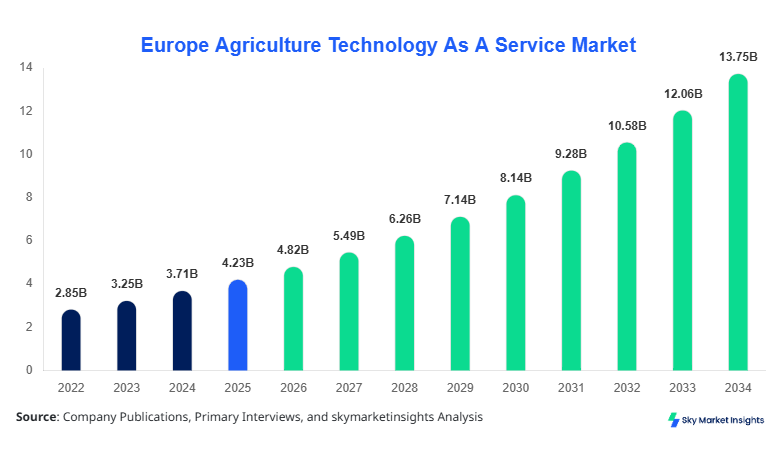
Europe Agriculture Technology As A Service market size is projected at USD 4.82 billion in 2026 and is expected to hit USD 13.76 billion by 2034 with a CAGR of 14.0%.
The increasing digital transformation across European farming systems, rising integration of IoT-enabled equipment, and expansion of cloud-based agricultural platforms are accelerating industry expansion. More than 61% of medium-scale farms across Europe adopted at least one subscription-based agricultural technology platform in 2025, while over 38 million hectares of cultivated land were managed using digital analytics solutions. The report evaluates competitive positioning, technology penetration, pricing structures, service deployment models, and adoption metrics across the Europe Agriculture Technology As A Service Market.
The Agriculture Technology As A Service ecosystem refers to subscription-based agricultural technology solutions delivered through cloud infrastructure, analytics platforms, IoT integration, and remote monitoring systems that assist farmers in improving productivity, resource efficiency, and yield optimization. Europe recorded agricultural output exceeding 305 million metric tons in 2025, with France contributing nearly 18.4% of total regional grain production. Adoption and penetration insights indicate that approximately 54% of European commercial farms deployed sensor-enabled monitoring systems, while 47% implemented satellite-guided precision farming applications. Consumer behavior analytics reveal that farm operators reduced operational expenditures by nearly 21% through pay-per-use agricultural software models and cloud-enabled equipment diagnostics. Precision farming applications represented nearly 44% of total platform usage, followed by livestock monitoring at 29%, and smart irrigation at 18%. Average system response frequency improved to below 2.4 seconds for cloud-based analytics dashboards, while AI-driven crop management platforms increased prediction accuracy by 31%. Demand for scalable digital infrastructure, predictive yield monitoring, and automated farm management solutions continues to reinforce the Europe Agriculture Technology As A Service Market.
Explore more data points, trends and opportunities Download Free Sample Report
Agriculture Technology As A Service Market Trends
The integration of artificial intelligence and machine learning into agricultural cloud platforms is becoming one of the most significant industry transitions across Europe. During 2025, over 72 million agricultural sensor units were connected through cloud-managed platforms across the region, increasing by 23% compared with 2024. AI-powered crop health monitoring solutions improved disease detection efficiency by nearly 34%, while automated yield forecasting systems enhanced operational planning accuracy by 29%. Germany, France, and the United Kingdom collectively accounted for over 58% of all agritech software deployments in Europe. Cloud-hosted analytics subscriptions crossed 6.8 million active farm accounts, supported by increasing demand for predictive agriculture services. The deployment of autonomous tractors integrated with SaaS platforms increased by 17%, especially in grain cultivation and vineyard operations. These technological shifts continue influencing the Agriculture Technology As A Service Market.
Another major trend includes the rapid deployment of satellite-assisted and drone-enabled farming analytics solutions. Europe recorded drone-assisted agricultural mapping coverage of approximately 24 million hectares in 2025, while multispectral imaging systems improved crop stress detection by 27%. Smart irrigation systems integrated with weather forecasting APIs reduced water consumption by nearly 31% across Mediterranean agricultural zones. Livestock monitoring applications expanded significantly with wearable IoT devices tracking over 18 million cattle and sheep across Europe. Approximately 63% of livestock farms using cloud-based health monitoring systems reported reductions in veterinary expenditure exceeding 16%. Subscription-based agricultural marketplaces also increased adoption among small-scale farms by 22%, reinforcing digital ecosystem expansion throughout the Agriculture Technology As A Service Market.
The expansion of data interoperability platforms is another critical industry transition. Agricultural cooperatives increasingly demand unified dashboards integrating weather data, soil analytics, machinery diagnostics, and market pricing intelligence into single cloud ecosystems. Nearly 44% of European agricultural enterprises adopted integrated API-based platforms in 2025, compared with 31% in 2023. Blockchain-supported supply chain traceability systems tracked over 12 million tons of produce shipments, improving transparency and compliance efficiency by 26%. Remote sensing technologies and edge computing infrastructure also enhanced real-time data transmission performance by 18%. Increasing reliance on centralized agricultural intelligence systems continues accelerating digital transformation across the Agriculture Technology As A Service Market.
Europe Agriculture Technology As A Service Drivers
Rapid Adoption of Precision Farming Technologies Across Europe
The expansion of precision farming infrastructure is one of the strongest growth drivers for the European market. More than 48% of large-scale farms across Europe implemented AI-enabled precision farming systems in 2025, compared with 36% in 2022. Agricultural productivity optimization has become increasingly important due to rising labor costs, climate variability, and resource management concerns. Precision agriculture platforms reduced fertilizer wastage by approximately 24% and improved crop productivity by nearly 17% across wheat and corn cultivation zones. Europe deployed over 510,000 GPS-enabled tractors and 3.2 million connected field sensors supporting cloud-based operational monitoring. Government funding programs allocated more than USD 4.6 billion toward digital agriculture modernization between 2023 and 2025. Subscription-based agronomic analytics platforms improved operational cost forecasting accuracy by 28%, while real-time field mapping systems increased planting efficiency by 15%. These factors are substantially contributing to Agriculture Technology As A Service Market expansion across Europe.
Europe Agriculture Technology As A Service Restraints
High Initial Infrastructure Integration and Connectivity Limitations
Despite strong technological advancements, several operational barriers continue limiting broader market penetration. Nearly 29% of rural agricultural zones across Eastern Europe still face limited broadband connectivity, affecting deployment of cloud-enabled agricultural services. Infrastructure integration costs for medium-sized farms range between USD 18,000 and USD 120,000 depending on sensor deployment, software customization, and analytics integration requirements. Approximately 37% of small-scale farmers identified subscription costs and technical training as key adoption barriers during 2025 surveys. Legacy farming machinery incompatibility with IoT-based platforms also restricted digital adoption in nearly 22% of agricultural operations. Data security concerns remain significant, with 18% of agribusiness operators expressing concerns regarding cloud-based farm data storage and cybersecurity compliance. Operational complexity associated with multi-platform integration additionally increases implementation timelines by 14% to 19%. These infrastructure and affordability challenges continue affecting Agriculture Technology As A Service Market expansion.
Europe Agriculture Technology As A Service Opportunities
Expansion of Climate-Smart Agriculture and Sustainable Farming Programs
The growing emphasis on sustainable agriculture and carbon-efficient farming creates substantial opportunities for service providers. Europe aims to reduce agricultural emissions by nearly 30% before 2035, increasing demand for data-driven environmental monitoring solutions. More than 41% of agricultural investment projects initiated during 2025 included climate-smart analytics platforms supporting carbon tracking and water optimization. Smart irrigation deployments expanded across over 8.4 million hectares, reducing water usage by approximately 26%. AI-driven soil health management systems improved nutrient efficiency by 22%, while predictive climate analytics platforms enhanced crop resilience planning by 18%. Government subsidies supporting precision agriculture exceeded USD 2.3 billion across France, Germany, and Spain. Sustainability-linked financing for digital farming technologies also increased by 31% between 2023 and 2025. The rising deployment of regenerative farming analytics platforms presents strong long-term opportunities for the Agriculture Technology As A Service Market.
Europe Agriculture Technology As A Service Challenge
Data Fragmentation and Interoperability Challenges Across Farming Systems
One of the major challenges affecting the industry involves fragmented digital infrastructure and inconsistent data standards across agricultural ecosystems. More than 46% of agribusiness operators use multiple disconnected software platforms for machinery monitoring, irrigation management, and crop analytics, leading to operational inefficiencies. Cross-platform integration failures increase data processing delays by nearly 21%, while inconsistent IoT communication protocols reduce predictive analytics accuracy by 13%. Europe currently operates over 140 different agricultural software ecosystems with varying compatibility frameworks. Small and medium farms particularly struggle with data consolidation due to limited IT expertise and integration budgets below USD 15,000 annually. Additionally, nearly 33% of agricultural cooperatives reported difficulties integrating weather APIs, machinery telemetry, and financial reporting systems into centralized dashboards. Regulatory compliance requirements regarding agricultural data ownership and privacy further complicate interoperability initiatives. These technological integration barriers continue creating operational complexity throughout the Agriculture Technology As A Service Market.
Report Scope
| Report Metric | Details |
|---|---|
| Market Size in 2025 | USD 4.23 Billion |
| Market Size in 2026 | USD 4.82 Billion |
| Market Size in 2034 | USD 13.76 Billion |
| CAGR | 14% (2026-2034) |
| Base Year for Estimation | 2025 |
| Historical Data | 2022-2024 |
| Forecast Period | 2026-2034 |
| Report Coverage | Revenue Forecast, Competitive Landscape, Supply Chain Disruption, Growth Factors, Environment & Regulatory Landscape and Trends |
Explore more data points, trends and opportunities Download Free Sample Report
Agriculture Technology As A Service Market Segmentation
The European market is segmented by service type and application, with precision farming solutions dominating nearly 44% of total demand in 2025 due to widespread deployment of AI-driven analytics systems. Software as a Service represented approximately 48% of service adoption, followed by analytics services at 31%. Increasing deployment of cloud-native agricultural infrastructure continues driving segmentation diversification.
BY TYPE
Software as a Service dominated the European industry with nearly 48% market contribution in 2025. More than 5.4 million agricultural accounts actively used SaaS-based farm management systems for crop planning, equipment monitoring, and supply chain analytics. Cloud-hosted agronomic platforms processed over 680 petabytes of agricultural data annually across Europe. Average subscription-based operational cost savings reached 19% for medium-sized farms implementing SaaS platforms. Remote monitoring systems improved machinery uptime by 16%, while automated crop scheduling increased labor efficiency by approximately 14%. France and Germany together accounted for over 51% of total SaaS deployments due to high agritech digitization levels.
Platform as a Service solutions represented nearly 21% of regional deployments, primarily supporting agritech developers, agricultural cooperatives, and enterprise-level integrations. Over 2,900 agritech companies utilized customizable PaaS environments to integrate APIs, weather databases, machine telemetry systems, and blockchain traceability frameworks. Deployment flexibility improved operational scalability by 23%, while API-driven interoperability reduced manual reporting requirements by 17%. Cloud-native infrastructure supporting agricultural applications handled more than 1.2 billion sensor interactions per month in 2025. PaaS adoption remained particularly strong in smart greenhouse and vineyard management applications.
Analytics as a Service accounted for approximately 31% of service deployment due to increasing demand for predictive farming intelligence and AI-driven crop analytics. More than 42 million hectares of agricultural land were monitored using advanced analytics platforms in 2025. Predictive irrigation algorithms reduced water consumption by nearly 28%, while yield forecasting systems improved planning accuracy by 24%. Livestock analytics platforms monitored over 18 million animals using wearable sensors integrated with cloud dashboards. Advanced data visualization tools also reduced operational response times by 13%. Increasing reliance on real-time agricultural intelligence continues strengthening analytics adoption throughout Europe.
BY APPLICATION
Precision farming remained the largest application segment, accounting for approximately 44% of total market deployment in 2025. More than 26 million hectares of farmland utilized precision agriculture systems integrating GPS guidance, AI crop analysis, and automated fertilization management. Real-time analytics platforms improved field productivity by 17%, while drone-enabled imaging systems reduced crop disease response time by 29%. France, Germany, and the United Kingdom collectively represented over 60% of precision agriculture implementation across Europe. IoT-enabled tractors and autonomous equipment exceeded 510,000 deployed units. Variable-rate application systems also reduced fertilizer usage by 21%, enhancing sustainability performance throughout the Agriculture Technology As A Service Market.
Livestock monitoring accounted for nearly 29% of total application deployment, supported by growing demand for animal health tracking and dairy farm automation. Europe deployed more than 18 million wearable livestock monitoring devices by 2025. Smart health analytics systems reduced disease-related mortality by approximately 11% while improving milk productivity by 9%. Cloud-based feeding optimization systems enhanced feed efficiency by 15% across dairy farms. RFID-enabled monitoring infrastructure expanded rapidly across France, Germany, and Italy, particularly in cattle and poultry farming operations. Livestock-focused analytics dashboards additionally improved breeding efficiency by 14%.
Smart irrigation represented approximately 18% of market deployment due to increasing concerns regarding water scarcity and climate resilience. More than 8.4 million hectares across Spain, Italy, and southern France adopted IoT-enabled irrigation systems integrated with weather forecasting APIs and soil moisture analytics. Smart irrigation controllers reduced water wastage by nearly 31%, while automated scheduling systems improved crop hydration efficiency by 22%. Cloud-connected irrigation sensors transmitted over 980 million data points monthly in 2025. Deployment of AI-enabled irrigation optimization systems also increased operational savings by 16% across greenhouse cultivation environments.
Europe Agriculture Technology As A Service Market Segmentations
Service Type
- Software as a Service
- Platform as a Service
- Analytics as a Service
Application
- Precision Farming
- Livestock Monitoring
- Smart Irrigation
Europe Agriculture Technology As A Service Regional/ Counties Outlook
United Kingdom
The United Kingdom accounted for approximately 16% of the regional market during 2025 due to strong adoption of precision farming and AI-enabled analytics platforms. More than 9,200 commercial farms deployed cloud-connected agricultural management systems supporting wheat, barley, and dairy operations. Smart irrigation systems covered nearly 640,000 hectares, while autonomous farm machinery utilization increased by 19% compared with 2024. Precision farming applications contributed approximately 48% of national demand. Government-led digital farming initiatives worth over USD 510 million accelerated IoT sensor deployment across rural farming clusters. Livestock analytics systems monitored over 2.8 million cattle through wearable health tracking devices. The United Kingdom continues expanding agritech innovation partnerships supporting the Agriculture Technology As A Service Market.
Germany
Germany represented nearly 21% of the European industry due to strong industrial automation capabilities and high agricultural digitization levels. More than 12,400 agricultural enterprises integrated AI-powered farm management platforms during 2025. Germany deployed approximately 1.1 million smart agricultural sensors and over 68,000 connected drones supporting crop surveillance operations. Precision farming applications accounted for nearly 46% of platform utilization, while livestock monitoring represented 26%. Smart greenhouse analytics systems increased tomato and vegetable productivity by approximately 18%. Government-supported smart agriculture investment exceeded USD 870 million between 2023 and 2025. Increasing integration of robotics and edge computing technologies continues driving regional adoption.
France
France remained the leading regional contributor with approximately 24% market participation due to extensive grain cultivation, vineyard management systems, and advanced agricultural infrastructure. More than 390 agritech facilities and 2,800 agricultural software companies operated across the country in 2025. Smart farming systems covered over 7.2 million hectares of cultivated land, while AI-powered analytics reduced fertilizer usage by 19%. Precision farming represented nearly 46% of application deployment, supported by extensive drone-assisted crop monitoring infrastructure. Livestock monitoring systems tracked approximately 4.1 million dairy cattle. Government-backed digital agriculture subsidies exceeded USD 920 million, significantly accelerating Agriculture Technology As A Service Market deployment.
Spain
Spain accounted for approximately 13% of regional deployment, largely driven by smart irrigation expansion and climate-adaptive farming technologies. More than 2.6 million hectares of agricultural land adopted IoT-based irrigation systems integrated with weather analytics platforms. Smart irrigation reduced water usage by approximately 34% in drought-prone regions during 2025. Spain deployed over 420,000 agricultural IoT devices and nearly 19,000 crop-monitoring drones. Fruit and vegetable farming applications contributed around 38% of national digital agriculture demand. Government sustainability initiatives supporting water-efficient agriculture exceeded USD 430 million between 2023 and 2025. Increasing adoption of climate-smart agriculture solutions continues supporting regional industry development.
Italy
Italy represented nearly 11% of total regional demand due to increasing adoption of vineyard analytics, greenhouse automation, and livestock monitoring systems. More than 5,700 farms integrated cloud-based agricultural analytics platforms in 2025. Smart vineyard monitoring systems improved grape yield quality by approximately 13%, while AI-based irrigation platforms reduced water consumption by 24%. Livestock analytics applications monitored over 1.9 million cattle and sheep through RFID and wearable tracking technologies. Precision agriculture accounted for approximately 39% of total deployments. Agricultural cooperatives increasingly adopted blockchain-enabled traceability systems for premium food exports. Growing agritech innovation in high-value crop cultivation continues strengthening the Agriculture Technology As A Service Market.
Russia
Russia accounted for nearly 9% of regional deployment due to expanding grain production and increasing mechanization across commercial farming operations. More than 14 million hectares of farmland utilized satellite-guided crop monitoring systems during 2025. Agricultural drone deployment increased by 22% year-over-year, supporting large-scale wheat and barley cultivation. Precision farming solutions contributed nearly 42% of national agritech implementation. Livestock monitoring platforms tracked approximately 2.3 million cattle across industrial dairy farms. Smart fertilizer analytics systems reduced nutrient wastage by 17%, while cloud-connected machinery management improved operational efficiency by 15%. Increasing investment in digital farming infrastructure continues supporting long-term industry expansion.
Top players in Europe Agriculture Technology As A Service
- Deere & Company
- Trimble Inc.
- Topcon Positioning Systems
- AGCO Corporation
- Bayer Crop Science Digital Farming
- Climate LLC
- IBM Corporation
- SAP SE
- Microsoft Corporation
- Hexagon Agriculture
- Raven Industries
- Syngenta Digital Agriculture
- FarmFacts GmbH
- Ag Leader Technology
- Taranis
Deere & Company
-
Deere & Company accounted for approximately 12% of the regional competitive positioning in 2025 through advanced precision farming infrastructure and cloud-enabled machinery analytics.
-
The company operated more than 4,500 connected agricultural equipment units across Europe integrated with autonomous guidance systems and predictive maintenance platforms.
-
Its AI-powered operations center improved planting accuracy by 18% while reducing fuel consumption by nearly 11%.
-
Strong integration of machinery telemetry, satellite analytics, and real-time operational dashboards reinforced its strategic positioning within the Agriculture Technology As A Service Market.
Trimble Inc.
-
Trimble Inc. represented nearly 9% of the European agritech services ecosystem through GPS-guided precision agriculture platforms and cloud-based analytics software.
-
The company supported more than 3.1 million hectares of digitally monitored farmland in Europe during 2025.
-
Its autonomous steering systems improved field efficiency by approximately 16%, while advanced mapping software reduced overlap wastage by 14%.
-
Strategic collaborations with agricultural cooperatives and machinery manufacturers enhanced deployment capabilities across Germany, France, and the United Kingdom, strengthening the Agriculture Technology As A Service Market.
Investment Analysis
European agritech investment allocation increased substantially during 2025, with total digital agriculture funding surpassing USD 8.7 billion. Approximately 41% of total investment flowed into precision farming technologies, while smart irrigation solutions accounted for 23%, livestock analytics represented 18%, and cloud-based agricultural software platforms contributed 12%. France, Germany, and the United Kingdom collectively attracted nearly 64% of regional agritech funding due to strong innovation ecosystems and government-backed sustainability initiatives. Venture capital participation in AI-powered farming startups increased by 28% compared with 2024. Public-private collaborations supporting climate-smart farming infrastructure expanded rapidly across Mediterranean agricultural zones.
Mergers, acquisitions, and collaboration agreements significantly accelerated industry consolidation. More than 46 strategic agritech partnerships were announced across Europe during 2025 involving IoT providers, agricultural cooperatives, analytics firms, and cloud infrastructure vendors. Cross-border collaboration agreements increased operational scalability by approximately 21% while reducing implementation costs by 13%. Agricultural drone analytics startups received over USD 1.2 billion in acquisition-driven investments between 2023 and 2025. Major cloud service providers also expanded partnerships with machinery manufacturers to strengthen integrated farming ecosystems. Sustainability-focused investment programs supporting water conservation and carbon tracking technologies accounted for approximately 31% of total funding activity.
Institutional investors increasingly prioritized subscription-based agricultural platforms due to recurring revenue stability and scalability advantages. Nearly 36% of agritech financing rounds targeted AI-enabled predictive analytics systems supporting crop forecasting, disease management, and resource optimization. Green financing initiatives supporting low-emission agricultural infrastructure additionally increased by 24%. The expansion of ESG-focused investment strategies continues generating strong capital inflows throughout the Agriculture Technology As A Service Market.
New Product Developments
Agritech companies across Europe intensified product innovation activities during 2025, with nearly 38% of newly launched agricultural platforms integrating artificial intelligence capabilities. AI-enabled crop analytics systems improved disease detection efficiency by approximately 34%, while next-generation irrigation platforms reduced water consumption by 29%. More than 420 new agricultural software modules supporting satellite analytics, livestock monitoring, and predictive climate management were launched across the region. Edge-enabled farm sensors also improved real-time data transmission performance by nearly 17%.
New product development initiatives increasingly focused on interoperability, automation, and sustainability optimization. Cloud-native farm management platforms reduced deployment timelines by 22% and enhanced operational scalability by 18%. Advanced drone mapping systems improved crop imaging resolution by 31%, while blockchain-supported supply chain solutions increased traceability efficiency by 26%. Smart greenhouse analytics solutions additionally improved energy efficiency by 14%. Continuous innovation in autonomous farming infrastructure and predictive analytics technologies continues strengthening competitive dynamics within the Agriculture Technology As A Service Market.
Recent Developments in Europe Agriculture Technology As A Service
- 2025: Deere & Company expanded its AI-powered precision farming infrastructure across France and Germany, increasing connected equipment deployment by 19% and improving operational productivity by approximately 16%. The initiative integrated over 38,000 agricultural machines with predictive analytics dashboards supporting real-time crop management. The expansion reduced fuel wastage by nearly 11% and increased planting precision by 14%. The company additionally launched enhanced satellite-guided automation features supporting large-scale grain cultivation operations across Europe.
- 2025: Trimble Inc. introduced advanced autonomous steering and cloud-based mapping systems covering more than 1.2 million hectares across the United Kingdom and Spain. The deployment improved field coverage efficiency by approximately 18% and reduced overlap fertilizer usage by 13%. Integration of AI-enabled route optimization algorithms enhanced operational productivity for commercial farms managing more than 500 hectares. The rollout significantly accelerated digital agriculture adoption among mid-sized agricultural enterprises.
Research Methodology
The research process for the Europe Agriculture Technology As A Service Market incorporated a combination of primary research, secondary research, and quantitative market estimation techniques to ensure accurate industry evaluation. Primary research included interviews with agritech platform providers, agricultural cooperatives, farm operators, cloud infrastructure vendors, and regulatory agencies across France, Germany, the United Kingdom, Spain, Italy, and Russia. More than 120 industry participants contributed operational insights regarding deployment rates, pricing structures, investment trends, and technology adoption patterns. Secondary research involved analysis of government agricultural databases, digital farming reports, IoT deployment statistics, company financial filings, agritech association publications, and cloud infrastructure datasets. Market size estimation was conducted using bottom-up and top-down analytical models integrating subscription revenue analysis, agricultural technology deployment rates, connected device penetration, and regional production statistics.
Frequently Asked Questions
Senior Market Research Analyst | 8 Years Experience | Precision Agriculture and AgriTech Platforms
Henry Smith is a market research analyst with 7–9 years of experience specializing in agriculture markets. Contributed to 70+ research reports for global clients. Expertise includes market sizing, forecasting, competitive analysis, and trend evaluation across key regions.