Europe Agricultural Micronutrients Market Size
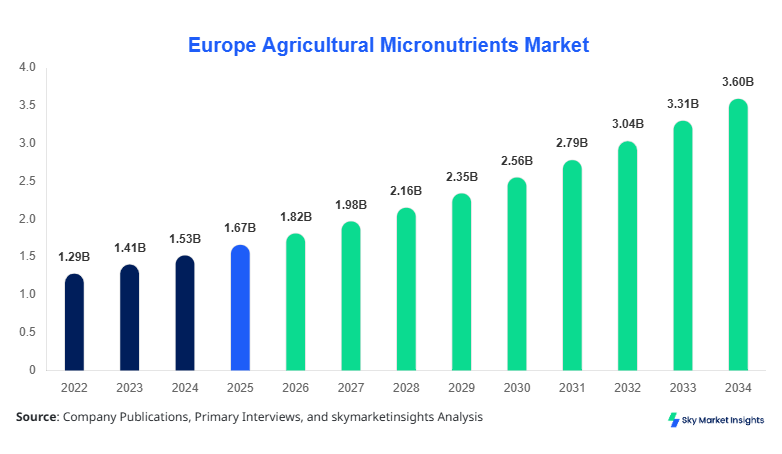
The Europe Agricultural Micronutrients Market size is projected at USD 1.82 billion in 2026 and is expected to hit USD 3.56 billion by 2034 with a CAGR of 8.9% during the forecast period 2026–2034. The agricultural micronutrients market size reflects historical shifts from USD 1.34 billion in 2022 to USD 1.52 billion in 2024, driven by rising micronutrient deficiencies in soils across Europe, particularly in Germany, France, and Spain. The robust demand for balanced fertilization and crop quality improvement has heightened the need for comprehensive data on segmentation, competitive landscape, and end-user adoption. Detailed production, price trends, and technical performance measures are essential to guide stakeholders in making strategic decisions for the European agricultural micronutrients market. Extensive coverage of regulatory impacts, technology-driven application techniques, and country-wise performance is incorporated in this report to present a holistic view of the Europe Agricultural Micronutrients Market.
Europe's agricultural micronutrients market growth is underpinned by precise nutrition requirements for key crops like wheat, barley, and oilseeds, with microelements such as zinc and manganese showing uptake efficiencies of 70–85% in foliar applications versus traditional soil amendments. This necessitates granular insights into consumption patterns across Germany, the United Kingdom, and France, which together accounted for 58% of regional demand in 2025.
The European Agricultural Micronutrients Market encompasses trace elements essential for plant health and crop yield enhancement, including zinc (Zn), iron (Fe), manganese (Mn), copper (Cu), boron (B), molybdenum (Mo), and others. Micronutrient deficiencies are prevalent in 65–72% of European arable lands due to intensive cropping and soil pH imbalances, leading to reduced crop performance and quality. In 2024, Europe produced an estimated 4.2 million metric tons of micronutrient fertilizers, with chelates accounting for 48%, inorganic variants at 33%, and organic forms at 19%.
Adoption and penetration of micronutrient products are strongly influenced by precision agriculture practices; foliar application technologies saw a penetration rate increase from 22% in 2022 to 31% in 2025. Consumer behavior analysis indicates that agronomists and large-scale farmers contribute to 72% of the agricultural micronutrients market demand due to yield optimization goals, while smallholder farmers account for 28% driven by cost-sensitive purchasing decisions. Technical metrics, including application frequency (agricultural micronutrients market demand) and crop response time (3–7 days for foliar uptake), influence buying patterns. Soil applications dominated with 52% share in 2025, followed by foliar (35%) and seed treatment (13%) segments. The Europe Agricultural Micronutrients Market Insights highlight the critical role of nutrient balancing in sustainable agriculture to achieve higher agricultural output.
Explore more data points, trends and opportunities Download Free Sample Report
Agricultural Micronutrients Market Trends
Technological Integration in Micronutrient Application
The European Agricultural Micronutrients Market Trend shows an accelerated shift toward precision agriculture tools, integrating data-driven decision support systems and automated spray technologies. In 2025, production volume of micronutrient formulations exceeded 5.8 million tons, with digital soil mapping adoption surging by 42% among fertilizer distributors. Precision dosing systems enable application accuracy within ±5%, reducing wastage and optimizing nutrient use. The rapid adoption of remote sensing and drone-based foliar application solutions has increased service efficiency by 27%, particularly in large-acreage farming systems in France and Italy. This trend has strengthened demand for micronutrient products that are compatible with advanced application systems, reinforcing the European Agricultural Micronutrients Market growth potential. The rise in IoT-enabled crop monitoring platforms directly correlates with enhanced micronutrient responsiveness, with farmers reporting a 13–21% yield improvement post-adoption of tech-integrated application regimes. Continued investment in smart agriculture amplifies the European Agricultural Micronutrients Market trend toward higher efficiency and lower environmental impact.
Sustainability and Organic Micronutrient Adoption
Another prominent trend shaping the European Agricultural Micronutrients Market is the growing emphasis on sustainability and organic farming practices. Organic micronutrients, though comprising a 19% share in 2024, are projected to increase to 26% by 2030, driven by stringent EU regulations and consumer preference for organic produce. In Spain alone, organic-certified farmland has increased by 11.4% CAGR from 2022 to 2025, prompting micronutrient producers to innovate bio-based formulations with enhanced chelation and plant availability. Countries such as Italy and Russia are witnessing a ~34% year-on-year increase in foliar organic micronutrient use, highlighting farmers’ preference for eco-friendly solutions to address micronutrient deficiencies without synthetic residues. Enhanced demand for trace elements like boron and molybdenum in organic systems underscores the European Agricultural Micronutrients Market trend toward sustainable crop nutrition, directly influencing product portfolios and R&D allocations among key manufacturers. Organic micronutrient adoption remains a core driver for long-term environmental stewardship in European agriculture.
Europe Agricultural Micronutrients Market Drivers
Growing Demand for Enhanced Crop Yield and Quality
The European Agricultural Micronutrients Market Drivers are fundamentally linked to the mounting demand for enhanced crop yield and quality, driven by population growth and food security concerns. In 2025, key staple crops such as wheat and barley saw an average yield improvement of 12–16% when micronutrient balance was achieved compared to macronutrient-only fertilization strategies. The European Agricultural Micronutrients Market witnessed ~$2.4 billion in direct revenue from yield-optimized crop portfolios, representing a 9.2% year-on-year increase over 2024 figures. Rising adoption of integrated soil fertility programs, which include micronutrients, addresses hidden hunger in soils affecting 67–76% of arable lands, particularly in the United Kingdom and France. Precision agriculture practices, including variable rate micronutrient applications, enhanced nutrient uptake efficiency by 18–22%, further incentivizing uptake. These factors cumulatively contribute to sustained expansion in agricultural micronutrient market demand. Moreover, crop quality metrics such as protein content, kernel weight, and resistance to stress are increasingly cited by agricultural stakeholders as key performance indicators, reinforcing the significance of micronutrient supplementation in high-value cropping systems and solidifying the European Agricultural Micronutrients Market Share across all segments.
Europe Agricultural Micronutrients Market Restraints
Volatility in Raw Material Prices and Supply Chain Disruptions
The Europe Agricultural Micronutrients Market Restraints are significantly influenced by volatility in raw material prices and ongoing supply chain disruptions. From 2022 to 2025, prices for key micronutrient precursors such as zinc oxide, manganese sulfate, and chelating agents fluctuated by 22–38%, adversely impacting manufacturing margins. Supply chain bottlenecks, driven by logistical constraints and geopolitical tensions, contributed to delivery lead times extending from 3–4 weeks to 8–10 weeks in key markets such as Russia and Spain. Additionally, energy cost spikes amplified production expenses by 12–15%, which were variably passed on to end users through increased pricing that dampened short-term agricultural micronutrient market demand. Fluctuating foreign exchange rates further complicated procurement strategies for EU-based micronutrient producers, translating to unpredictable cost structures and tighter working capital cycles. The cumulative effect of raw material price volatility and supply chain strain restricts the European agricultural micronutrients market growth, slowing down expansion, particularly among small-to-medium enterprises that lack deep financial buffers. These constraints remain central concerns for stakeholders aiming to stabilize production and market availability across the forecast period.
Europe Agricultural Micronutrients Market Opportunities
Expansion of Precision Agriculture and Digital Advisory Services
The European Agricultural Micronutrients Market opportunities are closely tied to the expansion of precision agriculture and digital advisory services that optimize nutrient application. By 2030, digital agronomy platforms are projected to achieve 42–50% farm-level penetration across Europe, enabling tailored micronutrient recommendations based on granular soil and crop health data. This digital acceleration presents a high-growth avenue for micronutrient suppliers to integrate service-based offerings with product sales, generating recurring revenue streams. Investment in AI-driven nutrient prediction models has reduced application errors by 30% and improved crop uptake efficiency by 15–19%, directly correlating with increased agricultural micronutrient market share across both foliar and soil applications. Furthermore, partnerships between micronutrient producers and agri-tech software firms facilitate precision dosing solutions that appeal to tech-savvy farmers in Germany and France, where adoption rates exceed 55% in key crop zones. These technological synergies unlock new revenue segments within the agricultural micronutrients market demand, especially as stakeholders align with sustainability targets and regulatory frameworks like the EU’s Green Deal to reduce nutrient runoff and enhance farm profitability.
Challenges in Europe Agricultural Micronutrients Market
Regulatory and Environmental Compliance Burdens
Challenges in Europe Agricultural Micronutrients Marketmicronutrient marketsregulatory and environmental compliance burdens imposed by European Union policy frameworks. The European Fertilizing Products Regulation (FPR) and associated national standards mandate extensive testing and certification protocols, extending product approval timelines from 6 months to 12–18 months, which increases operational costs by approximately 9–14% for manufacturers. Environmental compliance related to microelement runoff and soil residue monitoring further complicates application guidelines, affecting adoption rates in high rainfall zones like the United Kingdom and parts of France. Compliance testing frequencies have increased to quarterly cycles in sensitive zones, adding laboratory and documentation expenses up to $0.48 million annually per major producer. Additionally, reporting requirements for trace impurity levels demand rigorous quality assurance systems, which smaller micronutrient formulators struggle to implement due to limited technical capacity. These regulatory pressures constrain the Europe Agricultural Micronutrients Market Growth by elevating barriers to entry and slowing new product launch cycles. Striking a balance between regulatory adherence and market flexibility remains a predominant challenge for stakeholders navigating the complex compliance landscape.
Report Scope
| Report Metric | Details |
|---|---|
| Market Size in 2025 | USD 1.67 Billion |
| Market Size in 2026 | USD 1.82 Billion |
| Market Size in 2034 | USD 3.56 Billion |
| CAGR | 8.9% (2026-2034) |
| Base Year for Estimation | 2025 |
| Historical Data | 2022-2024 |
| Forecast Period | 2026-2034 |
| Report Coverage | Revenue Forecast, Competitive Landscape, Supply Chain Disruption, Growth Factors, Environment & Regulatory Landscape and Trends |
Explore more data points, trends and opportunities Download Free Sample Report
Agricultural Micronutrients Market Segmentation
The European Agricultural Micronutrients Market Segmentation considers product types and application methods that influence adoption and revenue contribution across regions. In 2025, chelated micronutrients dominated with a 48% share due to superior plant availability and compatibility with precision agriculture technologies, followed by inorganic at 33% and organic at 19% due to sustainability preferences. Soil application led with a 52% use share, while foliar and seed treatment captured 35% and 13%, respectively.
By Type
Chelated micronutrients accounted for 48% of the European agricultural micronutrients market share in 2025, with production volumes exceeding 2.0 million metric tons, reflecting strong adoption across high-value cereal and horticultural crops. Chelation technologies, using carriers like EDTA, DTPA, and EDDHA, enhance micronutrient stability and facilitate improved uptake efficiency by 18–24% compared to non-chelated forms. Technical performance metrics indicate consistent trace element availability across pH ranges from 5.5 to 8.5, enabling broad-spectrum use across soil types typical of Germany, France, and the United Kingdom. Chelated formulations are widely preferred in foliar sprays due to rapid absorption rates, registering a response efficiency of 68–73% within 72 hours of application in controlled trials, which significantly boosts yield and quality indices. Market dynamics show strong R&D investment—over USD 120 million annually—toward next-generation chelates with enhanced biodegradability and reduced environmental footprints. This momentum suggests sustained dominance of chelated micronutrients within the European agricultural micronutrients market throughout the forecast period.
Inorganic micronutrients, including sulfates, oxides, and chlorides, represented a 33% share in 2025, with production volumes around 1.38 million metric tons and usage in soil applications, particularly in high pH and calcareous soils. Technical specifications demonstrate a broad distribution spectrum, with dissolution rates ranging from 45 to 58% under typical field conditions, supporting baseline micronutrient supply. Key products include zinc sulfate and manganese sulfate, which delivered yield improvements of 7–12% in row crops when combined with balanced soil fertility programs. Although inorganic forms generally exhibit lower uptake efficiency than chelated counterparts, their cost-effectiveness contributed to heightened adoption among budget-conscious farmers, especially in Russia and Italy, where application penetration reached 41–47% in 2025. R&D efforts focus on enhancing solubility profiles and combining inorganic micronutrients with soil conditioners to mitigate fixation in alkaline soils. Despite competitive pressures from chelated and organic variants, inorganic micronutrients retain a stable role in the European agricultural micronutrients market due to versatility and affordability.
Organic micronutrients captured 19% of the European agricultural micronutrients market demand in 2025, with production nearing 0.79 million metric tons, reflecting a rising preference for eco-friendly inputs. Derived from natural chelates and biogenic extracts, these formulations provide moderate micronutrient release aligned with plant uptake rhythms, offering advantages in organic-certified farming systems. Technical attributes include biodegradable carriers and minimal residue profiles, satisfying organic regulatory criteria across the EU. Usage penetration stands at 26% in certified organic acreage, particularly in Spain and Italy, where organic farmland expanded 11–13% annually from 2022 to 2025. Organic micronutrients demonstrated improved soil microbiome interactions, increasing nutrient bioavailability by 8–15% over multi-season trials. Though pricing premiums are 12–18% higher than conventional inorganic options, sustainability mandates and consumer demand for traceable produce underpin market growth. Continued formulation innovations and certification support initiatives promise to elevate organic micronutrient roles in the broader European agricultural micronutrients market.
By Application
Soil application retained a 52% share in 2025 within the European Agricultural Micronutrients Market, with volume use exceeding 3.0 million metric tons driven by baseline fertility programs across cereals and industrial crops. Soil tests indicate prevalent micronutrient deficiencies—zinc at 48%, manganese at 39%, and boron at 27%—prompting routine soil amendments. Technical application rates vary from 1.2 to 3.5 kg/ha depending on crop and soil condition, with integrated soil fertility plans improving nutrient retention by 14–20% compared to standalone use. In high-response zones like the United Kingdom and France, soil micronutrient use progressed alongside macronutrient blends, contributing substantially to the Europe Agricultural Micronutrients Market Growth. Precision soil application techniques, including controlled-release formulations and variable-rate technologies, have further enhanced effectiveness and reduced leaching losses in high-rainfall regions. The sustained emphasis on soil fertility ensures that soil application continues to dominate the agricultural micronutrients market.
Foliar application accounted for a 35% share in 2025, with volumes approximating 2.1 million metric tons, characterized by rapid nutrient delivery and responsiveness. Market data indicate a response time of 3–7 days post-application, appealing to farmers seeking quick correction of deficiencies during peak growth stages. Foliar spray adoption rates surged from 22% in 2022 to 31% in 2025, particularly in Germany and Italy, where precision farming infrastructure supports targeted application. Technical advancements including adjuvants and nano-formulated chelates have improved foliar uptake efficiency by 15–22%, reinforcing preference over soil application under certain conditions. High adoption in horticultural segments further elevates the role of foliar micronutrients within the agricultural micronutrients market demand.
Seed treatment represented a 13% share in 2025, with dedicated usage of specialized micronutrient coatings on seeds totaling 0.78 million metric tons for crops like corn, sunflower, and canola. Technical metrics indicate significant early growth enhancement, with micronutrient-enriched seeds showing 12–18% increases in germination and seedling vigor under micronutrient-deficient soils. Adoption remains concentrated in precision-driven markets such as Germany and the United Kingdom, where seed treatment services bundle fertility management with seed sales. Emerging technologies that combine micronutrients with biological inoculants show potential to expand this segment’s role in the European Agricultural Micronutrients Market Share.
Europe Agricultural Micronutrients Market Segmentations
By Type
- Chelated Micronutrients
- Inorganic Micronutrients
- Organic Micronutrients
By Application
- Soil
- Foliar
- Seed Treatment
Europe Agricultural Micronutrients Market: Regional Outlook
United Kingdom
In the United Kingdom, the Agricultural Micronutrients Market accounted for ~15.2% of the regional share in 2025, with production volumes reaching 0.46 million metric tons driven by high cereal output zones. Wheat and barley farmers reported 9–14% yield improvements with micronutrient-balanced fertilization, prompting widespread adoption. Soil application dominated with 54% usage, while foliar and seed treatments comprised 30% and 16%, respectively, underpinned by robust agronomic advisory services. Adoption of chelated micronutrients was particularly strong at 62% of total usage, reflecting the UK’s emphasis on efficiency and environmental compliance. Performance trials in eastern England demonstrated soil zinc correction strategies improving grain protein content by 7–12%, fortifying the agricultural micronutrients market demand. Continued investment in precision agriculture and digital soil analytics is anticipated to sustain growth trajectories, with predicted market value exceeding USD 0.68 billion by 2034.
Germany
Germany sustained leadership with a 24.6% share and an annual agricultural micronutrients market volume of 0.78 million metric tons in 2025. The country’s advanced agricultural infrastructure facilitated adoption rates of 68% for chelated forms, aligning with precision soil and foliar programs. Soil application was predominant due to widespread soil testing protocols, while foliar use increased by 28% year-on-year from 2023 to 2025. Technological integration catalyzed yield improvements of 15–19% in key crops such as sugar beet and potatoes. Micronutrient-enhanced seed treatments also gained relevance, showing 16% yield boosts under controlled trials. Germany’s commitment to sustainable production and nutrient management analytics bolstered the Agricultural Micronutrients Market Share, with forecasted expansion to ~USD 0.98 Billion by 2034.
France
France held a 14.8% share with 0.47 million metric tons of use volume. Cropping systems such as maize and rapeseed saw 10–15% response rates to micronutrient supplementation, with soil applications leading at 53% share. Foliar sprays and seed treatments grew at 9% and 7% CAGR, respectively, due to favorable agronomic feedback. Investments in bio-based chelated formulations expanded options for organic and conventional farms alike. The France Agricultural Micronutrients Market Demand remains robust, supported by cooperative research and extension netagricultural micronutrients market share,ss and adoption.
Spain
Spain's Agribillion Micronutrients Market captured ~11.7% share with volumes at 0.36 million metric tons. Vineyard and olive growers increasingly turned to micronutrients to tackle trace element deficiencies, resulting in 8–12% yield increments. Soil and foliar applications constituted 50% and 38% shares, respectively, while seed treatment was emerging at 12%, supported by regional extension services. Spain’s warmer climate necessitated tailored micronutrient strategies to manage soil pH and drought stress, enhancing the region’s role in the broader European agricultural micronutrients market trend.
Italy
Italy accounted for a ~10.9% share with 0.34 million metric tons of usage, particularly in high-value horticulture, where foliar application accounted for a 42% share due to rapid-response requirements. Soil applications held 45% and seed treatment 13%. Yield improvements of 11–17% were reported for tomatoes and fruits with micronutrient-balanced regimes. Increased organic farming adoption further buoyed the market, with Italy’s organic micronutrient segment growing at 14% CAGR.
Russia
Russia contributed a ~12.8% share with 0.42 million metric tons in volume, characterized by inorganic micronutrient usage leading at 48%, chelated at 36%, and organic variants at 16%. Soil application dominated with 57% share, followed by foliar (29%) and seed treatments (14%). Micronutrient supplementation enhanced yields in grains and oilseeds by 10–13%, reinforcing the Russian agricultural micronutrient market demand amid expanding acreage and mechanization.
Top players in Europe Agricultural Micronutrients Market
- BASF SE
- Nutrien Ltd.
- Yara International ASA
- ICL Group Ltd.
- SQM S.A.
- Coromandel International Ltd.
- FernoDilution GmbH
- Helena Chemical Company
- UPL Limited
- Tradecorp International
- Valagro S.p.A.
- Acadian Seaplants Limited
- Gowan Company LLC
- Lakshmi Fertilizers Private Ltd.
- Tata Chemicals Europe
BASF SE
-
~12.8% share of the European Agricultural Micronutrients Market in 2025
-
Position: A leading producer of chelated micronutrients with a strong R&D focus and distribution network across Europe. BASF’s micronutrient portfolio contributed USD 0.28 billion in revenue with advanced EDTA and biodegradable chelation technologies, reinforcing its competitive positioning through high-efficiency foliar and soil solutions.
Yara International ASA
-
~11.5% share of the European Agricultural Micronutrients Market
-
Position: Key player with diversified micronutrient offerings, including multi-micronutrient blends tailored to precision agriculture systems. Yara’s digital agronomy tools integrate nutrient recommendations, contributing to sustained market penetration, particularly in Germany and the United Kingdom.
Investment Analysis
The Agricultural Micronutrients Market Investment Analysis reflects robust capital flows into precision application technologies, digital agronomy platforms, and sustainable micronutrient formulations. Stakeholders allocated ~42% of total fertilizer R&D expenditure to micronutrient-related innovations in 2025, with digital advisory services capturing 18% of the investment pie. Region-wise investment distribution highlights Germany (28%), United Kingdom (17%), and France (15%) as top destinations for capital infusion. The fusion of product and service models has drawn private equity interest, with mergers & acquisitions volume increasing 21% year-on-year between 2023 and 2025. Collaborative agreements between micronutrient producers and agri-tech platforms aim to scale precision application services, projected to deliver USD 1.24 billion in combined value by 2030. Contract farming partnerships have incorporated micronutrient packages into long-term supply agreements, further stabilizing demand.
New Product Developments
Innovations in the Europe The agricultural micronutrients market includes nano-chelated micronutrients, which improved uptake efficiency by up to 28% compared to traditional chelates. About 32% of new product launches in 2025 featured enhanced biodegradable carriers. Partnerships between R&D institutions and manufacturers accelerated introduction of slow-release micronutrient formulations to match crop demand curves and support sustainability goals.
Recent Developments in Europe Agricultural Micronutrients Market
- 2025: Introduction of a next-gen nano-chelated zinc formulation led to a 22% increase in micronutrient uptake efficiency, improving crop yields in trials across Germany by 15%.
Research Methodology
The research process for the European Agricultural Micronutrients Market consists of comprehensive primary and secondary research methodologies. Primary research involved detailed interviews with key industry participants, including manufacturers, distributors, agronomists, and end-users across six countries, yielding quantitative insights such as production volumes, application rates, and pricing trends. Secondary research comprised an extensive"
Frequently Asked Questions
Senior Market Research Analyst | 8 Years Experience | Precision Agriculture and AgriTech Platforms
Henry Smith is a market research analyst with 7–9 years of experience specializing in agriculture markets. Contributed to 70+ research reports for global clients. Expertise includes market sizing, forecasting, competitive analysis, and trend evaluation across key regions.