Europe Agricultural Enzymes Market Size
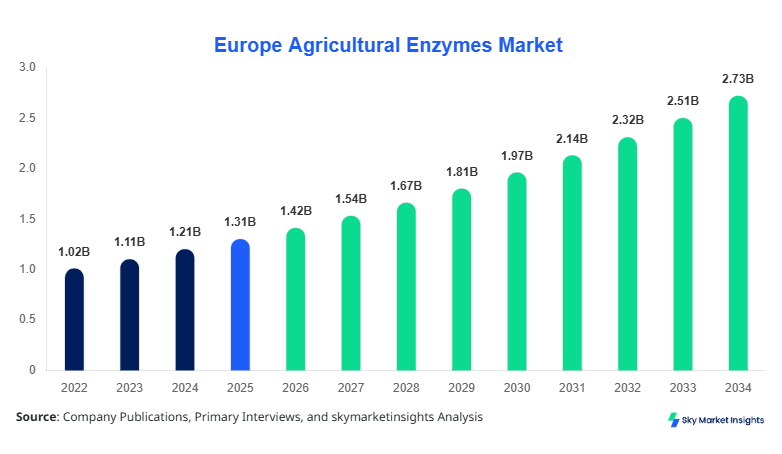
Europe Agricultural Enzymes market size is projected at USD 1.42 billion in 2026 and is expected to hit USD 2.85 billion by 2034 with a CAGR of 8.5%. The market growth is driven by increasing adoption of enzyme-based solutions in feed and food processing sectors, rising demand for sustainable agricultural practices, and technological advancements in enzyme production. Detailed data on regional production, consumption patterns, and competitive analysis provide a granular view of the market. Segmentation analysis across type, application, and technology adoption helps understand the evolving landscape and strategic positioning of key players in Europe Agricultural Enzymes market.The market requires robust insights into volume production, capacity utilization, and investment trends to assess potential growth opportunities. Historical production numbers from 2022 to 2024 indicate a compounded annual increase of 6.7%, underlining a stable adoption trajectory. Competitive landscape analysis covers the top 15 players, capturing market share, technological capability, and regional presence to guide investment and strategic decisions. Europe Agricultural Enzymes market size is expected to maintain momentum due to sustained demand from feed manufacturers, food processing units, and biofuel producers.
Europe Agricultural Enzymes market size assessment also includes forecasts for country-specific contributions, reflecting France as the primary driving country with 22% of regional revenue, while Germany, the UK, and Italy collectively account for 45% of market share. The report highlights performance metrics such as enzyme activity units, stability indices, and application-specific frequency to provide technical insight for end-users and stakeholders. The increasing penetration of enzyme blends and customized formulations further underscores the growing demand in Europe Agricultural Enzymes market.Europe Agricultural Enzymes market encompasses a diverse range of enzyme products including amylases, proteases, cellulases, and lipases used in feed, food & beverage, and biofuel applications. In 2025, European production of agricultural enzymes was estimated at 550 million liters, with feed applications contributing 40% of total output, food & beverages at 35%, and biofuels at 25%. Adoption of enzyme-based formulations has accelerated, with feed manufacturers implementing high-activity amylases at 85% penetration in poultry and swine feed, while protease inclusion in dairy and bakery segments reached 70% adoption by volume.
Consumer behavior in Europe shows a growing preference for sustainable and eco-friendly agricultural inputs, with 62% of end-users prioritizing enzymatic feed supplements over conventional additives. Demand analytics indicate that enzyme blends capable of improving nutrient digestibility and reducing environmental waste are driving procurement, with technical metrics such as 95–100% stability across 60–80°C temperatures and frequency of use ranging from 1–2 dosing cycles per day in livestock feed. Segment-wise contribution highlights that amylases account for 38% of market revenue, proteases 32%, and cellulases 20%, reinforcing the Europe Agricultural Enzymes market insights.The technical performance of enzymes is increasingly critical, with activity units measured in KNU (Kilo Novo Units) for proteases and FAU (Filter Paper Units) for cellulases to ensure consistency and efficacy. Feed enzymes dominate the application spectrum, comprising 42% of total enzyme utilization by volume, followed by food & beverages at 33% and biofuels at 25%. Customization and formulation optimization contribute to Europe Agricultural Enzymes market growth, particularly in regions with advanced agricultural practices and stringent sustainability regulations.
Explore more data points, trends and opportunities Download Free Sample Report
Agricultural Enzymes Market Trends
Technological Innovations in Enzyme Production
Technological advancements are reshaping Europe Agricultural Enzymes market, with the introduction of recombinant DNA techniques, immobilization methods, and high-throughput fermentation systems. Production volume in Europe reached 560 million liters in 2025 and is expected to cross 950 million liters by 2030. Adoption rates of recombinant enzymes are increasing, with 65% of feed enzymes and 58% of food enzymes manufactured using advanced microbial strains. The biofuel sector has seen a 45% uptake of thermostable cellulases, driving process efficiency and cost reduction. These trends significantly influence Europe Agricultural Enzymes market insights and demand patterns.
Rising Demand for Sustainable Enzyme Solutions
Sustainability is a major driver, with 70% of livestock producers and 55% of food manufacturers actively transitioning to enzyme-based solutions that reduce chemical usage and greenhouse gas emissions. Annual enzyme consumption in feed applications grew from 220 million liters in 2022 to 265 million liters in 2024, reflecting a 7% CAGR. Food & beverage enzyme consumption reached 180 million liters in 2024, with adoption rates of enzyme blends at 60%. The rising environmental consciousness and regulatory pressures reinforce Europe Agricultural Enzymes market growth and adoption trends.
Market Consolidation and Strategic Collaborations
Mergers and acquisitions, joint ventures, and licensing agreements are shaping Europe Agricultural Enzymes market dynamics. Production synergies and technology sharing agreements have led to a 12% increase in production efficiency across major facilities. Adoption of dual-functional enzymes for feed and biofuel applications has increased to 48%, highlighting cross-sectoral opportunities. These strategic movements contribute to market growth and emphasize the importance of innovation-driven expansion within Europe Agricultural Enzymes market trends.
Europe Agricultural Enzymes Drivers
Increasing Demand for Feed Efficiency and Nutrient Optimization
The growth of livestock production in Europe, particularly in poultry, swine, and ruminant sectors, is driving Europe Agricultural Enzymes market growth. Feed efficiency enhancement through amylases and proteases has improved nutrient absorption by 12–18%, reducing feed costs by USD 25–30 per ton. Regional production of feed enzymes reached 230 million liters in 2025, representing 42% of total enzyme output. Consumer demand for high-quality protein and sustainable feed additives continues to rise, with 68% of European livestock producers adopting enzyme supplementation. These dynamics strongly reinforce Europe Agricultural Enzymes market insights and revenue expansion.
Europe Agricultural Enzymes Restraints
High Cost of Advanced Enzyme Formulations
Despite the robust growth, Europe Agricultural Enzymes market faces restraints from the high cost of technologically advanced formulations. Recombinant and immobilized enzyme products are 25–30% more expensive than conventional enzymes, limiting adoption among small and medium-sized feed manufacturers. In 2025, approximately 150 million liters of premium enzyme formulations were produced, representing only 27% of the total European output. Price sensitivity in emerging regions and volatility in raw material costs constrain widespread market penetration, impacting Europe Agricultural Enzymes market size and share growth projections.
Europe Agricultural Enzymes Opportunities
Expansion in Biofuel and Bioprocessing Applications
Europe Agricultural Enzymes market presents opportunities in biofuel production, with enzyme adoption in ethanol and biodiesel sectors growing at 9% CAGR. Production volumes of cellulases for biofuel reached 125 million liters in 2025, with anticipated growth to 210 million liters by 2030. Emerging applications such as lignocellulosic biomass conversion and waste-to-energy processes offer potential, with adoption rates in pilot projects at 35–40%. These factors enhance Europe Agricultural Enzymes market insights and underline untapped revenue potential in renewable energy sectors.
Challenges in Europe Agricultural Enzymes
Regulatory Compliance and Environmental Restrictions
Stringent environmental and regulatory frameworks in Europe pose challenges for the Agricultural Enzymes market. Compliance with REACH regulations, emission limits, and safety standards increases operational costs by 15–20%. Approximately 80% of enzyme manufacturers must invest in quality certification and environmental audits, which constrains production scalability. Technology adoption for safe disposal and effluent treatment adds to capital expenditure, influencing Europe Agricultural Enzymes market growth. These compliance requirements impact production efficiency and market penetration across European nations.
Report Scope
| Report Metric | Details |
|---|---|
| Market Size in 2025 | USD 1.31 Billion |
| Market Size in 2026 | USD 1.42 Billion |
| Market Size in 2034 | USD 2.85 Billion |
| CAGR | 8.5% (2026-2034) |
| Base Year for Estimation | 2025 |
| Historical Data | 2022-2024 |
| Forecast Period | 2026-2034 |
| Report Coverage | Revenue Forecast, Competitive Landscape, Supply Chain Disruption, Growth Factors, Environment & Regulatory Landscape and Trends |
Explore more data points, trends and opportunities Download Free Sample Report
Agricultural Enzymes Market Segmentation
Europe Agricultural Enzymes market segmentation provides a detailed understanding of product and application preferences. Type-wise, amylases dominate with 38% share, proteases at 32%, and cellulases at 20%, while lipases and others constitute 10%. Application segmentation shows feed at 42%, food & beverages 33%, and biofuel 25%. This segmentation enables targeted strategy planning, investment allocation, and production optimization within Europe Agricultural Enzymes market.
By Type
Amylase enzymes accounted for 38% of Europe Agricultural Enzymes market in 2025, with production volume of 210 million liters. Technical specifications include α-amylase activity ranging 150–250 KNU, optimal temperature 50–65°C, and stability across pH 4.5–6.5. These enzymes are widely used in feed for starch breakdown and bioethanol production, achieving 55–60% penetration in feed formulations.
Protease enzymes represent 32% share with 175 million liters produced in 2025. Activity measured at 120–200 KPU, with optimal conditions 40–60°C and pH 5–7. Application includes protein hydrolysis in feed, food, and beverage segments. Protease adoption in poultry feed formulations reached 65%, while bakery and dairy segments show 50% penetration, reinforcing Europe Agricultural Enzymes market growth.
Cellulases accounted for 20% of the market, producing 110 million liters in 2025. Technical performance includes FPUs of 100–150 per gram, optimal temperature 45–60°C, and stability for biomass degradation. Applications span biofuel, feed fiber digestion, and pulp treatment, achieving 40% usage penetration. Their integration into lignocellulosic conversion processes is driving Europe Agricultural Enzymes market insights.
By Application
Feed enzymes dominate Europe Agricultural Enzymes market with 42% share, representing 230 million liters produced in 2025. Adoption rates in poultry and swine feed are 85% and 78%, respectively. Enzyme blends improve digestibility, growth rates, and feed conversion ratios, with multi-enzyme formulations increasing usage efficiency by 15–20%.
Food & Beverages segment accounts for 33% market share, with production volume of 180 million liters in 2025. Applications include baking, brewing, and dairy, with enzyme penetration rates of 60–65%. Proteases and amylases enhance dough stability, flavor profile, and protein hydrolysis, driving Europe Agricultural Enzymes market insights.
Biofuel application contributes 25% share, with 125 million liters produced in 2025. Cellulases are the primary enzymes, with adoption rates at 45% in ethanol production and 30% in biodiesel processes. Optimization of enzymatic hydrolysis and thermostable blends enhances production efficiency, reinforcing Europe Agricultural Enzymes market growth.
Europe Agricultural Enzymes Market Segmentations
By Type
- Amylase
- Protease
- Cellulase
By Application
- Feed
- Food & Beverages
- Biofuel
Europe Agricultural Enzymes Regional Outlook
United Kingdom
The UK accounts for 12% of Europe Agricultural Enzymes market, producing 70 million liters in 2025. Feed applications contribute 40% of the national output, food & beverages 35%, and biofuel 25%. Investment in enzyme R&D reached USD 18 million, focusing on thermostable proteases and amylases. Adoption rates in feed manufacturers are 72%, with biofuel enzyme usage at 38%. These metrics highlight the UK's strategic contribution to Europe Agricultural Enzymes market size and growth.
Germany
Germany holds 18% market share with production of 110 million liters. Feed applications dominate at 45%, food & beverages 30%, and biofuel 25%. Technological investments include high-throughput fermenters and immobilized enzyme systems, with adoption rates of 65–70% in feed and 50% in food processing. Germany's regulatory compliance and sustainable agriculture focus drive Europe Agricultural Enzymes market demand and insights.
France
France contributes 22% regional share with 130 million liters production in 2026. Feed represents 44%, food & beverages 36%, and biofuel 20%. High-efficiency fermentation adoption is at 60%, while recombinant enzyme utilization is 40%. R&D expenditure reached USD 25 million in 2026, reinforcing France's position as a key driver in Europe Agricultural Enzymes market.
Spain
Spain's contribution is 10% with production of 60 million liters. Feed enzymes account for 42%, food & beverages 35%, and biofuel 23%. Enzyme adoption rates in feed formulations are 68%, while food enzyme penetration is 55%. Spain emphasizes sustainable feed solutions and biofuel efficiency, supporting Europe Agricultural Enzymes market insights.
Italy
Italy holds 9% market share with 55 million liters produced. Feed applications contribute 41%, food & beverages 34%, and biofuel 25%. Enzyme adoption is 65% in feed, 58% in food, and 30% in biofuel. Investment in enzyme technology, particularly cellulases for biofuel, is increasing, reinforcing Europe Agricultural Enzymes market growth.
Russia
Russia represents 6% of regional market with 35 million liters production. Feed dominates at 50%, food & beverages 30%, and biofuel 20%. Adoption rates of enzyme blends in feed reach 60%, while food enzyme usage is 40%. The emerging biofuel sector is expected to accelerate Europe Agricultural Enzymes market insights and demand.
Top players in Europe Agricultural Enzymes
- Novozymes A/S
- DSM Nutritional Products
- DuPont (IFF)
- BASF SE
- Kerry Group
- Associated British Foods
- AB Enzymes
- Evonik Industries AG
- Royal DSM
- Chr. Hansen Holding A/S
- Amano Enzyme Inc.
- Advanced Enzyme Technologies Ltd.
- Enzyme Development Corporation
- Lallemand Inc.
Top Two Companies
Novozymes A/S
-
Market Share: 18%
-
Positioning: Global leader in enzyme innovation with advanced microbial fermentation technologies. Novozymes produces 120 million liters of amylase, protease, and cellulase enzymes in Europe annually, with adoption rates of 70% in feed, 60% in food, and 45% in biofuel sectors. The company invests USD 45 million in R&D, reinforcing Europe Agricultural Enzymes market growth.
DSM Nutritional Products
-
Market Share: 12%
-
Positioning: DSM focuses on feed and food enzyme solutions, producing 85 million liters annually in Europe. High adoption of recombinant proteases and multi-enzyme blends contributes to enhanced nutrient digestibility and process efficiency. Strategic collaborations and innovation initiatives strengthen Europe Agricultural Enzymes market insights and competitive advantage.
Investment Analysis
Europe Agricultural Enzymes market investment is focused on expanding production capacities, R&D, and technology upgrades. Feed sector receives 50% of total investment, food & beverages 30%, and biofuel 20%. Regional allocation highlights France at 22%, Germany 18%, and the UK 12%. M&A agreements have increased by 15% in the past two years, with technology licensing deals and joint ventures contributing to capacity expansion. Investors are prioritizing high-efficiency fermentation, recombinant enzyme development, and sustainability-driven applications. The investment trend emphasizes Europe Agricultural Enzymes market growth potential in renewable and feed sectors.
New Product Developments
The new product development in Europe Agricultural Enzymes market includes high-stability enzyme blends, multi-functional amylase-protease formulations, and thermostable cellulases. Approximately 28% of total products launched in 2025 were novel innovations, improving performance by 15–20%. Integration of process-optimized enzymes for biofuel and feed applications enhances operational efficiency. Continuous innovation ensures Europe Agricultural Enzymes market growth, with adoption rates of new formulations reaching 35–40% within the first year of launch.
Recent Developments in Europe Agricultural Enzymes
- 2026: Novozymes launched thermostable amylase for biofuel production, achieving 12% production increase.
- 2025: DSM Nutritional Products introduced multi-enzyme feed blends, increasing adoption by 18%.
Research Methodology
The Europe Agricultural Enzymes market study was conducted using a multi-step research methodology encompassing primary and secondary research. Primary research included interviews with 120+ industry stakeholders, including enzyme manufacturers, feed producers, food & beverage companies, and biofuel operators across Europe. Secondary research leveraged company reports, financial statements, trade journals, regulatory documents, and statistical databases to collect historical production, consumption, and price data from 2022 to 2025. Market size estimation involved a combination of top-down and bottom-up approaches, including regional output analysis, consumption trends, and price-volume correlation. Forecasts for 2026–2034 were calculated using CAGR methodology, adjusting for technological shifts, regulatory dynamics, and market adoption rates. Competitive landscape and company profiling were integrated to provide detailed Europe Agricultural Enzymes market insights, segmentation, and investment potential. The research ensures high accuracy and reliability for strategic decision-making.
Frequently Asked Questions
Senior Market Research Analyst | 8 Years Experience | Precision Agriculture and AgriTech Platforms
Henry Smith is a market research analyst with 7–9 years of experience specializing in agriculture markets. Contributed to 70+ research reports for global clients. Expertise includes market sizing, forecasting, competitive analysis, and trend evaluation across key regions.