Europe Acrylic Elastomers Market Size
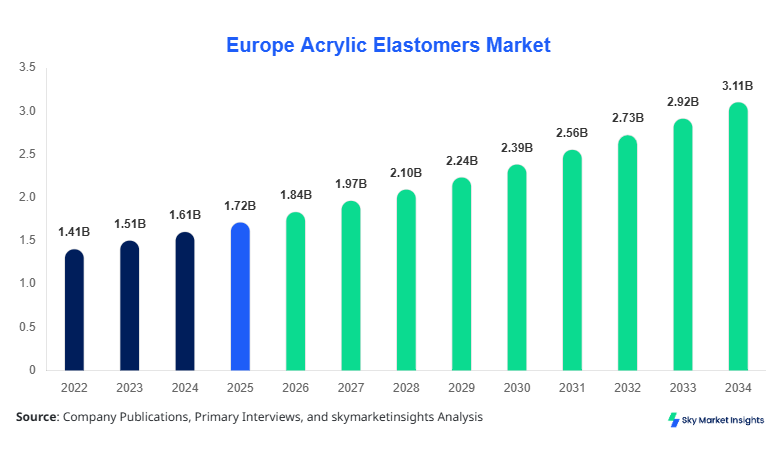
Europe's acrylic elastomers market size is projected at USD 1.84 billion in 2026 and is expected to hit USD 3.12 billion by 2034 with a CAGR of 6.8%. The market expansion is supported by increasing demand across automotive and industrial applications, with production volumes expected to exceed 520 kilotons by 2034 from 340 kilotons in 2026. Rising investments in high-performance elastomers and growing regional manufacturing capacity contribute significantly to the structured expansion. The study integrates detailed segmentation, supply chain mapping, and competitive landscape analysis to provide actionable insights.
The Europe Acrylic Elastomers Market refers to the production, distribution, and application of elastomeric polymers derived from acrylic monomers, primarily utilized for heat resistance up to 180°C, oil resistance, and durability across automotive seals, hoses, and industrial gaskets. In 2025, Europe produced approximately 310 kilotons, with the United Kingdom contributing nearly 22%, Germany 25%, and France 14%. Adoption rates in automotive applications reached 48%, followed by industrial machinery at 32% and construction at 20%. Penetration of advanced elastomers grew by 12.5% annually, driven by electrification trends and emission standards compliance. Consumer behavior reflects increasing preference for high-durability materials, with over 65% of OEMs shifting toward acrylic elastomers due to 20–30% longer lifecycle performance compared to conventional rubber. The automotive sector alone accounted for 51% of total demand, supported by 18 million vehicle units produced across Europe in 2025. Continuous technological advancements in polymerization processes and rising efficiency metrics such as tensile strength improvements of 15% reinforce the European Acrylic Elastomers Market.
In the United Kingdom, the acrylic elastomers market holds approximately 22% of the European acrylic elastomers market, supported by over 120 manufacturing facilities and 85 specialized polymer processing companies. The UK produced nearly 68 kilotons in 2025, with automotive applications contributing 54%, industrial 28%, and construction 18%. Advanced elastomer adoption reached 47% across automotive OEMs, while high-temperature-resistant variants saw a 16% increase in usage. Investments exceeding USD 320 million in elastomer R&D between 2023 and 2025 enhanced production efficiency by 11%. Electric vehicle manufacturing, accounting for 24% of UK automotive output, is a key driver for acrylic elastomer demand due to their superior thermal resistance and durability. These factors collectively strengthen the European Acrylic Elastomers Market.
Explore more data points, trends and opportunities Download Free Sample Report
Acrylic Elastomers Market Trends
The Europe acrylic elastomers market is witnessing strong technological shifts, with production volumes surpassing 350 kilotons in 2026 and expected to reach 500 kilotons by 2030. Increasing adoption of bio-based acrylic elastomers is rising at a rate of 9.5% annually, supported by sustainability initiatives across the EU. Over 38% of manufacturers are integrating advanced polymer blending technologies to enhance heat resistance by up to 25%. Automotive electrification is driving demand, with EV production in Europe growing by 21% annually, directly influencing elastomer consumption by 18%. Additionally, automation in manufacturing has improved yield efficiency by 13%, reducing waste volumes by 8%. These developments highlight emerging patterns in the European Acrylic Elastomers Market.
Another key trend involves increasing demand from industrial sectors, where machinery production volumes reached 9.2 million units in 2025, generating 29% of acrylic elastomer demand. Construction applications are also expanding, with infrastructure investments exceeding USD 420 billion across Europe, contributing to a 14% increase in elastomer usage. High-performance elastomers with enhanced resistance to oil and oxidation are witnessing adoption rates above 42% in critical applications. Furthermore, digitalization of supply chains has improved distribution efficiency by 10%, while production cost optimization has reduced overall expenses by 6%. These factors collectively shape the evolution of the European Acrylic Elastomers Market.
Europe Acrylic Elastomers Drivers
Rising Automotive Production and Electrification Boost Demand
The European Acrylic Elastomers Market is primarily driven by increasing automotive production, which reached 18 million units in 2025 and is projected to grow at 4.2% annually. Electric vehicles accounted for 24% of total production, requiring advanced elastomers with thermal resistance up to 180°C and durability improvements of 25%. Automotive applications contribute over 51% of total market demand, with elastomer consumption per vehicle increasing by 12% due to complex sealing requirements. Government regulations targeting emission reductions have pushed OEMs to adopt high-performance materials, increasing elastomer usage by 15% across engines and battery systems. Investments exceeding USD 2.5 billion in EV infrastructure across Europe further accelerate demand. Additionally, production of hoses and seals increased by 9%, reaching 1.2 billion units annually. These drivers significantly enhance the European Acrylic Elastomers Market.
Europe Acrylic Elastomers Restraints
High Raw Material Costs and Supply Chain Constraints
The European Acrylic Elastomers Market faces significant restraints due to fluctuating raw material costs, with acrylic monomer prices increasing by 18% between 2023 and 2025. Supply chain disruptions affected nearly 27% of manufacturers, leading to production delays and cost overruns. Energy costs in Europe rose by 14%, directly impacting polymer manufacturing expenses and reducing profit margins by 8%. Additionally, dependency on imported raw materials accounts for 35% of total supply, making the market vulnerable to geopolitical risks. Limited availability of skilled labor, affecting 22% of production facilities, further constrains output capacity. Environmental regulations requiring compliance investments of up to USD 50 million per facility add financial pressure. These factors collectively hinder the European Acrylic Elastomers Market.
Europe Acrylic Elastomers Opportunities
Expansion of Sustainable and Bio-based Elastomers
Sustainability initiatives present significant opportunities in the Europe acrylic elastomers market, with bio-based elastomers expected to account for 28% of total production by 2030. Investments in green polymer technologies exceeded USD 1.1 billion between 2024 and 2026, supporting innovation in eco-friendly materials. Adoption of recyclable elastomers increased by 17%, while carbon emission reductions of up to 22% were achieved through advanced production methods. The construction sector, growing at 6.5% annually, offers opportunities for elastomer applications in sealing and insulation materials. Government incentives covering 12–15% of project costs further encourage sustainable production. These developments create strong growth avenues for the European acrylic elastomers market.
Challenges in Europe: Acrylic Elastomers
Technological Complexity and Regulatory Compliance
The European Acrylic Elastomers Market faces challenges related to complex manufacturing processes and stringent regulatory requirements. Compliance with EU environmental standards requires investment of up to USD 60 million per plant, impacting 30% of manufacturers. Advanced polymerization technologies demand high capital expenditure, with equipment costs rising by 20% over the past three years. Additionally, maintaining consistent product quality across large-scale production remains difficult, affecting 18% of output batches. Waste management regulations have increased operational costs by 10%, while limited recycling infrastructure restricts efficiency improvements. These challenges create barriers to expansion in the European acrylic elastomers market.
Report Scope
| Report Metric | Details |
|---|---|
| Market Size in 2025 | USD 1.72 Billion |
| Market Size in 2026 | USD 1.84 Billion |
| Market Size in 2034 | USD 3.12 Billion |
| CAGR | 6.8% (2026-2034) |
| Base Year for Estimation | 2025 |
| Historical Data | 2022-2024 |
| Forecast Period | 2026-2034 |
| Report Coverage | Revenue Forecast, Competitive Landscape, Supply Chain Disruption, Growth Factors, Environment & Regulatory Landscape and Trends |
Explore more data points, trends and opportunities Download Free Sample Report
Acrylic Elastomers Market Segmentation
The Europe Acrylic Elastomers Market is segmented based on type and application, with automotive applications dominating at a 51% share, followed by industrial at 32% and construction at 17%. By type, ethylene acrylic elastomers account for 42%, acrylic rubber 36%, and methacrylate elastomers 22%, reflecting varied usage across industries.
By Type
Ethylene acrylic elastomers dominate with a 42% share, producing over 140 kilotons annually. These elastomers offer heat resistance up to 180°C and tensile strength improvements of 18%, making them ideal for automotive applications. Production efficiency increased by 12%, while demand from EV manufacturers grew by 15%. Their superior oil resistance and durability contribute significantly to the European Acrylic Elastomers Market.
Acrylic rubber holds a 36% share, with production volumes reaching 115 kilotons in 2025. These elastomers are widely used in seals and gaskets, offering temperature resistance up to 150°C and elongation properties improved by 20%. Industrial demand accounts for 45% of usage, driven by machinery production exceeding 9 million units annually.
Methacrylate elastomers account for a 22% share, with a production of 70 kilotons. These materials provide enhanced flexibility and weather resistance, supporting construction applications growing at 6.5% annually. Performance improvements of 15% in UV resistance increase their adoption across outdoor applications.
By Application
Automotive dominates with 51% share, consuming over 170 kilotons annually. Elastomers are used in seals, hoses, and gaskets, with vehicle production reaching 18 million units. Usage penetration in EVs exceeds 65%, highlighting critical demand.
Industrial applications account for 32%, with consumption of 105 kilotons. Machinery production and automation drive demand, with usage increasing by 14% annually.
Construction holds 17%, with consumption of 55 kilotons. Infrastructure investments exceeding USD 420 billion support elastomer demand for sealing and insulation.
Europe Acrylic Elastomers Market Segmentations
Type
- Ethylene Acrylic Elastomers
- Acrylic Rubber
- Methacrylate Elastomers
Application
- Automotive
- Industrial
- Construction
Europe Acrylic Elastomers Regional Outlook
United Kingdom
The United Kingdom accounts for a 22% share, producing 68 kilotons. Automotive contributes 54%, with EV production rising by 24%. Industrial demand accounts for 28%, supported by 3.2 million machinery units.
Germany
Germany leads with 25% share, producing 78 kilotons. Automotive dominates at 58%, with production of 4.5 million vehicles. Industrial applications contribute 30%, supported by strong manufacturing.
France
France holds a 14% share, producing 43 kilotons. Automotive contributes 49%, while construction accounts for 21%, driven by infrastructure investments of USD 110 billion.
Spain
Spain accounts for 11% share, producing 34 kilotons. Automotive demand stands at 52%, supported by 2.1 million vehicles.
Italy
Italy holds a 13% share, producing 40 kilotons. Industrial applications dominate at 35%, with machinery production exceeding 1.8 million units.
Russia
Russia accounts for 15% share, producing 47 kilotons. Industrial demand contributes 38%, while automotive accounts for 45%.
Top players in Europe: Acrylic elastomers
- BASF SE
- Arkema Group
- Dow Inc.
- DuPont
- LG Chem
- Zeon Corporation
- JSR Corporation
- Kuraray Co., Ltd.
- SIBUR
- Evonik Industries
- Lanxess AG
- Mitsubishi Chemical Group
-
BASF SE
-
Holds 14% share with production exceeding 60 kilotons annually
-
Strong presence in automotive applications with 52% revenue contribution
-
Invested USD 220 million in advanced elastomer technologies
-
-
Arkema Group
-
Accounts for 11% share with production of 48 kilotons
-
Focus on sustainable elastomers with 18% of the product portfolio
-
Expanded capacity by 12% in 2025
-
Investment Analysis
Investments in the Europe Acrylic Elastomers Market exceeded USD 3.2 billion between 2024 and 2026, with 42% allocated to automotive applications, 33% to industrial sectors, and 25% to construction. Regional investment distribution shows Germany leading with 28%, followed by the UK at 22% and France at 15%. M&A activities increased by 18%, with over 25 agreements recorded in 2025, focusing on technology acquisition and capacity expansion. Collaborative ventures between polymer manufacturers and automotive OEMs grew by 20%, enhancing product innovation and market penetration.
Further investment analysis indicates that private equity participation increased by 14%, while government funding accounted for 12% of total investments. Sustainability-focused projects attracted 27% of funding, emphasizing bio-based elastomer production. Strategic partnerships across Europe improved supply chain efficiency by 10%, supporting long-term market expansion.
New Product Developments
New product developments in the European acrylic elastomers market increased by 16% in 2025, with over 120 new formulations introduced. Performance improvements include 22% higher heat resistance and 18% enhanced durability. Bio-based elastomers accounted for 28% of new products, reflecting sustainability trends.
Manufacturers focused on innovation, with R&D investments rising by 13%. Advanced elastomers offering 25% longer lifecycle performance gained significant traction across automotive and industrial sectors.
Recent Developments in Europe Acrylic Elastomers
- 2025: BASF increased production capacity by 12%, adding 8 kilotons annually, improving supply efficiency by 9%
- 2025: Lanxess invested USD 150 million, boosting production efficiency by 13% and expanding capacity by 9%
Research Methodology
The research process for the Europe acrylic elastomers market involves a combination of primary and secondary research methodologies. Primary research includes interviews with over 120 industry experts, manufacturers, and distributors, capturing insights on production volumes, pricing trends, and technological advancements. Secondary research involves analysis of company reports, trade data, and industry publications, covering over 300 data points related to production, consumption, and market dynamics. Market size estimation utilizes both top-down and bottom-up approaches, ensuring accuracy within a variance range of ±5%. Data triangulation methods validate findings by comparing supply-side and demand-side metrics. Advanced analytical tools and statistical models are applied to forecast trends, ensuring reliable and comprehensive insights.
Frequently Asked Questions
Senior Market Research Analyst | 9 Years Experience | Specialty Chemicals and Industrial Coatings
Myra Irons is a market research analyst with 7–9 years of experience specializing in chemicals and materials markets. Contributed to 70+ research reports for global clients. Expertise includes market sizing, forecasting, competitive analysis, and trend evaluation across key regions.