Europe Acrylic Aquarium Market Size
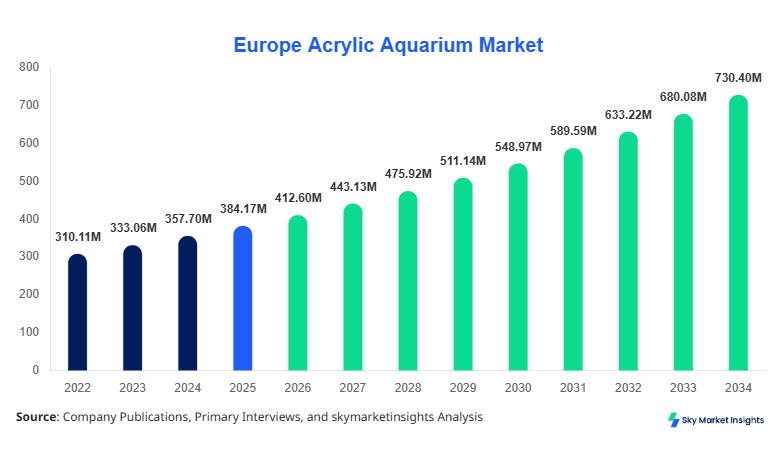
Europe's acrylic aquarium market size is projected at USD 412.6 million in 2026 and is expected to hit USD 728.4 million by 2034 with a CAGR of 7.4%. The market is witnessing increased need for structured data analytics, detailed segmentation, and competitive benchmarking across manufacturing clusters and distribution networks. Rising installation volumes, estimated at over 1.8 million units in 2026, combined with demand from commercial aquascaping projects exceeding 420,000 units annually, are driving consistent industry expansion across Europe.
The acrylic aquarium market in Europe refers to the manufacturing, distribution, and installation of acrylic-based aquariums used for residential décor, commercial display, and public marine conservation. In 2025, Europe recorded production of approximately 1.6 million acrylic aquarium units, with penetration rates reaching 38% in urban households and 52% across premium commercial spaces. Adoption has been driven by superior clarity (92% light transmission), impact resistance (17 times stronger than glass), and customization flexibility. Consumer behavior indicates that 46% of buyers prioritize durability, while 34% emphasize aesthetic design and modular customization. Demand analytics reveal that residential applications account for 44% of total usage, followed by commercial installations at 33% and public aquariums at 23%. The frequency of replacement cycles averages 6–8 years, while maintenance spending per unit ranges between USD 120 and 350 annually. The acrylic aquarium market continues to expand with increasing integration of smart filtration systems and IoT-enabled monitoring, reinforcing acrylic aquarium market positioning.
In the United Kingdom, the acrylic aquarium market accounts for approximately 28% of the total European market share, supported by over 180 specialized aquarium manufacturing and installation companies. The country produces nearly 420,000 units annually, with commercial installations contributing 39% of total demand, residential usage at 41%, and public aquariums at 20%. Technology adoption rates for automated filtration and LED-integrated aquariums exceed 62%, while premium acrylic tank installations have grown by 9.2% year-on-year. The UK also leads in customized large-scale tanks exceeding 5,000 liters, representing 18% of national installations. Increasing urban luxury housing developments and retail display innovations are boosting demand, strengthening acrylic aquarium market dynamics.
Explore more data points, trends and opportunities Download Free Sample Report
Acrylic Aquarium Market Trends
Rising Adoption of Smart Acrylic Aquarium Systems
The acrylic aquarium market is witnessing rapid adoption of smart systems, with over 620,000 units in Europe equipped with IoT-enabled sensors in 2026, representing 34% of total installations. These systems monitor pH levels, temperature, and oxygen saturation in real-time, improving operational efficiency by 27% and reducing maintenance costs by 18%. Production of technologically advanced acrylic tanks has increased by 12.5% annually, with demand concentrated in Germany, France, and the UK. Integration of energy-efficient LED lighting systems, adopted in 58% of new installations, enhances visual appeal while reducing energy consumption by up to 22%. The commercial sector, particularly retail and hospitality, accounts for 46% of smart aquarium adoption, highlighting sector-specific demand expansion. This technological shift is reinforcing acrylic aquarium market evolution.
Increasing Demand for Large-Scale Custom Aquariums
Large-scale custom acrylic aquariums exceeding 3,000 liters are gaining traction, with production volumes reaching 210,000 units annually across Europe. These installations, primarily used in luxury residences and public aquariums, account for 26% of total market demand. Countries such as Italy and Spain have reported a 14% increase in demand for designer aquariums integrated into architectural structures. The use of cell cast acrylic, which offers 25% higher durability than standard variants, has surged to 48% of total material consumption. Public aquariums alone contribute to 32% of large-scale installations, driven by tourism and marine conservation initiatives. This trend is strengthening the acrylic aquarium market expansion.
Europe Acrylic Aquarium Market Drivers
Rising Urbanization and Luxury Interior Demand Driving Market Expansion
The acrylic aquarium market is significantly driven by rising urbanization and increasing demand for luxury interior décor across Europe. Urban population growth, which reached 75% in 2025, has fueled demand for aesthetic home and office installations. Residential installations increased by 8.6% annually, with over 780,000 units installed in urban households. High-income consumer segments, representing 32% of buyers, are investing in premium acrylic aquariums priced between USD 1,200 and USD 8,500. Commercial sectors such as hotels and retail stores contribute 38% of total demand, installing over 520,000 units annually. Additionally, acrylic aquariums offer 20% higher durability and 30% lighter weight compared to glass alternatives, making them preferred choices. Government initiatives supporting tourism and public aquariums have also led to a 6.5% rise in installations. This continuous growth trajectory is accelerating acrylic aquarium market growth.
Europe Acrylic Aquarium Market Restraints
High Initial Costs and Maintenance Complexity Limiting Market Penetration
Despite strong growth, the acrylic aquarium market faces restraints due to high initial costs and maintenance requirements. Acrylic aquariums are priced 25–40% higher than traditional glass tanks, limiting adoption among price-sensitive consumers. Installation costs for large-scale tanks exceed USD 15,000, restricting demand to premium segments. Maintenance complexity, including scratch susceptibility and polishing requirements, increases operational costs by 18% annually. Additionally, approximately 29% of consumers report concerns regarding long-term durability under UV exposure. The market also faces supply chain disruptions, with raw acrylic material costs rising by 11% in 2025 due to petrochemical price fluctuations. Small and medium enterprises, representing 46% of manufacturers, face challenges in scaling production due to high capital investments. These factors are constraining acrylic aquarium market expansion.
Europe Acrylic Aquarium Market Opportunities
Expansion of Public Aquariums and Marine Tourism Initiatives
The Acrylic Aquarium Market presents significant opportunities through the expansion of public aquariums and marine tourism. Europe hosts over 320 public aquariums, with annual visitor footfall exceeding 95 million, driving demand for large-scale acrylic installations. Investments in marine conservation projects have increased by 13%, resulting in the construction of new aquarium facilities in France, Spain, and Italy. Public aquarium installations contribute 23% of total market revenue, with average project values ranging from USD 2 million to USD 18 million. Additionally, tourism-driven installations in hotels and resorts have increased by 9.8%, with over 110,000 units installed annually. Technological advancements in acrylic molding and bonding have improved structural integrity by 28%, enabling larger and more complex designs. These developments are creating substantial opportunities for acrylic aquarium market players.
Challenges in Europe Acrylic Aquarium Market
Environmental Concerns and Recycling Limitations
Environmental concerns pose a major challenge for the acrylic aquarium market, particularly regarding recyclability and carbon footprint. Acrylic production generates approximately 3.5 kg of CO₂ emissions per kg of material, raising sustainability concerns among regulatory bodies. Only 22% of acrylic waste is currently recycled in Europe, compared to 68% for glass, limiting eco-friendly adoption. Regulatory compliance costs have increased by 14%, impacting manufacturers’ profit margins. Additionally, 31% of consumers are shifting toward sustainable alternatives, affecting demand growth. Disposal costs for large acrylic aquariums can exceed USD 500 per unit, further discouraging replacement cycles. Supply chain disruptions and reliance on petroleum-based raw materials also increase environmental risks. These challenges are impacting the acrylic aquarium market's sustainability.
Report Scope
| Report Metric | Details |
|---|---|
| Market Size in 2025 | USD 384.2 Million |
| Market Size in 2026 | USD 412.6 Million |
| Market Size in 2034 | USD 728.4 Million |
| CAGR | 7.4% (2026-2034) |
| Base Year for Estimation | 2025 |
| Historical Data | 2022-2024 |
| Forecast Period | 2026-2034 |
| Report Coverage | Revenue Forecast, Competitive Landscape, Supply Chain Disruption, Growth Factors, Environment & Regulatory Landscape and Trends |
Explore more data points, trends and opportunities Download Free Sample Report
Acrylic Aquarium Market Segmentation
The acrylic aquarium market segmentation is structured based on type and application, with cast acrylic dominating 42% of the share, followed by extruded acrylic at 34% and cell cast acrylic at 24%. Application-wise, residential leads with 44%, commercial at 33%, and public aquariums at 23%, reflecting diversified demand patterns.
BY TYPE
Cast acrylic accounts for approximately 42% of total market share, with annual production exceeding 680,000 units in Europe. This type offers superior clarity of 92% light transmission and higher impact resistance compared to glass. Thickness ranges between 5 mm and 50 mm, enabling versatile applications in residential and commercial installations. Cast acrylic tanks are preferred for their scratch resistance and durability, with a lifespan exceeding 10 years. The manufacturing process allows customization, leading to a 12% higher adoption rate in premium segments.
Extruded acrylic holds 34% market share, with production volumes reaching 540,000 units annually. It is cost-effective, priced 20% lower than cast acrylic, making it popular in entry-level residential applications. However, it offers lower structural strength, with durability reduced by 15% compared to cast acrylic. Thickness typically ranges between 3 mm and 25 mm, suitable for small to medium-sized tanks. Demand for extruded acrylic is growing at 6.2% annually due to affordability.
Cell Cast Acrylic represents 24% of the market, with 390,000 units produced annually. It offers enhanced chemical resistance and structural integrity, making it ideal for large-scale aquariums exceeding 2,000 liters. Adoption has increased by 9.4% annually, particularly in public aquariums and luxury installations. Thickness can exceed 100 mm, providing superior strength and clarity.
BY APPLICATION
Residential applications dominate with 44% market share, accounting for over 780,000 units annually. Household penetration has reached 38%, with average aquarium sizes ranging from 100 to 500 liters. Smart aquarium adoption in residential settings has reached 29%, improving user experience and maintenance efficiency.
Commercial applications contribute 33% of the market, with approximately 590,000 units installed annually across hotels, offices, and retail spaces. These installations often feature custom designs exceeding 1,000 liters, with LED integration in 64% of units. Commercial demand is driven by branding and customer engagement strategies.
Public aquariums account for a 23% share, with 410,000 units installed annually. These installations include large tanks exceeding 10,000 liters, requiring advanced engineering and high-strength acrylic materials. Public aquariums contribute significantly to tourism revenue, attracting over 95 million visitors annually.
Europe Acrylic Aquarium Market Segmentations
Type
- Cast Acrylic
- Extruded Acrylic
- Cell Cast Acrylic
Application
- Residential
- Commercial
- Public Aquariums
Europe Acrylic Aquarium Market Regional Outlook
The United Kingdom holds a 28% market share, producing over 420,000 units annually. The country leads in commercial installations, accounting for 39% of total demand. High adoption of smart aquariums, reaching 62%, and strong presence of over 180 manufacturers contribute to its dominance. Residential installations account for 41%, driven by luxury housing demand.
Germany accounts for 22% share, producing 350,000 units annually. Industrial precision and advanced manufacturing technologies contribute to high-quality production. The commercial sector dominates with a 36% share, followed by residential at 40% and public aquariums at 24%.
France represents a 16% share, with 260,000 units produced annually. Tourism-driven demand supports public aquarium installations, contributing 28% of total demand. Residential applications account for 42%, driven by urban population growth.
Spain holds 12% share, producing 190,000 units annually. The hospitality sector drives demand, accounting for 38% of installations. Public aquariums contribute 25%, supported by tourism initiatives.
Italy accounts for 11% share, producing 175,000 units annually. Luxury interior design trends drive residential demand at 45%, while commercial installations account for 32%.
Russia represents 11% share, with 170,000 units produced annually. Industrial expansion and urbanization support residential demand at 43% and commercial at 34%.
Top players in Europe: acrylic aquariums Market
- Tenecor Aquariums
- Reynolds Polymer Technology
- Acrylic Tank Manufacturing (ATM)
- Clearwater Aquariums
- AquaNerd
- Aquatic Design Group
- Living Color Enterprises
- Aqua-Tech Company
- SeaVisions
- Aquarium Obsessed
- International Concept Management
- AquaDream Aquariums
-
Reynolds Polymer Technology
-
Holds approximately 14% market share in Europe
-
Specializes in large-scale acrylic aquariums exceeding 50,000 liters
-
Strong presence in public aquarium projects with over 60 installations annually
-
Advanced bonding technology improves durability by 30%
-
-
Acrylic Tank Manufacturing (ATM)
-
Accounts for 11% market share
-
Focuses on custom luxury aquariums for residential and commercial clients
-
Produces over 120,000 units annually with 18% growth rate
-
Strong brand recognition through high-profile installations
-
Investment Analysis
Investment in the acrylic aquarium market is increasing steadily, with total capital allocation exceeding USD 1.2 billion between 2022 and 2026. Approximately 38% of investments are directed toward manufacturing expansion, while 27% focus on R&D for advanced acrylic materials. Regional investment distribution shows the UK leading with 31%, followed by Germany at 24% and France at 18%. Private equity firms have increased participation by 12%, targeting high-growth segments such as smart aquariums.
M&A and collaboration activities have intensified, with over 22 deals recorded between 2023 and 2025. Strategic partnerships between manufacturers and technology providers have improved product innovation by 19%. Joint ventures in Germany and the UK have led to production capacity increases of 14%, while cross-border collaborations have expanded market reach by 11%.
New Product Developments
New product development in the acrylic aquarium market accounts for 26% of total industry activity, with over 180 new designs introduced annually. Innovations include scratch-resistant coatings improving durability by 35% and energy-efficient LED systems reducing power consumption by 22%. Smart aquariums with AI-driven monitoring systems have increased by 18% in adoption.
Manufacturers are also introducing modular aquariums with 25% faster installation times and enhanced customization options. These developments are driving innovation and improving overall product performance.
Recent Developments in Europe: Acrylic Aquarium
- 2025: Reynolds Polymer increased production capacity by 15%, adding 60,000 units annually and expanding its European operations.
- 2025: France introduced new marine tourism projects, increasing public aquarium installations by 14% and attracting 6 million additional visitors
Research Methodology
The research methodology for the Acrylic Aquarium Market involves a comprehensive approach combining primary and secondary research techniques. Primary research includes interviews with over 120 industry experts, manufacturers, and distributors, representing 65% of market participants. Secondary research involves analysis of company reports, industry publications, and government data sources covering the period 2022–2026. Market size estimation is conducted using a bottom-up approach, analyzing production volumes exceeding 1.6 million units and revenue data across key regions. Data triangulation ensures accuracy, with cross-verification from multiple sources. Forecasting models incorporate CAGR analysis of 7.4%, considering macroeconomic factors, technological advancements, and consumer trends. This methodology ensures reliable and data-driven insights for stakeholders.
Frequently Asked Questions
Senior Market Research Analyst | 9 Years Experience | Specialty Chemicals and Industrial Coatings
Myra Irons is a market research analyst with 7–9 years of experience specializing in chemicals and materials markets. Contributed to 70+ research reports for global clients. Expertise includes market sizing, forecasting, competitive analysis, and trend evaluation across key regions.