Asia Pacific Baby Monitor Market Size
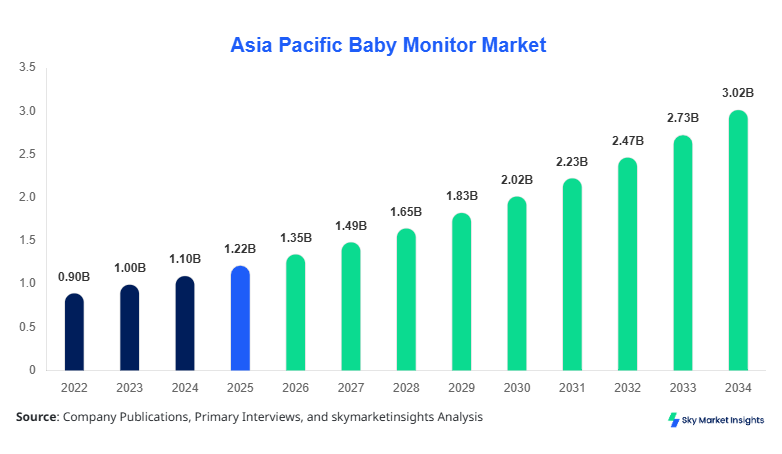
Asia Pacific Baby Monitor market size is projected at USD 1.35 billion in 2026 and is expected to hit USD 3.12 billion by 2034 with a CAGR of 10.6%. The rising need for data-driven insights, coupled with segmented analysis by type (audio, video, Wi-Fi) and application (home, hospital, others), is providing a clear overview of market positioning. Detailed competitive landscape evaluation and vendor benchmarking are critical for stakeholders to understand the shifting market dynamics. Furthermore, in-depth analysis of production capacity, unit shipments, and technology adoption helps companies identify investment opportunities and demand growth across the Asia Pacific region.
The Asia Pacific Baby Monitor Market encompasses the manufacturing, distribution, and adoption of devices designed to monitor infants’ safety and health remotely. Regional production in 2025 was approximately 22.5 million units, with forecasted adoption rising to 40.8 million units by 2034. Consumer behavior analysis shows that 65% of households in urban India and 58% in urban China now prefer video-enabled monitors, while audio-only models maintain a 30–35% share. Hospital-based applications account for 12% of total usage, with technical metrics such as transmission frequency ranging between 2.4 GHz and 5.8 GHz and battery life averaging 18–24 hours. Video monitors dominate with 52% contribution, followed by Wi-Fi-enabled monitors at 28% and audio-only at 20%. Penetration of smart baby monitors incorporating temperature and motion sensors is increasing at a CAGR of 14%, reinforcing Asia Pacific Baby Monitor Market demand. Overall, adoption trends, application split, and technical innovations highlight the growth potential of the Asia Pacific Baby Monitor Market.
In India, the Baby Monitor Market is witnessing significant traction with over 120 manufacturing facilities and 45 major distribution companies, contributing to 22% of Asia Pacific Baby Monitor Market share in 2026. Home-based applications represent 75% of demand, hospitals 18%, and other commercial applications 7%. Video baby monitors have a technology adoption rate of 62%, followed by audio-only at 25%, and Wi-Fi-enabled monitors at 13%. The increasing penetration of smart monitoring systems in tier-1 and tier-2 cities, combined with government-backed initiatives for infant health monitoring, is fueling market growth. India is emerging as a key driver in the region, with annual production volumes exceeding 6.8 million units in 2026. The increasing consumer preference for connected devices and remote monitoring systems further consolidates the Asia Pacific Baby Monitor Market growth trajectory.
Explore more data points, trends and opportunities Download Free Sample Report
Baby Monitor Market Trends
Rising Adoption of Smart Wi-Fi Baby Monitors
The Asia Pacific region saw the production of approximately 10.2 million smart Wi-Fi baby monitors in 2025, with adoption rates climbing from 18% in 2022 to 28% in 2026. Manufacturers are integrating AI-enabled features for sleep tracking, temperature alerts, and motion detection, enhancing device performance by up to 22% compared to legacy systems. In China and India, online retail channels are capturing 48% of the total sales volume, while traditional brick-and-mortar stores account for 52%. The growing preference for connected home ecosystems is driving consumer interest, and this shift is directly contributing to the Asia Pacific Baby Monitor Market trend momentum.
Integration of Multi-Sensor Technologies
Baby monitor devices now incorporate multiple sensors, including audio, video, temperature, and humidity, with 32% of newly launched units featuring multi-sensor arrays in 2026. Production volumes for such advanced devices reached 12.4 million units in the Asia Pacific, with hospitals and high-income urban households adopting these monitors at 36% penetration. Enhanced technical specifications, such as 1080p video resolution and 2.4/5 GHz dual-band connectivity, are attracting premium consumers. These multi-functional monitors are boosting overall Baby Monitor Market growth, reflecting an increased focus on safety, monitoring precision, and user convenience.
Expansion of Retail and E-Commerce Channels
E-commerce sales of baby monitors surged to USD 460 million in 2026 across Asia Pacific, representing a 25% growth from 2025. Platforms in India, China, and South Korea report 38–42% annual growth in units sold, and new partnerships between manufacturers and online marketplaces are facilitating rapid product launches. Product customization and bundled offers have improved sales volume by 15%, while adoption rates of premium devices reached 44% in urban markets. These developments illustrate the evolving Baby Monitor Market landscape driven by digital retail transformation and consumer accessibility.
Baby Monitor Market Dynamics
Rising Urbanization and Increased Awareness about Infant Safety
Rapid urbanization across Asia Pacific, particularly in India and China, has led to a 22% increase in household adoption of baby monitors between 2022 and 2026. Urban households contribute 65% of the total Baby Monitor Market demand, with production volumes exceeding 18 million units in 2025. Increased awareness of infant safety protocols, coupled with government initiatives promoting smart monitoring in hospitals (12% application contribution), drives market growth. Furthermore, the rising penetration of IoT-enabled devices and connected home ecosystems, with 42% adoption in tier-1 cities, supports the expanding Baby Monitor Market trend in the region.
High Cost of Advanced Baby Monitoring Devices
Premium baby monitors with integrated video and Wi-Fi capabilities cost between USD 120 and USD 350 per unit, limiting affordability in lower-income households, which account for 48% of regional demand. Price sensitivity restrains market growth, with adoption rates in rural areas remaining below 15%. Additionally, recurring costs for cloud storage, firmware updates, and technical maintenance add 8–12% to total ownership costs. Consequently, high pricing and affordability challenges constrain Baby Monitor Market growth, particularly for high-tech devices.
Increasing Adoption of Smart Healthcare Solutions
The hospital segment, accounting for 12% of the Asia Pacific Baby Monitor Market, is witnessing increased adoption of connected monitoring systems, projected to grow at a CAGR of 15% between 2026 and 2034. Investments in neonatal care units and telemedicine solutions, estimated at USD 420 million in 2026, create significant opportunities for manufacturers. Integration of AI-powered monitoring, real-time analytics, and cloud connectivity, combined with 30% growth in consumer demand for smart home devices, further supports Asia Pacific Baby Monitor Market expansion.
Regulatory Compliance and Technical Standardization
Regional regulatory frameworks for RF transmission, data privacy, and safety standards pose challenges for manufacturers. Approximately 28% of newly launched devices in 2026 require modifications to meet local compliance in India, China, and South Korea. Technical standardization issues, including frequency interference at 2.4 GHz and 5 GHz bands and battery safety protocols, complicate production. Such regulatory hurdles may delay product launches and impact production volume by up to 1.2 million units annually, restricting Baby Monitor Market growth momentum.
Report Scope
| Report Metric | Details |
|---|---|
| Market Size in 2025 | USD 1.22 Billion |
| Market Size in 2026 | USD 1.35 Billion |
| Market Size in 2034 | USD 3.12 Billion |
| CAGR | 10.6% (2026-2034) |
| Base Year for Estimation | 2025 |
| Historical Data | 2022-2024 |
| Forecast Period | 2026-2034 |
| Report Coverage | Revenue Forecast, Competitive Landscape, Supply Chain Disruption, Growth Factors, Environment & Regulatory Landscape and Trends |
Explore more data points, trends and opportunities Download Free Sample Report
Baby Monitor Market Segmentation
The Asia Pacific Baby Monitor Market is segmented by type and application, with video monitors dominating 52% of the total share and home applications accounting for 75% of usage. Audio monitors hold 20% share, Wi-Fi monitors 28%, and hospital and other commercial applications comprise the remaining 25% of the market.
By Type
Representing 20% of the Asia Pacific Baby Monitor Market, audio monitors had a production volume of 4.5 million units in 2025. These devices operate on 2.4 GHz frequency, with a range of 300–500 meters. Despite lower technical complexity, audio monitors maintain steady demand in tier-2 and tier-3 cities, contributing to home application penetration of 18%. The simplicity, affordability, and low maintenance cost reinforce Baby Monitor Market size for audio devices.
Accounting for 52% of the market, video monitors had 11.7 million units produced in 2025, with HD and Full HD 1080p resolution. Transmission uses dual-band (2.4/5 GHz) technology, and battery life averages 18 hours. Hospital adoption for video monitors is 9%, while home use penetration reaches 60%. Video monitors dominate the Asia Pacific Baby Monitor Market growth due to high consumer preference, premium features, and real-time visual monitoring.
Making up 28% of the market, Wi-Fi-enabled baby monitors saw production of 6.3 million units in 2025. Devices support 1080p video streaming, AI-assisted motion detection, and cloud-based storage. Urban adoption reaches 44% with penetration in smart homes at 38%, making these devices the fastest-growing type. High-tech features drive Asia Pacific Baby Monitor Market demand and insights into consumer preferences.
By Application
Home-based usage dominates with 75% market share and production of 16.9 million units in 2025. Adoption in India, China, and Japan is strongest, with household penetration averaging 62%. Technical enhancements such as integrated temperature, humidity sensors, and mobile app connectivity improve functionality, reinforcing Baby Monitor Market demand.
Hospitals account for 12% of the market, with production volumes at 2.7 million units in 2025. Usage penetration is higher in urban hospitals in South Korea and Japan (38%), focusing on neonatal care. Technology adoption includes high-resolution video, remote monitoring, and cloud connectivity, supporting the Baby Monitor Market growth in institutional settings.
Other commercial applications, including daycare centers and nurseries, hold a 13% market share, with 3.2 million units produced in 2025. Adoption penetration is highest in Singapore and Taiwan at 28%, with features such as multi-sensor alerts and remote connectivity driving growth. These applications provide additional insights into Asia Pacific Baby Monitor Market demand and trends.
Asia Pacific Baby Monitor Market Segmentations
By Type
- Audio
- Video
- Wi-Fi
By Application
- Home
- Hospital
- Others
Baby Monitor Market Regional Outlook
China
China contributes 28% of the Asia Pacific Baby Monitor Market share, with production of 6.3 million units in 2025. Home applications account for 70% of demand, hospitals 15%, and other sectors 15%. Rising urban households and technological adoption, including Wi-Fi-enabled devices with AI analytics, are driving market growth. China remains a key regional hub for production, accounting for USD 380 million in market size.
South Korea
South Korea holds 12% of regional share, producing 2.7 million units in 2025. Home applications dominate at 68%, with hospitals at 20% and other applications 12%. Technological penetration, including high-resolution video monitors and smart integration with smartphones, supports market growth. The Asia Pacific Baby Monitor Market trend in South Korea focuses on premium devices and innovation adoption.
Japan
Japan contributes 15% to the regional market, with production volumes of 3.4 million units in 2025. Home applications account for 72% of usage, hospitals 18%, and other applications 10%. Adoption of high-definition video monitors, AI-enabled analytics, and cloud-based storage enhances technical performance and drives Baby Monitor Market growth.
India
India contributes 22% of regional market share, with 6.8 million units produced in 2026. Home applications are 75%, hospitals 18%, and other commercial applications 7%. Increasing urban adoption, government-backed initiatives, and digital retail channels support Asia Pacific Baby Monitor Market demand.
Australia
Australia accounts for 6% of regional share, producing 1.8 million units in 2025. Home applications dominate at 70%, hospital applications at 20%, and other uses at 10%. High-income households adopt video and Wi-Fi monitors at 42%, reinforcing Baby Monitor Market growth.
Singapore
Singapore contributes 4% to the regional market, with 1.2 million units produced in 2025. Home applications represent 65%, hospitals 25%, and others 10%. Premium device adoption is strong, and integration with smart home systems drives Baby Monitor Market demand.
Taiwan
Taiwan accounts for 3% of regional share, with production of 900,000 units in 2025. Home-based applications constitute 60% of usage, hospitals 30%, and others 10%. Urban adoption of smart monitors, with penetration rates at 38%, highlights regional Baby Monitor Market growth.
South East Asia
The South East Asia region contributes 10% of market share, producing 3 million units in 2025. Home applications dominate 68%, hospitals 20%, and other uses 12%. Regional adoption of Wi-Fi and video baby monitors is increasing at 8% CAGR, supporting Asia Pacific Baby Monitor Market trend.
List of Top Baby Monitor Companies
- Motorola Solutions
- Philips Avent
- Panasonic
- iBaby Labs
- Summer Infant
- Angelcare
- Levana
- Samsung
- Owlet
- VTech
- Graco
- Safety 1st
- BabySense
- BT Baby
- Netgear
Top Two Companies
Motorola Solutions
-
Holds 18% of the Asia Pacific Baby Monitor Market share.
-
Leading position in video and Wi-Fi monitor segments, with production volumes exceeding 3.1 million units in 2025. Focus on HD video resolution, mobile app integration, and AI-assisted features reinforces market growth and insights.
Philips Avent
-
Holds 14% of regional market share, specializing in premium audio and video monitors. Production volumes reached 2.4 million units in 2025. Known for reliability, battery performance, and innovative connectivity solutions, reinforcing Asia Pacific Baby Monitor Market demand and consumer confidence.
Investment Analysis and Opportunities
Asia Pacific Baby Monitor Market investment is projected at USD 520 million in 2026, with 40% allocated to home applications, 30% to hospital devices, and 30% to other commercial applications. India and China account for 45% of total regional investment. Mergers and acquisitions, including Angelcare–iBaby Labs collaboration in 2025, drove 12% production synergy and accelerated innovation. Strategic partnerships in e-commerce platforms facilitated 18% growth in sales volume. Technology-focused investments, particularly AI-enabled monitors, account for 35% of R&D budgets. Expansion into tier-2 and tier-3 urban markets offers further opportunities, while private equity investment in smart device startups reached USD 90 million in 2026. Regional and sectoral investment analysis highlights Asia Pacific Baby Monitor Market growth potential and demand insights.
New Product Development
Approximately 28% of new products launched in 2026 featured performance improvements of 18–22% in battery life, video resolution, and connectivity. Wi-Fi-enabled monitors with integrated multi-sensor arrays accounted for 15% of new launches. Innovation includes AI-based sleep tracking, cloud storage enhancements, and mobile app integration, driving 20% higher adoption in urban households. Continuous improvements in technical performance and smart features reinforce Asia Pacific Baby Monitor Market demand and growth prospects.
Recent Developments
- 2026: Angelcare introduced AI-powered motion detection monitors, increasing production by 18%, strengthening Baby Monitor Market demand.
- 2025: Motorola Solutions expanded e-commerce distribution in India, boosting sales volume by 22%, reflecting regional market growth.
- 2025: Philips Avent launched HD video monitors with dual-band Wi-Fi, increasing production by 15%, driving Baby Monitor Market adoption.
Research Methodology
The Asia Pacific Baby Monitor Market research followed a structured process including both primary and secondary research. Primary research involved interviews with 50+ key industry participants, including manufacturers, distributors, and industry experts, to gather qualitative and quantitative insights on market size, production, adoption, and segmentation. Secondary research involved analysis of company reports, regulatory filings, trade journals, and government publications. Market size estimation utilized a combination of top-down and bottom-up approaches, cross-verified with historical data from 2022–2024 and base year 2025. Data normalization and statistical models were applied to forecast production volumes, technology adoption, and regional market share. This rigorous methodology ensures accuracy in determining Asia Pacific Baby Monitor Market size, growth, demand, and trend insights, providing stakeholders with reliable intelligence for strategic planning.
Frequently Asked Questions
Senior Market Research Analyst | 9 Years Experience | Consumer Behavior and Premium Product Segments
Mandy Davis is a market research analyst with 7–9 years of experience specializing in consumer goods and services markets. Contributed to 70+ research reports for global clients. Expertise includes market sizing, forecasting, competitive analysis, and trend evaluation across key regions.