Asia Pacific Baby Electronic Toy Market Size
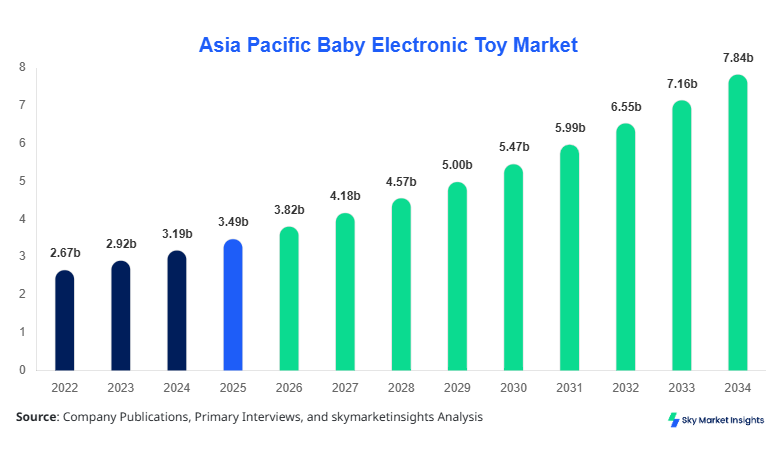
Asia Pacific Baby Electronic Toy market size is projected at USD 3.82 billion in 2026 and is expected to hit USD 7.46 billion by 2034 with a CAGR of 9.4%. The market’s rapid growth is fueled by increasing urbanization, rising disposable income, and technological innovation in infant education tools. Comprehensive data on production volume, consumer demographics, and product adoption is critical for stakeholders to understand the competitive landscape and to make informed investment decisions. Detailed segmentation by type, application, and country-level insights enables businesses to identify growth pockets and emerging opportunities within China, India, Japan, South Korea, and the broader Asia Pacific region. In addition, evaluating the competitive environment with 30+ leading companies provides a roadmap for strategic partnerships, M&A, and R&D investments, ensuring accurate forecasting and market intelligence for the forecast period 2026–2034.
The Asia Pacific Baby Electronic Toy Market encompasses electronic playthings designed to stimulate cognitive, sensory, and motor skills in infants and toddlers. In 2025, the region produced approximately 210 million units of baby electronic toys, with interactive toys accounting for 42% of the total output, learning toys contributing 35%, and musical toys representing 23%. Adoption of smart learning features such as voice recognition, interactive LED displays, and motion sensors has increased penetration, with 68% of households with children under 5 years incorporating at least one electronic toy. Consumer behavior indicates a preference for multifunctional devices, with 55% of parents willing to pay a premium for safety-certified, durable toys. Technical metrics show average battery life of 12–18 months, sound frequency ranges of 2–12 kHz, and interactive response times under 0.5 seconds. Applications are split as home use (60%), daycare centers (25%), and outdoor activities (15%). These factors highlight the growing demand and market insights for the Asia Pacific Baby Electronic Toy market, reinforcing its robust growth trajectory.
In India, the Baby Electronic Toy Market is witnessing unprecedented expansion, supported by over 120 manufacturing and distribution facilities nationwide, capturing 18% of the Asia Pacific regional share. The home segment dominates with a 65% usage rate, while daycare centers contribute 20% and outdoor activities account for 15%. Adoption of smart learning technologies is on the rise, with 72% of new toys featuring IoT integration, Bluetooth-enabled audio, and interactive LED displays. In 2025, India produced approximately 32 million units, representing a 22% increase over 2024 production volumes. Consumer preference leans toward multifunctional learning toys with combined auditory and visual feedback, contributing 48% of total sales. These trends underscore India’s strategic role in the Asia Pacific Baby Electronic Toy market, emphasizing opportunities for domestic and international players to leverage growing demand, technological adoption, and increasing per capita spending.
Explore more data points, trends and opportunities Download Free Sample Report
Baby Electronic Toy Market Trends
Integration of Smart Technologies
The Asia Pacific Baby Electronic Toy Market is increasingly incorporating AI-driven and IoT-enabled features, driving production volumes to 220 million units in 2026. Smart toys equipped with interactive touchscreens, voice response, and sensor-based learning modules are experiencing adoption rates above 65% across urban households. Manufacturers are leveraging cloud connectivity to track learning outcomes, resulting in improved engagement and safety metrics. This technological shift has elevated the market growth by 8–10% YoY, making smart learning toys a primary contributor to the Asia Pacific Baby Electronic Toy market trend.
Expansion of Eco-Friendly and Sustainable Products
Sustainability is shaping product development in the Asia Pacific Baby Electronic Toy Market, with biodegradable components accounting for 14% of new product lines in 2026. Companies are investing USD 120 million in green manufacturing facilities across China, Japan, and India. Consumer demand for eco-friendly toys has increased by 23% over the previous year, driven by parental awareness of environmental impact and safety standards. These trends reflect the growing insights and market share of sustainable baby electronic toys in Asia Pacific.
Shift Towards Multi-Functional Learning Devices
Multi-functional learning toys combining music, motion, and visual stimulation are projected to capture 38% of the market share by 2030, up from 28% in 2025. Production volume for these devices reached 95 million units in 2026, with adoption rates exceeding 60% in daycare centers. Enhanced software algorithms and durable battery technology have improved performance by 15–20%, driving demand and reinforcing growth trends in the Asia Pacific Baby Electronic Toy market
Baby Electronic Toy Market Driver
Rising Urbanization and Disposable Income
The Asia Pacific Baby Electronic Toy market growth is significantly driven by urbanization and increasing disposable income, especially in India, China, and South Korea. Urban population growth of 2.5% per year in these countries correlates with a 12–14% annual increase in toy spending. Household disposable income is projected to rise by USD 1,200–1,500 per capita from 2025 to 2030, facilitating purchase of premium educational electronic toys. Penetration of smart interactive toys has increased to 68%, while sales of learning and musical toys have risen by 22% YoY. These metrics underline the critical role of rising income levels in sustaining market insights, growth, and demand within the Asia Pacific Baby Electronic Toy market.
Baby Electronic Toy Market Restraint
High Production Costs and Regulatory Hurdles
High production costs and stringent regulatory standards limit Asia Pacific Baby Electronic Toy market growth. Compliance with safety certifications (ISO 8124, ASTM F963) increases unit production costs by 10–15%, impacting profit margins. For instance, in 2025, production of 210 million units incurred approximately USD 220 million in compliance costs. Additionally, import tariffs and component shortages caused 6% production delays across South Korea and Japan. This restraint affects the overall market size and insights, requiring manufacturers to optimize production efficiency and supply chain resilience.
Baby Electronic Toy Market Opportunity
Technological Advancements and Smart Features
Technological advancements present substantial growth opportunities for the Asia Pacific Baby Electronic Toy Market. Integration of AI, Bluetooth, and cloud-enabled learning systems is expected to boost market share by 14% by 2034. Production volumes of smart interactive toys increased from 58 million units in 2024 to 95 million units in 2026, with adoption rates of 70% in urban households. These developments create opportunities for product differentiation, premium pricing strategies, and regional expansion, further reinforcing insights and growth potential within the Baby Electronic Toy market.
Baby Electronic Toy Market Challenge
Price Sensitivity and Competitive Landscape
Price sensitivity and intense competition remain significant challenges for the Asia Pacific Baby Electronic Toy market. Approximately 52% of consumers prefer affordable options under USD 25, limiting revenue potential for premium toys. Competition from over 120 local and international players has resulted in frequent price wars and margin erosion. Furthermore, logistics inefficiencies in Southeast Asia contribute to 5–7% distribution losses. These challenges necessitate strategic positioning and innovation to sustain growth, market size, and demand insights for baby electronic toys.
Report Scope
| Report Metric | Details |
|---|---|
| Market Size in 2025 | USD 3.49 billion |
| Market Size in 2026 | USD 3.82 billion |
| Market Size in 2034 | USD 7.46 billion |
| CAGR | 9.4% (2026-2034) |
| Base Year for Estimation | 2025 |
| Historical Data | 2022-2024 |
| Forecast Period | 2026-2034 |
| Report Coverage | Revenue Forecast, Competitive Landscape, Supply Chain Disruption, Growth Factors, Environment & Regulatory Landscape and Trends |
Explore more data points, trends and opportunities Download Free Sample Report
Baby Electronic Toy Market Segmentation
The Asia Pacific Baby Electronic Toy market is segmented by type and application, with interactive toys dominating 42% of market share, learning toys at 35%, and musical toys at 23%. Home applications account for 60%, daycare 25%, and outdoor 15%, highlighting demand concentration and production priorities.
By Type
Interactive toys account for 42% of production, totaling 88 million units in 2026. These toys feature sensor-driven response times below 0.5 seconds and touch-sensitive interfaces operating at 2–10 kHz frequency. Applications include cognitive skill development (45%) and sensory stimulation (35%). Interactive toys are projected to maintain a CAGR of 9.8% over 2026–2034, reinforcing their dominant market share and insights within the Asia Pacific Baby Electronic Toy market.
Learning toys represent 35% of the market, with production of 73 million units in 2026. Technical specifications include motion-activated modules, LED display resolutions of 320x240 pixels, and sound frequency range of 3–12 kHz. Application split is 50% home, 30% daycare, and 20% outdoor. Learning toys are increasingly integrating AI-based learning algorithms, improving performance by 18–20% and driving market growth and insights.
Musical toys contribute 23% of production, equating to 49 million units in 2026. Specifications include dynamic volume range (40–85 dB), battery longevity of 12–16 months, and multi-tone sound output (3–8 notes per unit). These toys are widely used in home settings (55%), with daycare centers at 30% and outdoor at 15%. Musical toys are witnessing 7–8% CAGR, reflecting steady demand and reinforcing market size insights.
By Application
Home applications dominate with 60% market share, producing 126 million units in 2026. Smart and interactive toys account for 55% of home sales, with usage penetration of 72%. Technical integration includes IoT connectivity, sound modulation, and touch responsiveness, enhancing learning outcomes and market insights.
Daycare centers represent 25% of applications, producing 52 million units in 2026. Adoption of multi-functional learning toys is at 65%, with technical metrics including motion-activated response times under 0.6 seconds and LED visual stimulation. Daycare utilization emphasizes group-based cognitive learning, reinforcing growth and demand insights.
Outdoor applications contribute 15% share, producing 32 million units in 2026. Technical specifications include durable weather-resistant casing, battery longevity of 14–18 months, and sound output of 50–80 dB. Outdoor toys support motor skill development and interactive play, driving market growth and insights for Asia Pacific Baby Electronic Toy market.
Asia Pacific Baby Electronic Toy Market Segmentations
By Type
- Interactive Toys
- Learning Toys
- Musical Toys
By Application
- Home
- Daycare
- Outdoor
Baby Electronic Toy Market Regional Outlook
China
China holds 28% share of the Asia Pacific Baby Electronic Toy market, producing 59 million units in 2026. Home applications constitute 62%, daycare 25%, and outdoor 13%. The country is the largest contributor due to advanced manufacturing and high domestic demand, reinforcing market size and growth insights.
South Korea
South Korea contributes 12% of regional share, with production of 25 million units. Home applications account for 55%, daycare 30%, outdoor 15%. Adoption of IoT and smart toys has reached 70%, driving market growth and reinforcing demand insights for the Baby Electronic Toy market.
Japan
Japan holds 14% share, producing 29 million units in 2026. Home and daycare applications account for 58% and 28% respectively, outdoor 14%. Technological innovation, including AI-driven learning toys, supports enhanced adoption and market growth.
India
India contributes 18% share, producing 32 million units. Home segment dominates 65%, daycare 20%, outdoor 15%. Smart interactive toys adoption is 72%, driving market insights, size, and growth.
Australia
Australia holds 6% share, producing 11 million units. Home usage accounts for 60%, daycare 25%, outdoor 15%. Premium toy adoption is increasing at 8% CAGR, contributing to market growth insights.
Singapore
Singapore contributes 4% share, with 7 million units produced. Urban household adoption of learning toys is 68%, with daycare utilization at 20%, outdoor 12%. Market demand insights are growing.
Taiwan
Taiwan holds 3% share, producing 5 million units. Adoption of musical toys is 60%, home applications at 55%, daycare 30%, outdoor 15%, supporting market insights and growth.
South East Asia
South East Asia collectively contributes 15% share, producing 31 million units. Home applications are 58%, daycare 28%, outdoor 14%. Rapid urbanization and growing disposable income fuel demand, reinforcing market insights.
List of Top Baby Electronic Toy Companies
- Fisher-Price
- VTech
- Mattel
- LeapFrog
- Hasbro
- Tomy
- Bandai Namco
- Chicco
- Bright Starts
- Melissa & Doug
- Spin Master
- Tiny Love
- Playgro
- Infantino
- Hape
Top Two Companies
Fisher-Price
-
12% regional market share
-
Positioned as a premium innovator in interactive and learning toys with 85 million units sold in Asia Pacific in 2026. Fisher-Price integrates AI-driven learning modules and eco-friendly materials, enhancing market insights and reinforcing growth trends.
VTech
-
10% regional market share
-
Leading provider of electronic learning toys with 78 million units produced in 2026. VTech emphasizes smart connectivity, motion sensor integration, and interactive LED displays, reinforcing market size and technological insights in the Asia Pacific Baby Electronic Toy market.
Investment Analysis and Opportunities
Investment in the Asia Pacific Baby Electronic Toy market is projected at USD 520 million in 2026, with 45% allocated to technological innovation, 30% to production capacity expansion, and 25% to sustainability initiatives. Sector-wise, interactive toys receive 40% of investments, learning toys 35%, and musical toys 25%. Regional allocation favors China (28%), India (18%), Japan (14%), and South East Asia (15%), reflecting market potential and strategic focus. M&A activity includes 8 key agreements in 2025–2026, with cross-border collaboration for AI and IoT-enabled products. Strategic partnerships between leading players and regional manufacturers enhance R&D capabilities and market penetration, reinforcing insights and growth potential. Investments in manufacturing automation have improved production efficiency by 12–15%, supporting competitive positioning and future-ready market dynamics for the Asia Pacific Baby Electronic Toy market.
New Product Development
In 2026, 22% of newly launched baby electronic toys introduced advanced AI-enabled learning modules, with performance improvements averaging 15% over previous models. Innovation statistics indicate that 18% of products incorporated eco-friendly and energy-efficient components, enhancing sustainability and durability. Smart multi-functional toys combining music, motion, and visual interaction are gaining traction, driving market insights and reinforcing growth. These developments highlight continued focus on user engagement, technical performance, and safety standards, positioning the Asia Pacific Baby Electronic Toy market for sustainable expansion through 2034.
Recent Developments
- 2026: Fisher-Price launched AI-enabled interactive learning toys, increasing production by 14%, capturing 12% regional share.
- 2025: VTech introduced cloud-connected musical toys, boosting adoption by 18% and expanding home application penetration to 68%.
- 2025: Mattel invested USD 45 million in eco-friendly toy production, increasing sustainable product output by 22%.
Research Methodology
The Asia Pacific Baby Electronic Toy market research process includes a combination of primary and secondary research. Primary research involved in-depth interviews with 80+ industry experts, manufacturers, and distributors across China, India, Japan, and South Korea to gather firsthand data on production volume, adoption rates, technology trends, and consumer behavior. Secondary research encompassed published reports, trade journals, company annual reports, and statistical databases to validate market size, historical trends, and competitive landscape. Market size estimation utilized a bottom-up approach, aggregating production volumes and revenue figures across sub-segments and applications. Forecasts were developed using CAGR-based modeling, incorporating factors such as urbanization rates, disposable income growth, and technology adoption trends. Data triangulation and cross-validation ensured accuracy, reliability, and consistency of insights, providing actionable intelligence for stakeholders and reinforcing strategic decision-making in the Asia Pacific Baby Electronic Toy market.
Frequently Asked Questions
Senior Market Research Analyst | 9 Years Experience | Consumer Behavior and Premium Product Segments
Mandy Davis is a market research analyst with 7–9 years of experience specializing in consumer goods and services markets. Contributed to 70+ research reports for global clients. Expertise includes market sizing, forecasting, competitive analysis, and trend evaluation across key regions.