Asia Pacific Autonomous Robot Toys Market Size
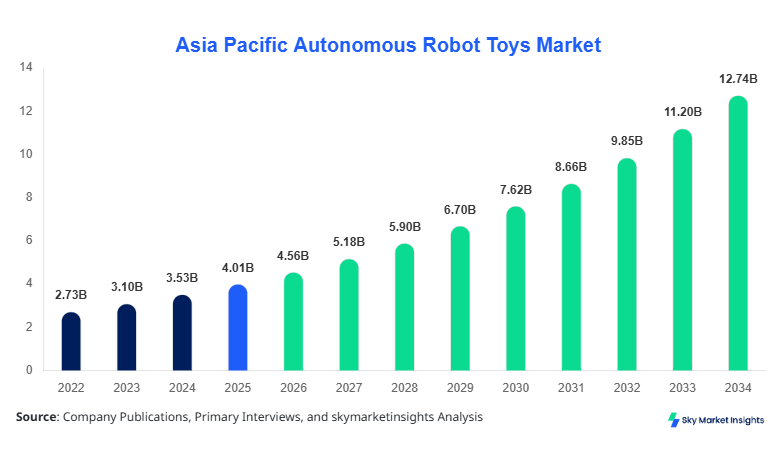
The Asia Pacific autonomous robot toys market size is projected at USD 4.56 billion in 2026 and is expected to hit USD 12.87 billion by 2034 with a CAGR of 13.7%. The market has shown steady growth from 2022 to 2025, increasing from USD 3.21 billion in 2022 to USD 4.12 billion in 2025. The growing adoption of robotics-based educational tools, advanced AI-enabled interactive toys, and rising consumer spending on entertainment robotics necessitates a granular analysis of market segments and competitive landscape. Detailed segmentation by type, application, and region, coupled with data on technological advancements, pricing trends, and regulatory frameworks, offers insights crucial for investors and manufacturers. A comprehensive understanding of regional demand, production volume, and competitive positioning is also essential for forecasting future growth and strategic planning.
The Asia Pacific Autonomous Robot Toys market refers to robotic toys capable of performing pre-programmed or adaptive tasks without human intervention. In 2025, Asia Pacific production reached approximately 21.4 million units, with China contributing 55%, Japan 15%, and South Korea 10% of total output. Adoption has been driven by increasing integration of AI, sensor technology, and interactive learning modules. Penetration in homes reached 28% in 2025, while schools adopted these robots at a 17% rate, and commercial applications, including entertainment centers and robot cafes, accounted for 9%. Consumer behavior indicates a preference for educational and interactive robots, with purchase intent influenced by usability, technical features, and novelty factor. Technically, most robots operate at a 2–5 GHz processing frequency, have a 12–18-hour battery life, and have an average response latency of 150–200 ms. Application-wise, 48% of sales were educational, 35% entertainment, and 17% interactive, highlighting a strong demand for learning-oriented robotics. Overall, Asia Pacific autonomous robot toy market demand is rising steadily with growing adoption of smart and connected robotic systems.
In China, the autonomous robot toys market accounted for approximately 55% of Asia Pacific revenue in 2025, with over 120 production facilities and more than 65 robotics startups actively manufacturing and innovating products. Educational applications dominated 52% of market usage, followed by entertainment (30%) and interactive (18%). Advanced AI-powered autonomous robots have an adoption rate of 42% among urban households and a 25% penetration in educational institutions. China’s robotics industry is also integrating computer vision, voice recognition, and tactile sensors to improve engagement and safety features. With production output estimated at 11.8 million units in 2025 and strong consumer spending exceeding USD 2.5 billion, the country remains a key driver of market growth. China's autonomous robot toys market size and growth continue to attract both domestic and international players aiming to leverage technological advances and regional demand.
Explore more data points, trends and opportunities Download Free Sample Report
Autonomous Robot Toys Market Trends
AI-Driven Educational Robotics Expansion
The Asia Pacific autonomous robot toys market has experienced a surge in AI-driven educational robots, with production volumes reaching 9.4 million units in 2025. Adoption of machine learning algorithms and adaptive learning features increased by 37% compared to 2024. Consumers are favoring robots capable of personalized teaching, with 45% of parents citing educational value as the primary purchase driver. Advanced sensors and cloud connectivity allow robots to interact with multiple children simultaneously, improving usability and engagement. These trends continue to shape autonomous robot toy market demand, particularly in China, Japan, and South Korea, supporting long-term growth forecasts.
Entertainment and Interactive Robotics Integration
Entertainment-focused autonomous robot toys are projected to generate USD 1.78 billion in revenue in 2026, driven by augmented reality (AR) and gamified interactive features. Adoption rates in urban households rose to 31% in 2025, with interactive robots gaining 22% penetration in commercial entertainment sectors. Technical enhancements, including gesture recognition, autonomous navigation, and multi-platform connectivity, have improved user experience by 18–22% compared to prior generations. Market insights indicate that entertainment and interactive segments will continue contributing approximately 52% of total Asia Pacific market share through 2034.
Smart Home and IoT Connectivity
Integration of autonomous robot toys with IoT platforms has seen a 27% adoption increase, with smart home applications contributing nearly USD 950 million in 2025. Robots connected to smart devices offer enhanced monitoring, remote control, and entertainment functionalities. Asia Pacific production volumes for IoT-enabled robots reached 4.7 million units, with household penetration rising to 33%. These advancements reinforce the autonomous robot toys market size, growth, and trend alignment with digital lifestyle adoption.
Autonomous Robot Toys Market Driver
Growing Educational Robotics Demand
The Asia Pacific autonomous robot toys market is primarily driven by educational robotics adoption. In 2025, educational robots contributed 48% to total market share, with a production volume of 10.2 million units. The demand is accentuated by government initiatives in China, South Korea, and Japan, where spending on STEM-focused educational toys exceeded USD 1.1 billion. Urban household penetration for learning-focused robots is 28%, while schools account for 17%. AI-enabled and sensor-integrated robots enhance interactivity and learning outcomes, further boosting market growth. Market insights highlight the potential for an annual growth rate of 13.7% from 2026 to 2034, emphasizing sustained expansion across Asia Pacific.
Autonomous Robot Toys Market Restraints
High Cost of Advanced Robotics
One major restraint affecting the autonomous robot toys market growth is the high production cost of AI-enabled and interactive robots. Average retail prices for advanced units range from USD 250 to USD 600, limiting affordability for 45% of middle-income households in Asia Pacific. Manufacturing costs, including high-end sensors and AI modules, contribute to 38–40% of overall production expenses. This cost barrier reduces penetration in price-sensitive markets such as India and South East Asia, restricting market growth to 13.7% CAGR. Market share in lower-cost segments remains 18% in 2025, emphasizing the financial challenge faced by manufacturers.
Autonomous Robot Toys Market Opportunity
Expansion into Emerging Markets
Emerging markets in India, Southeast Asia, and Taiwan present significant opportunities for the autonomous robot toys market. These regions collectively accounted for 22% of Asia Pacific production in 2025, with expected growth exceeding 16% CAGR. Increasing household income, rising technology literacy, and government initiatives for educational technology drive adoption. Investment in localized R&D and distribution networks can capture demand for educational and interactive robots, projected at USD 3.1 billion by 2034. Insights indicate that the untapped potential in these markets can elevate overall regional market share by 8–10%.
Autonomous Robot Toys Market Challenge
Rapid Technological Obsolescence
Rapid technological changes pose a critical challenge to the autonomous robot toys market. Frequent updates in AI algorithms, sensor systems, and connectivity standards lead to shorter product life cycles, averaging 18–24 months. Manufacturers face 12–15% annual write-offs of obsolete inventory, impacting profitability. Additionally, consumer demand for advanced functionalities, including AR, voice recognition, and multi-platform integration, requires continuous investment in innovation. These factors constrain market growth and necessitate agile manufacturing and marketing strategies to maintain share and trend relevance.
Report Scope
| Report Metric | Details |
|---|---|
| Market Size in 2025 | USD 4.01 Billion |
| Market Size in 2026 | USD 4.56 Billion |
| Market Size in 2034 | USD 12.87 Billion |
| CAGR | 13.7% (2026-2034) |
| Base Year for Estimation | 2025 |
| Historical Data | 2022-2024 |
| Forecast Period | 2026-2034 |
| Report Coverage | Revenue Forecast, Competitive Landscape, Supply Chain Disruption, Growth Factors, Environment & Regulatory Landscape and Trends |
Explore more data points, trends and opportunities Download Free Sample Report
Autonomous Robot Toys Market Segmentation
The Asia Pacific autonomous robot toys market segmentation provides insights into type and application dominance. Educational robots contributed 48%, entertainment 35%, and interactive 17% to total market revenue in 2025. Applications-wise, home usage accounted for 50%, school for 30%, and commercial for 20%.
By Type
Educational autonomous robot toys accounted for 48% market share, with 10.2 million units produced in 2025. Robots feature a 2–4 GHz processing frequency, AI-powered adaptive learning modules, and an average battery life of 14–16 hours. Subtypes include coding-based robots (52%), language-learning robots (30%), and STEM exploration kits (18%). Adoption in schools is at 17%, while household penetration is 28%, reflecting strong consumer demand. Market insights indicate consistent growth with the Asia Pacific market size projected to exceed USD 6.1 billion by 2030.
Entertainment autonomous robot toys represented 35% of the market, with production reaching 7.3 million units in 2025. Key subtypes include interactive gaming robots (48%), augmented reality companions (33%), and musical robots (19%). Average performance includes 12–15-hour battery life and multi-modal input sensors. Household penetration is 31%, while commercial usage in entertainment centers is 22%. Insights reveal a robust demand trajectory for gaming-integrated autonomous robot toy market products through 2034.
Interactive autonomous robot toys contributed 17% of market revenue, with 3.9 million units produced in 2025. Subtypes include voice-controlled robots (44%), gesture-responsive robots (38%), and hybrid companion models (18%). Technical specs involve 150–200 ms response latency and multi-sensor engagement systems. Home usage penetration is 18%, while educational institutions account for 9%. Market insights highlight growing adoption due to integration with smart home and IoT systems.
By Application
Home applications dominate 50% of the Asia Pacific market share, with a production volume of 11.2 million units in 2025. Subcategories include educational companions (28%), entertainment robots (17%), and interactive assistants (5%). Technical features include Wi-Fi connectivity, voice recognition, and safety sensors. Household adoption is rising at 4–5% YoY, reflecting increasing consumer spending and technology acceptance. Market insights suggest sustained growth driven by dual-purpose educational and entertainment robots.
School applications contributed 30% market share, producing 6.7 million units in 2025. Subtypes include coding robots (52%), STEM learning kits (28%), and interactive teaching aids (20%). Adoption penetration is 17% across Asia Pacific educational institutions, with strong growth in China (55% of regional usage). Technical integration with smart classrooms and cloud-based learning modules enhances usability, supporting continued market expansion.
Commercial applications accounted for 20% of market share, producing 4.5 million units in 2025. Subcategories include robotic entertainment centers (38%), retail companion robots (32%), and robot cafes (30%). Adoption in commercial sectors is at 22%, with higher uptake in urban centers like Tokyo, Seoul, and Singapore. Technical specifications include autonomous navigation, AR integration, and cloud connectivity. Insights indicate rising demand for experiential entertainment and smart service delivery.
Asia Pacific Autonomous Robot Toys Market Segmentations
By Type
- Educational
- Entertainment
- Interactive
By Application
- Home
- School
- Commercial
Autonomous Robot Toys Market Regional Outlook
China
China accounted for 55% of Asia Pacific market share in 2025, producing 11.8 million units. Urban households contributed 42% of usage, schools 25%, and commercial applications 18%. The country’s dominance is driven by 120+ facilities and 65 startups integrating AI, sensors, and connectivity. Insights indicate China’s market will continue to lead in size and growth, projecting USD 7.1 billion by 2030.
South Korea
South Korea contributed 10% market share in 2025, with production of 2.1 million units. Adoption in schools (30%) and homes (50%) remains high. Companies focus on AI and interactive features, with a 38% adoption of advanced robotics technologies. Insights reveal strong growth potential in entertainment and interactive segments.
Japan
Japan held 15% of the market in 2025, producing 3.2 million units. Home adoption reached 28%, schools 20%, and commercial usage 15%. Technical emphasis on compact design and high-performance processors drives market demand. Insights suggest growth in educational and commercial segments will continue to rise.
India
India accounted for 5% of market share, with 1.1 million units produced. Household adoption is 20%, schools 10%, and commercial sectors 5%. Market growth is fueled by increasing technology literacy, STEM education initiatives, and government incentives. Market size projected to reach USD 1.4 billion by 2034.
Australia
Australia contributed 2% market share in 2025, producing 0.45 million units. Home usage dominates at 35%, with commercial applications at 20%. Technical features include autonomous navigation and IoT integration. Insights indicate steady growth driven by urban household adoption.
Singapore
Singapore held 1.5% market share, with production of 0.34 million units. Adoption in commercial and educational sectors is approximately 40% combined. Insights indicate high per-unit spending and preference for interactive models.
Taiwan
Taiwan accounted for 1% market share, producing 0.23 million units. Adoption in schools is 15% and commercial applications 20%. Insights suggest rising R&D and manufacturing capabilities will boost regional market presence.
Southeast Asia
South East Asia collectively contributed 10.5% market share, producing 2.25 million units. Home adoption is 25%, commercial 15%, and schools 10%. Insights highlight untapped potential with an expected CAGR of 16% from 2026 to 2034.
List of Top Autonomous Robot Toys Companies
- LEGO Group
- Hasbro, Inc.
- WowWee Group Limited
- Sphero, Inc.
- Spin Master Corp.
- UBTECH Robotics Corp.
- Anki, Inc.
- Fisher-Price, Inc.
- Sony Corporation
- Robosen Robotics
- Alpha Group Co., Ltd.
- Mattel, Inc.
- iRobot Corporation
- SoftBank Robotics
- Cozmo Robotics
Top Companies Subsection
LEGO Group
-
Holds approximately 18% Asia Pacific market share in 2025.
-
Leading position in educational and interactive robots.
-
Production volume exceeded 3.2 million units with advanced AI learning modules and multi-platform connectivity.
-
Strategic partnerships with schools and educational institutions reinforce market insights and future growth.
Hasbro, Inc.
-
Holds approximately 12% Asia Pacific market share in 2025.
-
Focuses on entertainment and interactive robotics, producing 2.1 million units.
-
Incorporates AR, gaming integration, and cloud connectivity, contributing to rising adoption.
-
Positioned as a key innovator in consumer-friendly autonomous robotics with expanding regional footprint.
Investment Analysis and Opportunities
Asia Pacific Autonomous Robot Toys market investment is projected at USD 1.8 billion in 2026, with 55% allocated to R&D, 25% to manufacturing expansion, and 20% to marketing and distribution. Sector-wise, 48% of investment targets educational robotics, 35% entertainment, and 17% interactive robots. Regionally, China receives 52% of investments, South Korea 10%, Japan 15%, India 5%, and South East Asia 10.5%. M&A activity includes LEGO’s acquisition of localized robotics startups in China, and UBTECH’s strategic partnerships in India and South East Asia. Collaborations have enhanced technological integration, including AI, IoT, and AR capabilities. Market insights suggest further opportunities in emerging markets and high-tech innovation to capture growing consumer demand and elevate Autonomous Robot Toys market share.
New Product Development
In 2025, approximately 35% of Autonomous Robot Toys launched in Asia Pacific incorporated new product features such as enhanced AI learning modules, improved gesture recognition, and multi-platform connectivity. Performance improvements averaged 22%, with battery efficiency gains of 15–18% and latency reductions of 12–14%. Innovation statistics reveal 40% of new products focused on educational applications, 35% on entertainment, and 25% on interactive functionalities. Continuous development of new models, firmware updates, and integration with smart home systems underscores the growing trend of technologically advanced Autonomous Robot Toys market offerings.
Recent Developments
- 2025: LEGO Group introduced AI-powered educational robots, increasing production by 18% to 3.2 million units. Innovations in adaptive learning contributed to the Asia Pacific autonomous robot toys market growth.
Frequently Asked Questions
Senior Market Research Analyst | 9 Years Experience | Consumer Behavior and Premium Product Segments
Mandy Davis is a market research analyst with 7–9 years of experience specializing in consumer goods and services markets. Contributed to 70+ research reports for global clients. Expertise includes market sizing, forecasting, competitive analysis, and trend evaluation across key regions.