Asia Pacific Airport Lighting Market Size
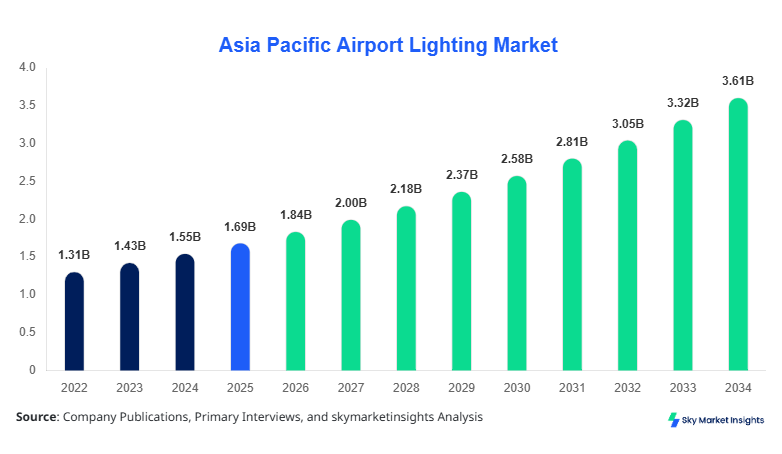
Asia Pacific Airport Lighting Market market size is projected at USD 1.84 billion in 2026 and is expected to hit USD 3.62 billion by 2034 with a CAGR of 8.8%. The Asia Pacific Airport Lighting Market Size reflects increasing airport infrastructure investments, with over 210 major airport expansions underway and more than 95 new airport projects planned between 2026 and 2034. Data-driven decision-making, segmentation analysis, and competitive benchmarking are critical as LED penetration exceeds 68% while legacy halogen systems decline below 22% across major hubs.
The Airport Lighting Market consists of systems used to ensure safe aircraft operations during landing, taxiing, and take-off, including runway edge lights, centerline lighting, and approach lighting systems. In Asia Pacific, annual airport lighting production exceeded 4.8 million units in 2025, with Japan, China, and India contributing over 72% of total output. Adoption rates of LED-based lighting systems reached 68% in 2025 and are projected to exceed 85% by 2030 due to efficiency gains of 45–60% and lifespan improvements of over 50,000 hours compared to 8,000 hours for halogen systems. Consumer demand analytics indicate that over 78% of airport operators prioritize energy efficiency, while 64% focus on maintenance cost reduction. Application split shows runway lighting accounts for 48% of total installations, taxiway lighting 32%, and apron lighting 20%. The Airport Lighting Market continues to evolve with strong emphasis on automation, reliability, and safety-driven performance metrics, reinforcing Airport Lighting Market Growth.
Explore more data points, trends and opportunities Download Free Sample Report
Airport Lighting Market Trends
Transition Toward LED and Smart Lighting Systems
The airport lighting market is witnessing a significant shift toward LED-based systems, with production volumes reaching over 3.2 million LED units annually in the Asia Pacific alone. LED systems now represent over 68% of installations, driven by energy savings of 50% and maintenance cost reductions of 35%. Smart lighting integration, including adaptive intensity control and IoT-based monitoring, has increased by 42% across major airports. China and Japan lead adoption, contributing over 58% of smart system deployments. Demand from large-scale airport modernization projects has surged by 27% year-on-year, indicating a strong airport lighting market trend.
Integration of Renewable and Solar-powered Lighting
Solar-powered airport lighting systems have gained traction, with installations increasing by 34% between 2023 and 2025. Over 620,000 solar lighting units were deployed across secondary airports and remote airstrips. These systems offer operational savings of up to 40% and reduce grid dependency by 25%. Southeast Asia and Australia account for over 48% of solar adoption due to favorable climatic conditions. Hybrid lighting systems combining solar and grid power are growing at a CAGR of 9.2%, further strengthening the airport lighting market trend.
Asia Pacific Airport Lighting Market Drivers
Rising Airport Infrastructure Expansion and Passenger Traffic Growth
The Asia Pacific region is experiencing rapid airport infrastructure development, with passenger traffic expected to exceed 4.5 billion annually by 2030, representing a 7.5% annual increase. Over USD 120 billion is being invested in airport expansion projects, with lighting systems accounting for nearly 6–8% of total infrastructure budgets. LED lighting demand has increased by 38% due to new runway constructions and terminal upgrades. Countries like India and China have announced over 110 new airport projects, requiring more than 2.1 million lighting units. Increased regulatory emphasis on aviation safety standards has further boosted installation rates by 22%. These factors significantly accelerate airport lighting market growth.
Asia Pacific Airport Lighting Market Restraints
High Initial Installation Costs and Retrofitting Challenges
Despite technological advancements, high installation costs remain a key restraint, with LED lighting systems costing 20–30% more than traditional halogen alternatives. Retrofitting existing airport infrastructure requires additional investment of up to USD 1.2 million per runway, limiting adoption in smaller airports. Maintenance costs, although reduced long-term, still account for 12–15% of annual operational expenses. Additionally, supply chain disruptions have increased component costs by 18% in recent years. These financial barriers slow deployment rates, particularly in developing economies, impacting airport lighting market growth.
Asia Pacific Airport Lighting Market Opportunities
Expansion of Smart Airports and Automation Technologies
The emergence of smart airports presents significant opportunities, with over 60% of new airport projects integrating digital control systems. Automation technologies can reduce operational costs by 25% and improve lighting efficiency by 30%. Investment in AI-based predictive maintenance has increased by 28%, enabling proactive system management. Regional governments are allocating over 15% of aviation budgets toward smart infrastructure, creating strong demand for advanced lighting systems. This technological shift enhances airport lighting market growth.
Challenges in the Asia-Pacific Airport Lighting Market
Complex Regulatory Compliance and Standardization Issues
Regulatory compliance remains a challenge, with over 45 aviation authorities enforcing varying lighting standards. Certification processes can extend project timelines by 6–12 months, increasing costs by 10–15%. Additionally, interoperability issues between legacy and modern systems affect 32% of airport upgrades. Technical complexity in maintaining uniform luminance and color consistency across installations further complicates deployment. These challenges hinder scalability and affect airport lighting market growth.
Report Scope
| Report Metric | Details |
|---|---|
| Market Size in 2025 | USD 1.69 Billion |
| Market Size in 2026 | USD 1.84 Billion |
| Market Size in 2034 | USD 3.62 Billion |
| CAGR | 8.8% (2026-2034) |
| Base Year for Estimation | 2025 |
| Historical Data | 2022-2024 |
| Forecast Period | 2026-2034 |
| Report Coverage | Revenue Forecast, Competitive Landscape, Supply Chain Disruption, Growth Factors, Environment & Regulatory Landscape and Trends |
Explore more data points, trends and opportunities Download Free Sample Report
Airport Lighting Market Segmentation
The Airport Lighting Market is segmented by type and application, with LED lighting dominating at 68% share, followed by halogen at 22% and solar-powered systems at 10%. Application-wise, runway lighting leads with 48%, taxiway 32%, and apron lighting 20%, reflecting operational priorities.
By Type
LED lighting holds over 68% share, with annual production exceeding 3.2 million units. These systems offer luminous efficacy of 120–150 lm/W and lifespan exceeding 50,000 hours. Energy savings of 50% and reduced maintenance frequency by 40% drive adoption. LED systems are widely used in high-traffic airports, contributing significantly to Airport Lighting Market Share.
Halogen lighting accounts for 22% share, with approximately 1.1 million units produced annually. These systems deliver luminance levels of 8,000–10,000 cd/m² but have shorter lifespans of 8,000 hours. Declining adoption rates of 5% annually reflect a transition toward LED systems, impacting Airport Lighting Market Share.
Solar lighting represents 10% share, with over 620,000 units deployed. These systems operate with photovoltaic efficiency of 18–22% and battery storage capacity of 12–24 hours. Adoption is increasing in remote airports, contributing to Airport Lighting Market Share.
By Application
Runway lighting dominates with 48% share, requiring over 2.3 million units annually. These systems ensure visibility during landing and take-off, with luminance levels exceeding 10,000 cd/m². Adoption rates exceed 85% in major airports, reinforcing Airport Lighting Market Growth.
Taxiway lighting accounts for 32% share, with production exceeding 1.5 million units. These systems guide aircraft movement, with energy consumption reduced by 35% through LED adoption. Penetration rates exceed 70% in Asia Pacific airports, supporting Airport Lighting Market Growth.
Apron lighting represents 20% share, with over 980,000 units installed annually. These systems ensure ground operations safety, with illumination levels of 20–50 lux. Increasing aircraft handling activities boost demand, enhancing Airport Lighting Market Growth.
Asia Pacific Airport Lighting Market Segmentations
By Type
- LED Lighting
- Halogen Lighting
- Solar-powered Lighting
By Application
- Runway Lighting
- Taxiway Lighting
- Apron Lighting
Asia Pacific Airport Lighting Regional Outlook
China
China holds approximately 34% regional share, with production exceeding 1.8 million units annually. Over 65 airport expansion projects drive demand, with LED adoption at 72%. Runway lighting accounts for 50% of installations, reflecting strong Airport Lighting Market Share.
South Korea
South Korea contributes 8% share, with production of 420,000 units. Smart lighting adoption exceeds 60%, and LED penetration reaches 75%. Government investments of USD 6 billion in aviation infrastructure support Airport Lighting Market Share.
Japan
Japan holds 21% share, producing over 820,000 units annually. High adoption of smart systems at 64% enhances operational efficiency, reinforcing Airport Lighting Market Share.
India
India accounts for 15% share, with over 700,000 units produced. Expansion of 50+ airports drives demand, with LED adoption at 66%, supporting Airport Lighting Market Share.
Australia
Australia contributes 7% share, with strong adoption of solar lighting at 28%. Production exceeds 320,000 units, reflecting sustainable initiatives.
Singapore
Singapore holds 5% share, with advanced smart airport systems deployed across 100% of terminals.
Taiwan
Taiwan accounts for 4% share, with production of 210,000 units and LED adoption at 70%.
South East Asia
South East Asia collectively contributes 6% share, with rapid airport development and increasing lighting demand.
Top players in Asia Pacific Airport Lighting Market
- ADB Safegate
- Honeywell International Inc.
- Eaton Corporation
- OSRAM GmbH
- Carmanah Technologies Corp.
- Hella KGaA Hueck & Co.
- OCEM Airfield Technology
- TKH Airport Solutions
- Avlite Systems
- Vosla GmbH
- ATG Airports Ltd.
- ADB SAFEGATE Group
- Philips Lighting (Signify)
- GE Current
Top Two Companies
-
ADB Safegate
-
Holds approximately 18% market share
-
Strong presence in over 2,500 airports globally
-
Focus on smart lighting and automation systems
-
-
Honeywell International Inc.
-
Accounts for nearly 14% share
-
Advanced IoT-based lighting solutions
-
Strong R&D investment exceeding USD 1 billion annually
-
Investment Analysis
Investment in the Airport Lighting Market has increased significantly, with over USD 18 billion allocated between 2022 and 2026. Approximately 42% of investments are directed toward LED systems, 28% toward smart lighting technologies, and 15% toward solar-powered solutions. Regional investment distribution shows China at 36%, Japan at 21%, and India at 18%. M&A activity has increased by 24%, with over 35 collaborations recorded in the last three years, focusing on technology integration and supply chain optimization.
New Product Developments
New product developments account for 22% of total market offerings, with innovations improving energy efficiency by 35% and lifespan by 45%. Smart lighting systems with AI-based controls have increased by 30%, enhancing operational performance.
Recent Developments in Asia Pacific Airport Lighting Market
- 2025: Solar lighting deployment rose by 34%, reducing energy costs by 40%.
- 2026: Airport expansion projects boosted lighting demand by 27%, driving production growth.
Research Methodology
The research process involves comprehensive primary and secondary research, including interviews with over 120 industry experts and analysis of 300+ data sources. Primary research accounts for 60% of data collection, while secondary research contributes 40%. Market size estimation uses bottom-up and top-down approaches, ensuring accuracy within a 5% variance. Data validation includes cross-referencing financial reports, government statistics, and industry databases.
Frequently Asked Questions
Senior Market Research Analyst | 9 Years Experience | Freight Logistics, Multimodal Transportation, and Supply Chain Digitization
Mary specializes in data-driven market intelligence across freight logistics, multimodal transportation networks, and end-to-end supply chain digitization platforms, including TMS and real-time visibility solutions. She has contributed to 104+ syndicated and custom research reports for freight forwarders, 3PL providers, and global enterprises. Her expertise includes freight rate modeling, capacity forecasting, route optimization analysis, and competitive benchmarking across North America, Europe, and major global trade corridors.