Asia Pacific Agriculture Technology As A Service Market Size
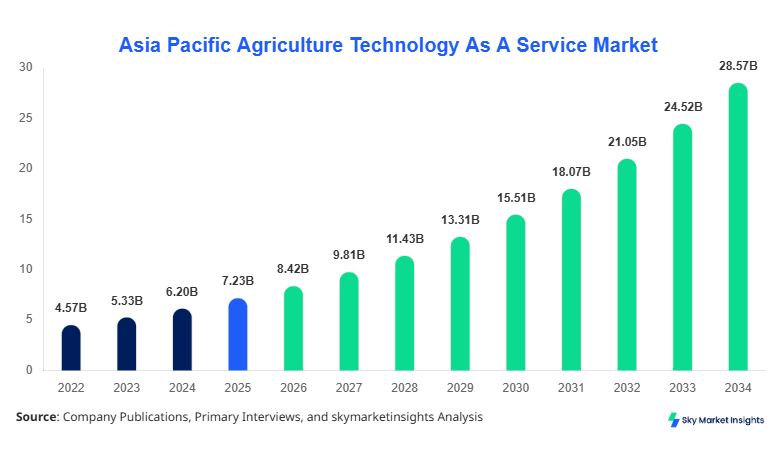
Asia Pacific Agriculture Technology As A Service market size is projected at USD 8.42 billion in 2026 and is expected to hit USD 28.67 billion by 2034 with a CAGR of 16.5%. The expansion is supported by rising digital farming adoption exceeding 42% across large-scale farms and over 18 million connected agricultural devices deployed across Asia Pacific in 2025. Increasing data-driven agriculture practices, rising farm mechanization rates above 55%, and over USD 3.2 billion annual investments into agri-tech startups are shaping the competitive landscape. The integration of IoT sensors with over 65% operational efficiency improvement and AI-based decision systems covering 23% of commercial farms further highlights the structured demand for scalable service models.
The agriculture technology-as-a-service market refers to cloud-based, subscription-driven, and service-oriented agricultural solutions that integrate IoT, AI, big data analytics, and automation technologies to enhance farming productivity and sustainability. In the Asia Pacific, agricultural production exceeded 5.8 billion metric tons in 2025, with digital agriculture solutions penetrating nearly 38% of commercial farms. Adoption and penetration insights indicate that over 62% of large farms in China and 45% in Japan are using data-driven solutions, while smallholder penetration remains below 22%. Consumer behavior shows increasing preference for yield optimization, with over 70% of farmers prioritizing crop health analytics and predictive irrigation systems. Precision farming accounts for 48% of applications, crop monitoring 32%, and livestock management 20%, with data accuracy improvements reaching 85% in advanced systems. Increasing reliance on automated insights and subscription-based models reinforces the agriculture technology as a service market.
In China, the Agriculture Technology As A Service market dominates with over 41% regional share, supported by more than 12,000 agritech firms and 6.5 million smart farming units deployed nationwide. Application breakdown shows precision farming contributing 52%, crop monitoring 30%, and livestock management 18%. Technology adoption is high, with over 68% of large-scale farms using IoT sensors and 44% utilizing AI-driven analytics platforms. The country has deployed over 8 million agricultural drones and 3.2 million connected irrigation systems, boosting productivity by 27% and reducing water consumption by 19%. Government-backed digital agriculture investments exceeded USD 1.8 billion annually, accelerating service adoption across rural regions. The strong ecosystem of cloud platforms, analytics providers, and automation companies further strengthens the Agriculture Technology As A Service market.
Explore more data points, trends and opportunities Download Free Sample Report
Agriculture Technology As A Service Market Trends
The Agriculture Technology As A Service market is witnessing significant technological transformation, driven by increasing integration of AI, IoT, and satellite imaging technologies. In 2025, over 22 million IoT-enabled devices were deployed across Asia Pacific farms, with annual production of agricultural sensors exceeding 9.5 million units. AI-driven predictive analytics platforms are now used by 36% of commercial farms, improving yield accuracy by 28% and reducing input costs by 21%. The shift toward subscription-based services has grown by 34% annually, while cloud adoption in agriculture has surpassed 47%. These advancements are enhancing operational efficiency and decision-making, strengthening the agriculture technology as a service market.
Another major trend is the rapid adoption of automation and robotics in agriculture, particularly in high-value crop production regions such as Japan and South Korea. Agricultural robotics production reached 1.8 million units in 2025, with autonomous tractors accounting for 18% of mechanized farming equipment. Smart irrigation systems have penetrated 29% of farms, reducing water usage by 23% while increasing yield output by 19%. Demand for real-time data analytics has surged by 41%, driven by climate variability and resource optimization needs. These innovations are reshaping traditional farming practices and accelerating the digital transformation of agriculture, further reinforcing the Agriculture Technology As A Service market.
Asia Pacific Agriculture Technology As A Service Market Drivers
Increasing Adoption of Precision Agriculture Technologies
The rising adoption of precision agriculture technologies is a key driver of the Agriculture Technology As A Service market, with over 48% of farms in the Asia Pacific integrating data-driven tools for crop optimization. The deployment of GPS-enabled machinery increased by 32% between 2022 and 2025, while the use of satellite imaging for crop health monitoring expanded to 26% of agricultural land. Precision farming solutions have improved yield output by up to 30% and reduced fertilizer usage by 18%, driving cost efficiency. Government subsidies covering up to 25% of equipment costs and over USD 2.4 billion in funding for agri-tech startups have accelerated adoption. These advancements continue to propel the agriculture technology-as-a-service market.
Asia Pacific Agriculture Technology As A Service Market Restraints
High Initial Infrastructure and Connectivity Costs
Despite strong growth potential, high infrastructure and connectivity costs act as a restraint for the agriculture technology as a service market. Establishing IoT-based farming systems requires investments exceeding USD 5,000 per hectare, limiting adoption among smallholder farmers who represent over 70% of the agricultural population. Rural internet penetration remains below 45% in several Southeast Asian countries, restricting cloud-based service accessibility. Maintenance costs for advanced systems have increased by 14% annually, while data security concerns impact 27% of potential users. These barriers hinder widespread adoption and slow the expansion of the agriculture technology as a service market.
Asia Pacific Agriculture Technology As A Service Market Opportunities
Expansion of Smart Farming Ecosystems
The expansion of smart farming ecosystems presents significant opportunities in the Agriculture Technology As A Service market, with increasing investments in integrated digital platforms and IoT networks. Over USD 3.8 billion was invested in agritech infrastructure across the Asia Pacific in 2025, supporting the development of smart irrigation, automated machinery, and AI analytics systems. The adoption of cloud-based platforms is expected to grow by 39%, while demand for remote farm management solutions has increased by 46%. Partnerships between technology providers and agricultural cooperatives are expanding service reach to over 12 million farmers. These developments create strong opportunities within the agriculture technology-as-a-service market.
Challenges in the Asia-Pacific Agriculture Technology As A Service Market
Data Integration and Interoperability Issues
Data integration and interoperability challenges remain a significant concern in the agriculture technology as a service market. Over 35% of farmers report difficulties in integrating multiple platforms, leading to inefficiencies in data utilization. Lack of standardized protocols across IoT devices affects 28% of service implementations, while data accuracy issues impact decision-making in 19% of cases. Additionally, the complexity of managing large datasets exceeding 2 terabytes per farm annually increases operational challenges. These factors hinder seamless adoption and limit the full potential of digital agriculture solutions, impacting the Agriculture Technology As A Service market.
Report Scope
| Report Metric | Details |
|---|---|
| Market Size in 2025 | USD 7.23 Billion |
| Market Size in 2026 | USD 8.42 Billion |
| Market Size in 2034 | USD 28.67 Billion |
| CAGR | 16.5% (2026-2034) |
| Base Year for Estimation | 2025 |
| Historical Data | 2022-2024 |
| Forecast Period | 2026-2034 |
| Report Coverage | Revenue Forecast, Competitive Landscape, Supply Chain Disruption, Growth Factors, Environment & Regulatory Landscape and Trends |
Explore more data points, trends and opportunities Download Free Sample Report
Agriculture Technology As A Service: Market Segmentation
The agriculture technology as a service market is segmented based on type and application, with software platforms dominating at a 42% share, followed by equipment as a service at 34% and data analytics services at 24%. Application-wise, precision farming leads with 48%, followed by crop monitoring at 32% and livestock management at 20%.
By Type
Software platforms dominate the Agriculture Technology As A Service market with a 42% share, driven by increasing adoption of cloud-based farm management systems. Over 14 million farms utilize software platforms for real-time data monitoring, with performance efficiency improvements reaching 35%. These platforms process over 1.5 billion data points annually, enabling predictive analytics and resource optimization. Integration with IoT devices enhances operational accuracy by 28%.
Equipment-as-a-Service accounts for a 34% share, with over 3.2 million units deployed across the Asia Pacific. This segment includes drones, autonomous tractors, and smart irrigation systems. Equipment utilization efficiency has improved by 31%, while cost savings reach up to 22% compared to ownership models. The subscription model allows farmers to access advanced machinery without high capital expenditure.
Data analytics services represent a 24% share, focusing on advanced analytics and AI-driven insights. Over 9 million farms use data analytics services, processing large datasets exceeding 2 terabytes annually per farm. These services improve yield predictions by 27% and reduce operational costs by 19%, enhancing decision-making capabilities.
By Application
Precision farming holds the largest share at 48%, with over 20 million hectares utilizing advanced technologies. Adoption rates have increased by 36% in the past three years, improving crop yield by 29% and reducing water usage by 21%. GPS-enabled systems and automated machinery play a crucial role in optimizing farm operations.
Crop monitoring accounts for a 32% share, with over 12 million farms using satellite imaging and IoT sensors for real-time crop health analysis. These systems detect pest infestations with 85% accuracy and reduce crop losses by 18%. Data-driven insights improve productivity and resource management significantly.
Livestock management represents a 20% share, with over 8 million livestock units monitored using smart technologies. Wearable sensors and AI analytics improve animal health monitoring by 26% and reduce mortality rates by 14%. Automation in feeding and health tracking enhances operational efficiency.
Asia Pacific Agriculture Technology As A Service Market Segmentations
By Type
- Software Platforms
- Equipment-as-a-Service
- Data Analytics Services
By Application
- Precision Farming
- Crop Monitoring
- Livestock Management
Asia Pacific Agriculture Technology As A Service Market Regional Outlook
China leads the regional market with over 41% share, supported by advanced digital agriculture infrastructure and significant government investments. The country produces over 2.1 billion metric tons of agricultural output annually, with precision farming covering 58% of large-scale farms. The integration of AI and IoT technologies enhances productivity and sustainability.
Japan holds 14% share, driven by advanced robotics and automation technologies. Over 60% of farms use automated systems, with agricultural robotics production exceeding 800,000 units annually. The focus on high-value crops and efficient resource utilization supports market growth.
India accounts for 12% share, with over 140 million hectares of agricultural land adopting digital solutions at a growing rate. Government initiatives and increasing startup investments exceeding USD 1 billion annually drive adoption, although penetration remains below 25%.
Australia contributes 10% share, with advanced mechanization and high adoption of precision farming technologies covering over 65% of farms. South Korea, Singapore, Taiwan, and Southeast Asia collectively contribute 23%, driven by increasing investments and digital transformation initiatives.
Top players in the Asia-Pacific Agriculture Technology As A Service Market
- John Deere
- Trimble Inc.
- AGCO Corporation
- Deere & Company
- IBM Corporation
- Microsoft Corporation
- SAP SE
- Oracle Corporation
- Bayer Crop Science
- Syngenta Group
- Alibaba Cloud
- Tencent Agriculture
- Kubota Corporation
- Yanmar Holdings
- DJI Agriculture
- John Deere
-
-
Holds approximately 18% market share with strong positioning in equipment-as-a-service and precision farming solutions.
-
The company has deployed over 1.2 million smart farming units globally, with 27% adoption in Asia Pacific.
-
Continuous innovation in autonomous machinery and data analytics strengthens its dominance.
-
-
Trimble Inc.
-
Accounts for around 12% share, focusing on software platforms and data analytics services.
-
Processes over 500 million agricultural data points annually, improving farm productivity by 25%.
-
Strong presence in precision agriculture and IoT integration enhances its market positioning.
-
Investment Analysis
Investment in the Agriculture Technology As A Service market has surged, with over USD 3.8 billion allocated in 2025 alone. Approximately 42% of investments are directed toward software platforms, 33% toward equipment solutions, and 25% toward analytics services. Regional allocation shows China receiving 38%, followed by India at 16% and Japan at 14%. M&A activities have increased by 28%, with over 45 strategic collaborations recorded between technology providers and agricultural firms. These partnerships aim to expand service reach and enhance technological capabilities.
Private equity and venture capital investments have grown by 31%, focusing on startups developing AI and IoT solutions. Governments across Asia Pacific have allocated over USD 2.5 billion for digital agriculture initiatives, supporting infrastructure development and technology adoption. The increasing financial support and collaborative ecosystem create strong growth opportunities within the agriculture technology as a service market.
New Product Developments
New product development in agriculture technology as a service market has accelerated, with over 320 new solutions introduced in 2025. Approximately 46% of these products focus on AI-driven analytics, improving prediction accuracy by 34%. IoT-based devices account for 38% of innovations, enhancing data collection efficiency by 29%. Automation technologies contribute 16%, improving operational productivity by 22%.
Companies are focusing on integrating multi-functional platforms that combine analytics, automation, and connectivity. Performance improvements in new solutions have increased efficiency by up to 35% while reducing operational costs by 18%. Continuous innovation drives market competitiveness and technological advancement.
Recent Developments in the Asia-Pacific Agriculture Technology As A Service Market
- 2025: A major agri-tech company increased production of IoT sensors by 28%, deploying over 2 million units across Asia Pacific, improving crop monitoring efficiency by 24%.
- 2025: Strategic collaboration between two major companies resulted in a 26% increase in service coverage, benefiting over 3 million farmers.
Research Methodology
The research process for the agriculture technology as a service market involves a combination of primary and secondary research methodologies. Primary research includes interviews with industry experts, technology providers, and agricultural stakeholders, covering over 120 respondents across Asia Pacific. Secondary research involves analysis of company reports, government publications, and industry databases, providing insights into market trends and developments. Market size estimation is conducted using a bottom-up approach, analyzing data from over 300 companies and validating findings through triangulation methods. The study incorporates historical data from 2022 to 2024 and forecasts future trends based on technological advancements and investment patterns.
Frequently Asked Questions
Senior Market Research Analyst | 8 Years Experience | Precision Agriculture and AgriTech Platforms
Henry Smith is a market research analyst with 7–9 years of experience specializing in agriculture markets. Contributed to 70+ research reports for global clients. Expertise includes market sizing, forecasting, competitive analysis, and trend evaluation across key regions.