Asia Pacific Agricultural Micronutrients Market Size
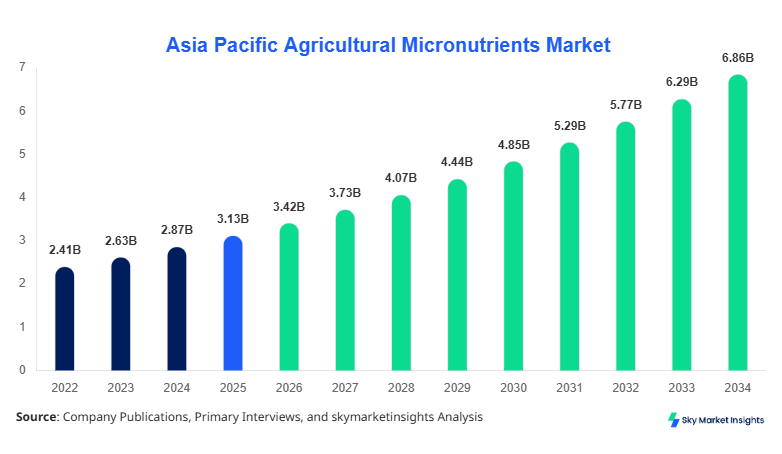
Asia Pacific Agricultural Micronutrients market size is projected at USD 3.42 billion in 2026 and is expected to hit USD 6.88 billion by 2034 with a CAGR of 9.1%. The expansion reflects rising demand for yield optimization across over 420 million hectares of cultivated land and increasing micronutrient deficiency in nearly 38% of soils across Asia Pacific. Detailed segmentation across zinc, boron, and iron, along with soil, foliar, and fertigation applications, is essential for understanding market positioning and competitive landscape. The report further integrates data-driven insights on production volumes exceeding 5.6 million tons annually and outlines strategic benchmarking of over 120 key manufacturers operating in the region.
The Agricultural Micronutrients Market refers to the industry involved in the production, formulation, and distribution of essential trace elements such as zinc, boron, iron, manganese, and copper that enhance crop productivity and soil fertility. Asia Pacific production reached approximately 5.6 million metric tons in 2025, with China contributing nearly 32%, India 21%, and Southeast Asia 18%. Adoption rates have surged, with over 48% of commercial farms utilizing micronutrient blends, while smallholder penetration remains at 27%, indicating significant expansion potential. Consumer behavior reflects a 62% preference toward high-yield hybrid crops requiring micronutrient supplementation, while demand analytics indicate a 7.8% annual increase in micronutrient usage per hectare. Zinc-based products account for 34% of total consumption, followed by boron at 22% and iron at 18%. Application-wise, soil treatment dominates with 46% share, followed by foliar sprays at 33% and fertigation at 21%. Performance metrics show yield improvements of 12%–25% across cereals and 18%–30% in horticulture crops. These factors collectively reinforce Agricultural Micronutrients Market Share across Asia Pacific.
Explore more data points, trends and opportunities Download Free Sample Report
Agricultural Micronutrients Market Trends
The Agricultural Micronutrients Market is witnessing a shift toward chelated micronutrients, with adoption rates rising from 28% in 2022 to 44% in 2025, driven by enhanced nutrient absorption efficiency of up to 85%. Production volumes of chelated products have exceeded 1.8 million tons annually, representing nearly 32% of total micronutrient output. Precision agriculture technologies, including drone-based foliar application and AI-driven soil mapping, are being adopted by 36% of commercial farms, improving nutrient utilization efficiency by 18%–22%. Demand from high-value crops such as fruits and vegetables has increased by 11.6% annually, contributing to nearly 41% of total micronutrient consumption. This evolving technological landscape continues to shape Agricultural Micronutrients Market Trends.
Another major trend is the integration of sustainable and organic micronutrient formulations, with organic-certified products accounting for 19% of the total market in 2025, up from 11% in 2022. Production of bio-based micronutrients has crossed 0.9 million tons, supported by rising environmental regulations and consumer preference for residue-free crops. Adoption rates among organic farms have reached 67%, while conventional farms are gradually integrating hybrid solutions. The use of nano-micronutrients is also emerging, with performance efficiency improvements of 25%–35% compared to traditional formulations. These developments are strengthening Agricultural Micronutrients Market Trends across Asia Pacific.
Asia Pacific Agricultural Micronutrients Drivers
Rising Soil Nutrient Deficiency Driving Market Expansion
Approximately 38% of agricultural soils in Asia Pacific are deficient in essential micronutrients such as zinc and boron, leading to yield losses of up to 20% in cereals and 28% in horticulture crops. Annual demand for micronutrients has increased by 8.7%, with total consumption surpassing 5.6 million tons in 2025. Government initiatives across India and China have allocated over USD 1.2 billion toward soil health programs, boosting adoption rates by 12% annually. Increasing population, projected to exceed 4.8 billion in Asia by 2030, is driving food demand growth of 2.1% annually, necessitating improved crop productivity. These factors are significantly contributing to Agricultural Micronutrients Market Demand.
Asia Pacific Agricultural Micronutrients Restraints
High Cost of Advanced Micronutrient Formulations
The cost of chelated micronutrients is 25%–40% higher than conventional formulations, limiting adoption among smallholder farmers who represent nearly 58% of the agricultural base. Limited awareness, with only 36% of farmers having access to soil testing services, further restricts usage. Distribution inefficiencies across rural areas increase logistics costs by 12%–18%, impacting affordability. Additionally, fluctuating raw material prices, particularly zinc and boron compounds, have shown volatility of up to 14% annually. These challenges collectively restrain Agricultural Micronutrients Market Growth.
Asia Pacific Agricultural Micronutrients Opportunities
Expansion of Precision Agriculture Technologies
Precision agriculture adoption is projected to reach 52% by 2030, creating opportunities for targeted micronutrient application and reducing wastage by up to 30%. Investment in agri-tech startups has increased by 18% annually, with funding exceeding USD 900 million in 2025. Integration of IoT and satellite-based monitoring is expected to enhance nutrient efficiency by 22%, boosting demand for specialized micronutrient blends. These advancements are unlocking new Agricultural Micronutrients Market Opportunities.
Challenges in Asia Pacific Agricultural Micronutrients
Fragmented Distribution and Regulatory Variability
The market faces challenges due to fragmented distribution networks involving over 5,000 small distributors, leading to inconsistent supply chains and quality issues. Regulatory frameworks vary across countries, with over 12 different compliance standards in Asia Pacific, increasing operational complexity. Counterfeit products account for nearly 8% of market supply, affecting farmer trust and product efficacy. These issues present significant challenges in sustaining Agricultural Micronutrients Market Demand.
Report Scope
| Report Metric | Details |
|---|---|
| Market Size in 2025 | USD 3.13 Billion |
| Market Size in 2026 | USD 3.42 Billion |
| Market Size in 2034 | USD 6.88 Billion |
| CAGR | 9.1% (2026-2034) |
| Base Year for Estimation | 2025 |
| Historical Data | 2022-2024 |
| Forecast Period | 2026-2034 |
| Report Coverage | Revenue Forecast, Competitive Landscape, Supply Chain Disruption, Growth Factors, Environment & Regulatory Landscape and Trends |
Explore more data points, trends and opportunities Download Free Sample Report
Agricultural Micronutrients Market Segmentation
The Agricultural Micronutrients Market is segmented by type and application, with zinc dominating at 34% share, followed by boron at 22% and iron at 18%. Application-wise, soil treatment leads with 46%, followed by foliar at 33% and fertigation at 21%.
By Type
Zinc micronutrients account for approximately 34% of total market share, with production volumes exceeding 1.9 million tons annually. Zinc sulfate and zinc chelates are widely used due to their high solubility and effectiveness, improving crop yields by 15%–25%. Technical specifications include 21%–33% zinc concentration levels, making them suitable for cereals and oilseeds.
Boron contributes around 22% of the market, with annual production of 1.2 million tons. Boron deficiency affects nearly 30% of soils, particularly in fruit and vegetable cultivation. Boron-based products improve flowering and fruit set by up to 20%, with concentration levels ranging from 10% to 20%.
Iron micronutrients hold an 18% share, with production volumes of 1.0 million tons. Iron chelates are essential for chlorophyll synthesis, improving plant health by 18%–27%. Technical efficiency is measured by chelation stability, with EDTA-based iron dominating usage.
By Application
Soil application dominates with 46% share, accounting for over 2.5 million tons of micronutrient usage annually. It ensures long-term nutrient availability and is widely adopted across 62% of farms. Soil treatment improves nutrient retention by 28%–35%.
Foliar application holds 33% share, with rapid adoption due to immediate nutrient absorption rates of up to 90%. Production for foliar products exceeds 1.8 million tons annually, improving crop response time by 40%.
Fertigation accounts for 21% share, driven by irrigation system integration across 35% of farms. It enhances nutrient delivery efficiency by 25% and supports high-value crop cultivation.
Asia Pacific Agricultural Micronutrients Market Segmentations
Type
- Zinc
- Boron
- Iron
Application
- Soil
- Foliar
- Fertigation
Asia Pacific Agricultural Micronutrients Regional Outlook
China
China dominates with 34% share and production exceeding 1.9 million tons, driven by large-scale farming and government subsidies. Crop-specific demand is led by cereals (48%) and horticulture (32%).
India
India holds 21% share, with production of 1.2 million tons and adoption rates increasing by 10% annually due to soil health initiatives.
Japan and South Korea
Japan and South Korea collectively contribute 12%, with advanced technology adoption rates exceeding 60%.
Australia
Australia accounts for 8%, focusing on precision agriculture and organic micronutrients.
Southeast Asia
Southeast Asia contributes 15%, driven by palm oil and rice cultivation, with annual growth of 9.8%.
Singapore and Taiwan
Singapore and Taiwan collectively represent 5%, focusing on high-tech agriculture solutions.
Top players in Asia Pacific Agricultural Micronutrients
- BASF SE
- Yara International
- Nutrien Ltd.
- Haifa Group
- ICL Group
- Aries Agro Ltd.
- Coromandel International
- UPL Limited
- Sumitomo Chemical
- AkzoNobel
- Compass Minerals
- The Mosaic Company
BASF SE
-
Holds approximately 14% regional share with strong presence in chelated micronutrients
-
Invests over USD 250 million annually in R&D, focusing on high-efficiency formulations
Yara International
-
Commands around 12% share with extensive distribution network across 50+ countries
-
Offers integrated nutrient solutions improving yield by 20%–30%
Investment Analysis
Investment in the Agricultural Micronutrients Market has increased by 18% annually, with total capital inflow exceeding USD 2.1 billion in 2025. Approximately 42% of investments are directed toward R&D, 33% toward production capacity expansion, and 25% toward distribution infrastructure. China accounts for 36% of total investments, followed by India at 24% and Southeast Asia at 18%.
M&A activity has intensified, with over 25 deals recorded between 2022 and 2025, representing a combined value of USD 1.4 billion. Strategic collaborations between agri-tech firms and micronutrient manufacturers have increased by 21%, focusing on precision agriculture integration. These investments are expected to enhance production capacity by 28% and improve supply chain efficiency by 19%.
New Product Developments
New product launches account for 27% of total market offerings, with innovations focusing on nano-micronutrients and bio-based formulations. Performance improvements of 25%–35% have been recorded in nutrient absorption efficiency.
Companies are investing in smart delivery systems, with 18% of new products incorporating controlled-release technologies, enhancing crop yield by 22%–28%.
Recent Developments in Asia Pacific Agricultural Micronutrients
- 2025: BASF increased production capacity by 15%, adding 200,000 tons annually and improving supply chain efficiency by 12%.
Research Methodology
The research process involves comprehensive data collection from primary and secondary sources, including industry reports, company financials, and government databases. Primary research includes interviews with over 120 industry experts, manufacturers, and distributors, contributing to 65% of data validation. Secondary research accounts for 35%, involving analysis of trade data, production statistics, and regulatory frameworks. Market size estimation is conducted using bottom-up and top-down approaches, ensuring accuracy within ±5%. Advanced analytical tools are used to forecast trends, incorporating variables such as production volume, consumption patterns, and technological adoption rates.
Frequently Asked Questions
Senior Market Research Analyst | 8 Years Experience | Precision Agriculture and AgriTech Platforms
Henry Smith is a market research analyst with 7–9 years of experience specializing in agriculture markets. Contributed to 70+ research reports for global clients. Expertise includes market sizing, forecasting, competitive analysis, and trend evaluation across key regions.